
Cambodia offers citizenship through naturalization, marriage, descent, or investment, with its Citizenship by Investment (CBI) program being the only active one in Southeast Asia. As of December 2025, dual citizenship is allowed, making it a viable option for U.S. citizens and others seeking asset protection, land ownership, and access to Southeast Asian markets. Key benefits include visa-free travel to ASEAN nations and a territorial tax system exempting foreign-earned income not brought into the country. However, the Cambodian passport offers limited global mobility, ranking 85th globally, with access to around 50 countries.
Highlights:
- Investment Route: $1,000,000+ in approved sectors or a $3,000,000 donation, with processing fees of $15,000.
- Naturalization: Requires 7 years of residence (3 for those born in Cambodia).
- Visa-Free Access: Includes ASEAN nations like Singapore, Thailand, and Vietnam.
- Challenges: Limited Western access, strict approval processes, and a cap of 200 annual investment-based citizenships.
Cambodian citizenship is ideal for investors focused on Southeast Asia but less appealing for those seeking extensive global travel options.
How to Obtain Cambodian Citizenship
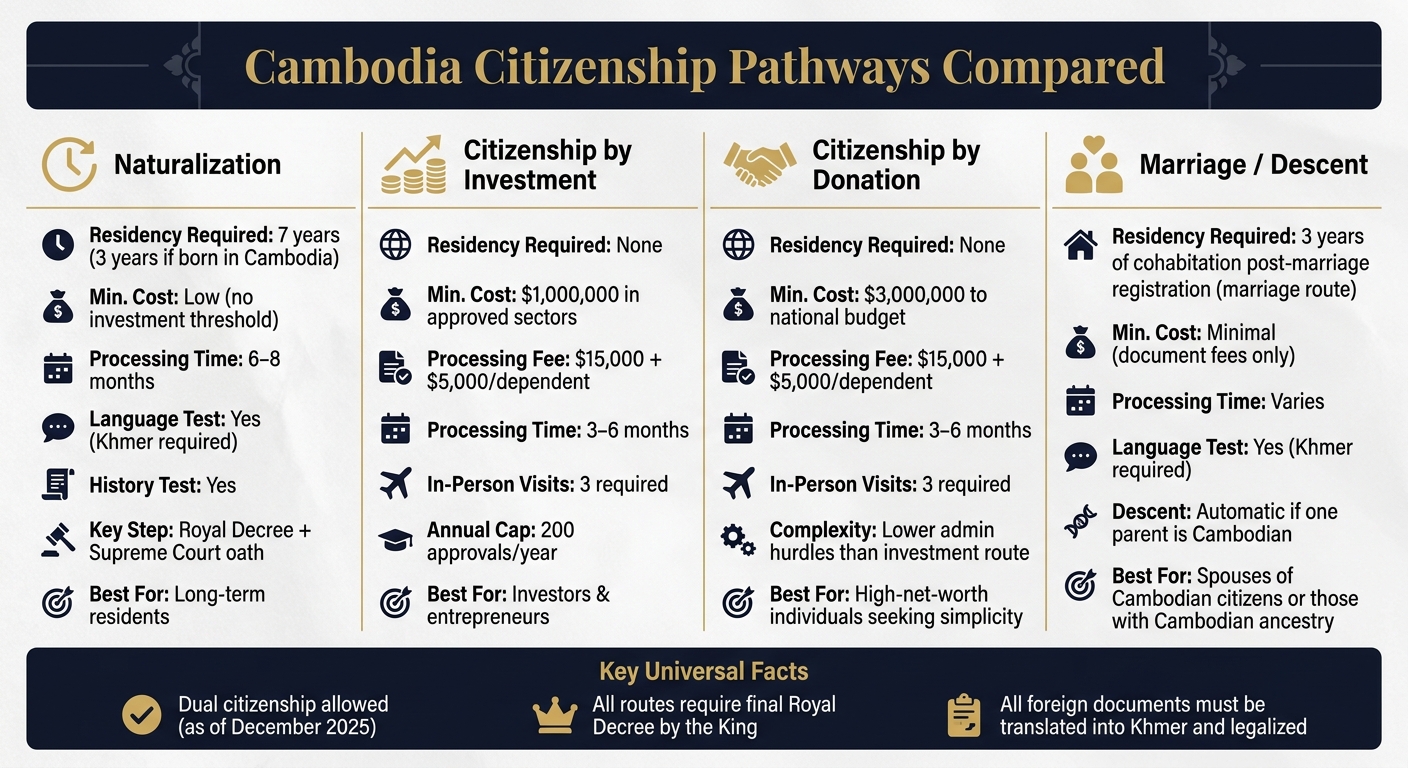
Cambodia provides four legal pathways to citizenship: naturalization, investment, marriage, and descent. Each option caters to different circumstances, timelines, and financial commitments. Choosing the right path depends on your connection to Cambodia, your resources, and how quickly you want to achieve citizenship. Below is a breakdown of the requirements and processes for each route.
Citizenship by Naturalization
Naturalization is the standard route to Cambodian citizenship, requiring seven years of continuous legal residence in Cambodia. This period is reduced to three years for individuals born in the country. To qualify, applicants must meet the following criteria:
- Prove legal residence for the required duration
- Demonstrate proficiency in Khmer
- Pass a Cambodian history test
- Provide a clean criminal record and a certificate of good conduct from local authorities
Under the Law on Nationality, naturalization is not an automatic right but a privilege granted at the discretion of the Kingdom. After the Ministry of Interior and the Prime Minister approve an application, it must receive final consent from the King, who issues a Royal Decree. Applicants are then required to travel to Cambodia to take an oath before the Supreme Court.
Citizenship by Investment or Donation
For those seeking a faster route, Cambodia offers an expedited pathway through investment or donation. This option eliminates the residency requirement and is governed by Sub-Decree No. 225, enacted in December 2025. There are two financial options:
| Pathway | Minimum Commitment (USD) | Processing Fee |
|---|---|---|
| Investment | ~$1,000,000 (4 billion Riel) | ~$15,000 + $5,000 per dependent |
| Donation | ~$3,000,000 (12 billion Riel) | ~$15,000 + $5,000 per dependent |
For the investment route, funds must be allocated to government-approved sectors, including agriculture, food processing, digital and high-tech industries, tourism, or affordable housing. The donation route involves contributing directly to the national budget to support socio-economic and humanitarian initiatives.
The process typically takes three to six months and requires at least three in-person visits to Cambodia for biometrics, administrative steps, and the oath ceremony. Rigorous checks on applicants’ backgrounds and sources of funds are conducted to ensure compliance.
Citizenship by Marriage or Descent
Familial ties can also provide a pathway to Cambodian citizenship. Foreigners married to Cambodian citizens may apply after living together for at least three years following the official registration of their marriage. Similar to naturalization, applicants must demonstrate basic Khmer language skills and knowledge of Cambodian history.
For those with Cambodian ancestry, the process is much simpler. Citizenship is automatically granted to any child with at least one Cambodian parent, regardless of where the child is born. Additionally, children born in Cambodia to foreign parents – provided the parents were also born and legally residing in the country – may qualify. In these cases, all foreign-issued documents, such as birth certificates and criminal background checks, must be legalized and translated into Khmer by an authorized translator before submission to the General Department of Identification.
sbb-itb-39d39a6
Application Process and Requirements
Understanding the application process is crucial to avoid delays or errors. Gaining Cambodian citizenship involves several steps, each with specific requirements and timelines.
Required Documents and Due Diligence
Applicants must gather a standard set of documents, regardless of the chosen route. Here’s what you’ll need:
| Document Type | What’s Required |
|---|---|
| Identity | Valid passport and birth certificate |
| Criminal Record | Police clearance from your home country and Cambodian authorities |
| Health | Medical examination certificate confirming physical and mental fitness |
| Financial | Bank statements, tax returns, and proof of legal source of funds |
| Language | Certificate or proof of Khmer language proficiency |
| Route-Specific | Marriage certificate, or investment/donation authorization letters |
Any documents issued outside Cambodia must be translated into Khmer by an authorized translator and legalized by the Ministry of Foreign Affairs before submission to the General Department of Identification. Skipping this translation and legalization step is a common reason for delays.
Financial documentation is under stricter scrutiny now, with all funds requiring clear and traceable records. Keeping your financial paperwork organized and transparent is essential to avoid complications. Once your documents are ready, plan your application timeline and budget accordingly.
Timelines and Costs
The government takes 45 business days for an initial review after submission. If any deficiencies are found, applicants have 30 business days to address them, followed by a 15-business-day re-evaluation period. The total process duration varies: 3–6 months for the investment route and 6–8 months for naturalization. After approval, receiving the physical passport takes an additional 30 business days.
Costs differ depending on the route:
- Investment Route: Requires a minimum of $1,000,000 in approved sectors.
- Donation Route: Involves a $3,000,000 contribution to the national budget.
- Both routes include a processing fee of approximately $15,000, plus $5,000 per dependent.
- CM2H Residency Path: A lower-cost option, requiring either a $50,000 one-time donation or a $100,000 real estate purchase. This grants a 10-year visa, with citizenship eligibility after five years.
Understanding these timelines and costs helps you prepare for the next step: addressing potential challenges.
Common Challenges and How to Handle Them
One of the biggest hurdles is discretionary approval. According to Cambodia’s Law on Nationality:
"Naturalization is not a right of the applicant, but only a favour of the Kingdom of Cambodia. In any case, such application may also be rejected by a discretionary power."
Additionally, the government limits citizenship approvals through investment to 200 per year. Submitting your application early in the year can improve your chances of falling within this quota.
For investment-route applicants, selecting a compliant project is another challenge. Since there’s no centralized list of pre-approved projects, working with experienced local legal counsel for private consultations is critical. This ensures the chosen investment meets the Ministry of Interior’s criteria and avoids disqualification. On the other hand, the donation route is generally simpler, with fewer administrative hurdles. While language requirements can sometimes be waived for investment applicants, this is not guaranteed and should not be relied upon.
These steps and challenges reflect Cambodia’s approach to balancing asset protection and global mobility opportunities for applicants.
Where a Cambodian Passport Lets You Travel
Travel flexibility is a key perk of holding Cambodian citizenship, especially for those focusing on asset protection and international mobility. As of 2026, the Cambodian passport ranks 85th globally on the Henley Passport Index, offering visa-free or visa-on-arrival access to around 50 countries and territories. While it doesn’t rival some regional leaders, it still provides access to important business and travel hubs. Below, we’ll break down the regional advantages and offer practical travel tips for Cambodian passport holders.
Visa-Free and Visa-on-Arrival Access in Asia-Pacific
Cambodia’s membership in ASEAN brings significant travel benefits. Passport holders can enjoy visa-free access to all other ASEAN member states, including:
- Thailand: 60 days
- Vietnam: 30 days
- Singapore: 30 days
- Malaysia: 30 days
- Philippines: 30 days
- Indonesia: 30 days
- Laos: 30 days
- Myanmar: 14 days
- Brunei: 14 days
Outside of ASEAN, Cambodian passport holders can visit countries in Africa, the Middle East, and the Americas with relative ease. Nations like Rwanda, Seychelles, Ecuador (90 days), and Panama (90 days) allow visa-free entry. Additionally, countries such as Kenya, Sri Lanka, and Suriname offer simplified entry options like eVisas or Electronic Travel Authorizations (eTAs).
| Region | Visa-Free | Visa-on-Arrival/eTA |
|---|---|---|
| Asia-Pacific | Brunei, Indonesia, Laos, Malaysia, Myanmar, Philippines, Singapore, Thailand, Vietnam | Bangladesh, Maldives, Nepal, Sri Lanka (eTA), Timor-Leste, Palau |
| Middle East / Africa | Iran, Rwanda, Seychelles, Palestine | Egypt, Kuwait, Kenya (eTA), Madagascar, Mauritius, Tanzania |
| Americas | Barbados, Dominica, Ecuador, Haiti, Panama | Nicaragua, Saint Lucia, Suriname (eTA) |
Limited Access to Western Countries
Cambodian passport holders face stricter requirements when traveling to Western nations. Entry into the United States, Canada, the United Kingdom, or Schengen Area countries requires a formal visa. The disparity is stark compared to neighboring nations like Singapore, whose passport grants access to 192 destinations, while Cambodia’s covers fewer than 55.
A practical workaround for this limitation is obtaining a long-term multiple-entry visa from countries like the U.S. or those in the Schengen Area. These visas can unlock easier entry into secondary markets such as Mexico, Turkey, Colombia, Serbia, and Argentina. Many Cambodian passport holders use this strategy to expand their travel options without needing separate visas for every destination. For those with dual citizenship, the Cambodian passport is often used for regional ASEAN access and local land ownership purposes, while the other passport facilitates travel to Western countries.
Tips for International Travel with a Cambodian Passport
Travel regulations can change quickly, so it’s essential to stay up-to-date by checking the official immigration or Ministry of Foreign Affairs website of your destination before booking. While passport index tools can provide a general overview, they may not always reflect recent updates.
- Passport Validity: Ensure your passport is valid for at least six months and has one to two blank pages, as these are common requirements for visa-free and visa-on-arrival destinations.
- Vaccination Certificates: For regions like Africa or South America, carry an International Certificate of Vaccination for Yellow Fever, as countries such as Ghana and Ethiopia require it.
- Pre-Registration: For destinations like Cape Verde, where visas are issued on arrival, complete online pre-registration at least five days in advance.
- Western Visa Applications: Start the visa process early for Western countries. Schengen visa rejection rates for applicants from developing regions increased from 18.6% to 26.6% between 2015 and 2024, and processing times have also grown longer. Contacting the relevant embassy directly will provide the most accurate guidance.
Cambodian Citizenship in an Asset Protection and Global Strategy
Cambodian citizenship brings notable advantages, including a legal presence in a dynamic economy and rights that go beyond what residents enjoy. These benefits tie into asset protection strategies, complementing the travel and investment perks discussed earlier.
Dual Citizenship and Jurisdictional Diversification
Holding dual citizenship provides an opportunity to reduce dependence on just one government, legal framework, or currency. With Cambodia, you can retain your current nationality while adding a Cambodian passport to your portfolio.
From an asset protection standpoint, Cambodia’s dollarized economy helps minimize currency exchange risks. Even with some financial sector challenges, like non-performing loans accounting for 17.6% of total loans, the country’s economy is projected to grow between 4.0% and 5.0% by 2026. This positions Cambodia as an appealing jurisdiction for diversification.
It’s important to note that dual citizens must register any foreign passports with Cambodian authorities to avoid administrative penalties or complications in business dealings.
Owning Assets and Doing Business in Cambodia
Citizenship provides direct access to asset ownership and business opportunities. For example, Cambodian nationals can legally own land outright, a privilege unavailable to foreigners due to constitutional restrictions. This applies to both agricultural land and ground-floor properties.
For those without citizenship, the 2019 Trust Law offers an alternative through trust structures, enabling beneficial ownership of land. However, these arrangements can be complex and lack the simplicity of direct ownership.
Beyond real estate, citizenship removes barriers to industries and licenses reserved for Cambodian nationals. Sectors like agro-industry, digital technology, and affordable housing development become fully accessible. Additionally, with a 20% capital gains tax postponed until January 1, 2027, investors have a limited window to capitalize on property profits under more favorable tax conditions.
Integrating Citizenship into a Global Asset Strategy
To maximize its value, Cambodian citizenship should be part of a broader strategy focused on asset protection and international diversification. While the Cambodian passport alone offers limited global mobility, pairing it with offshore structures can significantly enhance its utility.
For instance, as a Cambodian citizen, you can own land and operate restricted businesses locally. Meanwhile, offshore trusts or private interest foundations can manage international assets. This layered approach – leveraging local citizenship rights alongside offshore entities – is a strategy that firms like Global Wealth Protection specialize in. Services such as offshore trust formation in Anguilla, U.S. LLC structuring, and relocation planning through programs like Global Escape Hatch can complement Cambodian citizenship to strengthen your global strategy.
Another key advantage is Cambodia’s territorial tax system. Income earned abroad and not remitted into the country is generally exempt from Cambodian income tax. This tax efficiency is particularly appealing for entrepreneurs and investors with diversified, location-independent income streams. By combining these benefits, Cambodian citizenship becomes a powerful tool in building a robust global asset protection strategy. Consulting with an experienced advisor can help tailor this approach to your specific needs.
Conclusion: Is Cambodian Citizenship Right for You?
Cambodian citizenship appeals to a specific type of investor – those prioritizing access to Southeast Asian markets, direct land ownership, and diversification in jurisdictions. However, it’s not the ideal choice for individuals seeking extensive global passport mobility. Ranked approximately 87th globally in 2026, the Cambodian passport allows visa-free travel to about 53-54 countries, offering limited access to Western nations.
This program is particularly suited for entrepreneurs and investors with a long-term vision, typically spanning 5 to 10 years, who aim to establish a presence in ASEAN markets. Citizenship can be obtained through expedited investment or donation pathways, requiring minimum contributions of $1,000,000 or $3,000,000, respectively. For those with smaller budgets, the CM2H residency program offers an alternative.
One notable financial advantage is the deferral of the 20% capital gains tax on property until January 1, 2027. Investors who act before the end of 2026 can benefit from the current tax framework before the new regulations take effect.
It’s important to understand that meeting the financial requirements does not guarantee citizenship. Approval is discretionary and requires a Royal Decree signed by the King. The government has also enhanced background checks and source-of-funds verification following high-profile revocations in late 2025. Seeking expert legal guidance is essential to navigate the process effectively.
"Citizenship is no longer merely a transactional benefit but a privilege tied closely to genuine contribution, legality, and alignment with national development objectives." – Angkor Times
For those who value access to ASEAN markets, direct land ownership, territorial taxation, and a dollarized economy, Cambodian citizenship can be a strategic addition to your global asset protection plan. Success lies in setting clear expectations and partnering with the right professionals to guide you through the process.
FAQs
Can I keep my U.S. citizenship if I become Cambodian?
Cambodia permits dual citizenship, meaning you can retain your U.S. citizenship while also becoming a Cambodian citizen. Similarly, the United States allows its citizens to hold multiple passports without issue.
However, if you become a dual citizen, you’ll need to register your foreign passport with the Cambodian government to comply with local regulations. It’s also important to stay informed about how U.S. laws might impact your dual citizenship status to avoid any complications.
What investment options actually qualify for Cambodia’s $1,000,000 route?
To pursue Cambodia’s $1,000,000 citizenship pathway, you’ll need to invest at least 4 billion riel (approximately $1,000,000) in an approved project. These projects must hold an official investment permit and fall within sectors prioritized by the government. Key areas include agriculture, manufacturing, digital industries, tourism, waste processing, and affordable housing. Additionally, the project must be registered as a qualified investment project to meet the program’s requirements.
Does a Cambodian passport help me get visas for the U.S. or Europe?
No, a Cambodian passport does not grant visa-free access to the United States or Schengen Area countries. It also doesn’t make obtaining a visa for these destinations easier or guarantee approval. In fact, in certain situations, travelers with valid U.S. or Schengen visas may receive visa-free entry to other countries – not the reverse. For travel to these regions, the visa requirements depend on the rules associated with your primary citizenship.
