
Puerto Ricans are U.S. citizens by statute, not by the 14th Amendment, which affects their rights and tax obligations. While they can move freely within the U.S., carry U.S. passports, and serve in the military, they cannot vote in presidential elections or have full congressional representation.
Tax-wise, Puerto Rico operates under its own tax system. Residents who meet bona fide residency requirements – spending 183+ days on the island, establishing a tax home, and proving stronger ties to Puerto Rico than the mainland – can exclude Puerto Rico-source income from U.S. federal taxes under IRC Section 933. However, U.S.-source income, like dividends or mainland wages, remains federally taxable.
Puerto Rico’s Act 60 offers major tax benefits, such as 0% on local capital gains (until 2027) and a 4% corporate tax rate on export services. But compliance is strict, with audits and penalties for missteps. Proper planning, detailed record-keeping, and expert advice are critical for maximizing these benefits while staying within legal boundaries.
Legal Status: Are Puerto Ricans US Citizens?
Yes, Puerto Ricans are U.S. citizens, but their citizenship is granted by statute rather than the 14th Amendment. This distinction plays a key role in shaping tax planning opportunities for residents of Puerto Rico.
How Puerto Ricans Became US Citizens
Puerto Ricans gained U.S. citizenship through the Jones–Shafroth Act of 1917. This statutory citizenship was later reinforced by the Immigration and Nationality Act. Unlike constitutional citizenship, which is protected by the 14th Amendment and applies to those born in the 50 states, statutory citizenship can be modified or even revoked by Congress through new legislation.
"Puerto Rico holds a unique position as an unincorporated U.S. territory. Under Internal Revenue Code (IRC) §933, Puerto Rico source income is excluded from U.S. federal tax." – Glen E. Frost, Managing Partner, Frost Law
Rights and Limits for Puerto Rican US Citizens
Puerto Ricans enjoy many rights associated with U.S. citizenship. They carry U.S. passports, can move freely between Puerto Rico and the mainland, and serve in the U.S. military. However, there are notable limitations. While living in Puerto Rico, residents cannot vote in U.S. presidential elections and lack voting representation in Congress. The island is represented federally only by a non-voting resident commissioner. Despite having a population of about 3.2 million – larger than 18 U.S. states – Puerto Rico has no formal vote in federal elections.
Additionally, Puerto Rican residents are excluded from some federal benefit programs available to state residents, such as Supplemental Security Income (SSI) and the Federal Earned Income Tax Credit. These distinctions contribute to Puerto Rico’s unique tax system and its appeal for asset protection strategies.
Citizenship vs. Tax Residency
While U.S. citizenship typically subjects individuals to worldwide taxation, residents of Puerto Rico can exclude income earned locally under IRC Section 933. However, citizenship alone does not grant access to this tax benefit. To qualify, individuals must meet specific residency criteria:
- Presence Test: Spending at least 183 days physically in Puerto Rico.
- Tax Home Test: Establishing a primary place of business in Puerto Rico.
- Closer Connection Test: Demonstrating stronger personal and economic ties to Puerto Rico than to the mainland.
Failing to meet any of these tests disqualifies an individual from the federal tax exclusion, regardless of their citizenship. This separation between citizenship and tax residency has significant financial implications for those considering a move to Puerto Rico.
sbb-itb-39d39a6
How Puerto Rico’s Tax System Differs From the US Mainland
Puerto Rico as Its Own Tax Jurisdiction
Puerto Rico operates as a distinct tax jurisdiction, separate from the U.S. federal system. Unlike other U.S. territories that follow the federal tax code, Puerto Rico has its own tax framework, governed by the Puerto Rico Internal Revenue Code of 2011. This system is administered by the island’s Department of Treasury, commonly referred to as Hacienda.
Thanks to IRC §933, bona fide residents of Puerto Rico can exclude Puerto Rico-source income from their U.S. federal gross income. This means that income generated on the island is taxed locally by Hacienda rather than by the IRS.
"Puerto Rico-source income usually goes to Hacienda, while US-source income may still go to the IRS." – Andrew Coleman, CPA
This separation highlights the importance of establishing bona fide residency to take full advantage of these tax benefits.
What It Means to Be a Bona Fide Puerto Rico Resident
As previously mentioned, achieving bona fide residency is essential for accessing Puerto Rico’s tax advantages. To qualify, individuals must meet specific requirements related to presence, tax home, and closer connection.
Residency isn’t just about completing forms. The IRS has intensified its focus on taxpayers claiming Puerto Rico residency. In 2021, it launched a compliance campaign targeting high-income individuals, and in 2025, Puerto Rico’s Office of Incentives audited 1,798 tax decrees. As a result, 305 deficiency notices were issued, with fines reaching up to $10,000 each. To avoid issues, maintain detailed records such as travel logs, flight tickets, utility bills, and evidence of community ties.
Additionally, individuals with worldwide gross income exceeding $75,000 must file Form 8898 with the IRS when beginning or ending bona fide residency. Failure to file this form results in an automatic $1,000 penalty.
How Puerto Rico and US Federal Tax Rules Interact
While Puerto Rico’s tax system offers distinct benefits, residents still have U.S. federal tax obligations on certain types of income. Bona fide residency does not exempt individuals from paying U.S. federal taxes on non-Puerto Rico income. For instance, residents must pay federal taxes on U.S.-source income, including dividends, rental income from the mainland, and wages from the federal government. Additionally, they remain subject to FICA and self-employment tax requirements. Self-employed individuals earning $400 or more must file Form 1040-SS with the IRS.
The table below provides a breakdown of tax responsibilities based on income source:
| Income Type | Taxed by IRS (Federal) | Taxed by Hacienda (Local) |
|---|---|---|
| Earned in Puerto Rico (bona fide resident) | No | Yes |
| U.S. mainland-source income | Yes | Yes (with credit) |
| U.S. bank interest or dividends | Yes | Yes (with credit) |
| Federal government wages | Yes | Yes (with credit) |
| Act 60 capital gains (PR-source) | No | 0% or 4% |
Properly identifying the source of income is critical for managing tax liabilities and avoiding IRS scrutiny. Misclassifying income could lead to unexpected tax burdens or penalties.
Using Puerto Rico’s Tax Incentives for Asset Protection
What Acts 20 and 22 (Act 60) Offer
In 2019, Puerto Rico combined Act 20 and Act 22 into a single framework known as Act 60. This legislation offers a 4% fixed corporate tax rate on income from export services and a 0% tax rate on local capital gains, dividends, and interest for eligible individual investors who establish residency there. However, any gains accrued before relocating to Puerto Rico are still subject to U.S. federal taxes. Additionally, assets held for at least 10 years after the move qualify for a reduced 5% tax rate.
"There is nothing unlawful or deceitful about choosing to reside in a state or territory because of its low taxes." – U.S. Court of Appeals for the Third Circuit
Starting January 1, 2027, new applicants under the Resident Individual Investor program will face a 4% tax on covered investment income, marking the end of the 0% benefit for new participants. While these tax benefits significantly reduce liabilities, they also play a role in broader asset protection strategies, as discussed below.
How Puerto Rico’s Tax Rules Support Asset Protection
Puerto Rico offers more than just tax savings – it provides a level of legal stability that offshore jurisdictions often lack. For instance, banking services in Puerto Rico are FDIC-insured, intellectual property rights are safeguarded under U.S. federal law, and contracts are enforceable within a familiar legal framework.
However, there are nuances to consider. Puerto Rico’s civil law, which enforces forced heirship rules, might limit the effectiveness of U.S.-based wills when dealing with local assets. To address this, individuals incorporating Act 60 into their asset protection strategy should consider drafting a Puerto Rico-specific will under local law.
Additionally, Puerto Rican corporations or LLCs can be used to hold assets and benefit from the 4% export services tax rate. However, these structures need careful planning, as standard U.S. trust arrangements may not be fully recognized or could be overridden by Puerto Rico’s civil code provisions. While these incentives enhance asset protection, they come with strict compliance requirements that must be followed.
Risks and Compliance Requirements
The IRS has increased its focus on Act 60 compliance, issuing subpoenas and collaborating with high-tax states to examine residents relocating to Puerto Rico.
"The IRS has identified significant abuse by taxpayers claiming benefits without truly relocating, leading to heightened audits, expanded data sharing and GAO recommendations." – Nicole Suk, Principal, Tax & International Services Co-Leader, Windham Brannon
If the IRS disputes a taxpayer’s residency and no federal tax return was filed, the statute of limitations for tax assessments remains open indefinitely.
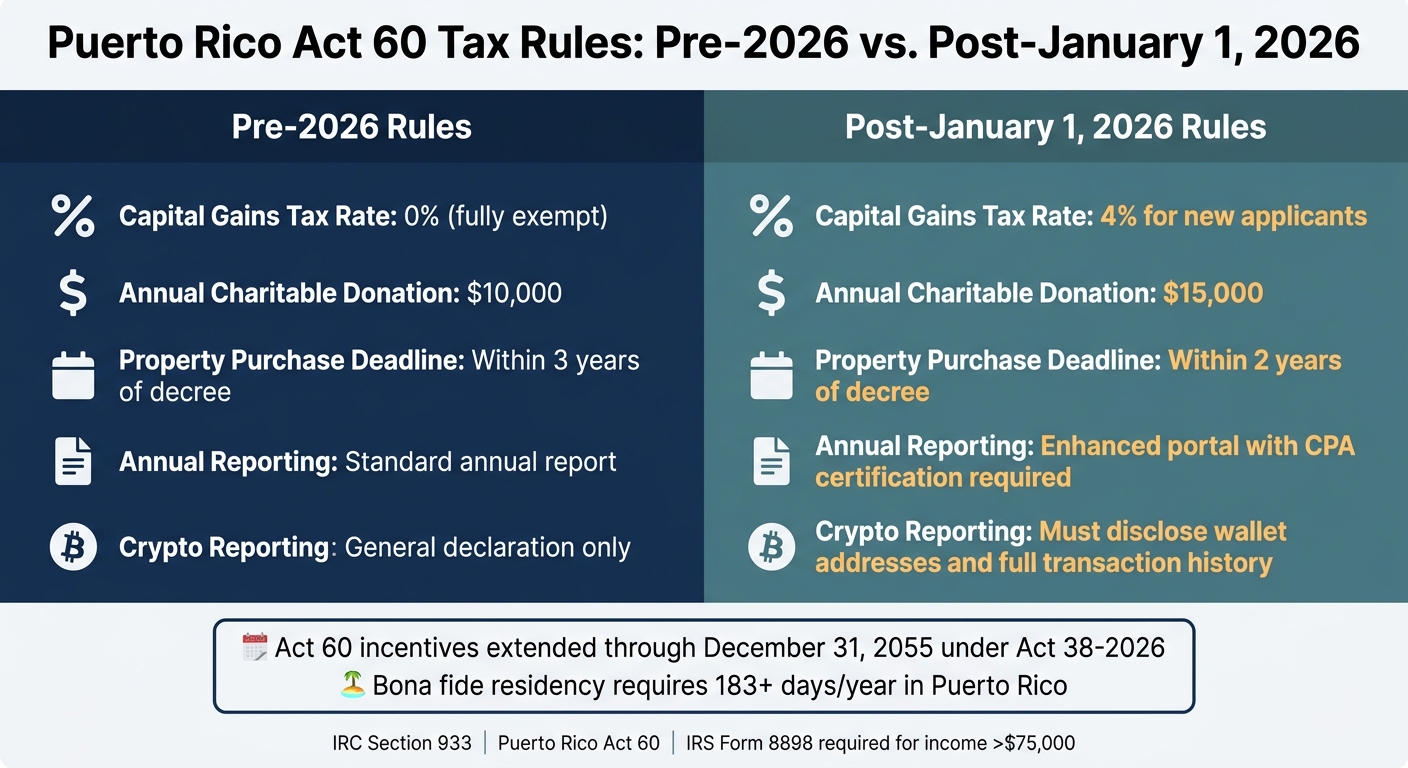
To fully benefit from Puerto Rico’s tax incentives while minimizing risks, applicants must adhere to updated compliance rules:
| Requirement | Pre-2026 Rule | Post-January 1, 2026 Rule |
|---|---|---|
| Capital gains tax rate | 0% (exempt) | 4% for new applicants |
| Annual charitable donation | $10,000 | $15,000 |
| Property purchase deadline | Within 3 years | Within 2 years |
| Annual reporting | Standard annual report | Enhanced portal with CPA certification |
| Crypto reporting | General declaration | Wallet addresses and transaction history |
Applicants must also demonstrate stronger personal and economic ties to Puerto Rico. The Vento v. Director of Virgin Islands Bureau of Internal Revenue case highlights what the IRS might expect. In this case, taxpayers successfully defended their residency status by purchasing property, establishing local business interests, obtaining Puerto Rican driver’s licenses, and registering to vote locally. To protect against audits, maintaining a detailed residency file – complete with flight records, utility bills, and other local connections – is essential. This documentation supports both your tax strategy and asset protection efforts. For those with significant property holdings, specialized asset protection for real estate is a critical component of this documentation.
How to Set Up a Puerto Rico Tax Strategy and Stay Compliant
Is Puerto Rican Residency the Right Move for You?
Puerto Rico offers enticing tax incentives, particularly for high-income investors and entrepreneurs whose earnings come from capital gains, dividends, or services provided outside Puerto Rico. However, if your income primarily comes from a mainland W-2 salary, the benefits may not be as impactful.
"A move to Puerto Rico can deliver substantial financial advantages, but the benefits depend entirely on proper planning and ongoing compliance." – Jack Thomas, CFP
Before diving in, ask yourself if you can fully commit to living in Puerto Rico. The IRS mandates spending at least 183 days per year on the island and requires you to shift your business operations and personal connections there. Trying to claim residency without meeting these criteria could lead to scrutiny from the IRS. If you’re ready to move forward, here are the key steps to establish and maintain your residency.
Steps to Establish and Keep Puerto Rican Residency
To satisfy IRS residency requirements, it’s not enough to simply book flights or spend occasional time on the island. You’ll need to make Puerto Rico your true home by relocating your core operations, registering locally, obtaining a Puerto Rican driver’s license, and opening local bank accounts.
If you’re an Act 60 decree holder, there are additional obligations to meet. For example, you must purchase a primary residence in Puerto Rico within two years of receiving your decree and contribute $15,000 annually to local nonprofits. Additionally, if your worldwide gross income exceeds $75,000 in the year you establish residency, you’re required to file IRS Form 8898 to notify the federal government. Skipping this step could result in a $1,000 penalty.
It’s also crucial to separate your income sources from the start. Puerto Rico-source income is excluded from federal taxes under IRC Section 933, but mainland-source income remains fully taxable by the IRS. Following these steps not only ensures compliance but also helps you maintain the tax benefits and fortify your asset protection strategy.
Combining Puerto Rican Planning With Asset Protection
Using Puerto Rico as part of a larger financial plan can maximize its benefits. For example, pairing an Act 60 export services decree – which offers a 4% tax rate on qualifying business income – with a US LLC for mainland assets is a common approach. If you have international holdings, you could also consider using an offshore entity to manage those assets outside US jurisdiction.
Coordination is critical to making this work. Puerto Rico operates under a civil law system, which includes forced heirship rules that can override a standard US will when it comes to assets held locally. This means your estate plan, business structure, and residency documentation must align seamlessly. As Andrew Coleman, CPA, explains:
"The idea of living in Puerto Rico to avoid taxes needs careful wording. Puerto Rico can reduce federal income tax for qualified residents, but it is not a blanket ‘no tax’ move."
To navigate these complexities, work with advisors who are well-versed in both US and Puerto Rican tax laws. Their expertise can help you integrate your Puerto Rico strategy into a comprehensive financial plan.
Conclusion: Key Points on Puerto Rican Citizenship and Tax Planning
Puerto Ricans hold US citizenship, but their tax obligations can differ greatly. For bona fide residents, Puerto Rico–source income is exempt from US federal taxes under IRC Section 933. Act 60 offers additional advantages, including a 4% corporate tax rate on export services income and, for decrees issued before December 31, 2026, a 0% tax rate on dividends, interest, and capital gains. However, for applications submitted starting January 1, 2027, passive income will be taxed at 4%. Thanks to Act 38-2026, these incentives are extended through December 31, 2055, ensuring the program remains available for decades to come.
That said, taking advantage of these benefits requires strict adherence to the rules. As Andrew Coleman, CPA, explains:
"The Puerto Rico tax haven rules are legal, but they are not automatic."
The IRS carefully audits Act 60 participants, focusing on factors like physical presence, tax home, and personal connections to Puerto Rico. Keeping detailed residency records is essential to prove compliance. This highlights the importance of meticulous tax planning and careful documentation.
Since financial situations vary widely, it’s crucial to customize your approach to fit your specific needs. A solid understanding of your citizenship status and the tax strategies discussed – like bona fide residency and Act 60 compliance – can be key to protecting your assets. Collaborating with advisors who are well-versed in both US federal and Puerto Rico tax laws is the best way to navigate these opportunities without risking costly errors.
FAQs
Do I still owe IRS taxes if I move to Puerto Rico?
If you establish yourself as a bona fide resident of Puerto Rico, you typically won’t owe U.S. federal income taxes on income sourced from Puerto Rico. That said, you might still be responsible for taxes on income sourced from the U.S. or other places outside Puerto Rico, depending on your residency status and where the income originates. Be sure to consult IRS guidelines to stay aligned with federal tax requirements.
What counts as Puerto Rico-source income vs U.S.-source income?
Puerto Rico-source income refers to earnings tied directly to activities or assets within Puerto Rico. This includes:
- Income from services performed in Puerto Rico.
- Revenue from property located in Puerto Rico.
- Royalties for using property within Puerto Rico.
- Gains from selling property based in Puerto Rico.
On the other hand, U.S.-source income comes from activities or assets within the United States. Examples include:
- Earnings from services performed in the U.S.
- Interest paid by U.S.-based entities.
- Dividends from U.S. corporations.
- Proceeds from selling personal property by U.S. residents.
Understanding the distinction between these income types is key for tax and financial purposes, as different rules may apply depending on the source.
What documents should I keep to prove bona fide Puerto Rico residency?
To establish bona fide residency in Puerto Rico, it’s essential to keep detailed records. These can include travel logs, flight itineraries, passport stamps, and boarding passes to show your physical presence. Additionally, documents like hotel receipts, utility bills, proof of property ownership or long-term leases, and evidence of family ties can support your claim. Participation in local activities, such as social or community involvement, also helps demonstrate your connection to Puerto Rico and compliance with residency rules.
Related Blog Posts
- The Difference Between Citizenship-Based and Residency-Based Tax Systems
- Costa Rica Tax Residency vs Physical Residency: What You Actually Need to Stay Legal
- Tax-Free Countries in the Americas: From Panama to Paraguay and Beyond
- Crypto Tax-Free Countries: Where to Hold Digital Assets Without the IRS Headache
