
If you’re tired of crypto taxes eating into your profits, some countries offer legal ways to reduce or eliminate those burdens. Key destinations like the UAE, Cayman Islands, Singapore, Germany, Portugal, and Puerto Rico provide attractive tax benefits for cryptocurrency investors. Here’s a quick breakdown:
- UAE: 0% tax on personal crypto gains, but residency requires significant investment.
- Cayman Islands: No income or capital gains tax, but high living costs and import duties apply.
- Singapore: No capital gains tax for personal holdings, though professional trading can be taxed up to 22%.
- Germany: Gains are tax-free if held for over a year; short-term gains are taxed up to 45%.
- Portugal: Long-term holdings are tax-free; short-term gains taxed at 28%.
- Puerto Rico: 0% tax for U.S. citizens on crypto acquired post-relocation under Act 60.
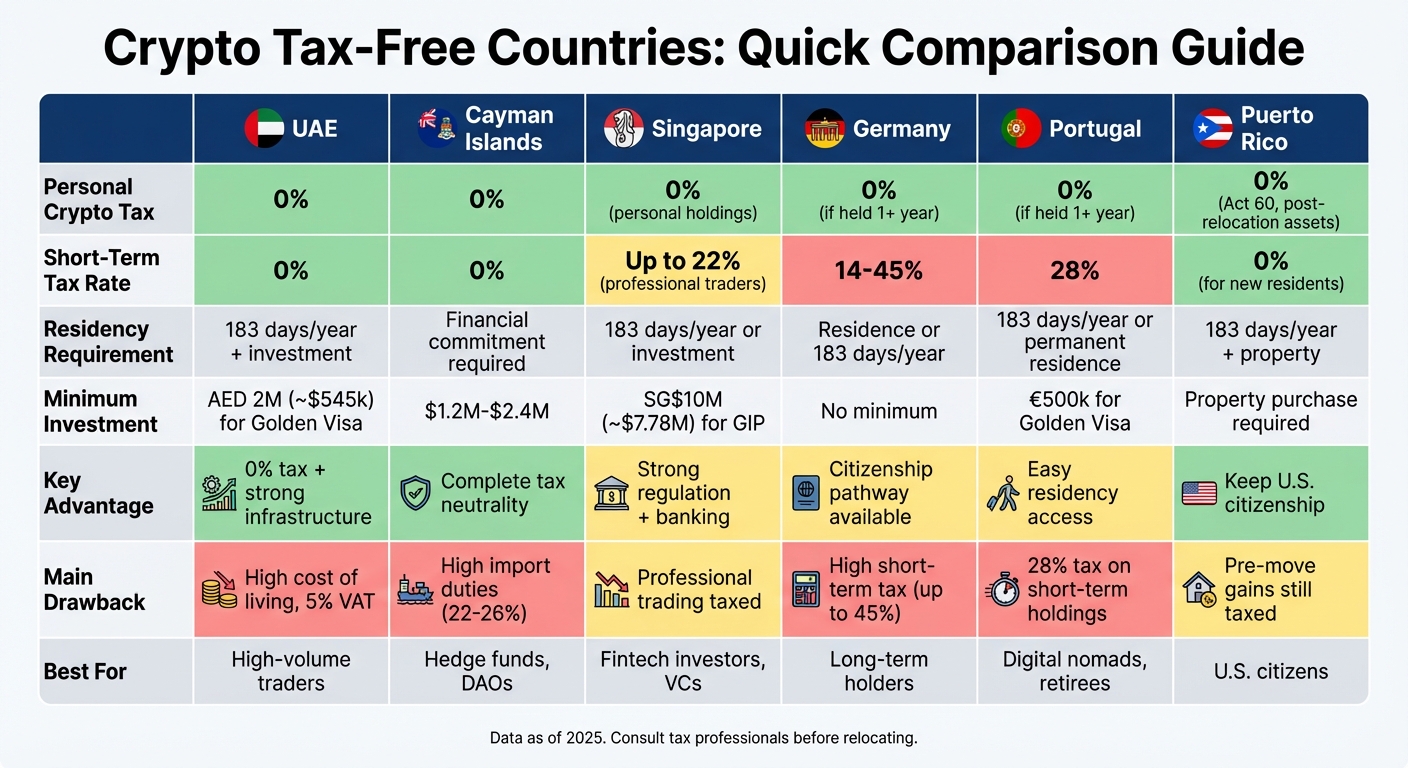
Quick Comparison:
| Country | Personal Crypto Tax | Residency Requirement | Key Drawback |
|---|---|---|---|
| UAE | 0% | 183 days + investment | High cost of living, 5% VAT |
| Cayman Islands | 0% | Financial commitment | High import duties, living costs |
| Singapore | 0% (personal) | 183 days or investment | Up to 22% tax for professional use |
| Germany | 0% (1+ year) | Residence or 183 days | High short-term tax rates |
| Portugal | 0% (1+ year) | 183 days or investment | 28% tax on short-term holdings |
| Puerto Rico | 0% (Act 60) | 183 days + property | U.S.-sourced gains still taxable |
Each location has unique rules, so careful planning is essential. Whether you’re a U.S. citizen looking at Puerto Rico or a long-term holder considering Germany, understanding tax laws and residency requirements can save you significant money. Always consult a tax expert before making a move.
1. United Arab Emirates
The UAE stands out as a haven for crypto investors, offering 0% personal income tax and 0% capital gains tax on digital assets held for personal use. Whether you’re trading Bitcoin, Ethereum, or other cryptocurrencies, individual investors don’t owe the UAE government any taxes on their profits.
Tax Policies
For individual investors, the tax benefits are crystal clear: zero taxes on gains from trading, staking rewards, and even NFT transactions, provided these activities are for personal purposes. However, there’s a catch – if your annual turnover exceeds AED 1,000,000 (around $272,000), the tax authority might classify your activity as a business.
For crypto-related businesses, a 9% corporate tax applies to annual profits exceeding AED 375,000 (about $102,000). However, companies operating in free zones like DMCC, ADGM, or DIFC can enjoy a 0% corporate tax rate on qualifying income for up to 50 years. Additionally, most crypto transactions are exempt from the UAE’s standard 5% VAT. Ankita Dhawan, Senior Associate at Métis Institute, explains:
The UAE has essentially classified virtual assets in the same bucket as traditional financial services – several of which are already exempt from VAT. This legitimizes VAs.
| Activity | Individual Tax | Corporate Tax (over AED 375,000) | Value-Added Tax (VAT) |
|---|---|---|---|
| Buying & Holding | 0% | 9% | Exempt |
| Day Trading | 0% | 9% | Exempt |
| Staking Rewards | 0% | 9% | Exempt |
| Commercial Mining | Not applicable | 9% | 5% |
Residency Requirements
To benefit from these tax perks, you need to meet residency requirements. This includes holding a residency visa and spending at least 183 days per year in the UAE. The Golden Visa program offers a 10-year renewable residency permit for those who invest at least AED 2 million (approximately $545,000) in property or investment funds. Alternatively, setting up a company in a UAE free zone can help you secure a work visa.
Crypto Regulations
The UAE has a structured regulatory framework for digital assets. Dubai’s VARA oversees activities on the mainland, while DFSA and FSRA regulate major financial hubs. Crypto-to-fiat transactions must be conducted through licensed virtual asset service providers (VASPs) since UAE banks don’t directly handle crypto deposits. As of late 2024, over 20 VASPs, including Binance and OKX, have received VARA approval.
In a groundbreaking move, Dubai’s Department of Finance completed its first government transaction using digital assets in October 2025. A property map fee was paid through the DubaiPay system, with crypto instantly converted to dirhams for settlement. Additionally, the UAE has committed to the OECD’s Crypto-Asset Reporting Framework, with automatic data exchanges set to begin by 2028. These steps enhance regulatory clarity and security for crypto investors.
Infrastructure
The UAE’s infrastructure solidifies its appeal to crypto enthusiasts. Dubai’s DMCC Crypto Centre is home to over 650 blockchain companies. Major banks like Emirates NBD and Standard Chartered now provide crypto-to-fiat services through licensed VASPs. For example, Emirates NBD‘s Liv X platform offers institutional-grade access to crypto.
Retail adoption is also growing. In May 2022, Majid Al Futtaim partnered with Binance to integrate Binance Pay across its malls, including the Mall of the Emirates, enabling customers to pay with Bitcoin and Ethereum.
To stay compliant, ensure you maintain detailed transaction records and wallet addresses to meet anti-money laundering requirements.
sbb-itb-39d39a6
2. Cayman Islands
The Cayman Islands stand out as a tax-neutral haven, free from personal income, capital gains, corporate, inheritance, and withholding taxes. This means crypto investors can keep 100% of their profits. Plus, with the Cayman dollar pegged to the U.S. dollar, there’s no currency exchange risk to worry about.
Tax Policies
Crypto enthusiasts benefit from zero taxes on their holdings or trades, no matter how frequently they trade or how long they hold their assets.
For businesses, the Cayman Islands offers a tax exemption certificate for a nominal fee. This certificate provides 20 to 50 years of guaranteed tax-free status, ensuring no new taxes on profits or income will be introduced. As Chris Duncan and Richard Munden from Carey Olsen highlight:
The Cayman Islands is a leading global financial centre and has developed a reputation as one of the world’s most innovative and business-friendly places to operate.
The approach to regulation varies between individual investors and service providers. While individual traders face no regulatory requirements, Virtual Asset Service Providers (VASPs) – like custodial services or trading platforms – must register with the Cayman Islands Monetary Authority (CIMA) and adhere to anti-money laundering (AML) laws.
In addition to its tax perks, the Cayman Islands offers a variety of residency options, making it even more appealing for crypto investors.
Residency Requirements
Residency in the Cayman Islands requires a significant financial commitment. Here are three main options:
- Global Citizen Concierge Program: Designed for remote workers, this visa provides residency for up to 24 months. Applicants need an annual income of at least $100,000 and must pay a yearly fee of $1,500 for themselves and one dependent. However, this visa cannot be renewed.
- 25-Year Residency Certificate: This option requires an investment of $1.2 million, with at least $600,000 allocated to developed real estate. Applicants must also show an annual income exceeding $146,000 and pay a government fee of about $24,400. Residency requires staying in the Cayman Islands for at least 30 days each year.
- Permanent Residency: For those seeking indefinite residency, this pathway demands a $2.4 million investment in developed real estate and a one-time fee of $122,000. This option also allows applicants to pursue British Overseas Territories Citizenship and a Caymanian passport, with only one day of physical presence required annually. However, only 250 grants are issued each year.
| Residency Pathway | Investment Required | Min. Annual Income | Physical Presence |
|---|---|---|---|
| Global Citizen (Nomad) | None | $100,000+ | 90 days/year |
| 25-Year Certificate | $1.2M ($600k in RE) | $146,000+ | 30 days/year |
| Permanent Residency | $2.4M in RE | N/A | 1 day/year |
Crypto Regulations
The Cayman Islands pairs its tax benefits with clear rules for digital assets. As of April 1, 2025, it fully rolled out Phase 2 of the Virtual Asset (Service Providers) Act. This requires crypto custodians and trading platforms to secure formal licenses instead of simply registering. Businesses had until June 29, 2025, to meet these licensing requirements.
Global exchanges like Coinbase and Binance have already obtained licenses under the updated VASP Act. This framework ensures regulatory clarity while enforcing CIMA-approved AML measures. As Carey Olsen explains:
The VASP Act framework makes the Cayman Islands an attractive jurisdiction for virtual asset services businesses as it provides regulatory certainty for those wishing to operate in the space, while furthering Cayman’s commitment to international standards.
While individual investors remain unregulated, VASPs must appoint AML compliance officers approved by CIMA and have at least one independent director on their board. Additionally, the "Travel Rule" mandates that intermediaries collect essential information for all virtual asset transfers.
Infrastructure
The Cayman Islands has built an infrastructure that supports crypto businesses. For example, Cayman Enterprise City (CEC), a special economic zone, allows blockchain-related companies to set up operations in just 4–6 weeks. It also streamlines work permit processing. Alternatively, the Tech Cayman initiative offers a framework for tech companies outside the special economic zone.
While crypto mining isn’t banned, high electricity costs and import duties on equipment make it less practical. On the legal side, the system is rooted in English common law, providing investors with a stable and familiar framework. Additionally, there are no annual property taxes – buyers only pay a one-time stamp duty of about 7.5% when purchasing property.
With its tax benefits, residency options, and regulatory clarity, the Cayman Islands continues to attract crypto investors and businesses alike.
3. Singapore
Singapore offers a tax-friendly environment for cryptocurrency enthusiasts, with zero capital gains tax on personal crypto holdings. This means long-term gains from personal investments remain tax-free. Cryptocurrencies are categorized as "Digital Payment Tokens" and treated as intangible property, not legal tender. As a result, gains are considered capital receipts rather than taxable income. Let’s dive into Singapore’s tax policies, residency options, crypto regulations, and infrastructure.
Tax Policies
In Singapore, how your cryptocurrency is taxed depends on how you use it. If you’re a personal investor who buys and holds crypto, you won’t owe taxes on your gains. However, if your activities resemble trading – frequent transactions, systematic operations, or running a crypto-related business – your profits could be classified as taxable income, with rates ranging from 0% to 24%.
For businesses, cryptocurrency payments are taxed based on their fair market value at the time of receipt. Similarly, staking and mining rewards are taxable if they exceed SGD 300 annually or are conducted with the intent to make a profit. The corporate tax rate for crypto-related businesses stands at 17%.
On the bright side, digital payment tokens used as a medium of exchange are exempt from Singapore’s 9% Goods and Services Tax (GST). The government has repeatedly emphasized that its tax policies are a key part of its economic strategy.
Residency Requirements
To take advantage of Singapore’s tax benefits, you need to establish tax residency. The most common way is through the 183-day rule – spend at least 183 days in Singapore within a calendar year, and you qualify as a tax resident. Alternatively, strong economic ties, such as local employment or a long-term home lease, can also help establish residency.
For high-net-worth individuals, the Global Investor Programme (GIP) offers a fast track to permanent residency with a minimum investment of SG$10 million (about $7.78 million). Professionals and entrepreneurs can opt for an Employment Pass as a more accessible route to legal residency.
However, U.S. citizens living in Singapore must still comply with U.S. tax laws due to citizenship-based taxation. This means worldwide income remains subject to U.S. taxes. Additionally, the Inland Revenue Authority of Singapore (IRAS) requires detailed records of all crypto transactions, including dates, SGD values, and wallet addresses, to be maintained for at least five years.
Crypto Regulations
Singapore’s crypto regulations are guided by the Payment Services Act (PSA) 2019 and the Financial Services and Markets Act (FSMA) 2022. Starting June 30, 2025, the Digital Token Service Provider (DTSP) regime mandates that Singapore-incorporated firms serving international customers must obtain licenses. To date, over 33 firms, including Coinbase, OKX, and Crypto.com, hold Monetary Authority of Singapore (MAS) licenses for digital payment token services.
Licensed platforms must prioritize customer asset security by storing them primarily in cold wallets. MAS prohibits licensed firms from offering lending or staking services to retail investors and bans crypto advertising in public spaces. Depending on transaction volumes, Standard Payment Institutions (SPI) need SGD 100,000 in minimum capital, while Major Payment Institutions (MPI) require SGD 250,000 with no transaction limits.
The regulatory landscape continues to evolve. In October 2025, MAS launched the BLOOM initiative to explore tokenized bank liabilities and regulated stablecoins for cross-border payments. Draft legislation for stablecoins is anticipated in 2026, focusing on single-currency tokens pegged to the SGD or G10 currencies.
Infrastructure
Singapore is home to over 2,000 blockchain companies, creating a robust ecosystem for crypto investors. Major global exchanges operate subsidiaries locally, making fiat-to-crypto transactions convenient for residents. In 2025, Singapore’s top three banks – DBS, OCBC, and UOB – successfully piloted 24/7 settlements using Singapore dollar CBDCs.
For businesses, the licensing process typically takes 6 to 12 months, with initial compliance costs ranging from SG$50,000 to SG$200,000. Singapore’s legal framework, rooted in English common law, provides a stable environment for investors. Additionally, the city-state plans to adopt the OECD’s Crypto-Asset Reporting Framework (CARF), with automatic data exchanges between tax authorities set to begin in 2028.
To maintain tax-free status for personal investments, it’s essential to separate personal wallets from business operations. Tools like Koinly and CoinTracking, which support SGD conversions, can simplify reporting. The IRAS requires all valuations to be reported in Singapore Dollars rather than USD or token amounts.
With a thriving blockchain ecosystem and investor-friendly policies, Singapore stands out as a hub for digital asset management.
4. Puerto Rico
Puerto Rico presents a distinct opportunity for U.S. citizens looking to reduce their crypto tax burden without giving up their citizenship. Thanks to Act 60 (previously Acts 20 and 22), bona fide residents can enjoy a 0% tax rate on both long- and short-term gains for digital assets acquired after they establish residency. This is a stark contrast to the federal tax rates in the United States.
Tax Policies
The tax benefits of Act 60 hinge on strict sourcing rules. Only cryptocurrency acquired and sold while you are a bona fide resident of Puerto Rico qualifies for the 0% tax rate. Gains made before relocating to the island remain subject to U.S. federal taxes. However, if you hold pre-move assets for at least 10 years after becoming a resident, the tax rate on those gains can drop to 5%.
Crypto-related businesses also benefit under Act 60. Companies providing qualifying export services can take advantage of a 4% corporate tax rate – far lower than the 21% federal rate. Additionally, residents under Act 60 are exempt from taxes on dividends and interest income. That said, the IRS closely monitors participants to ensure compliance. As noted by Holland & Knight in 2025:
Act 60 rewards compliance, not creativity. Those who align their facts with the sourcing rules… can reap the benefits. Those who cut corners risk audits, penalties and disappointment.
Strict adherence to the residency and sourcing rules is critical to fully benefit from these tax advantages.
Residency Requirements
To qualify for these benefits, you must meet three key residency tests: the Presence Test, the Tax Home Test, and the Closer Connection Test. This includes spending at least 183 days per year in Puerto Rico, maintaining a primary workplace on the island, and demonstrating stronger ties to Puerto Rico than to the mainland U.S. Additionally, you’re required to establish a primary residence by purchasing property within two years of receiving your Act 60 decree.
The application process involves a $750 fee, a $5,000 government contribution, and a $10,000 annual donation to approved nonprofits. Missing residency or filing requirements can lead to penalties, including fines of $200 per day.
Many crypto investors opt to sell their U.S.-acquired digital assets and repurchase them after moving to Puerto Rico. This resets the cost basis, ensuring that all future gains qualify for the 0% tax rate. Keeping detailed records of travel and residency is essential to support claims of Puerto Rico-sourced gains.
Crypto Regulations
Puerto Rico follows U.S. federal standards for Anti-Money Laundering (AML) and Know Your Customer (KYC) compliance. Since the IRS considers cryptocurrency as property, taxation depends on your residence at the time of sale. While residents must report U.S.-sourced income on Form 1040, they also need to file Puerto Rico Form 482 to account for their worldwide income.
Andrea Darling De Cortes, a Partner at Holland & Knight, highlighted in 2025:
The IRS has signaled that it will aggressively police Act 60 claims… Taxpayers cannot simply ‘re-characterize’ U.S.-sourced gains as Puerto Rico-sourced.
These tax benefits are expected to remain in place until December 31, 2035.
Infrastructure
Despite its tax advantages, Puerto Rico does face some infrastructure challenges, such as frequent power outages and vulnerability to hurricanes. However, for U.S. crypto investors willing to adapt to island life, the combination of zero capital gains tax, retained U.S. citizenship, and legal residency makes Puerto Rico an appealing choice for managing digital assets efficiently.
5. Germany
Germany offers a compelling tax advantage for crypto enthusiasts: if you hold your digital assets for more than one year, your gains are completely tax-free. Unlike jurisdictions in the Caribbean or Middle East, Germany takes a different route by rewarding long-term holders with this benefit. While stocks are subject to a flat 25% capital gains tax, cryptocurrencies fall into a separate category of "other economic assets", similar to collectibles like gold or art.
Tax Policies
At the heart of Germany’s crypto tax system is the one-year rule. If you hold your digital assets for at least 366 days, your gains are tax-free. Starting with the 2024 tax year, annual crypto gains up to €1,000 will remain exempt, but anything above that threshold will be taxable. For those who sell within a year, gains are taxed progressively, with rates ranging from 14% to 45%, plus a 5.5% surcharge on amounts exceeding €18,130.
Rewards from staking and lending are treated as "other income", with a €256 annual exemption. Germany also uses the First-In-First-Out (FIFO) method to calculate holding periods and gains. Stefan Winheller, an Attorney at Law, highlights Germany’s appeal:
Germany presents foreign crypto investors with appealing tax benefits, particularly the tax exemption of trading profits following a holding period of one year.
Residency Requirements
To take advantage of these tax benefits, you need to establish "unlimited tax liability" in Germany. This can be done by either maintaining a residence or having a habitual abode in the country. Renting an apartment that is accessible at any time qualifies as a residence, even if you don’t live there full-time. Alternatively, staying in Germany for over six months (typically 183+ days) establishes a habitual abode. However, experts often recommend staying for more than one year to ensure full compliance with tax laws.
Crypto Regulations
Germany was a trailblazer in crypto recognition, becoming the first country to recognize Bitcoin as a "unit of account" back in 2013. The regulatory framework continues to evolve, aiming for greater transparency. Starting in January 2026, the DAC8 directive will require crypto exchanges to automatically report transaction data to the Federal Central Tax Office (BZSt).
Frequent trading is not classified as a commercial activity unless you set up formal organizational infrastructure, which could disqualify you from the one-year tax exemption. It’s crucial to maintain detailed records for at least 10 years, including acquisition dates, sale prices, and wallet addresses. Without proper documentation, German banks may freeze transfers from crypto exchanges, so staying organized is key.
6. Portugal
Portugal stands out as a destination for crypto enthusiasts, offering attractive tax incentives for long-term holders and various residency options. The country has become home to over 1.6 million foreigners, drawn by its straightforward crypto policies and residency pathways.
Tax Policies
Portugal’s tax approach to crypto focuses on long-term holding. If you hold digital assets for over a year, gains are completely tax-free when converting to fiat – provided the counterparty is in a qualifying jurisdiction. For assets held less than one year, gains are taxed at a flat 28%, which also applies to staking, lending, and yield farming income. Crypto-to-crypto swaps aren’t taxed; taxes only apply when assets are converted to fiat or used for purchases. Gains are calculated using the FIFO (First-In-First-Out) method.
Professional traders face progressive tax rates ranging from 14.5% to 53%. Under Portugal’s Simplified Regime, for incomes below €200,000, only 15% of turnover is taxable, while mining income is taxed on 95% of its value.
"The move from tax-free to transparent has helped Portugal modernize its policies while still keeping the door open for serious crypto enthusiasts."
However, Portugal does impose an exit tax if you relinquish tax residency. This tax is applied as a "deemed sale", meaning you’re taxed on the market value of your holdings minus their original cost at the time of departure.
Beyond tax benefits, Portugal offers a variety of residency options tailored to different investor profiles.
Residency Requirements
To access Portugal’s crypto tax advantages, you need to establish tax residency by spending more than 183 days in the country within a year or maintaining a permanent residence. Portugal provides three main visa options for crypto investors:
- The D7 Passive Income Visa is aimed at retirees and those with dividend-based income, requiring a minimum monthly income of €870 ($920).
- The D8 Digital Nomad Visa targets remote workers and freelancers, requiring proof of monthly earnings equal to four times the Portuguese minimum wage – about €3,480 (roughly $3,680).
- The Golden Visa caters to high-net-worth individuals, requiring a minimum investment of €500,000 in approved funds, such as the 3CC Global Crypto Fund regulated by Portugal’s CMVM. This visa only requires an average residency of 7 days per year.
Both the D7 and D8 visas require you to spend either six consecutive or eight non-consecutive months in Portugal annually. Regardless of the visa type, obtaining a Portuguese Tax Identification Number (NIF) is the first step.
Crypto Regulations
Portugal’s regulatory framework for digital assets continues to evolve. The country is aligning with international standards, including the EU’s DAC8 directive, which will require crypto exchanges to automatically report Portuguese residents’ transaction data starting January 1, 2026. Additionally, Portugal is preparing to implement the OECD’s Crypto-Asset Reporting Framework, with global data-sharing expected by 2027–2028.
Investors must keep detailed records of all crypto transactions, including acquisition dates, wallet addresses, and transaction values. The tax year runs from January 1 to December 31, with tax filings due between April 1 and June 30 of the following year, submitted via the Modelo 3 IRS form.
"The 2023 State Budget established a dedicated tax framework for crypto-assets in Portugal, clearly defining how crypto-asset income is taxed… aligning Portuguese crypto taxation with international standards."
Portugal has also embraced crypto in real estate. In May 2022, Braga saw the first property sale completed entirely in Bitcoin, following regulatory changes that now allow deeds to be signed in cryptocurrency, provided anti–money laundering measures are in place. Notably, unique NFTs are currently excluded from Portugal’s crypto tax framework.
Advantages and Disadvantages
Choosing a crypto tax-free jurisdiction comes with its perks and challenges. For instance, the UAE and Cayman Islands offer a 0% tax rate on personal crypto gains. But these benefits come with strings attached: the Cayman Islands imposes hefty import duties of 22–26%, while the UAE charges a 5% VAT on purchases and requires a property investment of at least AED 2 million (around $545,000) to qualify for its Golden Visa. This trade-off between tax benefits and residency or cost requirements is a recurring theme across different jurisdictions.
Singapore stands out with its clear regulations under the Monetary Authority of Singapore (MAS) and strong banking infrastructure. However, professional traders face income tax rates of up to 22%, and the Global Investor Programme demands a substantial investment of SG$10 million.
Germany and Portugal take a different approach, offering a 0% tax on crypto holdings kept for over a year. But in Germany, short-term gains can be taxed at rates as high as 45%, while Portugal applies a flat 28% tax on crypto held for less than 365 days. To make it easier to compare, here’s a quick breakdown:
| Jurisdiction | Primary Advantage | Key Drawback | Best For |
|---|---|---|---|
| UAE | 0% tax; strong exchange infrastructure | High cost of living; 5% VAT | High-volume traders |
| Cayman Islands | Complete tax neutrality | Import duties of 22–26%; high living costs | Hedge funds, DAOs |
| Singapore | Strong regulation and banking support | Professional trading taxed up to 22% | Fintech investors, VCs |
| Germany | 0% after 1 year; citizenship pathway | Up to 45% tax on short-term gains | Long-term holders |
| Portugal | 0% after 1 year; easy residency access | 28% flat tax on short-term holdings | Digital nomads, retirees |
| Puerto Rico | 0% for U.S. citizens; legal protections | 183-day residency requirement; pre-move gains taxed | U.S. citizens |
Tax attorney David Lesperance highlights an important consideration:
Failing to plan your departure properly can be more expensive than the taxes you were trying to avoid.
This warning is especially timely as 48 jurisdictions – including Singapore, Switzerland, and the UAE – have signed onto the OECD’s Crypto-Asset Reporting Framework, which will enable automatic data exchanges starting between 2027 and 2028. Even so-called "tax-free" jurisdictions like Switzerland impose other charges, such as cantonal wealth taxes ranging from 0.1% to 1% on total crypto holdings.
Additionally, places like Singapore, Malaysia, and Malta apply a "badges of trade" test to distinguish between casual investors and professional traders. In Malta, for example, professional traders can face tax rates of up to 35%. To avoid being classified as a business, investors should keep detailed records to prove long-term holding intent. Nagy Szabolcs from IMI offers a cautionary note:
The 183-day rule that nomad blogs promote as a tax escape is a myth that can backfire with serious consequences.
As global regulations tighten, maintaining thorough documentation to demonstrate long-term investment goals is becoming increasingly critical.
Conclusion
The best choice for a crypto tax-free jurisdiction depends on your investment habits and citizenship. For long-term holders planning to keep assets for over a year, Germany and Portugal are appealing, offering a 0% capital gains tax on digital assets held for more than 12 months. On the other hand, active traders who frequently buy and sell may find the UAE and the Cayman Islands more suitable, as these locations often impose no tax regardless of the holding period.
For U.S. citizens, Puerto Rico is a standout option for enjoying a 0% capital gains tax without giving up citizenship. Thanks to Act 60, U.S. citizens can qualify by residing in Puerto Rico for at least 183 days annually. However, this only applies to crypto acquired after establishing residency – assets owned before the move remain taxable.
The regulatory environment is changing quickly. With 48 jurisdictions adopting the OECD’s Crypto-Asset Reporting Framework and automatic data sharing set to begin in 2027, transparency is becoming the norm. Additionally, countries like Singapore, Switzerland, and Malta, which distinguish between "private investors" and "professional traders", demand precise documentation to prove your activities qualify as personal investment rather than business trading. In this evolving landscape, expert advice is crucial. As Jon Tyson wisely puts it:
The goal isn’t tax evasion; it’s smart, legal tax optimization.
To navigate these complexities, consult cross-border tax professionals who are familiar with your home country’s exit requirements and the residency rules of your destination. Building a strong connection to your new home and keeping detailed records of your holdings, transactions, and time spent there are essential. What works for a digital nomad in Portugal may not be the right fit for a high-volume trader in Dubai or a U.S. citizen moving to San Juan.
FAQs
Will the IRS still tax me if I move to a crypto tax-free country?
Yes, relocating to a country with no crypto taxes can help minimize or even eliminate local taxes on digital assets. However, U.S. citizens are typically obligated to pay taxes to the U.S. government on their worldwide income, no matter where they reside – unless certain exceptions apply, such as moving to Puerto Rico.
How do I prove tax residency (and avoid dual residency) after moving?
To confirm your tax residency and steer clear of dual residency after relocating, it’s important to establish strong connections to your new country. This can include meeting residency criteria like spending a required number of days in the country, obtaining a residence permit, or officially registering your address.
At the same time, it’s equally important to cut ties with your previous country to avoid dual residency complications. Actions like selling property or deregistering your address can help demonstrate that you’ve moved your center of life.
In cases where dual residency issues arise, tax treaties often provide a framework to resolve them. These agreements typically look at factors such as where your vital interests lie or where you maintain your habitual abode.
What actions could make my crypto activity count as a business instead of investing?
Your crypto activity could be considered a business if it includes frequent trading, providing crypto-related services, or actively managing assets with the goal of making a profit. Since definitions differ depending on where you live, it’s crucial to check your local regulations to see how your activities might be classified.
