
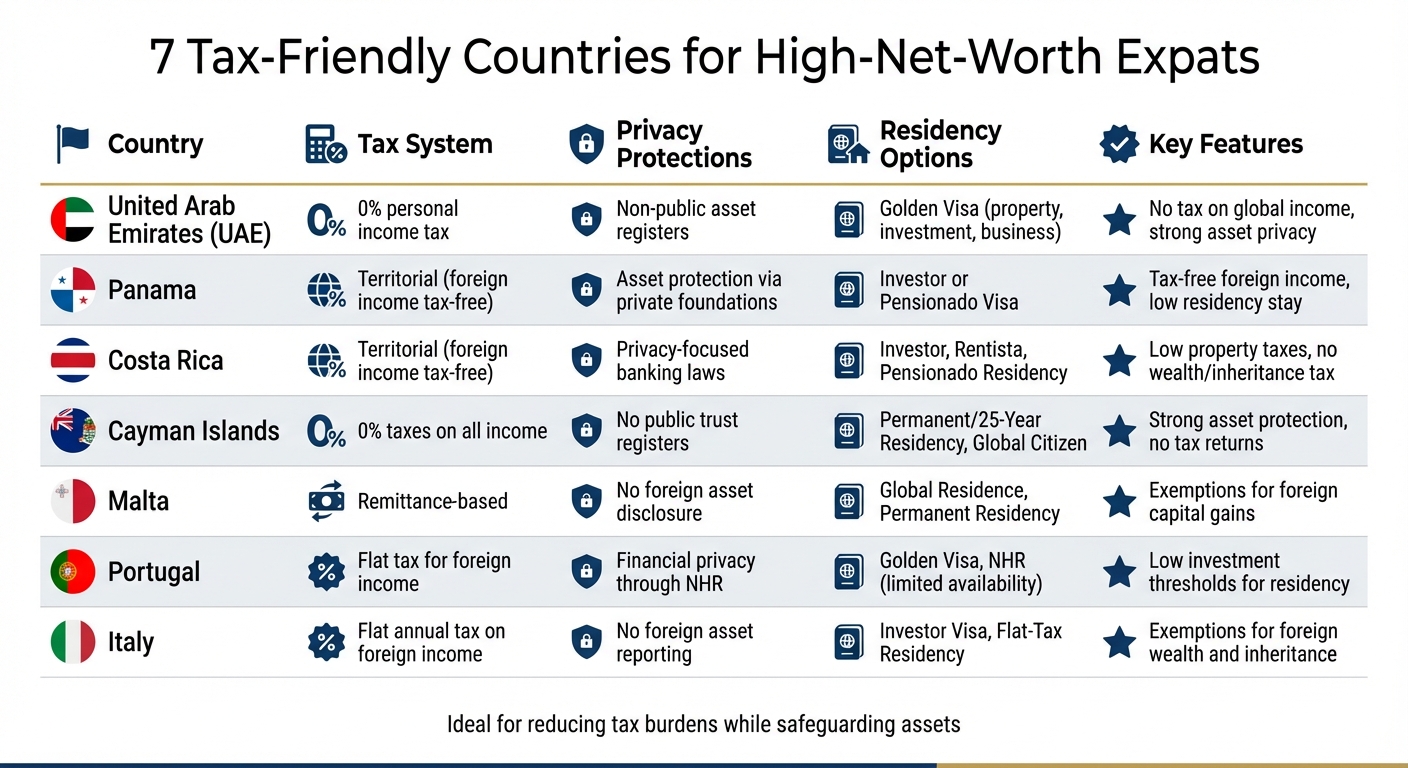
Looking for tax-friendly options to protect your wealth and maintain privacy? Here’s a quick rundown of seven countries offering low or no taxes, strong privacy laws, and residency programs tailored for high-net-worth individuals:
- United Arab Emirates (UAE): 0% personal income tax, no capital gains tax, and robust privacy protections through non-public asset registers.
- Panama: Territorial tax system exempting foreign income, affordable residency options, and asset protection through private foundations.
- Costa Rica: Tax-free foreign income, low property taxes, and privacy-focused banking laws.
- Cayman Islands: No personal or corporate taxes, strong asset protection laws, and flexible residency options.
- Malta: Remittance-based tax system, exemptions for foreign capital gains, and secure residency programs.
- Portugal: Flat tax rates for foreign-source income under the Non-Habitual Residency (NHR) program, though recent changes apply.
- Italy: Flat tax regime for foreign income, privacy from foreign asset disclosures, and straightforward residency options.
These countries combine tax efficiency with privacy measures, offering tools like trusts, foundations, and local legal safeguards to protect assets. Residency requirements vary, but most demand proof of genuine ties, such as real estate investments or minimum stay periods.
Quick Comparison
| Country | Tax System | Privacy Protections | Residency Options | Key Features |
|---|---|---|---|---|
| UAE | 0% personal income tax | Non-public asset registers | Golden Visa (property, investment, business) | No tax on global income, strong asset privacy |
| Panama | Territorial (foreign income tax-free) | Asset protection via private foundations | Investor or Pensionado Visa | Tax-free foreign income, low residency stay |
| Costa Rica | Territorial (foreign income tax-free) | Privacy-focused banking laws | Investor, Rentista, Pensionado Residency | Low property taxes, no wealth/inheritance tax |
| Cayman Islands | 0% taxes on all income | No public trust registers | Permanent/25-Year Residency, Global Citizen | Strong asset protection, no tax returns |
| Malta | Remittance-based | No foreign asset disclosure | Global Residence, Permanent Residency | Exemptions for foreign capital gains |
| Portugal | Flat tax for foreign income | Financial privacy through NHR | Golden Visa, NHR (limited availability) | Low investment thresholds for residency |
| Italy | Flat annual tax on foreign income | No foreign asset reporting | Investor Visa, Flat-Tax Residency | Exemptions for foreign wealth and inheritance |
These destinations are ideal for those seeking to reduce tax burdens while safeguarding assets and maintaining a high standard of living.
1. United Arab Emirates (UAE)
Tax Advantages
The UAE’s 0% personal income tax policy for both citizens and expatriates makes it an attractive destination for those looking to preserve wealth. There’s no capital gains tax on personal investments – whether in real estate or securities – and no inheritance, estate, or gift taxes to complicate succession planning.
Businesses also benefit from a favorable corporate tax system. Companies pay only 9% tax on profits exceeding AED 375,000 (about $102,000), while qualifying free zone companies can still enjoy a 0% tax rate. VAT is set at just 5%, far lower than in many developed countries. Additionally, residents aren’t required to report foreign income or disclose bank balances, providing an extra layer of privacy.
This tax structure complements the UAE’s flexible residency programs.
Residency Options
The Golden Visa program offers long-term residency (5 or 10 years) without the need for a local sponsor. To qualify through real estate, applicants must invest at least AED 2 million (around $545,000) in property. This can be a single property or multiple units combined to meet the threshold. Recent updates allow the use of mortgages from approved UAE banks, provided the investor’s equity meets the AED 2 million requirement.
Other pathways include depositing AED 2 million in a UAE-licensed fund, starting a qualifying company, or launching a startup project valued at AED 500,000, or one approved by an incubator. Applications are processed in 1 to 2 weeks, and visa holders can sponsor spouses, children of any age, and domestic staff.
Privacy Protections
The UAE also offers robust privacy protections. Foundations and trusts established in the Dubai International Financial Centre (DIFC) or Abu Dhabi Global Market (ADGM) provide "privacy by design" through non-public registers of founders and beneficiaries. These structures create a legal separation between individuals and their assets, shielding wealth from risks such as lawsuits, creditor claims, or foreign legal actions. The DIFC alone manages over $700 billion in assets and supports more than 120 ultra-wealthy families.
"Unlike offshore jurisdictions under pressure from transparency laws, Dubai’s foundation registers remain non-public, ensuring discretion." – Juriszone
Non-Muslim expatriates can safeguard their asset distribution by registering a will with the DIFC Probate Registry for a fee of approximately AED 10,000. This ensures their wishes are followed in line with UAE law. While the UAE prioritizes internal discretion, it adheres to international agreements like FATCA and shares tax-related information with treaty partners.
Lifestyle Considerations
In 2025, Dubai welcomed nearly 9,800 new millionaires, reinforcing its reputation as a global wealth hub. The UAE Dirham’s peg to the US Dollar ensures currency stability. Golden Visa holders enjoy unparalleled flexibility, including the ability to stay outside the UAE for over six months without losing their residency status. Basic health insurance starts at AED 1,500 per person, and the UAE is known for its safety, advanced banking infrastructure, and stable economy. Together, these factors contribute to a secure and appealing environment for asset protection and living.
sbb-itb-39d39a6
2. Panama
Tax Advantages
Panama operates on a territorial tax system, meaning residents only pay taxes on income earned within the country. Any foreign-source income – whether from crypto and stock profits, consulting fees for international clients, or e-commerce businesses – is entirely tax-free for residents. Foreign capital gains are also taxed at 0%, while gains from Panamanian real estate or securities are subject to a flat 10% rate. Additionally, Panama does not impose net wealth, gift, or inheritance taxes for direct heirs. Dividends from foreign income are taxed at 5%, compared to 10% for local income.
For property owners, the first $120,000 of a primary residence is exempt from property tax, and the country’s VAT rate is a relatively low 7%.
"Panama’s tax system is based on the principle of territoriality. This means Panama only taxes income earned within Panama – any money you make abroad is not subject to Panamanian tax." – NDM
These tax policies align seamlessly with Panama’s residency programs, making it an appealing option for those seeking financial efficiency.
Residency Options
Panama offers several pathways to permanent residency. One popular option is the Qualified Investor Visa, which requires a minimum real estate investment of $300,000. The funds must originate from outside Panama, and accepted payment methods include international bank transfers and approved cryptocurrencies like USDT, USDC, and BTC. This visa extends to spouses, dependents under 25, and parents. The approval process typically takes around 30 days, and residents only need to spend one day in Panama every two years.
For retirees, the Pensionado Visa is available by demonstrating a lifetime pension of at least $1,000 per month, with an additional $250 required for each dependent. Another option is the Friendly Nations Visa, designed for citizens of specific countries. This visa requires either a $200,000 real estate investment or a fixed-term bank deposit. After five years of permanent residency, individuals can apply for Panamanian citizenship.
Privacy Protections
Panama’s territorial tax system reduces the need for financial disclosures, as foreign-source income is not reported locally. For those seeking asset protection and estate planning solutions, Private Interest Foundations are a reliable option. The legal system, grounded in civil law, provides a stable framework for international business. However, Panama enforces strict KYC (Know Your Customer) and AML (Anti-Money Laundering) regulations.
It’s worth noting that U.S. expats in Panama are still subject to FATCA requirements. Panamanian banks report account details of U.S. persons to the IRS, meaning U.S. citizens must file Form 1040 and disclose foreign accounts if their total value exceeds $10,000.
Lifestyle Considerations
Panama uses the U.S. Dollar as its official currency, eliminating exchange rate concerns. The country also boasts a sizable English-speaking expat community and access to high-quality healthcare services. However, all residency applications must be handled by a licensed local attorney.
"Establishing your tax residency in Panama is not an evasion strategy; it’s a smart optimization decision. It’s about legally structuring your finances to protect your assets and maximize your growth in a global economy." – Panama Way
3. Costa Rica
Tax Advantages
Costa Rica is a standout for high-net-worth expats looking for tax-friendly policies and privacy. The country only taxes income earned within its borders. This means income from remote international work, offshore investments, or foreign pensions is entirely tax-free.
Additionally, Costa Rica does not impose taxes on inheritance, gifts, or wealth. Capital gains are taxed at a flat 15%, but primary residences are generally excluded. For properties acquired before July 1, 2019, owners can choose a one-time 2.25% tax on the sale price instead of the standard 15% on net gains. Dividends are taxed at a flat 15% rate.
To qualify as a tax resident, you must live in Costa Rica for over 183 days per year. The Value-Added Tax (VAT) is set at 13%, while local income is taxed on a progressive scale up to 25%. For high-end properties, a "Luxury Home Tax" applies to homes with construction values between $240,000 and $275,000, with rates ranging from 0.25% to 0.55%.
These tax policies make Costa Rica a compelling destination for expats aiming to optimize their financial setup.
Residency Options
Costa Rica offers several paths to residency:
- Investor Residency: Requires an investment of at least $150,000, or $100,000 for forestry or reforestation projects.
- Rentista Residency: Requires proof of $2,500 in monthly passive income or a $60,000 bank deposit.
- Pensionado Residency: Available with a monthly pension of $1,000.
In 2021, the investment threshold for Investor Residency was reduced from $200,000 under Ley 9996 to encourage economic recovery. Qualifying investments include real estate, business equity, or productive assets like boats or aircraft used commercially. Temporary residency lasts two years and can transition to permanent residency after three years, with citizenship available after seven years.
Processing times for residency applications vary between 6 and 18 months, depending on the category. All residents must join the CAJA public health program, contributing 9% to 11% of their declared income monthly. Government filing fees typically range from $200 to $350, while attorney fees are usually between $2,000 and $5,000.
Privacy Protections
Costa Rica has strong privacy laws that protect corporate anonymity. Companies are not required to publicly disclose directors or beneficial owners, and domestic banking institutions limit information sharing. There are no exchange controls, allowing free transfer of funds in and out of the country without restrictions or mandatory disclosure of their source.
For asset protection, Costa Rica offers "fideicomisos" (testamentary trusts) and private interest foundations. Companies operating solely outside Costa Rica are exempt from filing annual tax reports locally. However, as a member of the OECD Multilateral Convention, Costa Rica complies with the Common Reporting Standard (CRS) and FATCA, participating in the automatic exchange of financial account information.
These measures provide a robust framework for protecting financial and personal privacy.
Lifestyle Considerations
Costa Rica is home to around 70,000 Americans, with the expat population growing at 14% annually. Property taxes are low, approximately 0.25% of the municipal value. Non-residents can open bank accounts with state-owned banks like Banco de Costa Rica (BCR) or Banco Nacional (BN), which offer deposit insurance up to $50,000.
The country’s stable democracy, lack of military, and excellent healthcare system make it a desirable place for expats seeking both financial advantages and a high quality of life.
4. Cayman Islands
Tax Advantages
The Cayman Islands is often highlighted as one of the most tax-friendly jurisdictions in the world. It operates under a 0% tax regime, meaning there are no personal income taxes, capital gains taxes, inheritance taxes, estate taxes, or gift taxes. Additionally, there are no wealth taxes, payroll taxes, or withholding taxes, regardless of whether earnings are domestic or international.
For businesses, the corporate tax rate is also 0%. Instead of annual property taxes, the Cayman Islands imposes a one-time stamp duty on real estate transfers. This duty is currently 7.5%, but it will increase to 10% for properties valued over $2 million starting January 1, 2026. Another advantage? No requirement to file annual tax returns, which simplifies administration.
The islands’ appeal as a financial hub is clear. By 2016, the Cayman Islands was home to nearly 300 banks, 750 insurance companies, and 10,500 mutual funds. However, before making the move, it’s crucial to consult with tax professionals in your home country to ensure you’ve exited your prior tax domicile properly, avoiding any potential double taxation issues.
Residency Options
The Cayman Islands offers a variety of residency programs tailored to different investment levels and goals:
| Residency Type | Minimum Investment | Annual Stay Requirement | Key Features |
|---|---|---|---|
| Permanent Residence | $2.4M (developed real estate) | 1 day per year | Lifetime residency; pathway to British Overseas Territories Citizenship (BOTC) |
| 25-Year Certificate | $1.2M (50% in real estate) + $146,400 annual income or $488,000 bank deposit | 30 days per year | Renewable; no work rights |
| Substantial Business Presence | 10% ownership in an approved business | 90 days per year | 25-year renewable residency; includes work rights for your business |
| Global Citizen Concierge | $100,000+ annual income | No minimum | 2-year remote work permit |
For those seeking BOTC, the Certificate of Permanent Residence for Persons of Independent Means is the only pathway. This option requires a $610 application fee and a one-time grant fee of $122,000. Alternatively, the 25-year certificate costs $24,400 upfront, with an additional $1,220 per dependent each year.
"The Cayman Islands has no income tax, capital gains tax, inheritance or estate taxes, or annual property taxes. Purchasing a property above $1 million can also put buyers on a fast-track toward potential Cayman residency." – Stefan Cohen, Co-owner and Director, The Agency Cayman Islands
If you’re planning to relocate, take advantage of duty-free concessions for personal effects brought in within the first six months. Standard import duties typically run at 22%, though specific items may range from 5% to 42%.
Privacy Protections
The Cayman Islands prioritizes privacy, making it an attractive choice for asset protection. There is no public trusts register, and trust deeds remain private, as they are not filed with any government registry. Access to the beneficial ownership register is restricted to authorities or approved cases with "legitimate interest", as outlined by the Beneficial Ownership Transparency (Access Restriction) Regulations 2024.
Under these 2024 regulations, beneficial owners can request to restrict the disclosure of their information if they face risks such as kidnapping, extortion, or violence. Additionally, the Trusts Act includes "firewall" provisions to protect Cayman trusts from foreign judgments, including forced heirship claims.
The jurisdiction imposes no exchange controls, allowing for unrestricted movement of funds. While the Cayman Islands complies with international standards like FATCA and the Common Reporting Standard (CRS) for tax information sharing, it still offers robust privacy measures. High-net-worth individuals may also consider Foundation Companies, which combine trust-like features with a separate legal personality, often used for family offices.
Lifestyle Considerations
The Cayman Islands is home to a diverse population of about 78,000 people, representing over 130 nationalities. However, the cost of living is 30% to 50% higher than in most U.S. cities. The financial services sector plays a major role in the local economy, contributing approximately 40% of the territory’s GDP.
"Grand Cayman’s luxury real estate market remains fundamentally strong and resilient, defined by stability rather than speculative excess." – Stefan Cohen, Co-owner and Director, The Agency Cayman Islands
The legal system is based on English Common Law, reflecting its status as a British Overseas Territory. Some luxury real estate developments, like the Mandarin Oriental Residences, now accept digital currency for property purchases. Limited land availability, especially along Seven Mile Beach, combined with strict planning regulations, helps maintain property values. This exclusivity aligns with the goals of high-net-worth individuals looking to protect their wealth and maintain privacy.
5. Malta
Malta stands out as a destination that blends tax efficiency with strong privacy measures, making it attractive for high-net-worth expats.
Tax Advantages
Malta operates on a remittance-based tax system, meaning foreign income is only taxed when brought into the country. If you’re a resident but not domiciled in Malta, you’ll only pay taxes on foreign income remitted locally, while foreign-source capital gains remain entirely exempt – even if transferred to local accounts.
The country also avoids imposing taxes on wealth, inheritance, or gifts, and there’s no requirement to declare assets held domestically or abroad, offering significant financial privacy. For individuals earning at least $37,100 in foreign income kept offshore, a minimum annual tax of about $5,300 is applied. Additionally, Malta has over 70 double taxation treaties, including agreements with the US, UK, and Canada.
Under the Global Residence Programme (GRP), foreign income remitted to Malta is taxed at a flat 15% rate, with a minimum annual tax of $15,900. Professionals in sectors like finance, gaming, or blockchain may benefit from the Highly Qualified Persons Rules, which also offer a 15% flat tax rate on employment income.
Residency Options
Malta offers several residency programs tailored to different investment levels. The Malta Permanent Residence Programme (MPRP) provides lifelong residency without a specific minimum annual tax requirement. Applicants must show total assets of around $530,000 (with $159,000 in liquid assets) and face an overall cost of approximately $179,000 when renting or about $502,000 when purchasing property.
| Program | Upfront Cost | Annual Tax | Property Requirement | Validity |
|---|---|---|---|---|
| Global Residence (GRP) | ~$31,800+ | $15,900 minimum | Purchase from ~$233,000+ or rent from ~$9,300 per year | 1 year (renewable) |
| Permanent Residence (MPRP) | ~$179,000+ | None specified | Purchase from ~$397,000+ or rent from ~$14,800 per year | Lifelong |
| Citizenship (MEIN) | ~$1,060,000+ | N/A | Purchase from ~$742,000+ or rent from ~$17,000 per year (over 5 years) | For life |
For those seeking citizenship, the Maltese Exceptional Investor Naturalisation (MEIN) program offers a pathway to a passport after 12 or 36 months of residency. This passport provides visa-free access to 185–188 countries. Contributions range from $636,000 (after 36 months) to $795,000 (after 12 months), with an additional $53,000 per dependent [62, 66]. The program includes a rigorous four-tier due diligence process involving Interpol and Europol.
Privacy Protections
Malta’s approach to privacy sets it apart from traditional banking secrecy jurisdictions. There’s no requirement to declare foreign-held assets, partly because Malta doesn’t impose a net wealth tax. Non-domiciled status is determined by personal circumstances rather than a public application.
"For internationally mobile individuals, changing domicile is difficult in practice. Even long-term residence in Malta may not be enough if strong ties remain elsewhere… These factors often suggest an intention to return, making a domicile of choice in Malta unlikely." – Albert Ioffe, Legal and Compliance Officer, Immigrant Invest
Residency applications must go through Licensed Agents or Authorised Registered Mandatories (ARM), adding a layer of confidentiality between applicants and the government. As an EU member state, Malta complies with GDPR and follows the OECD Common Reporting Standard (CRS) and FATCA. To maintain privacy and tax efficiency, segregating bank accounts to distinguish between non-taxable capital and taxable income is recommended.
Lifestyle Considerations
Malta combines the perks of EU residency with a Mediterranean lifestyle, often at a lower cost than other Western European nations. The country benefits from 74 double taxation treaties and has seen steady property price growth, averaging around 10% annually. The standard VAT rate is 18%, among the lowest in the European Union.
"Malta is a strong jurisdiction that keeps punching above its weight." – Economy & Finance News
In 2024, the MPRP contributed approximately $48.7 million to the Consolidated Fund and supported about $38.1 million in property purchases. Interestingly, over 97% of residency applicants choose to rent instead of purchasing property to meet program requirements. Malta’s legal system, rooted in Anglo-Saxon traditions, also supports the use of trusts and partnerships to manage wealth discreetly.
Malta offers a compelling mix of tax efficiency and privacy, making it an excellent choice for safeguarding wealth while enjoying a high-quality lifestyle.
6. Portugal
Portugal has become a popular destination for high-net-worth expats looking for tax efficiency within the European Union. Unlike traditional offshore havens, Portugal offers a blend of tax benefits and strong privacy protections, aligning with a global shift toward in-continent asset protection strategies.
Tax Advantages
Portugal’s Non-Habitual Residency (NHR) program was a key draw for expats, offering 10 years of favorable tax treatment for those who hadn’t been Portuguese tax residents in the prior five years. However, as of early 2024, the NHR program closed to most new applicants. It has been replaced by the Fiscal Incentive for Scientific and Innovation (IFICI), also known as "NHR 2.0", which focuses on professionals in research, technology, and innovation.
Under the original NHR regime, foreign pensions were taxed at 10%, while high-value Portuguese-sourced income faced a flat 20% tax rate – well below the progressive rates that climb to 48% for income exceeding $101,600. Most foreign-source income, including dividends, interest, and rental income, was exempt from Portuguese taxation if it was taxable in the source country under one of Portugal’s 79 Double Taxation Agreements.
Portugal also stands out for its lack of a general wealth tax on international assets. Inheritance and gift taxes are eliminated for close relatives, with spouses, descendants, and ascendants paying 0%, while others incur a flat 10% stamp duty. Cryptocurrency assets held for over a year are typically exempt from personal income tax. To benefit from NHR status, applicants must apply by March 31 of the year following their establishment of Portuguese tax residency.
Residency Options
The Portugal Golden Visa program offers residency-by-investment for non-EU/EEA/Swiss nationals, requiring minimal physical presence – just 7 days per year (or 14 days over two years). Launched in 2012, this program has brought in over $8.9 billion in foreign investment and granted residency to more than 17,700 main applicants and 40,000 total beneficiaries.
As of October 2023, real estate investments are no longer eligible for the Golden Visa. Current investment options include:
- A minimum $609,000 investment in CMVM-regulated private equity or venture capital funds.
- $305,000 for cultural support (or $244,000 in low-density areas).
- $609,000 for scientific research (or $488,000 in low-density areas).
After five years of legal residency, investors may apply for permanent residency or Portuguese citizenship, provided they meet basic A2-level Portuguese language requirements and maintain a clean criminal record. The program boasts a 98.5% citizenship approval rate.
Total costs for the program range from $305,000 to over $670,000, depending on the chosen investment route and family size. Additional expenses include legal fees, which fall between $7,300 and $18,300, and government fees of about $8,300 per person. U.S. investors must work with a registered Broker-Dealer to ensure compliance with SEC and FINRA regulations.
Privacy Protections
Portugal offers a balance between privacy and international transparency. The country does not impose broad annual wealth taxes, and non-residents generally avoid filing Portuguese tax returns unless they receive Portugal-sourced income. Additionally, there is no tax on transferring foreign or domestic currency into Portugal, and amounts below $12,200 do not require customs declaration.
Financial privacy is safeguarded through regulated investment funds and data protections overseen by the Bank of Portugal and CMVM. While Portuguese civil law doesn’t recognize trusts locally, foreign trusts are not prohibited. With 79 double tax treaties and numerous Tax Information Exchange Agreements, Portugal is recognized as a compliant "white list" tax environment within the EU.
Lifestyle Considerations
Portugal ranks as the 7th safest country in the world, according to the 2024 Global Peace Index. The cost of living is 30-40% lower than in Western European cities like London or Paris, and the country enjoys over 300 days of sunshine annually. Property buyers should note transfer taxes of up to 7.5% and a 0.8% stamp duty.
With its world-class healthcare, stable legal environment, and evolving tax policies, Portugal continues to attract high-net-worth individuals seeking a balance of tax benefits and quality living.
7. Italy
Italy stands out as an attractive destination for ultra-high-net-worth expats, offering substantial tax benefits and strong privacy measures through its flat tax regime under Article 24-bis TUIR.
Tax Advantages
Starting January 1, 2026, new residents will pay a flat annual tax of $326,400 (€300,000) on all foreign-sourced income. This is an increase from the $108,800 (€100,000) rate introduced in 2017 and the $217,600 (€200,000) rate set for 2024. However, a grandfathering policy ensures that pre-2026 residents can retain the older, lower rates. This flat fee covers income from dividends, capital gains, interest, and rental properties.
Between 2017 and 2022, 2,730 individuals joined the program, with an estimated 1,200 ultra-high-net-worth individuals registering in 2023. On average, participants reduce their global tax burden by 70% compared to progressive tax systems. Family members can join the program for an additional annual fee of $54,400 (€50,000) per person. Participants are also exempt from Italian wealth taxes on foreign real estate (IVIE) and financial assets (IVAFE), as well as inheritance and gift taxes on foreign assets. However, income sourced within Italy is still subject to progressive tax rates ranging from 23% to 43%, with local surcharges potentially raising the effective rate above 45%.
Residency Options
Italy’s Investor Visa (Golden Visa) has no physical presence requirement, making it a great option for those who prioritize global mobility. The approval process is one of the quickest in Europe, typically taking 3 to 4 months. Investment options include:
- $271,750 (€250,000) in an innovative Italian startup
- $543,500 (€500,000) in an Italian limited company
- $2,174,000 (€2,000,000) in government bonds
After maintaining continuous residence for 5 years, investors can apply for permanent residency. After 10 years, they become eligible for Italian citizenship, provided they meet a B1-level Italian language requirement and have a clean criminal record. Both the Investor Visa and the Elective Residency Visa , as well as the Italy Digital Nomad Visa , allow for the inclusion of spouses, dependent children, and dependent parents. These options, combined with Italy’s privacy measures, make the residency process appealing for high-net-worth individuals.
Privacy Protections
Flat-tax participants enjoy significant privacy benefits. Unlike ordinary Italian residents, they are not required to disclose the nature, value, or location of foreign financial assets through the "Quadro RW" form.
"The flat tax regime eliminates this burdensome reporting requirement for foreign assets."
– Riccardo Virga, Specialist Team of Anglo-Italian Legal Advisors, The Italian Lawyer
Between 2020 and 2023, nearly 4,000 taxpayers under the flat tax scheme contributed €117.6 million in tax revenue in 2023 alone. To streamline the process, the Italian Revenue Agency has set up a dedicated office for handling applications. Prospective participants are encouraged to file an advance tax ruling (interpello) to verify eligibility before relocating.
Lifestyle Considerations
Italy offers more than just tax perks – it provides a reliable legal framework for international residents. With over 100 double taxation treaties, Italy ensures a stable environment for global citizens. To maintain tax residency under the regime, individuals must register with the Italian civil registry and spend more than 183 days in the country. For Golden Visa holders, the transfer of investment funds must be completed within 3 months of entering Italy with the approved visa, minimizing upfront financial risks.
Conclusion
Relocating to a jurisdiction with favorable tax laws and strong privacy protections can help safeguard wealth, protect assets, and maintain regulatory confidentiality. Countries like the UAE and the Cayman Islands stand out with their zero personal income tax policies, while places like Portugal and Italy offer flat-tax regimes that can significantly lower tax obligations. Beyond tax advantages, these locations provide legal tools – such as offshore trusts, foundations, and holding companies – that separate beneficial and legal ownership, offering a layer of protection against foreign civil judgments and creditors.
Today, privacy is less about secrecy and more about regulated confidentiality. These jurisdictions ensure client data is protected by strict legal frameworks, requiring thorough local reviews before recognizing foreign judgments.
"A jurisdiction with weak courts or inconsistent regulations creates more exposure than benefit." – Savory & Partners
Successfully navigating an international move requires careful planning and expertise. Complying with global reporting standards like FATCA and CRS, addressing exit taxes, and setting up proper legal structures are all critical steps. Asset protection mechanisms, such as trusts or holding companies, must be established proactively – before any creditor claims – to avoid issues like fraudulent transfer allegations. Additionally, ensuring detailed documentation is key to meeting banking due diligence requirements. Partnering with Global Wealth Protection professionals can help assess your assets, minimize risks, and create a strategy that balances compliance with privacy.
FAQs
Will moving abroad reduce my U.S. taxes?
U.S. citizens living abroad are still required to pay taxes to the United States, as the country taxes worldwide income regardless of where you reside. That said, relocating to a country with lower taxes can help you manage your overall tax obligations more effectively. With proper planning, you can take advantage of benefits like foreign income exclusions or tax treaties to ease your tax burden.
Do these countries still report my accounts under FATCA/CRS?
Many countries adhere to FATCA and CRS reporting standards. However, certain jurisdictions provide structures that meet FATCA requirements while enabling Americans to preserve their privacy and secure their assets. These approaches allow for complete compliance with reporting rules while maintaining confidentiality.
What makes me a tax resident in each country?
Tax residency is determined by the specific rules of each country, often revolving around factors like physical presence, domicile, or legal residency status. A common benchmark is the 183-day rule – spending more than half the year in a country can make you a tax resident there. Other countries might base residency on having a permanent home, meeting certain financial thresholds, or securing formal residency or citizenship. It’s crucial to review the legal requirements for the jurisdiction you’re considering.
