
In the Americas, several countries offer ways to legally reduce taxes on foreign income. Here’s what you need to know:
- Zero-Tax Jurisdictions: Countries like the Cayman Islands and the Bahamas impose no personal or corporate income taxes, regardless of where your income is earned. These locations rely on indirect taxes like VAT and property taxes.
- Territorial Tax Systems: Panama, Paraguay, and Costa Rica tax only income generated within their borders. Foreign-sourced income is tax-free, making them attractive for digital entrepreneurs and retirees.
- U.S. Citizens: While these systems reduce local taxes, U.S. citizens must still file with the IRS and may owe federal taxes. However, tools like the Foreign Earned Income Exclusion (FEIE) can help minimize U.S. tax obligations.
Key Highlights:
- Panama: Foreign income is untaxed. Residency options include the Friendly Nations Visa ($200,000 investment) or Pensionado Visa ($1,000 monthly pension proof).
- Paraguay: Flat 10% tax on local income; foreign income is tax-free. Residency requires minimal investment and physical presence (1 day every 3 years).
- Uruguay: Offers an 11-year exemption on foreign income for new residents.
- Caribbean Islands: Zero-tax havens like the Cayman Islands and the Bahamas require significant investments for residency.
Pro Tip: Combining residency in a territorial tax country with offshore structures, like a U.S. LLC, can help optimize your tax situation while maintaining banking access. But remember, U.S. citizens remain subject to federal tax rules.
For those considering relocation, understanding residency requirements, investment thresholds, and physical presence rules is crucial. Countries like Paraguay and Panama stand out for their ease of residency and low living costs, while the Cayman Islands and Bahamas cater more to high-net-worth individuals.
Top Tax-Free and Low-Tax Countries in the Americas
Some countries in the Americas offer legal ways to reduce or eliminate taxes on foreign-sourced income. These systems are often designed to attract businesses, investors, and retirees. Below, we’ll explore how Panama, Paraguay, and Uruguay implement these tax-friendly structures.
Panama: Territorial Tax System with USD Economy
Panama operates on a territorial tax system, meaning only income earned within Panama is taxed. Any income generated from clients, investments, or businesses outside the country is tax-free. Additionally, Panama uses the U.S. dollar as its official currency, which simplifies financial management for North Americans and eliminates exchange rate risks.
For those seeking residency, Panama offers several options:
- Pensionado Visa: Requires proof of a lifetime pension of at least $1,000 per month.
- Friendly Nations Visa: Requires either a $200,000 real estate investment or a fixed-term deposit.
- Qualified Investor Visa: Demands a $500,000 investment and offers fast processing within 30 days.
As Panama Way explains:
"Establishing your tax residency in Panama is not an evasion strategy; it’s a smart optimization decision. It’s about legally structuring your finances to protect your assets and maximize your growth in a global economy."
To qualify for tax residency, you must either spend more than 183 days per year in Panama or establish it as your primary place of residence with economic ties. Local income is taxed at rates up to 25%, and a 7% value-added tax is applied to most goods and services.
Paraguay: 10% Tax on Local Income Only
Paraguay offers a simple territorial tax system where only local income is taxed at a flat 10% for corporations and 8–10% for individuals. Foreign income remains completely tax-free. According to Freedom & Finance Advisor Paul Albert:
"Paraguay stands out for its remarkably minimal tax domiciliation requirements and its unique territorial taxation system: 0% tax on foreign-source income."
The country does not impose taxes on wealth, inheritance, gifts, or capital gains for foreign assets. Export businesses can benefit from the Maquila program, which applies a low 1% tax on value added. Residency is easy to maintain, requiring just one visit every three years.
Permanent residency can typically be obtained for about $5,000 within 60 to 90 days, or expedited with a $70,000 investment in a Paraguayan business[10,11]. To enjoy the 0% tax on foreign income, residents must secure a Taxpayer Identification Number (RUC) and provide proof that their income originates outside Paraguay. Monthly living expenses are generally between $1,200 and $1,800.
Uruguay: 11-Year Foreign Income Tax Exemption
Uruguay offers new tax residents an 11-year exemption on foreign-sourced income, making it a long-term option for entrepreneurs and investors looking for a tax holiday. Each of these jurisdictions provides frameworks to help residents protect their assets while minimizing local tax burdens.
Caribbean Zero-Tax Islands
The Caribbean is home to several islands that impose zero personal income tax, making them attractive destinations for high-net-worth individuals. Unlike territorial tax systems seen in countries like Panama or Paraguay, these jurisdictions don’t tax income, whether domestic or foreign. Instead, they rely on indirect taxes, such as value-added tax (VAT), import duties, and property taxes, to generate government revenue. These islands provide additional tax-efficient options for those seeking to diversify their financial strategies.
Cayman Islands, Bahamas, and Anguilla
The Cayman Islands stands out as a true tax haven. It imposes no personal income, corporate, capital gains, or withholding taxes on dividends and interest. Additionally, there are no property, payroll, inheritance, or sales taxes. As a major global financial hub, the Cayman Islands offers residents a 25-year tax guarantee. To gain residency, investors must commit at least $610,000 to a local business, along with processing fees of approximately $32,500 and an annual fee of about $15,000.
The Bahamas also exempts individuals and corporations from personal, corporate, capital gains, inheritance, or wealth taxes. Residency can be obtained through a $500,000 property investment, with first-year fees totaling around $6,000. Maintaining permanent residency status typically requires spending over 90 days annually in the country. A new 15% minimum tax, effective in late 2024, will primarily target large multinational corporations rather than individual investors.
Anguilla, a British Overseas Territory, offers a tax-free environment with no personal or corporate income taxes, no capital gains, inheritance, or gift taxes, and no VAT. To qualify, applicants must purchase property worth at least $400,000 and agree to an annual lump-sum tax payment of $75,000. Anguilla operates under English common law and has an efficient electronic companies registry, making it an appealing choice for offshore business formation.
Antigua and Barbuda: Citizenship by Investment
Antigua and Barbuda provide a compelling mix of tax benefits and citizenship opportunities through investment. In 2016, the country eliminated personal income tax entirely. Additionally, its Tax Residency Program requires only 30 days of physical presence per year, a permanent local address, a minimum annual income of $100,000, and a flat annual tax payment of $20,000.
For those seeking faster access to these benefits, the Citizenship by Investment (CBI) program offers a streamlined path. Investors must contribute a minimum of $230,000. This can take the form of a non-refundable donation to a state fund or a $200,000–$300,000 real estate investment in approved projects. Processing takes approximately 3 to 6 months, and participants avoid the need for costly Alien Landholding Licenses, which can add 5% to 10% to a property’s value. While citizenship requires minimal physical presence (0 to 5 days in the first 5 years) [25, 26], achieving tax residency requires spending at least 183 days in the country annually.
These Caribbean jurisdictions offer a range of options for those looking to protect their assets and optimize taxes, adding valuable tools to a comprehensive wealth management strategy in the Americas.
Country Comparison Table
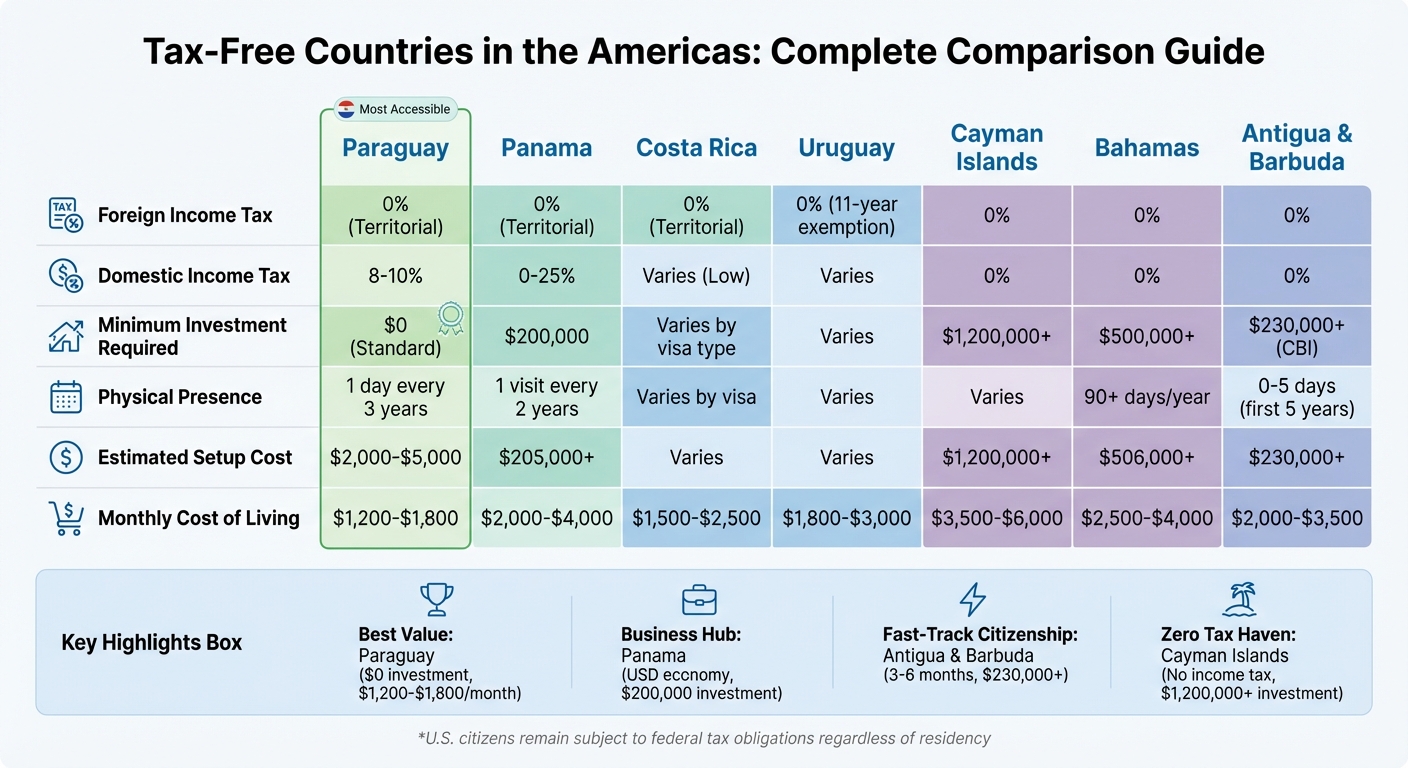
When it comes to picking a tax-friendly jurisdiction, it’s about more than just low foreign income tax rates. Factors like required investments, physical presence rules, and setup costs all play a role. Here’s a comparison of some of the most accessible countries in the Americas, based on data from March 2026:
| Country | Foreign Income Tax | Domestic Income Tax | Min. Investment Required | Physical Presence | Estimated Setup Cost | Monthly Cost of Living |
|---|---|---|---|---|---|---|
| Paraguay | 0% (Territorial) | 8% – 10% | $0 (Standard) | 1 day every 3 years | $2,000 – $5,000 | $1,200 – $1,800 |
| Panama | 0% (Territorial) | 0% – 25% | $200,000 | 1 visit every 2 years | $205,000+ | $2,000 – $4,000 |
| Costa Rica | 0% (Territorial) | Varies (Low) | Varies by visa type | Varies by visa | Varies | $1,500 – $2,500 |
| Uruguay | 0% (11-year exemption) | Varies | Varies | Varies | Varies | $1,800 – $3,000 |
| Cayman Islands | 0% | 0% | $1,200,000+ | Varies | $1,200,000+ | $3,500 – $6,000 |
| Bahamas | 0% | 0% | $500,000+ | 90+ days/year | $506,000+ | $2,500 – $4,000 |
| Antigua & Barbuda | 0% | 0% | $230,000+ (CBI) | 0–5 days (first 5 years) | $230,000+ | $2,000 – $3,500 |
Key Takeaways:
- Paraguay stands out with no mandatory investment and minimal physical presence requirements – just one day every three years after establishing residency.
- Panama offers tax advantages through its Friendly Nations program, requiring a $200,000 investment.
- On the higher end, Cayman Islands and Bahamas demand substantial investments but provide complete tax exemptions on all income.
- Antigua & Barbuda is appealing for its fast-track citizenship process, typically completed in 3 to 6 months through a $230,000+ investment.
It’s important to keep in mind that while these countries provide tax benefits, U.S. citizens remain subject to federal tax obligations. Mike Wallace, CEO of Greenback Expat Tax Services, explains:
"Moving to a zero-tax country does not eliminate your U.S. federal tax obligations… because you pay no foreign income tax, you cannot claim the Foreign Tax Credit (FTC) to offset your U.S. liability".
Cost of living is another factor to consider. Paraguay offers the most affordable lifestyle, with monthly costs ranging from $1,200 to $1,800, while the Cayman Islands is the most expensive, with costs as high as $6,000 per month for a single person. These considerations are essential when evaluating jurisdictions for asset protection. Up next, we’ll dive into how these residency requirements and investment thresholds align with broader financial strategies.
sbb-itb-39d39a6
How to Obtain Residency and Citizenship
Navigating the path to residency or citizenship in tax-friendly countries means understanding the specific rules and timelines for each destination. Whether you’re pursuing standard residency, investment-based programs, or aiming for citizenship later, each approach has its own criteria.
Physical Presence Requirements by Country
In many tax-friendly jurisdictions across the Americas, the physical presence requirements for maintaining residency are surprisingly minimal. For instance, Paraguay only requires permanent residents to visit once every three years. Panama is slightly stricter, mandating a visit every two years to maintain your residency card. However, if you’re looking to establish tax residency in Panama, you’ll need to spend at least 183 days there annually to obtain a Tax Residency Certificate. Antigua and Barbuda has a similar 183-day rule for tax residency.
It’s worth noting that Costa Rica has a much tougher stance – if you’re absent for two consecutive years, your residency will be canceled.
When it comes to citizenship, the timelines are longer. Paraguay allows naturalization after three years of permanent residency (or five years from your initial application). Panama typically requires five years of permanent residency but reduces this to three years for citizens of certain countries. In the Bahamas, you’ll need to hold permanent residency for at least 10 years before you can apply for citizenship.
Once you’ve got a handle on the physical presence requirements, it’s time to explore how investment programs can speed up the process.
Residency Through Investment Programs
Investment programs can significantly shorten the timeline for obtaining residency. For example, Panama’s Qualified Investor Visa offers permanent residency in about 30 days with a real estate investment of US$300,000 – though this threshold will rise to US$500,000 after October 2026. Another option in Panama is the Friendly Nations Visa, which requires a US$200,000 investment in real estate, a fixed-term deposit, or a valid job offer from a Panamanian company.
In Paraguay, the SUACE program provides an expedited route to residency with a phased investment of US$70,000, a faster alternative to the standard low-cost pathway. Thanks to digital upgrades, Paraguay now processes residency applications in just 75–90 days, while Panama’s Qualified Investor Visa typically takes 30–45 business days.
The costs vary depending on the country and program. In Panama, setup expenses (excluding the required investment) range from US$5,000 to US$15,000. Meanwhile, Paraguay’s standard residency costs are much lower, between US$1,400 and US$5,000.
Once residency is secured, combining it with offshore structures can amplify your asset protection strategy.
Combining Residency with Offshore Structures
Pairing residency with offshore structures can be a smart way to protect your assets. For example, combining residency in Paraguay with a U.S. LLC structured as a disregarded entity offers unique advantages. As Polystate explains:
"The LLC provides business credibility and banking access, while Paraguay handles the zero‑tax magic on your profits".
In Paraguay, you’ll need to establish an active tax ID (RUC) and file monthly returns, even if you have no local income. Both Panama and Paraguay operate on territorial tax systems, meaning that income earned outside their borders – like dividends, remote work earnings, or investment returns – is not taxed.
Banking is another key consideration. In Paraguay, you can’t open a bank account until you’ve received your Cédula (national ID), which comes after residency approval. Panama’s banking system involves more stringent checks, often taking three to five months to open an account. Residency is a prerequisite, and non-residents face higher deposit requirements – ranging from US$10,000 to US$250,000, compared to US$500 to US$5,000 for residents.
To avoid delays, start gathering necessary documents like apostilled birth certificates and police clearances two to three months before your trip. Keep in mind that these documents often expire after six months. For Panama’s Qualified Investor Visa, remember that your investment must remain intact for at least five years to maintain your residency status.
Global Wealth Protection Services

Once you’ve chosen your residency strategy, Global Wealth Protection steps in to help finalize your offshore asset protection plan. After selecting the right jurisdiction, they assist in implementing your offshore and tax optimization strategy. Their services cover tax optimization, offshore structuring, and relocation planning throughout the Americas.
GWP Insiders Membership
The GWP Insiders Membership is designed to help you navigate digital nomad taxes and territorial tax systems in low-tax jurisdictions like Panama, Paraguay, and Costa Rica. Members gain access to resources and guidance on strategies such as combining residency with offshore structures. A compelling analysis highlights the synergy of this approach:
"The US provides the business infrastructure, Paraguay provides the tax optimization, and you provide the entrepreneurial vision." (Polystate.io)
This method allows digital entrepreneurs to retain access to U.S. banking and maintain business credibility while taking advantage of Paraguay’s 0% tax on foreign-sourced income.
From here, the next step involves structuring your entities through offshore company formation and trusts.
Offshore Company Formation and Trusts
Global Wealth Protection simplifies company formation by managing the process remotely via Power of Attorney. In Paraguay, for instance, the Sociedad Anónima Simplificada (S.A.S.) allows 100% foreign ownership with just one shareholder, and no minimum capital is required. The entire incorporation process, including obtaining a tax ID and setting up corporate bank accounts, typically takes 20 to 30 days.
For high-net-worth clients, Panama Foundations offer strong asset protection. Unlike traditional trusts where a trustee manages assets, the Foundation itself holds the assets. This not only bypasses probate but also shields wealth from potential creditors. Additionally, the service provides tailored guidance on invoicing and payment flows to ensure that international income is correctly classified as foreign-sourced, maintaining a 0% tax rate under territorial systems .
The next phase involves private consultations to create a relocation plan tailored to your financial objectives.
Private Consultations for Custom Relocation Plans
Private consultations begin with an in-depth analysis of your profile to identify the most suitable residency program. Using specialized tax calculators, advisors estimate potential savings before you commit to relocating and then craft a personalized action plan.
This process includes strategic income structuring and handling all necessary documents for residency applications. Once legal residency is secured, consultants guide you through obtaining a tax residency certificate from local authorities, such as Panama’s DGI, to solidify your tax status. Many plans integrate residency with offshore structures, such as using a U.S. LLC for business credibility or a Private Interest Foundation for safeguarding assets [16, 5].
Conclusion
The Americas offer practical tax planning opportunities, especially for those looking to optimize their tax situations legally. Countries like Paraguay, Panama, Costa Rica, and Uruguay follow territorial tax systems, meaning they only tax income earned within their borders while leaving foreign-sourced income untouched. For instance, Paraguay applies a flat 10% tax rate on local income but does not tax foreign earnings. Panama, with its territorial system and U.S. dollar-based economy, is another attractive option. Uruguay even provides new residents with an 11-year exemption on foreign income taxes. However, leveraging these benefits requires careful, strategic planning beyond simply relocating.
Relocation alone won’t suffice. To fully benefit, you’ll need to sever tax ties with your home country by spending fewer than 183 days there annually and reducing economic connections. Additionally, obtaining a local tax ID – such as Paraguay’s RUC – and registering minimal economic activity are essential steps to be recognized as a tax resident on an international level. Many successful strategies involve combining residency in a territorial tax country with offshore structures. For example, pairing a U.S. LLC with Paraguay residency can help maintain business credibility while ensuring profits remain untaxed.
It’s worth noting that these opportunities may not remain as accessible forever. Panama’s Friendly Nations Visa has already become more restrictive, and Paraguay’s previously straightforward residency process is expected to tighten as more individuals take advantage of these benefits. Acting promptly allows you to lock in current advantages before further policy changes make it harder to qualify.
For those looking to navigate this process seamlessly, Global Wealth Protection offers comprehensive services. From analyzing your income and managing documents to setting up offshore structures and ensuring compliance, they simplify the path to legally reducing your tax burden while safeguarding your assets.
FAQs
Do I need tax residency or just legal residency to get 0% tax on foreign income?
To take advantage of a 0% tax rate on foreign income, you generally need to become a tax resident in a specific country. Certain places, such as Paraguay, provide tax exemptions for foreign income under their territorial tax systems. However, simply having legal residency often isn’t sufficient. It’s your tax residency status that determines whether you’re eligible for these benefits.
How do I prove my income is foreign-sourced in a territorial tax country?
To demonstrate that your income is earned outside a territorial tax country like Panama or Paraguay, you’ll need to provide clear documentation. This might include contracts, invoices, bank statements, or payment records from foreign clients or employers. These documents must clearly show that the income originates from outside the country. Proper records are essential to meet tax regulations and avoid local taxation.
If I’m a U.S. citizen, what U.S. taxes still apply after moving?
U.S. citizens are required to file annual tax returns and report their worldwide income, even while living abroad. However, there are ways to potentially lower the tax burden. One option is the Foreign Earned Income Exclusion (FEIE), which allows qualifying individuals to exclude a portion of their foreign income from U.S. taxation. Additionally, some countries, like Panama and Paraguay, have territorial tax systems that exempt foreign income from local taxes. These strategies can help ease the financial obligations of living overseas.
