
If I had to give a short answer, I’d put Costa Rica and Panama at the top for most expats. Costa Rica stands out for political calm, healthcare, and day-to-day stability. Panama is close behind, with strong infrastructure, private healthcare, and an easier fit for retirees and business-minded expats. Belize is simpler for many Americans because English is the main language, but services are thinner. Nicaragua is cheaper, but the risk level is higher.
If you’re comparing these four countries, I’d focus on six things first:
- Crime and day-to-day safety
- Political stability
- Healthcare access
- Roads, internet, and public services
- Residency and visa rules
- Monthly cost, often around $1,500 to $3,000 in this group
Here’s the short version:
- Costa Rica: Best all-around pick for many retirees, families, and remote workers
- Panama: Best fit if you want city convenience, private healthcare, and retiree perks
- Belize: Easiest language fit for U.S. expats, but with weaker systems
- Nicaragua: Lowest cost of the four, but more political and safety risk
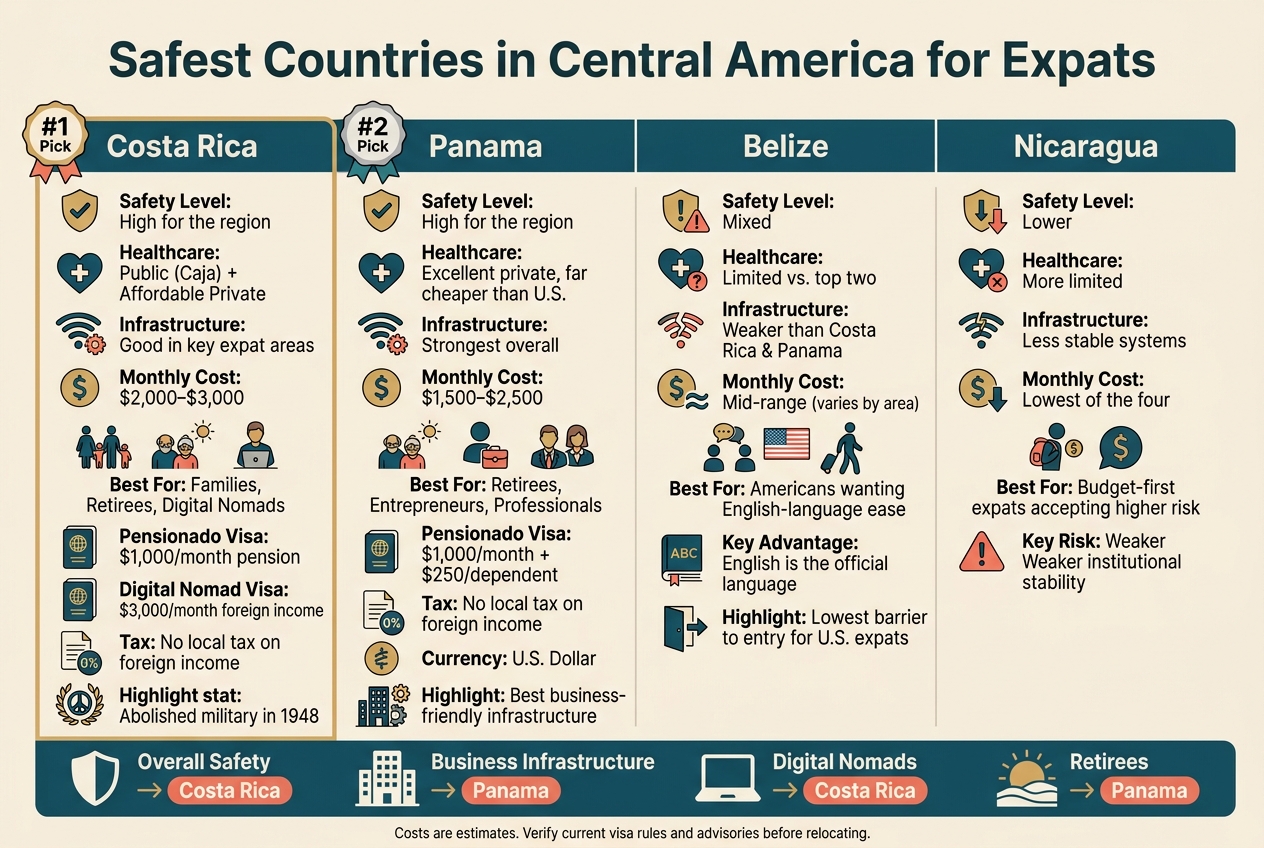
Quick Comparison
| Country | Safety Feel | Healthcare | Infrastructure | Cost per Month | Best For |
|---|---|---|---|---|---|
| Costa Rica | High for the region | Public + private | Good in key expat areas | $2,000–$3,000 | Families, retirees, nomads |
| Panama | High for the region | Strong private care | Strongest overall | $1,500–$2,500 | Retirees, entrepreneurs |
| Belize | Mixed | Limited vs. top two | Weaker than top two | Mid-range, varies by area | Americans who want English use |
| Nicaragua | Lower | More limited | Less stable systems | Lower-cost option | Budget-first expats |
The main point: if safety is your top concern, I’d start with Costa Rica and Panama, then compare specific neighborhoods, not just countries. That’s where the gap in risk, cost, and comfort often shows up the most.
sbb-itb-39d39a6
1. Costa Rica
Safety and Political Stability
Costa Rica is one of Central America’s safest mainstream expat destinations, with a long record of democratic stability. For expats who care about safety, political calm, and a daily routine that feels predictable, it usually sits near the top of the list.
A big part of that appeal comes from its history. Costa Rica abolished its military in 1948, and that choice still shapes how people see the country today. Neutrality and stable public institutions are a major draw.
Healthcare and Infrastructure
Costa Rica has a dual healthcare system. There’s the universal public system, called the Caja, and there’s private care, which is often affordable and usually comes with shorter wait times.
Day-to-day life is also easier here than in many nearby countries. Reliable internet, international schools, and decent urban infrastructure help support families, retirees, and remote workers.
Expat Fit and Trade-offs
Costa Rica is a strong match for retirees, digital nomads, and families. The Pensionado visa calls for at least $1,000 per month from a lifetime pension. The Digital Nomad Visa requires $3,000 per month in foreign income and can be processed in as little as 15 days.
There’s also a tax angle that many expats like: Costa Rica uses a territorial tax system, so foreign-sourced income isn’t taxed locally.
The downside is cost. A comfortable expat lifestyle usually lands around $2,000 to $3,000 per month. That’s not cheap for the region, but many people see the higher price as the cost of getting more stability, solid healthcare access, and a better-developed expat network.
| Visa Type | Min. Monthly Income | Duration | Tax Status |
|---|---|---|---|
| Digital Nomad Visa | $3,000 (foreign sources) | 1 year, extendable to 2 | No local tax on foreign income |
| Pensionado (Retiree) | $1,000 (lifetime pension) | Residency pathway | No tax on foreign income |
For expats who want similar stability but with a more urban, business-friendly setup, Panama is the next comparison.
2. Panama
Crime and Advisories
Panama ranks high for expat safety for a pretty simple reason: it pairs stable institutions with strong infrastructure and dependable private healthcare. That mix gives many newcomers peace of mind.
Compared with Costa Rica, Panama leans more toward an established business and retirement setup, with a lifestyle that feels more urban and convenience-driven. In practice, its safety profile comes less from being cheap and more from day-to-day stability and service quality.
Political Stability
Panama has built a reputation as an expat-friendly country, and that makes the move easier for newcomers. Clear residency pathways and well-established public institutions help smooth out the setup process.
Healthcare and Infrastructure
Private healthcare in Panama is excellent and costs far less than private care in the U.S.. For many expats, that’s a big deal.
The country also stands out for its modern infrastructure. Good roads, dependable services, and easier daily logistics make Panama a strong pick for retirees and remote workers who want a secure home base without a lot of friction.
Expat Fit and Trade-offs
Panama is a strong match for retirees, digital nomads, and entrepreneurs. The Pensionado visa requires a minimum monthly pension of $1,000, plus $250 for each dependent, and it comes with discounts on healthcare, travel, dining, and utilities. A comfortable lifestyle usually runs $1,500 to $2,500 per month.
| Factor | Panama |
|---|---|
| Pensionado Visa Requirement | $1,000/month pension + $250/dependent |
| Monthly Cost of Living | $1,500–$2,500 |
| Foreign Income Tax | Not taxed locally |
| Healthcare | Excellent private options, far cheaper than U.S. private care |
The trade-off is pretty clear. Panama fits expats who want predictability and convenience, not the lowest possible monthly budget. Most top-tier services are centered in Panama City, so if you’re picturing a rural town or laid-back coastal life, you’ll likely notice the infrastructure drops off much faster outside the main urban areas.
For expats who want a different mix of safety, language, and cost, Belize is the next comparison.
3. Belize
Belize has a different safety profile for expats. Day-to-day life is often simpler, and the fact that English is the main language removes a lot of friction. At the same time, the country doesn’t have the same depth of infrastructure or healthcare as Costa Rica or Panama.
That trade-off matters. Belize can be a good fit for expats who care more about a slower pace and simple living than city convenience. But if you want deeper hospital networks, more services, and smoother systems, Costa Rica or Panama may feel like a safer bet in practical terms.
So Belize sits in the middle. It offers an English-speaking lifestyle that’s easier to settle into, but expats need to weigh that against weaker infrastructure and a smaller healthcare base. From here, the article moves to Nicaragua, where safety and stability become a bigger concern.
4. Nicaragua
Expat Fit and Trade-offs
Nicaragua sits behind Costa Rica, Panama, and Belize for expats who put stability and day-to-day security near the top of the list. The country ranks poorly on institutional stability. That makes it a weaker choice for retirees, families, and remote workers looking for digital nomad opportunities in Latin America who want predictable conditions.
The next section weighs these trade-offs country by country.
Pros and Cons by Country
Each country in this guide has a different safety picture. So the best choice comes down to what matters most to you: healthcare, cost, political calm, or day-to-day lifestyle. The table below gives you a quick side-by-side look at the main trade-offs.
| Country | Key Pros | Key Cons | Best Matched Expat Profile |
|---|---|---|---|
| Costa Rica | Peaceful environment; universal healthcare; affordable private options; welcoming to solo women travelers | Higher cost of living ($2,000–$3,000/month); all residents pay into the universal healthcare system | Eco-conscious retirees and families |
| Panama | Modern infrastructure; U.S. dollar currency; excellent, affordable private healthcare; residency-based discounts on medical services; no tax on foreign income | Strict banking compliance (KYC checks); more urban and business-oriented feel | U.S. retirees, entrepreneurs, and cost-conscious professionals |
| Belize | English-speaking and easy to settle into; lower barrier to entry for newcomers | Weaker healthcare and infrastructure than Costa Rica or Panama | Expats prioritizing language ease and a slower pace over services |
| Nicaragua | Lower-cost option than the other three | Weaker institutional stability and higher safety concerns than the other three | Budget-driven expats willing to accept higher risk |
A simple way to think about it: Costa Rica leans toward peace of mind and healthcare, but you’ll pay more for it. Panama gives you modern systems, strong private care, and tax perks, though it can feel more business-focused. Belize is easier for many Americans to adjust to because English is the main language, but services aren’t as strong. Nicaragua may appeal on price, yet that lower cost comes with more risk.
For most expats, the safest pick has less to do with one country being “best” across the board and more to do with what you’re willing to trade for stability, lower costs, or an easier landing.
Conclusion
No country is the right pick for every expat. The best place for you depends on your priorities, not just what you want to get away from.
Use the table below to match each country with what matters most to you.
| Priority | Best Country | Why |
|---|---|---|
| Overall Safety | Costa Rica | Longest track record of political stability |
| Business-Friendly Infrastructure | Panama | Best for business-friendly infrastructure and stable services |
| Digital Nomads | Costa Rica | visas for digital nomads and foreign-income tax advantages |
| Retirees | Panama | Retirement-friendly residency and strong private healthcare |
Belize is the easiest language match for Americans. Nicaragua comes with lower costs, but also weaker security and stability.
After you have a shortlist, go one step deeper and compare neighborhoods, not just countries. That part matters more than many people expect. Safety and cost can shift a lot from one area to another, even within the same country. Before you make any move, check the U.S. State Department’s current travel advisories for the exact region you’re considering.
U.S. citizens are taxed on worldwide income no matter where they live, so working with a CPA who knows cross-border tax law is a practical step, not an optional one.
The right fit comes down to how each country stacks up on crime, stability, healthcare, infrastructure, and residency rules for your situation. Visit the places on your shortlist in person before you commit, then confirm local safety and visa rules for the exact neighborhood you plan to use.
FAQs
Which areas are safest within Costa Rica and Panama?
The sources don’t clearly rank specific neighborhoods or regions in Costa Rica or Panama by safety.
In Panama, Panama City, Boquete, and Coronado stand out as established expat hubs. English is widely spoken in these areas, and they offer modern amenities, which can make day-to-day life easier.
For Costa Rica, the sources lean more toward infrastructure than neighborhood-by-neighborhood safety. Urban areas tend to have better connectivity, while rural areas may come with less reliable internet.
At a broader level, both countries are described as stable options for expats, with quality healthcare and strong community support.
How much savings should I have before moving?
It comes down to how you live and what things cost where you’re going.
In many Central American expat spots, $1,500–$2,500 per month is enough for a comfortable lifestyle. If you want more room in the budget for a higher-end setup or frequent travel, $3,000–$4,000 per month is often a better fit.
Before you move, map out your monthly expenses and check any residency-related money rules. That can include required bank deposits or passive income minimums. It’s smart to start planning at least three months in advance.
What visa is easiest for U.S. retirees or remote workers?
For U.S. retirees and remote workers, Costa Rica and Panama are often the easiest places to look at first. Both have clear programs made for people who want to live abroad without getting buried in red tape.
Costa Rica offers a digital nomad visa with a simple in-country application process. In many cases, it can be finished in as little as 15 days.
Panama is well known for its flexible Friendly Nations Visa. And for retirees, its pensioner visa can start at $1,000 per month.
