
The short answer: in 2026, the worst inflation cases are Venezuela, Sudan, Iran, South Sudan, Argentina, Türkiye, Nigeria, Zimbabwe, Egypt, and Sierra Leone.
If I were scanning this list for the main takeaway, it would be this:
- Venezuela is the clear outlier, at about 617% year over year
- Iran, South Sudan, Zimbabwe, and Sierra Leone are also under heavy price pressure
- Argentina, Türkiye, and Nigeria are lower than the worst cases, but still high enough to hurt savings and day-to-day costs
- In many of these countries, the main problem is not just inflation itself, but currency loss, import costs, and weak local conditions
Put simply: if you earn, save, or invest in a country on this list, cash can lose buying power fast. And if your income is fixed in local currency, the squeeze can get worse month by month.
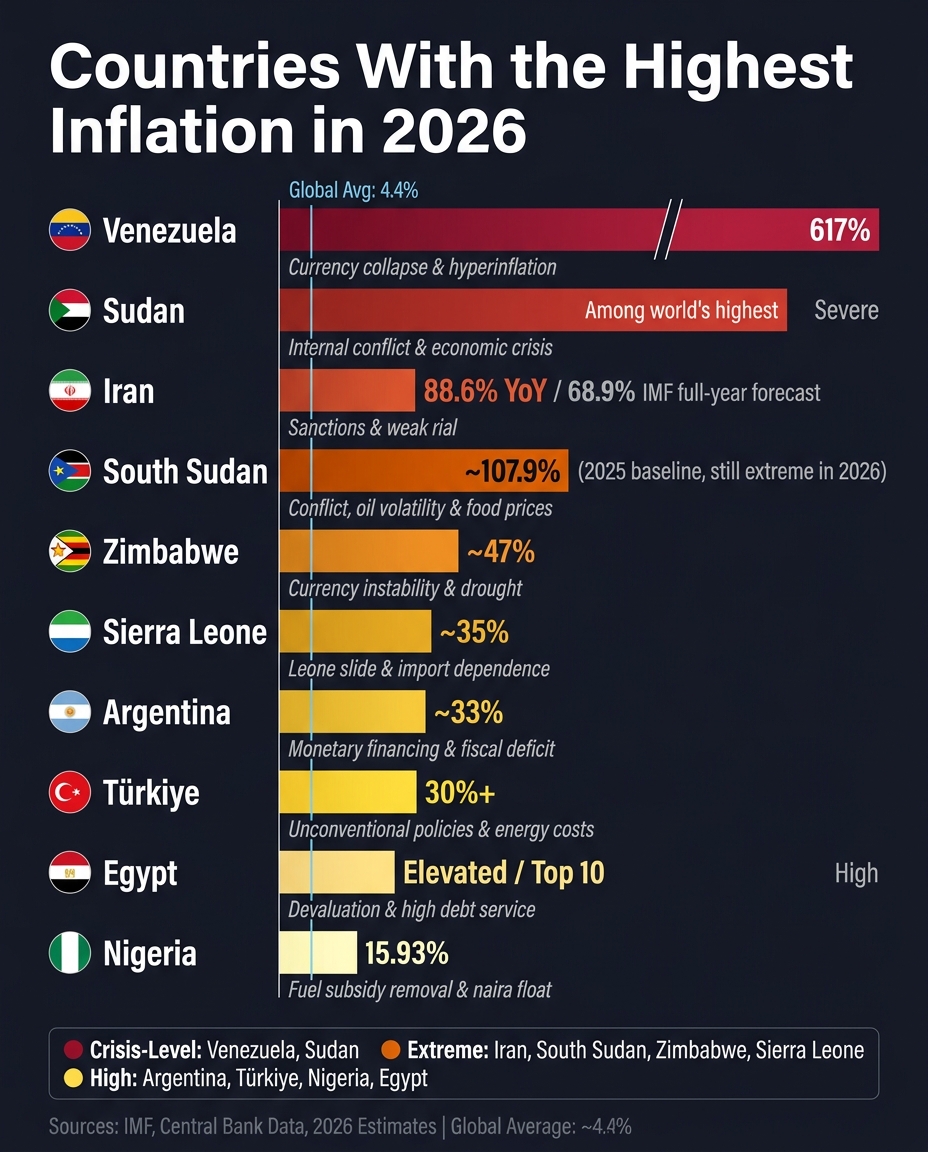
Quick Comparison
| Country | 2026 inflation picture | Main driver |
|---|---|---|
| Venezuela | ~617% | Currency collapse |
| Sudan | Among the world’s highest | Instability and money printing |
| Iran | 88.6% YoY in June; 68.9% full-year IMF forecast | Sanctions, conflict, weak rial |
| South Sudan | Still very high after 107.9% in 2025 | Conflict, oil disruption, FX shortage |
| Argentina | ~33% in February 2026 | Fiscal strain and peso pressure |
| Türkiye | 30%+ | Food, energy, rent |
| Nigeria | 15.93% in May 2026 | Fuel, transport, food, naira pressure |
| Zimbabwe | ~47% | Currency weakness, shortages |
| Egypt | High enough for a top-10 spot | Import and energy shock |
| Sierra Leone | ~35% | Weak leone, import dependence |
Bottom line: I’d treat this ranking as a list of places where holding local currency is risky, budgeting is harder, and business costs can shift fast.
sbb-itb-39d39a6
1. Venezuela
As of February 2026, Venezuela’s inflation rate is about 617% year over year, which is far above the 2026 global forecast of roughly 4.4%. That gap points to severe monetary instability. In plain English, it makes day-to-day budgeting, saving, and business pricing wildly unstable.
The bolívar keeps losing value fast. Prices for basic goods can double or triple in a short stretch. If you’re holding cash locally, inflation can eat through it at a brutal pace.
For expats and investors, keeping savings in bolívars is a losing bet. The practical move is to hold assets priced in U.S. dollars or euros when possible. Gold can also help preserve purchasing power.
If you’re budgeting in Venezuela, expect a steep import-price premium and lean toward local goods when you can.
Venezuela sits at the extreme end of the 2026 inflation rankings. Next is Sudan, where price pressure is still severe.
2. Sudan
Sudan ranks second in the world for inflation in 2026. That’s far above Africa’s projected 10.3% average. For expats, investors, and entrepreneurs, the effect is hard to ignore: money loses value fast, and local prices can change without much warning.
On the ground, the damage runs deeper than the ranking suggests. Political instability, weak institutions, and blocked market access have pushed the government toward printing more money, which has sped up currency devaluation. As a result, imported basics like food, medicine, and energy now cost households much more.
That pressure hits expats too. Housing in safer areas can come at a steep price, and private healthcare may cost even more. It’s the kind of setup where budgeting can feel like aiming at a moving target.
There’s also the legal and business side to deal with. Weak property rights, contracts that may not be enforced, and international isolation make long-term commitments highly risky. Next is Iran, where inflation stays high for different but equally damaging reasons.
3. Iran
Iran ranks third, with year-on-year inflation at 88.6% in June 2026, and the IMF projects 68.9% for the full year. It’s one of the clearest cases of how sanctions and a weak currency can turn inflation into a day-to-day survival problem.
Sanctions, conflict, and a falling rial are driving the spike. Military strikes in early 2026 sent the rial down hard, moving from 1,350,000 per $1 at the start of the year to a record 1,900,000 per $1 by mid-2026. Once a currency drops that fast, prices don’t just inch up. Import costs climb, local production gets more expensive, and households feel it almost right away.
Food prices show just how bad things have gotten. Meat and poultry prices rose about 178% year over year, while bread and cereals jumped 139%. The official minimum monthly wage is 166,255,000 rials, but a basic household living basket is estimated at 450,000,000 rials. In plain terms, minimum-wage workers can cover only about 37% of basic living costs. That gap is the main danger for expats and operators on the ground.
For expats and investors, the biggest risk is currency collapse. Keep income and savings in USD or EUR and limit rial exposure as much as possible. The IMF also expects Iran’s real GDP to shrink by 6.1% in 2026.
Next is South Sudan, where inflation remains extreme but comes from a different mix of currency stress and food shortages.
4. South Sudan
South Sudan is one of the highest-inflation countries going into 2026. It posted 107.9% inflation in 2025, and 2026 still points to heavy price pressure. The main causes haven’t changed: conflict and oil-output disruptions.
The inflation story here is pretty direct. Conflict and oil disruptions keep squeezing foreign exchange. And because South Sudan imports most basic goods in hard currency, weaker oil revenue quickly feeds into higher prices for food, fuel, and medicine.
The SSP traded above 1,300 per $1 in early 2026. At the same time, parallel-market rates were running 20% to 50% higher than official rates, and the currency was flagged as high risk for more downside.
For businesses and investors, the biggest problem is repatriation risk. In a downturn, restrictions can make it hard to move profits out of the country. One practical way to cut that risk is to invoice in USD or EUR and shorten payment terms to 15 to 30 days.
For expats, the day-to-day math can get rough fast. Private healthcare, international schooling, and imported goods often push actual living costs well above the headline inflation rate.
Next is Argentina, where inflation stays high for a different reason: a mix of fiscal strain and currency pressure.
5. Argentina
Argentina is no longer at peak-crisis inflation levels, but the squeeze hasn’t gone away. Inflation fell to about 33% in February 2026. That’s lower than before, but it’s still high enough to eat into household budgets and chip away at savings.
For investors, the takeaway is pretty simple: don’t park long-term savings in pesos. Peso balances lose real value over time. Dollar-linked assets and hard assets like gold can help cut peso risk.
Expats and fixed-income earners feel this in different ways. People who depend on imported goods, short-term rentals, or restaurants with menus that are repriced all the time tend to feel more pain than those who stick with local staples. For pensioners and other fixed-income earners, that loss of buying power is the main danger.
Next is Türkiye, where inflation is still high, but for different reasons.
6. Türkiye
Türkiye ranks high on the list because inflation is still far above both OECD and global norms. In 2026, inflation remains above 30%, even though the Central Bank of the Republic of Türkiye (CBRT) set an interim target of 16% for the year. The main drivers are energy, food, and rent. Food prices are hitting especially hard. Türkiye has led the OECD in food price increases, with rates that previously ran at six times the OECD average. Energy costs have also faced pressure from regional conflict and higher oil prices. On top of that, drought and climate stress are keeping food prices under strain.
For expats, this pressure tends to show up in a few clear places:
- Imported goods still cost far more than local options.
- Long-term rent increases are partly capped, but short-term and tourist-market rents are climbing much faster.
- Expats who rely on imports or short-term rentals tend to feel inflation more, while those who buy local and lock in longer leases usually feel less of the hit.
The business climate also comes with real capital risk. Corporate defaults are rising as inflation puts pressure on balance sheets. In August 2025, Erşan Et, a major Turkish meat producer, filed for bankruptcy, and a court granted a three-month provisional stay of proceedings because of severe financial difficulties. That case shows how long periods of high inflation can push thin-margin firms into distress. For operators and mobile individuals, that can mean tighter credit, more default risk, and weaker counterparties.
USD or EUR earners get some early relief from lira weakness. But that edge can shrink fast if prices in popular expat cities climb faster than the currency moves. For longer stays, it makes sense to avoid holding large cash balances in lira. Hard currency or inflation-linked assets are a safer way to handle longer-term exposure.
Nigeria follows, where currency weakness and food costs keep inflation high.
7. Nigeria
Nigeria’s headline inflation hit 15.93% in May 2026, up from 15.69% in April and 15.38% in March. That makes three straight monthly increases. It also marks a clear turn from the cooling trend seen through 2025, when inflation had fallen from a peak above 26%.
Even so, 15.93% is still high by any normal standard. It continues to eat into household buying power and keeps Nigeria firmly in the high-inflation group, even if it remains below the worst cases covered earlier.
The biggest pressure point is energy. Nigeria still relies on imported refined fuel, so when crude prices move up, transport costs move with them. Food prices then follow, and food plus transport make up roughly 70% of Nigeria’s inflationary pressure. Average fuel prices rose to about ₦1,250 per liter in early 2026, up from roughly ₦800–₦900 before.
There’s also the currency issue. The naira is projected to stabilize around N1,400 to the U.S. dollar in 2026, but that doesn’t remove the risk. When global shocks hit, exchange-rate weakness can still push costs higher in a hurry. That’s why many businesses now price in U.S. dollars or link local prices to the dollar to protect margins.
The picture also changes a lot by location. Bayelsa posted the highest state-level inflation at 27.37%, while Osun posted the lowest at 5.25%. That’s a huge spread. Rural inflation also came in above urban inflation, at 17.22% versus 14.64%. In plain English: where you live, shop, or run a business in Nigeria can change your cost burden by a lot.
Next is Zimbabwe, where inflation pressure is shaped by currency weakness and shortages.
8. Zimbabwe
Zimbabwe’s inflation is about 47% in 2026, which puts it 8th globally that year. That’s still far above normal and more than enough to eat away at purchasing power fast. For expats and investors, the result is simple: cash loses value sooner, and everyday expenses can climb in a hurry.
The main issue is currency instability. In 2024, Zimbabwe rolled out the Zimbabwe Gold (ZiG), a new currency backed by precious metals, as part of an effort to steady the economy. In February 2026, the official exchange rate was about 26 to 28 ZiG per $1, while parallel-market rates were 20% to 50% weaker. On top of that, low reserves reduce the central bank’s ability to support the ZiG.
That creates problems for pricing, saving, and moving money. If you’re running a business locally, it can feel like trying to hit a moving target. Costs shift, exchange rates split between official and street markets, and planning gets messy fast.
For expats and investors, the biggest risk is currency loss and repatriation friction, especially when cash is held in ZiG or profits need to be converted inside the country.
Next: Egypt.
9. Egypt
Egypt ranks 9th among the countries with the highest inflation in 2026.
Egypt’s inflation story is driven more by imports than by local demand. In 2026, the main pressure comes from higher energy costs and disrupted regional supply chains, both of which push import prices up fast. The 2026 conflict involving the U.S., Israel, and Iran has put heavy pressure on energy markets, and Egypt, as an import-dependent economy, is seeing those shocks flow through to consumer prices.
Energy is the clearest path for that pressure. When oil prices climb, transport gets more expensive. Manufacturing costs climb too. Then those higher costs show up at the checkout line.
For expats and investors, the bigger day-to-day issue is weakness in the Egyptian pound. A weaker currency makes imports more expensive and cuts dollar-based purchasing power. That’s why businesses may want to avoid large upfront commitments and keep capital deployment flexible.
Unlike Egypt’s import-driven pressure, Sierra Leone’s inflation is shaped more by local supply issues and currency stress.
10. Sierra Leone
Sierra Leone shows a pattern a lot like Egypt: a weak currency, heavy reliance on imports, and fast-rising prices. But in Sierra Leone, the strain is even harder because the leone has fallen so far.
In May 2026, Sierra Leone recorded 35% inflation, which put it sixth worldwide. The main reason is the leone’s continued slide. By February 2026, the exchange rate was about 20,969 leones per $1, making it one of Africa’s weakest currencies.
That matters fast in an import-heavy economy. When the leone drops, the cost of food, fuel, and other everyday goods and services tends to climb right behind it.
For expats, the pinch can feel even worse than the headline CPI suggests. Costs tied to housing and private healthcare often move up faster than CPI. On top of that, global private medical insurance costs are projected to increase by nearly 10% in 2026.
For investors and business owners, one of the biggest dangers is sitting on cash in leones. A business can post nominal gains and still lose ground in real terms after inflation. To reduce that hit, firms often price based on replacement cost and shorten payment cycles so money loses less value before it’s used. Repatriation risk is another issue. If rules make profit conversion and transfer harder, moving local earnings back into hard currency can become a serious problem.
That makes Sierra Leone a useful final comparison before the summary below.
How the Top 10 High-Inflation Countries Stack Up
Taken as a whole, the top 10 split into two clear camps: full-blown inflation crises and high inflation that’s harsh, but less severe. The biggest gap between these countries comes down to scale. In some places, inflation is being pushed by a collapsing currency. In others, the pressure comes more from imports, sanctions, or supply disruptions.
- Venezuela and Sudan: crisis-level inflation, driven by currency collapse and instability.
- Iran, South Sudan, Zimbabwe, and Sierra Leone: extreme inflation, with currency weakness and import dependence driving prices.
- Argentina, Türkiye, and Nigeria: still high, but clearly below the worst-hit cases.
- Egypt: elevated, but outside the top risk tier.
Iran and Nigeria show two very different inflation patterns. In Iran, sanctions push prices up across the economy. In Nigeria, the story is more about import-heavy structural pressure. Venezuela and Sudan belong in a separate class altogether, where currency collapse has made even basic budgeting close to impossible.
For expats, investors, and entrepreneurs, the core issue is simple: can local income, pricing, and cash savings keep pace with currency loss? That’s the point that matters most when weighing the trade-offs of living, saving, or doing business in a high-inflation market.
Pros and Cons of Operating in High-Inflation Countries
These markets can still work for the right operator. But there’s a catch: you need tight control over currency exposure and cash flow.
That’s the whole game.
Some high-inflation countries still appeal to people who earn in foreign currency. Others are so shaky that longer stays stop making sense fast. The table below shows where the upside may exist, and where the risk can bite.
| Country | Possible Upside | Main Downside | Best Suited For | Key Risk |
|---|---|---|---|---|
| Iran | Energy sector opportunities exist in theory | Geopolitical conflict and sanctions drive broad price instability across the economy | Specialized investors | High geopolitical risk |
| Argentina | Deep value for those using local pricing | Structural inflation and currency decoupling erode fixed incomes fast | USD or EUR earners; short-term operators | Rapid erosion of purchasing power on locally held cash |
| Türkiye | Strong expat infrastructure; high-end lifestyle for FX earners | Inflation above 30% in 2026; service costs rising sharply | USD or EUR earners; high-net-worth individuals | The lira can stabilize while local prices keep rising, which can erase the currency advantage |
| Nigeria | Large domestic market; fuel subsidy removal has begun reshaping local supply chains | High fuel import costs drive transport and food prices across the economy | Risk-tolerant investors | Supply chain friction tied directly to global oil price moves |
| Egypt | Large domestic market; government price controls on staples offer limited short-term buffer | Import-dependent economy means energy price shocks pass through to consumer prices fast | Short-term operators with hard-currency income | Capital deployment risk if the pound weakens further |
The pattern is pretty clear. The upside comes from earning in hard currency. The danger comes from sitting on local currency for too long.
That edge only lasts while the exchange rate works in your favor.
In high-inflation markets, short stays, foreign-currency income, and fast cash conversion help limit the hit.
Conclusion
The 2026 inflation leaders point to the same set of danger signals: weak currencies, heavy reliance on imports, and unstable policy. So the main issue isn’t just the headline inflation number. It’s the risk sitting underneath it.
For U.S.-based readers, the gap is still stark: OECD inflation is projected at 4.2% in 2026, versus 2.7% from the Federal Reserve. At 4.2%, purchasing power roughly halves in 17 years.
And inflation doesn’t act alone. High inflation gets much worse when it shows up alongside capital controls and weak rule of law. That mix can squeeze both households and investors from more than one side at once.
Before relocating or committing capital, weigh inflation against currency convertibility, political stability, and legal risk. That’s the right lens to use before holding cash or doing business abroad. At these inflation levels, even small month-to-month gaps can turn into major losses fast.
FAQs
Why is inflation so high in these countries?
The causes vary from one country to the next. In countries stuck with severe, chronic inflation, the main problem is often government policy failure. That can mean printing too much money, using price controls that distort markets, dealing with political instability, or failing to protect property rights. If a country also relies heavily on a single commodity export, inflation can get worse fast when that market turns.
On a broader level, recent inflation has also been pushed up by energy supply shocks linked to the conflict with Iran. Those shocks have driven up the cost of transport, electricity, and production around the world. Higher food prices have added more strain, and in some regions, trade tariffs have piled on extra pressure.
How does high inflation affect expats and investors?
High inflation eats away at purchasing power and adds more financial swings for both expats and investors.
For expats, it can push up the cost of housing, imported goods, and private health care. In some cases, that means cutting back, reworking a budget, or even moving to a new base. For investors, a weaker currency can wipe out some of the upside from geographic arbitrage. That’s why many turn to geographic diversification, multi-hub strategies, and more defensive asset allocations.
Which countries face the highest currency risk?
In 2026, the highest currency risk usually shows up in countries hit hard by global energy supply shocks, geopolitical conflict, and heavy reliance on imports.
Take Angola and South Africa. In both, persistent currency swings can make imported goods more expensive. That puts more pressure on households, businesses, and inflation.
Some Middle Eastern countries also face this kind of pressure. Regional conflict and energy supply disruptions can weaken local currencies and push prices higher.
