
If I want to pass family wealth with less tax in 2026, I’d do three things first: keep low-basis assets for a step-up at death, gift high-growth assets early, and use the right trust or entity based on control, family needs, and cross-border rules.
The big 2026 numbers are simple. The federal estate, gift, and GST exemption is $15,000,000 per person and $30,000,000 for married couples. The annual gift exclusion is $19,000 per person or $38,000 for married couples who split gifts. But that does not mean planning is easy. State estate tax, capital gains, trust income tax, and foreign ownership rules can still cost a lot.
Here’s the short version:
- Hold low-basis assets until death when a step-up in basis may wipe out built-in capital gains
- Gift high-growth assets sooner so future growth moves outside the taxable estate
- Use GRATs, SLATs, dynasty trusts, ILITs, or family LLCs based on how much control I want to keep
- Watch state estate tax rules, since some states tax estates far below the federal level
- Be extra careful with cross-border families, because non-resident aliens may face U.S. estate tax above just $60,000 of U.S.-situs assets
- Set up compliance before funding any offshore trust, entity, or account
- Review the plan every year after major family, business, or residency changes
One more point matters a lot: a plan that cuts estate tax can still create a capital gains problem later. That’s why the best move in 2026 is often not “give away more.” It’s give away the right assets, at the right time, in the right structure.
Know the 2026 tax rules before moving assets
Start with the tax rules that govern the transfer.
Federal estate, gift, and GST tax rules for 2026
The One Big Beautiful Bill Act locked in a $15,000,000 per-person federal exemption for estate, gift, and generation-skipping transfer (GST) taxes for 2026 and beyond. For married couples, portability can push that combined amount to $30,000,000.
There’s one catch: the GST exemption does not carry over between spouses. It has to be allocated on the estate tax return as part of the first spouse’s estate planning. That matters most when the plan is to pass wealth to grandchildren or later generations.
For 2026, the annual exclusion is:
- $19,000 per recipient
- $38,000 for married couples who split gifts
- $194,000 for gifts to a noncitizen spouse
Used year after year, those exclusions can shrink a taxable estate over time without touching the lifetime exemption.
Once you know the tax baseline, the next move is picking the transfer setup that fits the asset.
State taxes, basis rules, and why timing matters
State estate or inheritance taxes can kick in at much lower thresholds. That means where you live – and where the asset sits – can affect when and how you transfer it.
For many families, basis may matter more than the exemption in 2026. Here’s why. If you gift an asset during life, the recipient takes your original cost basis. If they later sell, they may owe capital gains tax on all of the appreciation. If that same asset passes at death, heirs usually get a step-up in basis to fair market value, which can wipe out the built-in gain.
In a high-exemption year, gifting low-basis assets can lead to capital gains tax that could have been avoided.
Gift high-growth assets now; hold low-basis legacy assets until death to preserve step-up in basis.
That timing issue points straight to the next question: should the asset go into a trust, an entity, or an outright gift?
Cross-border tax exposure for U.S. persons and foreign family members
U.S. citizens and domiciled residents owe estate tax on worldwide assets. Non-resident aliens (NRAs) play by a different set of rules: only U.S.-situs assets are taxed, and the exemption is just $60,000.
| Status | Exemption | Assets Taxed |
|---|---|---|
| U.S. Citizen / Domiciled Resident | $15,000,000 | Worldwide assets |
| Non-Resident Alien (NRA) | $60,000 | U.S.-situs assets only |
U.S.-situs assets include U.S. real estate, tangible property located in the U.S., and stock in U.S. corporations – even if the shares are held through a foreign brokerage.
Things get more tangled in mixed-residency families. The unlimited marital deduction does not apply when the surviving spouse is not a U.S. citizen. In that case, a Qualified Domestic Trust (QDOT) is needed to defer estate tax.
And if someone is thinking about giving up U.S. citizenship, there’s another layer. The exit tax under IRC 877A can treat worldwide assets as sold the day before expatriation, with a $910,000 exclusion for 2026.
Those rules often drive the choice between an offshore trust, a foreign holding company, and a domestic setup.
With residency and situs rules mapped out, the next step is choosing the structure that protects the asset without giving up control.
sbb-itb-39d39a6
Choose the right transfer structures for your assets and family goals
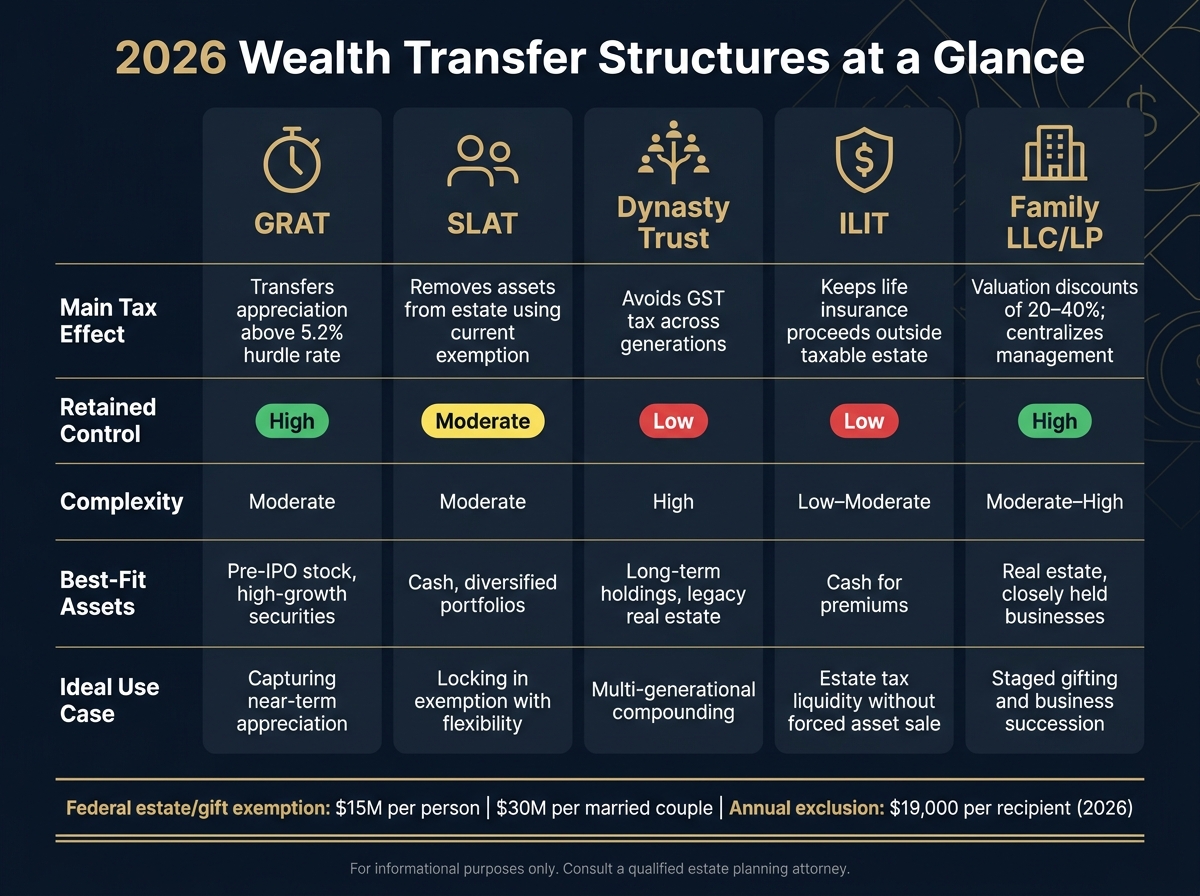
Once the tax rules are clear, the next step is picking a structure that moves future growth with as little loss of control as possible.
Trusts that move future appreciation outside the estate
Irrevocable trusts can lock in today’s value and push future growth outside the estate. That can work well for high-basis or fast-growing assets you want out of the estate. The basic idea is simple: move the appreciation before it keeps piling up inside a taxable estate. By contrast, low-basis assets are often better held until death so heirs can get a step-up in basis.
A Grantor Retained Annuity Trust (GRAT) pays the grantor a fixed annuity for a set term, and any growth above that amount goes to heirs. In 2026, the Section 7520 hurdle rate is 5.2%. If the asset grows faster than that rate, the excess can pass to heirs gift-tax free, as long as the grantor survives the term. Short 2- to 3-year GRATs often work well for volatile assets like pre-IPO stock because they can lock in upside fast. If the goal is more access or a longer time frame, SLATs and dynasty trusts may be a better fit.
A Spousal Lifetime Access Trust (SLAT) lets one spouse fund the trust for the other spouse. That can remove assets from the combined estate while still keeping indirect access through the beneficiary spouse. But mirror SLATs need different trustees, terms, and funding dates. If they look too similar, the reciprocal trust doctrine can become a problem.
For families planning far into the future, a dynasty trust can use the $15,000,000 GST exemption to avoid transfer tax at each generational handoff. Florida allows these trusts to last as long as 1,000 years. The tradeoff is clear: the grantor gives up access entirely. In return, the trust can serve as a long-term, tax-sheltered vehicle for grandchildren and great-grandchildren.
One catch matters a lot here: non-grantor trusts can create serious income-tax drag. They hit the top 37% bracket at just $16,000 of taxable income, while individuals do not hit that same bracket until $640,600. That gap is huge. So trust design – grantor or non-grantor status, distribution rules, and asset choice – matters just as much as the trust label itself.
Family LLCs, LPs, and investment companies for control and succession
If control matters more than an immediate transfer, an entity may make more sense than a trust.
Family LLCs and limited partnerships let a family keep management in one place while shifting economic value to heirs. In most cases, the senior family member keeps the general partner or manager role and stays in charge of operations. Heirs receive limited partnership or membership interests, which means economic rights without voting power.
That split between control and economics can also support valuation discounts. Minority interests in a family LLC may support discounts of 20% to 40% for lack of control and marketability, depending on the appraisal. But this is not something to do casually. Those discounts need rigorous, contemporaneous appraisals if they’re going to hold up under IRS review.
For operating businesses, family entities can also make succession easier. Founders can gift economic interests over time by using annual exclusions, or they can phase in the next generation without triggering a taxable sale.
Use the structure that lines up with the asset’s growth rate, liquidity, and control needs.
Comparison table: trusts vs. GRATs vs. family entities
| Structure | Main Tax Effect | Retained Control | Complexity | Best-Fit Assets | Ideal Use Case |
|---|---|---|---|---|---|
| GRAT | Transfers appreciation above a hurdle rate | High (grantor receives annuity payments) | Moderate | Pre-IPO stock, high-growth securities | Capturing a near-term appreciation event |
| SLAT | Removes assets from estate; uses current exemption | Moderate (indirect access via spouse) | Moderate | Cash, diversified portfolios | Locking in current exemption while retaining some flexibility |
| Dynasty Trust | Avoids GST tax across multiple generations | Low (irrevocable; no grantor access) | High | Long-term family holdings, legacy real estate | Multi-generational compounding without transfer tax at each handoff |
| ILIT | Keeps life insurance proceeds outside the taxable estate | Low (irrevocable) | Low to moderate | Cash for premiums | Providing liquidity to pay estate taxes without forcing a sale of illiquid assets |
| Family LLC/LP | Valuation discounts; centralizes management | High (GP or manager role) | Moderate to high | Real estate, closely held businesses, brokerage accounts | Staged gifting and business succession with retained control |
Once the structure is chosen, jurisdiction and reporting rules determine how well it works across borders.
Add international layers for asset protection, insurance, and jurisdiction planning
Offshore trusts, holding companies, and reporting requirements
When assets, heirs, and liabilities span more than one country, jurisdiction stops being a side issue. It becomes part of the plan itself.
Offshore asset protection trusts in places with strong firewall statutes can help shield trust assets from foreign forced heirship rules and creditor claims that begin in the settlor’s home country. For families with high liability exposure, that extra layer can matter a lot. A domestic-only setup may not give the same legal separation.
Non-U.S. family members who own U.S.-situs assets face a steep estate-tax problem: a 40% federal estate tax on U.S.-situs assets above $60,000. That’s a small threshold and a big hit. A foreign holding company or an Irish UCITS ETF can shift ownership away from direct U.S.-situs exposure.
In 2026, compliance is not optional. Offshore structures need to line up with FBAR (FinCEN 114), FATCA reporting, and Form 3520. The penalties are severe. A willful FBAR violation can cost the greater of $165,353 or 50% of the account balance, and failing to report foreign trust distributions or transfers on Form 3520 can trigger a penalty of 35% of the gross value of the property.
There’s another layer now: automatic exchange rules cover crypto and e-money too. And these structures can’t exist only on paper. They need real local substance, such as:
- Local offices
- Separate bank accounts
- Independent directors
Without that, they can be treated as shell entities under current international rules.
Life insurance and PPLI for tax-efficient liquidity
If a future tax bill would force a sale, insurance can step in with liquidity at the right time.
Life insurance is one of the most overlooked tools in generational planning, especially when an estate holds illiquid assets. Think family businesses, real estate, or private investments. You may have plenty of wealth on paper, but not enough cash when taxes come due.
For cross-border planning, U.S. life insurance proceeds are generally not treated as U.S.-situs assets, which can make them efficient for wealth transfer. For families who move between countries or hold assets across borders, that point can make a big difference.
Private Placement Life Insurance (PPLI) goes a step further. It places an investment portfolio inside an insurance structure, which can provide tax-deferred growth and estate liquidity. Cayman, Bermuda, and Luxembourg are common jurisdictions for PPLI structures used by globally mobile high-net-worth families.
Once the structure and jurisdiction are set, the next move is to fund it the right way and review it every year.
Build a step-by-step 2026 plan and review it regularly
A practical order of steps for implementation
Once you’ve picked the right structure, the next job is to turn it into a funded plan. Start with a full audit of every asset, entity, residency, citizenship, and banking relationship. Then map the tax situs for each asset.
After that, measure the tax exposure and spot any funding gap. Run the numbers on that gap before moving money or assets.
A practical sequence looks like this:
- Start with domestic tools such as trusts, GRATs, SLATs, and family LLCs
- Add offshore layers only if they fix a clear cross-border issue
- Use insurance last, mainly to add liquidity
From there, form the entities, transfer the assets, and set up a compliance calendar for required filings before funding assets.
Governance, documentation, and annual reviews
Update the plan after births, deaths, marriages, business sales, and residency changes. For families spread across more than one country, it’s smart to have one lead advisor coordinate the CPA, estate counsel, and international counsel through quarterly reviews.
Paperwork matters here. Document trust funding, operating agreements, trustee decisions, and entity substance. If you use offshore entities, economic substance rules have to be met in a real way, not just on paper.
Conclusion: Keep more family wealth by matching structure, tax rules, and jurisdiction
Match the structure to the tax rule and the jurisdiction, then review the plan every year.
FAQs
Which assets should I gift now vs. keep until death?
It comes down to a tradeoff: estate tax savings now versus a step-up in basis at death.
When you keep assets until death, those assets usually get a basis reset to fair market value. For heirs, that can wipe out built-in capital gains. That matters a lot. If you give away low-basis assets during your lifetime, the person who gets them may also get that built-in tax bill later.
That’s why lifetime gifts often fit better with:
- Cash
- High-basis securities
- High-growth assets
With high-growth assets, the upside is pretty clear: future appreciation moves out of your taxable estate.
Do I need a trust, an LLC, or both?
It depends on what you want most: control, liability protection, or tax treatment.
A trust can help you decide how and when heirs receive wealth. It can also help with asset protection in some cases.
An LLC can offer liability protection. And, if it’s set up and run the right way, it may also support valuation discounts.
In many families, the best setup is to use both. The LLC holds the assets, and the trust owns the LLC interests. That structure can make long-term wealth transfer easier and more tax-efficient.
Tax treatment can change based on where you live and where the assets are located, so specialized advice matters.
What changes if my spouse or heirs live outside the U.S.?
If your spouse or heirs live outside the United States, estate planning gets more complicated.
For starters, a non-citizen spouse doesn’t qualify for the unlimited marital deduction. That means part of the estate could face a 40% estate tax unless you use a QDOT. Lifetime gifts to a non-citizen spouse can still be tax-free, but only up to $194,000 per year in 2026.
There can be other issues too. You may run into forced heirship rules, double taxation, conflicting inheritance laws, and extra reporting. And here’s where things can get messy: some countries don’t recognize trusts at all. When that happens, tax deferral may be limited, and the compliance burden can grow fast.
