
If your money, property, or heirs sit in more than one country, one will is often not enough. I’d start with four things: map each asset to the country that controls it, line up wills and beneficiary forms, check whether a trust, foundation, or company should hold the asset, and review estate and inheritance tax before anything is transferred.
Here’s the short version:
- More than one country can control the same estate
- Local inheritance rules can override your wishes
- Foreign property often needs its own probate process
- Bad titling can trap assets in court or freeze access
- U.S. estate tax rules change a lot based on status
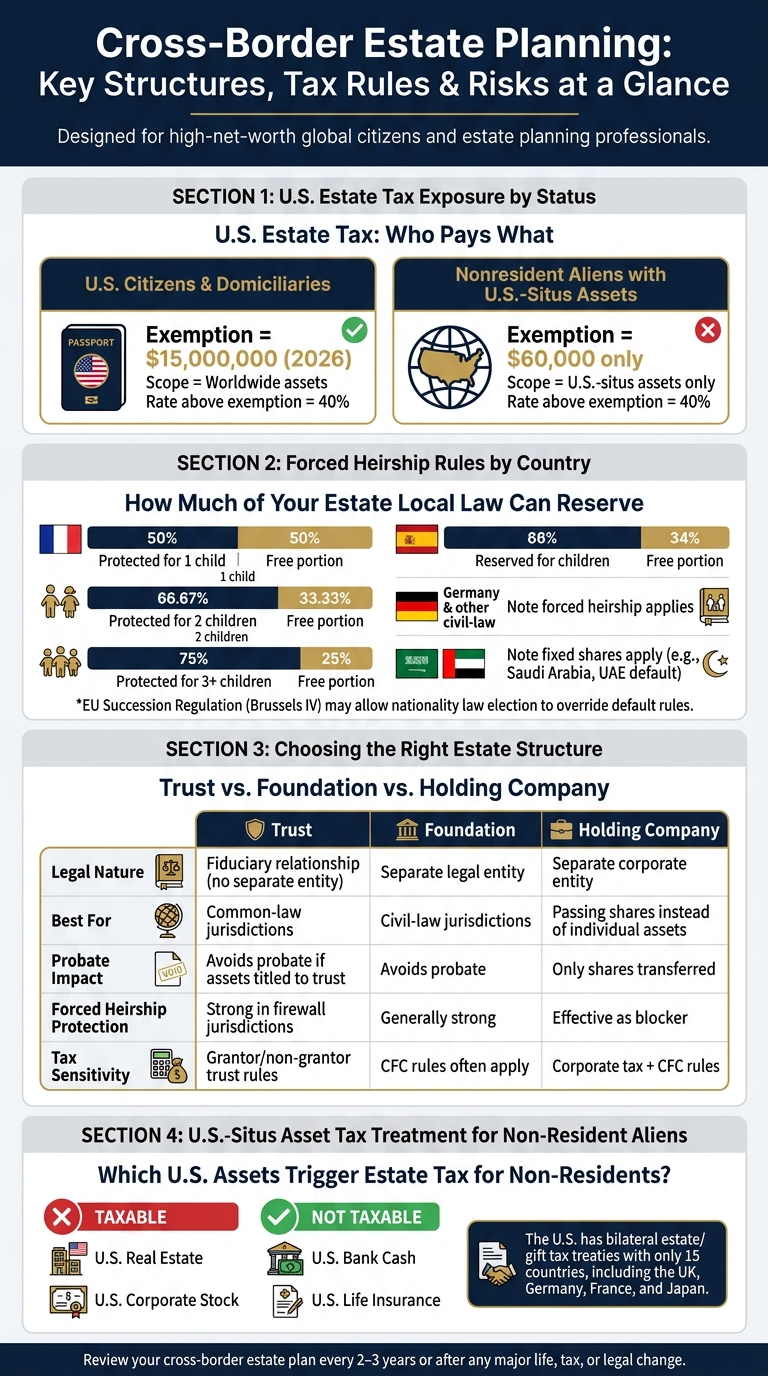
- U.S. citizens and domiciliaries: up to $15,000,000 exemption in 2026
- Nonresident aliens with U.S.-situs assets: only $60,000 exemption
- Accounts with named beneficiaries may bypass your will
- Trusts, foundations, and holding companies each solve a different problem
- Your family needs a ready-to-use file with documents, contacts, and account details
I’d treat cross-border estate planning as a coordination job, not just a document job. Who owns the asset, where it sits, which court has power, which tax rules apply, and who can act after death all need to point in the same direction.
For a quick view, here are the main moving parts:
| Area | What I’d check first | Main risk if missed |
|---|---|---|
| Jurisdiction | Citizenship, residence, domicile, asset location | Conflicting laws |
| Wills | One will vs. local wills | Accidental revocation or delay |
| Succession law | Forced heirship and local default rules | Wishes not followed |
| Ownership | Sole name, joint title, trust, company | Probate, freezes, extra filings |
| Tax | U.S. estate tax, local inheritance tax, treaties | Double tax or surprise tax bills |
| Administration | Apostilles, originals, local counsel, digital access | Family can’t act on time |
If I were planning this today, I’d keep the goal simple: make it easy for heirs to access, transfer, and report assets with as little court delay, tax drag, and document conflict as possible.
1. Identify cross-border risks before choosing any estate planning structure
Start by figuring out which country has power over each asset and which rules can overrule your wishes. The big variables are citizenship, domicile, residence, where the asset is located, and where your heirs live. More than one set of rules can apply at the same time. Once you sort out those links, you can match the estate plan to the countries that actually control the property.
Domicile, residence, citizenship, and asset location drive the legal outcome
These terms sound similar, but they do very different jobs.
Citizenship shapes U.S. estate-tax exposure. U.S. citizens and green card holders are taxed on worldwide assets, even if those assets sit outside the United States. The 2026 federal estate tax exemption is $15 million per individual under the One Big Beautiful Bill Act, but that shield applies only to U.S. citizens and domiciliaries. A nonresident alien with U.S.-situs assets gets only a $60,000 exemption, and anything above that can be taxed at a flat 40%.
Domicile means the country you treat as your permanent home, not just the place where you happen to live today. In the UK, starting April 6, 2025, the old domicile test was replaced by a long-term residence model. Anyone resident in the UK for 10 of the last 20 years faces UK inheritance tax on worldwide assets.
Asset location is often the hardest rule to get around. Real estate is usually governed by the law of the country where the property sits. A U.S. will by itself will not control a villa in Tuscany or a flat in Dubai. Bank and brokerage accounts may instead follow domicile or residence rules.
Forced heirship and local succession rules can override your intentions
A will does not always get the last word. In civil law countries such as France, Spain, and Germany, and in Sharia-based jurisdictions such as Saudi Arabia and the UAE by default, local law can reserve fixed shares of an estate for certain heirs.
Here’s where this gets very real: a U.S. citizen living in Portugal can use the EU Succession Regulation (Brussels IV) to clearly elect U.S. law in a will, which may allow more freedom than the default law of habitual residence. Without that election, the default rule is the law of habitual residence.
France is one of the strictest examples. 50% of the estate is protected for one child, 66.67% for two children, and 75% for three or more. Spain reserves 66% for children. If you ignore those rules, your written instructions may not control the result.
Misaligned documents and administrators slow down probate across borders
Even when the plan looks fine on paper, the documents may not work smoothly in another country. Wills and powers of attorney meant for use abroad often need apostilles or local legalization. For the 129 countries in the Hague Convention, an apostille is enough.
Ancillary probate, which is a separate probate case in another country, can cost 3% to 7% of the property value in legal and administrative fees alone. On a $500,000 foreign property, that can mean $15,000 to $35,000 in fees before any heir receives anything. That’s not a paperwork headache. That’s money gone.
A practical way to stay ahead of this is to keep three records up to date:
- An asset map listing each asset, its legal situs, and the local rules that apply
- A document inventory showing where original wills, deeds, and account agreements are stored
- A country-by-country summary of who has authority on death or incapacity
It also helps to name executors who live in the same jurisdiction as the assets. That can cut bank and court delays.
"One of the most valuable gifts a testator can provide to heirs is a coordinated testamentary plan in which instruments executed in several jurisdictions work together." – Allison E. Dolzani
That map should guide your choices for wills, beneficiary designations, and incapacity documents.
sbb-itb-39d39a6
2. Coordinate wills and succession documents across the right jurisdictions
Once you know which jurisdictions control your assets, the next step is making sure your documents work in each place. That point matters more than people think. The law of the jurisdiction drives the document plan.
The first call is simple on paper but tricky in practice: Should you use one coordinated will or separate local wills?
Single global will vs. multiple local wills: how to choose
One will that covers all assets can work if your assets sit in one jurisdiction, or if they are in countries with closely aligned common-law systems. But for high-net-worth families with foreign real estate or business interests, one will is often not enough.
Separate local wills are often the safer route when major assets are spread across more than one country. Why? Because they can let probate begin at the same time in each jurisdiction, which may cut delays that otherwise drag on for months or even years.
| Feature | One Will Covering All Assets | Separate Local Wills for Each Country |
|---|---|---|
| Scope | Covers all worldwide assets in one document | Each document is limited to assets in a specific country |
| Probate speed | Slow; foreign courts may require ancillary probate and translations | Faster; allows simultaneous probate proceedings in different jurisdictions |
| Recognized by local courts | May be rejected or overridden due to local formalities or language | High; drafted to meet specific local legal requirements |
| Risk of conflict | Lower risk of internal contradiction | Higher risk of accidental revocation if not carefully coordinated |
A single will can look neat. In practice, though, neat doesn’t always mean workable. If a foreign court wants local language, local witnesses, or a local probate process, that one document can hit a wall fast.
Drafting points that prevent revocation, delay, and asset confusion
The biggest technical problem with multiple wills is accidental revocation. In many jurisdictions, a new will cancels all earlier wills unless it says otherwise. So if you’re using separate local wills, each one should state clearly that it does not revoke wills tied to assets in other places. A common example is: "This will relates only to assets in [Jurisdiction] and does not revoke any prior wills relating to assets in other jurisdictions."
That one sentence can save a family from a mess.
Where local law allows it, an express choice-of-law clause can also help. Under EU Regulation 650/2012, a person may choose the law of their nationality to govern succession in most participating EU member states. That may let them avoid local forced heirship rules in some cases.
Beneficiary designations and incapacity documents must match the estate plan
A will can be perfectly drafted and still fail to control key assets. That’s because some assets pass outside the will.
Life insurance, retirement accounts, and payable-on-death accounts usually go to the named beneficiary on file. If those forms are old or they conflict with the estate plan, they can override the distribution you meant to create.
The same review should happen for business documents. Shareholder agreements and family charters need to line up with the estate plan so they don’t cause fights or transfer problems when business interests pass to the next owner.
Cross-border planning also needs incapacity documents, not just death documents. A power of attorney that works in one country may be useless in another because local banks or registries refuse foreign forms. The practical fix is often to sign a separate power of attorney in each country where you hold major assets. The same idea applies to healthcare directives.
That gap between death and the grant of probate is where things often freeze. Banks may lock accounts. Families can get stuck. Bills still show up, but no one has the authority to act. Coordinating beneficiary designations, local powers of attorney, and liquidity tools like irrevocable life insurance trusts can help bridge that gap before it turns into a cash-flow problem or an administrative standstill.
When documents by themselves can’t move wealth cleanly across borders, the next step is often to use a structure that holds the assets under one plan.
3. Use trusts, foundations, and holding entities to centralize control and simplify succession
When separate wills and beneficiary forms still leave assets exposed across borders, a legal structure can pull control into one succession plan. Trusts, foundations, and holding companies do different jobs. The best fit depends on where the assets are held and which legal system governs them.
When trusts work best for internationally spread families
In common-law systems, a revocable living trust can keep titled assets out of probate and pass control straight to a successor trustee. That can stop assets from getting stuck in several courts at the same time.
If a family wants tighter control over how heirs receive money, a discretionary trust gives the trustee room to decide when distributions happen. That timing can be tied to age, major life events, or financial need. Offshore trusts in places like Jersey or Nevis can also separate legal ownership from family control and lower forced-heirship risk.
One role that often gets overlooked is the trust protector. This is an independent party who oversees trustees and adds another layer of oversight. U.S. persons also need to pay close attention to Form 3520 and Form 3520-A reporting.
Where trusts often work in common-law systems, foundations tend to serve a similar purpose in civil-law jurisdictions.
Example: a U.S. family with heirs in Portugal and accounts in Switzerland can place those assets in one trust so the trustee distributes them under one plan instead of multiple local probate cases.
How foundations and companies can hold assets more cleanly across borders
In civil-law systems, a private foundation can stand in for a trust because it is a separate legal entity that can own and pass assets under one plan. A Liechtenstein Stiftung, for example, can hold family assets and transfer wealth to named beneficiaries without triggering probate in the countries where the underlying assets are located.
A holding company deals with a different issue. It places assets inside one company, so heirs inherit shares rather than each asset one by one. Holding companies in Switzerland, Luxembourg, or Singapore are often used for this because they can use broad double-tax treaty networks and offer a stable corporate framework.
For non-U.S. persons, a foreign blocker corporation can hold U.S.-situs assets so heirs inherit company shares instead of the assets directly. That can reduce U.S. estate-tax exposure.
Choose the structure by function, not by label
The table below compares the three main options based on the factors that matter most in cross-border planning.
| Feature | Trust (Common Law) | Foundation (Civil Law) | Holding Company |
|---|---|---|---|
| Legal nature | Fiduciary relationship; no separate entity | Separate legal entity | Separate corporate entity |
| Probate impact | Avoids probate if assets are titled to the trust | Avoids probate; ownership remains with the entity | Avoids probate; only shares are transferred |
| Control | Trustee/protector | Board of council/founder | Board of directors/shareholders |
| Forced heirship | Strong in firewall jurisdictions | Generally strong in civil-law systems | Effective when set up as a blocker |
| Tax sensitivity | High; grantor and non-grantor trust rules apply | High; CFC rules often apply | High; corporate tax and CFC rules apply |
What matters most here is function. A trust is usually about control and probate avoidance in common-law systems. A foundation can do similar work in civil-law countries. A holding company is often the cleaner choice when the main goal is to pass one block of shares instead of a mix of accounts, properties, or business interests.
The next step is matching the structure to asset titling, tax exposure, and administration before the transfer happens.
4. Align asset titling, tax exposure, and administration before wealth transfers occur
Cross-border estates often fall apart when asset title, tax treatment, and legal paperwork each point to a different country. That’s why asset titling is the next big stress test. It shows whether the plan will work in practice or stall when heirs try to use it.
How asset titling determines whether heirs face probate, freezes, or clean transfers
How an asset is titled often decides what happens at death. Sole-name assets usually go through probate. If the asset sits in another place, ancillary probate can add months of delay and major fees.
A UK expat with Dubai property needs local succession paperwork because the asset’s location can control the transfer. A DIFC (Dubai International Financial Centre) will can help ensure common-law principles govern the asset rather than default local succession rules.
Each asset needs to be checked against its current title, not just where the owner wants it to end up. That sounds obvious, but this is where plans drift off course. Property held in joint tenancy with right of survivorship may pass by survivorship and skip probate entirely. If an asset is supposed to sit inside an entity, retitle it now. Don’t just mention it in a will and hope that does the job.
Once title is lined up, the next step is tax.
Cross-border tax planning: estate tax, inheritance tax, and reporting obligations
Tax exposure in cross-border estates depends on a few moving parts: citizenship or residence, where the assets are located, and whether a tax treaty applies. For U.S. citizens and residents, the federal estate tax applies to worldwide assets, with a 2026 exemption of $15,000,000 per person. For non-resident aliens, the exemption falls to $60,000 for U.S.-situs assets such as U.S. real estate or shares in U.S. corporations, with a 40% tax rate on the excess.
The table below shows which U.S. asset types are subject to estate tax for non-resident aliens:
| Asset Type | U.S. Estate Tax (Non-Resident) |
|---|---|
| U.S. Real Estate | Subject to tax |
| U.S. Corporate Stock | Subject to tax |
| U.S. Bank Cash | NOT subject to tax |
| U.S. Life Insurance | NOT subject to tax |
Without a tax treaty, the same asset can be taxed by the country where it sits and by the country tied to citizenship or residence. The U.S. has bilateral estate or gift tax treaties with only 15 countries, including the UK, Germany, France, and Japan.
Before you fund any trust, foundation, or holding company, check the transfer itself for tax costs. The structure may look fine on paper, but the act of moving assets into it can trigger its own problems.
Tax is only one side of the handoff. The family also needs the paperwork to get anything done.
Build an administration file your family and fiduciaries can actually use
After death, executors can act only with local authority. Without a clear administration file, heirs can lose weeks just trying to find documents, identify advisors, and sort out which country needs to move first.
The file should include:
- Certified estate documents
- Local counsel contacts
- Account lists
- Entity records
- Tax IDs
- Digital-asset access instructions
Any document meant for foreign use should already have an apostille.
A coordinated file speeds up administration because each jurisdiction sees the same plan instead of a patchwork of half-matching records.
This file should be reviewed after marriage, divorce, relocation, a new citizenship, a business exit, or a foreign real-estate purchase. Any one of those events can shift domicile, change tax residency, or add an asset in a jurisdiction that the current documents don’t cover.
When the records stay current, the transfer works like a process instead of turning into a scramble.
Conclusion: effective estate planning for global citizens requires coordinated documents, structures, and jurisdictions
Once you’ve mapped the risks, lined up the documents, and checked how assets are owned, one job still remains: maintenance. Cross-border estate planning only works when each document, structure, and title points to the same plan.
Start by mapping every jurisdiction where you own assets, hold citizenship, or live. Then make sure your wills, entity structures, titles, and incapacity documents all support the same result. When assets sit in more than one country, death doesn’t make the rules simpler. It usually adds more layers.
Liquidity is one piece that often gets skipped. Taxes and administration costs may come due before heirs can get access to assets. Life insurance held inside an Irrevocable Life Insurance Trust (ILIT) can give the estate cash to cover those costs before probate or local administration is finished.
Even a solid plan can break down if it isn’t funded and kept current. Review it every 2–3 years, and also after any major life, tax, or legal change. That regular check helps keep the plan usable as laws, assets, or family circumstances shift.
The goal isn’t a perfect document. It’s a coordinated plan your family and fiduciaries can use without delay.
FAQs
Do I need a separate will in each country?
Not always. But one will for global assets can lead to frozen accounts and long probate delays.
That’s why separate situs wills are often the practical move. Each will deals only with assets in a given jurisdiction, which can make administration less messy.
If you go with multiple wills, coordination matters A LOT. One poorly worded document can accidentally revoke another. Each will should state clearly that it applies only to assets in its own jurisdiction.
How can forced heirship affect my estate plan?
Forced heirship laws in many civil law, Middle Eastern, and Asian jurisdictions can override your will.
That means part of your estate may have to go to certain relatives, such as a spouse or children, even if your will says something else. And yes, that can clash directly with your stated wishes.
To lower that risk, you may use:
- a choice-of-law clause
- a DIFC-governed will in the UAE
- structures such as trusts, foundations, or holding companies in jurisdictions with firewall legislation
This matters most in cross-border estate planning, where the rules in one country can pull against the terms of your will in another.
Which assets can pass outside probate?
Assets can stay out of probate if they’re set up so they don’t become part of your probate estate when you die.
Some of the most common examples are:
- Beneficiary designations, like retirement accounts and life insurance
- Pay-on-death (POD) or transfer-on-death (TOD) accounts
- Joint ownership with survivorship rights
- Assets held in trusts, which pass under the trust document without court involvement
Put simply, these assets usually move straight to the named person or according to the trust terms, instead of going through probate court.
