
Yes – but usually not by taking the offshore assets directly. If you are a U.S. person, a U.S. court can often pressure you with a repatriation order, civil contempt, fines, or jail, even when the trustee and trust assets sit outside the United States.
Here’s the short version:
- A U.S. court usually has power over you, not the foreign trustee
- Offshore trust assets are harder to seize directly
- Self-settled trusts are often easier to attack
- Retained control can sink the plan
- Bad timing matters – especially transfers made during lawsuits or near insolvency
- Bankruptcy adds a long 10-year lookback for some self-settled trust transfers
- Cook Islands and Nevis can slow creditors down with local filing rules, new lawsuits, and bonds from $25,000 to $100,000
That’s the core answer. An offshore trust is not “100% protected.” But if it is irrevocable, run by an independent foreign trustee, funded before any claim shows up, and kept clear of U.S. assets and backdoor settlor control, it can make collection much harder and more expensive.
Quick comparison
| Issue | Weaker setup | Harder-to-reach setup |
|---|---|---|
| Settlor role | Settlor is also a beneficiary or keeps powers | Settlor gives up control |
| Trustee | U.S. trustee or U.S. ties | Independent foreign trustee |
| Timing | Funded after a demand or lawsuit | Funded before any claim |
| Assets | U.S. real estate or U.S. brokerage assets | Offshore liquid assets or LLC interests |
| Court pressure | Settlor can comply with court order | Settlor cannot direct assets back |
| Fraud review | 4-year state lookback, often with bad facts | Cleaner funding history |
| Bankruptcy risk | Up to 10 years under 11 U.S.C. § 548(e) | Less exposure if facts are clean |
I’d put it this way: offshore asset protection changes the fight, but it does not end it. The court’s main question is simple – can you still get the money back if ordered to do so? If the answer is yes, the trust may not hold up well under pressure.
sbb-itb-39d39a6
How US courts try to reach offshore trust assets
When direct reach doesn’t work, U.S. courts usually go after the settlor instead. The main playbook is pretty direct: use turnover orders, then back them up with contempt if needed. Under turnover rules, a court may order a debtor to produce assets held abroad if the debtor has the legal ability to do so. And that pressure gets much stronger when the trust still leaves the settlor holding any power.
Turnover and repatriation orders against the settlor
The first step is often a repatriation order. In plain English, that’s a court order telling the settlor to direct the foreign trustee to send the assets back to the U.S. or move them to a court-appointed receiver.
The reasoning is straightforward. The assets may sit offshore, but the settlor is still within the court’s reach.
Civil contempt, fines, and jail as enforcement tools
If the settlor refuses to comply, the court can turn to civil contempt. That can mean daily fines, jail, or both, all aimed at forcing compliance. How well that works usually comes down to one thing: how much control the settlor kept.
Courts have backed this approach in offshore trust cases. Mark Lawrence served nearly six years in prison for refusing to repatriate $7 million from a Cook Islands trust; the Eleventh Circuit held that his impossibility defense was self-created.
"Lawrence’s claimed defense is invalid because the asserted impossibility was self-created." – Eleventh Circuit Court of Appeals
Settlors often respond by saying compliance is impossible because an anti-duress clause kicked in and stripped them of any power over the trustee. But that argument only works when the settlor gave up control from day one. If the trust was set up with retained powers or quiet backdoor control, courts usually reject the defense.
Why foreign trustees are harder to compel
An independent foreign trustee is much harder for a U.S. court to force because the court usually lacks personal jurisdiction over that trustee. In places like the Cook Islands and Nevis, U.S. judgments are not recognized or enforced, so creditors often have to file a new case under local law.
That’s why enforcement usually starts with the U.S. settlor. The key issue isn’t just that the trust is offshore. It’s whether the trust’s design gives creditors a route back to the settlor. From there, the weak spots tend to show up fast: self-settled trusts, retained control, and bad timing.
When an offshore trust is vulnerable to a US judgment
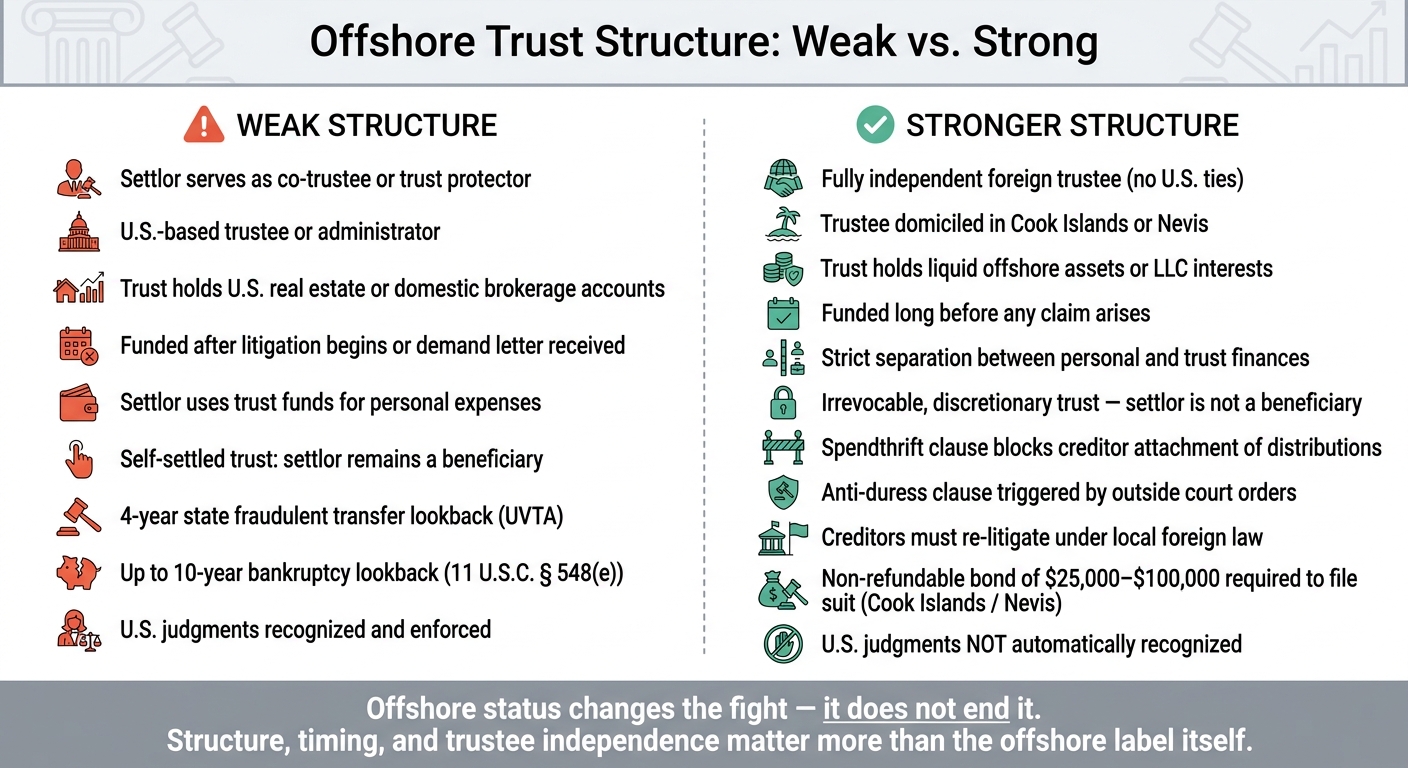
Not every offshore trust holds up when a U.S. court takes a hard look at it. Structure and timing do most of the work here. The main issue is simple: if the setup leaves a route back to the settlor, creditors may be able to follow it.
Self-settled trusts and retained control
The biggest weak spot is a self-settled trust – a trust where the settlor is also a beneficiary. In many U.S. states, including New York and Illinois, that setup is open to creditor claims. The Illinois Supreme Court said exactly that in Rush University Medical Center v. Sessions (2012), holding that a Cook Islands trust was highly vulnerable to a $1.5 million claim because the settlor remained a beneficiary.
Even in states outside New York and Illinois, retained control can create major exposure. If the settlor can remove the trustee, direct distributions, or serve as trust protector, courts may view the settlor as still having the power to bring the assets back. That was the problem in SEC v. Solow (2010). The court rejected the settlor’s impossibility defense because he had earlier used trust assets to pay personal taxes and living expenses.
Fraudulent transfer timing and lookback periods
Get the timing wrong, and the trust can lose much of its shield. Under the Uniform Voidable Transactions Act (UVTA), most states use a 4-year lookback period for fraudulent transfer claims. Bankruptcy law goes further. Under 11 U.S.C. § 548(e), a bankruptcy trustee has a 10-year window to unwind transfers made to self-settled trusts when there was intent to hinder, delay, or defraud creditors.
Some facts tend to wave a red flag right away:
- Transfers made after a demand letter
- Transfers made during active litigation
- Transfers made while the settlor is insolvent
In In re Cork (2017), the debtor moved $3.1 million during active state court litigation. The Arizona Bankruptcy Court found actual intent to defraud and denied the debtor a bankruptcy discharge entirely.
U.S. ties that weaken the structure
Control and timing matter, but the nuts and bolts of the trust matter too. Some U.S. connections make an offshore trust much easier to attack.
A U.S.-based trustee gives domestic courts direct jurisdiction over trust administration. U.S. real estate and domestic brokerage assets can also be exposed because local law may override offshore planning. A 2026 case involving California property held by a Nevada trust shows that situs law can control.
Put plainly, the more separate the trust is from the settlor, and the more independent the trustee is, the harder it is for a creditor to break through.
| Weak Structure | Stronger Structure |
|---|---|
| Settlor serves as co-trustee or protector | Fully independent foreign trustee |
| U.S.-based trustee or administrator | Trustee domiciled in Cook Islands or Nevis |
| Trust holds U.S. real estate or domestic brokerage accounts | Trust holds liquid assets or LLC interests |
| Funded after litigation begins | Funded long before any claim arises |
| Settlor uses trust funds for personal expenses | Strict separation between personal and trust finances |
Those weak points show what courts tend to focus on when deciding whether creditors can get at offshore trust assets.
What makes an offshore trust harder for creditors to reach
Stronger protection comes from structure, not secrecy. The trusts that hold up best are usually funded early, strip out settlor control, and use an independent foreign trustee. That’s the heart of it. In most cases, a creditor gets to the trust by getting leverage over the settlor first. Those are the pressure points they press on.
Legal features that limit direct creditor access
The strongest setups rely on irrevocable, discretionary drafting. That means the settlor can’t demand money from the trust. And if the settlor can’t force a distribution, a creditor usually can’t force one either.
A spendthrift clause adds one more barrier. It stops a beneficiary’s creditors from attaching future distributions before the money is actually paid.
An anti-duress clause can help, but only in a narrow situation: when the trigger is an outside court order, not something the settlor set up or caused. Retained powers make the trust weaker. If the settlor can remove trustees or block distributions, that undercuts the whole setup.
A foreign trustee with no U.S. office, no U.S. bank accounts, and no U.S. employees does not have to comply with U.S. restraining notices or turnover orders. Add a U.S.-based co-trustee, administrator, or protector, and that buffer can shrink fast. That’s why control, not labels, tends to decide the result.
Why jurisdiction choice matters
Jurisdiction matters because some offshore courts do not automatically recognize U.S. judgments. They may also use short fraud-lookback periods and demand a high proof standard.
The Cook Islands requires creditors to prove fraudulent intent beyond a reasonable doubt and re-litigate the case there from scratch. Nevis works in much the same way. In both places, a creditor may also have to post a non-refundable bond of $25,000 to $100,000 before filing suit.
That creates friction. A lot of it.
By contrast, a Nevada domestic asset protection trust still faces Full Faith and Credit issues and may be reached through federal bankruptcy law under 11 U.S.C. § 548(e). Of course, those rules only help if the trust also limits settlor control and wasn’t funded at a bad time.
Weak structure versus strong structure: side-by-side examples
In practice, the gap between a weak trust and a strong one usually comes down to a handful of setup choices. Courts look at the whole pattern, including:
- who controlled the trust
- when it was funded
- how distributions were used
- whether any duress clause was real or self-created
A properly structured Cook Islands trust funded before any claim has been extremely difficult for U.S. creditors to penetrate for decades.
Conclusion: The truth about offshore trust protection for U.S. persons
Here’s the plain truth: offshore status can make direct seizure much harder, but it does not stop pressure on the settlor. A U.S. court may not be able to grab offshore trust assets on its own, yet it can still lean on the settlor through contempt, fines, or even jail. That’s the part many people overlook.
Whether the trust holds up often comes down to choices made before any claim shows up. Courts often pick apart protection when the trust is self-settled, when the settlor keeps too much control over trustees, when funding happens too late, or when assets stay in the U.S. That’s why timing, control, and trustee independence matter far more than the offshore label itself.
The point is lawful risk reduction, not immunity. Structuring offshore trusts for asset protection can make collection more costly and harder to pull off. Creditors may need to re-litigate in foreign courts that do not recognize U.S. judgments, deal with shorter foreign fraudulent-transfer windows, and post bonds of $25,000 to $100,000 just to file suit. That kind of friction often pushes creditors toward settlement.
Offshore trusts tend to work best when they are irrevocable, independently administered, and funded before any claim arises.
FAQs
Can I be jailed if I can’t access my offshore trust?
Yes. A U.S. court can jail you for civil contempt if it orders you to repatriate offshore trust assets and you do not comply.
An impossibility defense may fail if the court thinks you still kept practical control over the trust or helped cause the trustee’s refusal. The risk is highest when the settlor still has backdoor control.
Does an anti-duress clause really stop a U.S. court?
No. An anti-duress clause, by itself, does not stop a U.S. court. It doesn’t limit the court’s jurisdiction over the settlor.
What it can do is tell a foreign trustee to ignore U.S. repatriation orders. But that’s only part of the picture. If a court decides the settlor still has enough practical control over the trust, it can use contempt power against them anyway.
That’s the part people often miss. The clause may block direct compliance by the trustee, but it does not block the court from pressuring the settlor. And if the court thinks the claimed impossibility is a sham, things can get ugly fast: fines, asset seizure, or even incarceration.
Are Cook Islands and Nevis trusts safer than U.S. trusts?
It depends on what you mean by "safer."
Cook Islands and Nevis trusts are often harder for creditors to reach because those places usually do not recognize U.S. court judgments. They also apply stricter fraudulent transfer rules.
That said, they are not off-limits. A U.S. court can still order a settlor to bring the assets back. If the settlor refuses, penalties can follow.
And the shield gets weaker if the trust is a sham or if the settlor keeps too much control.
