
Here’s the short answer: FTC v. Affordable Media is the 1999 case where the Ninth Circuit said an offshore trust will not save you from contempt if you still control the trust in practice.
If I had to boil the case down to a few points, I’d put it this way:
- The Andersons moved money into a Cook Islands trust
- They did this after legal heat had started
- They kept roles that gave them practical control
- They argued a duress clause made compliance impossible
- The court said that problem was self-made
- Result: civil contempt and jail confinement stayed in place
That’s why this case still gets cited. A U.S. court may not need control over the offshore assets themselves. If the court has power over you, and it thinks you can make the assets come back, it can order you to do it.
A few facts stand out:
- Decision year: 1999
- Court: U.S. Court of Appeals for the Ninth Circuit
- Main issue: control
- Main rule: you can’t set up your own roadblock and then say compliance is impossible
- Planning lesson: timing, trust structure, and who holds power matter more than labels
| Point | What the court focused on |
|---|---|
| Trust location | Offshore status did not end the case |
| Settlor control | Co-trustee and protector roles hurt the Andersons |
| Duress clause | The court did not treat it as a clean escape |
| Impossibility defense | Failed because the barrier was self-created |
| Result | Repatriation order enforced through contempt |
So if you’re trying to understand why Affordable Media still matters, the answer is simple: offshore does not mean out of reach when the settlor still has the power to act.
What happened in FTC v. Affordable Media
Those facts mattered because they showed why the court focused on control, not just legal title. Michael and Denyse Anderson ran Affordable Media LLC, a telemarketing company that the FTC said was part of a fraudulent investment scheme. When the FTC moved to recover money for victims, it found that the Andersons had transferred investor funds into a Cook Islands trust they set up in 1995. That timing turned the case from a trust-planning dispute into a direct test of whether an offshore trust could block a U.S. order to bring assets back.
The court also looked hard at when those transfers happened. Because the Andersons moved the money after the FTC had already started investigating their business, the court saw the trust as a shield for assets, rather than a legitimate strategy for offshore asset protection, not normal estate planning.
The trust structure the court examined
The trust itself got careful attention. The Andersons did not hand everything over to an independent foreign trustee and step aside. Instead, they named themselves as co-trustees along with a Cook Islands trustee. They also kept trust protector roles, which gave them continued sway over how the trust worked.
The trust included a "duress clause" too. That clause was meant to remove the Andersons as trustees if a U.S. court ordered repatriation. On paper, that may have looked like a barrier. But the court treated it as something the Andersons built into the trust to avoid obeying a court order.
Why repatriation became the central dispute
Once the FTC won an order requiring the assets to be returned, the fight narrowed to a simple point: could the Andersons comply or not? The court’s power came from personal jurisdiction over the Andersons themselves, not over the offshore trustee or the trust assets.
The Andersons said compliance was impossible because the duress clause had removed their trustee power and the offshore trustee would not release the money. The court didn’t buy that argument. Since the Andersons still held protector-level influence, the court thought they still had a practical way to make compliance happen. The Ninth Circuit said their claimed inability to comply came from a structure they had set up themselves.
That finding on control led straight to the Ninth Circuit’s ruling on repatriation and contempt.
How the Ninth Circuit ruled and the legal principle it set
In June 1999, the Ninth Circuit in FTC v. Affordable Media, LLC upheld civil contempt against Michael and Denyse Anderson for failing to comply with a repatriation order, and it affirmed their jail confinement for civil contempt. The court focused on a simple but hard question: did the Andersons still control the trust in practice?
That point mattered because civil contempt is meant to pressure someone to comply. Repatriation means bringing assets back to the United States. And the impossibility defense says compliance is not just hard, but actually beyond the person’s control. So the court had to decide whether the Andersons could still be forced to return the assets.
Why the impossibility defense failed
The Ninth Circuit rejected the impossibility defense. It said a person has to show, with specific and detailed proof, that compliance is genuinely out of reach. Here, the court found the opposite. In its view, the trust had been set up in a way that was meant to prevent compliance from the start.
"It is readily apparent that the Andersons’ inability to comply with the district court’s repatriation order is the intended result of their own conduct – their inability to comply and the foreign trustee’s refusal to comply appears to be the precise goal of the Andersons’ trust."
That was the turning point. The court treated the claimed inability as self-made, not as actual impossibility.
The rule for offshore trusts
The rule that came out of Affordable Media is blunt: a settlor cannot dodge contempt by building a trust that makes compliance hard and then saying compliance is impossible.
"A contemnor cannot avoid enforcement by creating their own inability to comply."
That idea is the main legal mark left by Affordable Media, and courts still lean on it when they look at offshore trust setups. That’s why judges pay such close attention to retained control, duress clauses, and foreign trustees. Those details often decide whether a trust leaves assets open to attack or gives them a better shot at protection.
sbb-itb-39d39a6
Why Affordable Media still matters for trust planning
The lasting takeaway is pretty simple: courts don’t stop at the paperwork. They look at how much control the settlor actually kept. That’s the part that still shapes trust planning today.
Trust features courts treat as exposed
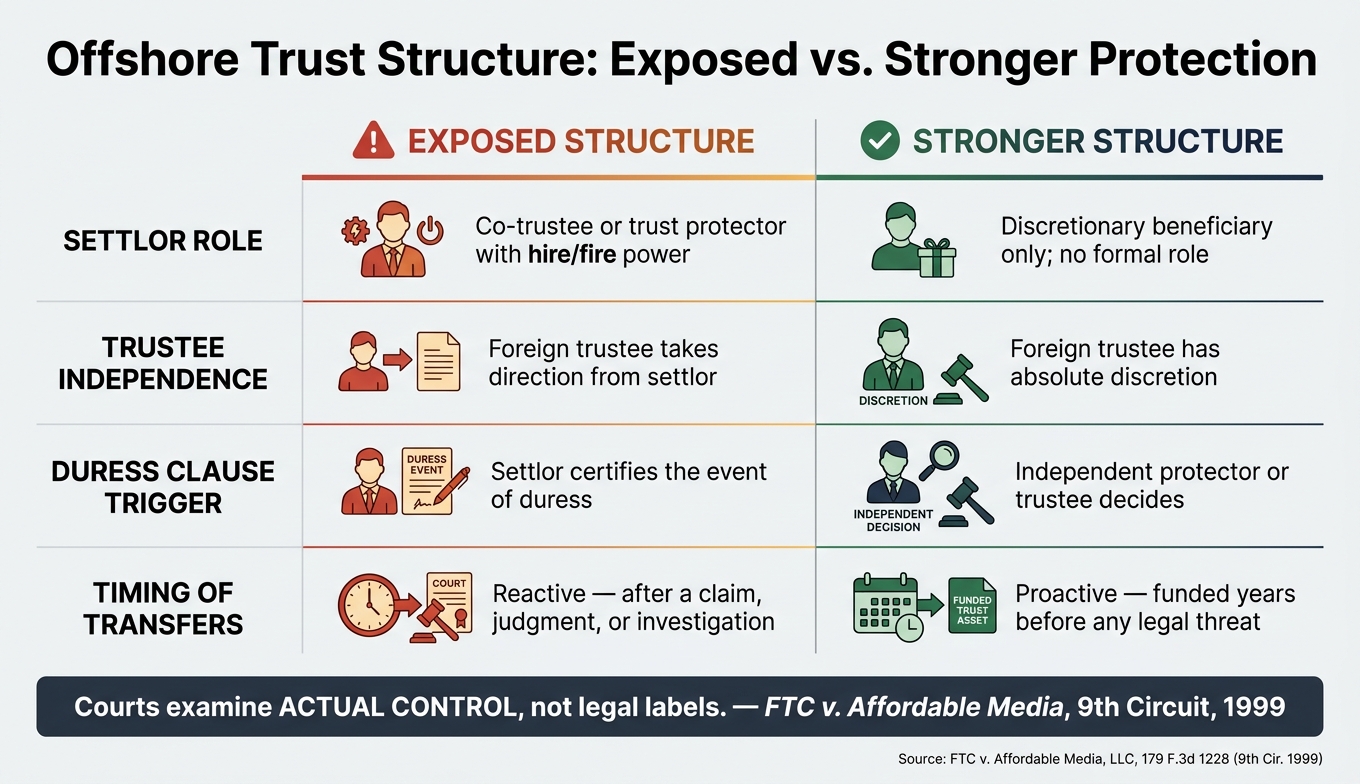
The biggest red flag is when the settlor keeps a formal control role inside the trust. If the settlor serves as a co-trustee or trust protector and can fire or replace the foreign trustee, a court has direct proof of control. That was the flaw that sank Affordable Media.
Informal influence can hurt just as much. In SEC v. Solow, the court rejected an impossibility defense after the settlor had used trust assets to pay personal taxes and expenses.
Timing also matters a lot. Transfers made after a claim, judgment, or investigation stand out right away. In bankruptcy, 11 U.S.C. § 548(e) can reach self-settled trust transfers made as far back as 10 years if fraudulent intent is proven.
Trust features that may strengthen protection
Setups with more protection tend to share a few traits. The settlor has no formal role and remains only a discretionary beneficiary. The foreign trustee has real, independent power to decide on distributions without direction from the settlor.
Duress clauses matter too. A clause is more exposed when the settlor is the one who triggers or certifies duress. It is less exposed when an independent trust protector or foreign trustee makes that call alone. Courts care about who controls the trigger, not what the clause is called.
Timely tax filings can also help credibility and undercut claims of good faith.
Protective features vs. exposed features: a side-by-side comparison
The table below shows the split between features courts read as control and features that show distance.
| Feature | Exposed Structure | Stronger Structure |
|---|---|---|
| Settlor role | Co-trustee or trust protector with hire/fire power | Discretionary beneficiary only; no formal role |
| Trustee independence | Foreign trustee takes direction from settlor | Foreign trustee has absolute discretion |
| Duress clause trigger | Settlor certifies the event of duress | Independent protector or trustee decides |
| Timing of transfers | Reactive; after a claim, judgment, or investigation | Proactive; funded years before any legal threat |
Those lines set up the practical lesson in the next section.
Conclusion: The practical lesson from Affordable Media
The comparison above points to one simple lesson: courts care about control, not labels. FTC v. Affordable Media turned on control, not geography. The Andersons lost because they still had practical control while saying they could not comply.
The Ninth Circuit held that their claimed inability to comply was the result of their own conduct. That’s the heart of the case. A court does not need to reach offshore assets to hold a settlor accountable. It only needs to decide that the settlor still had the power to act and refused to do so.
That rule has a blunt effect for anyone using an offshore trust. An offshore setup may protect assets, but it will not protect a settlor who still holds control. The trust assets stayed offshore and untouched, but the Andersons themselves were jailed for contempt in the U.S. That line matters a great deal for anyone trying to understand what an offshore trust can and cannot do.
In practice, trust effectiveness comes down to three things: structure, timing, and actual governance. A trust funded years before any legal threat, run by a genuinely independent foreign trustee, with no formal role kept by the settlor, looks very different to a court than one put together after trouble starts while the settlor still has influence. Civil contempt punishes defiance, deception, and retained control.
That’s why a trust has to be judged by real control, not paperwork. The case still matters because the main question has stayed the same: does the settlor actually have the power to comply? If the answer is yes, the trust will not prevent contempt.
FAQs
Does this case mean offshore trusts never work?
No. FTC v. Affordable Media does not mean offshore trusts don’t work.
What it does show is more specific: an offshore trust may prevent direct seizure by U.S. creditors, but it does not stop a U.S. court from using personal jurisdiction over the settlor.
In that case, the settlors were held in civil contempt mainly because they kept a lot of practical control and put the structure in place after legal threats had already surfaced. That timing mattered. So did the control issue.
A properly established trust can still work if real control is handed to an independent trustee. That’s the key point. If the settlor still has their hands on the wheel, a court may look past the paperwork and focus on what’s actually happening.
What counts as retained control in a trust?
Retained control means the settlor still has practical power over trust assets, even when the trust papers suggest the opposite. What matters to a court is simple: can the settlor still, in day-to-day terms, steer what happens inside the trust?
That control can show up in a few common ways:
- Serving as a protector or trustee
- Holding the power to remove or replace trustees
- Using duress clauses
- Relying on informal side agreements
- Keeping veto power
- Showing a pattern where the trustee routinely follows the settlor’s instructions
Can a duress clause help protect trust assets?
Yes, but it depends a lot on how the trust was set up and what its history looks like.
A duress clause can strip the settlor of control and hand authority to an independent foreign trustee if a U.S. court orders repatriation.
If the trust was created long before any liability arose, and the settlor kept no backdoor control, impossibility may work as a defense. But courts often look at these clauses with skepticism, and they may treat any retained influence as self-created impossibility.
