
If I had to give the short answer, I’d say this: Spain is the top pick for infrastructure, Mexico is the best match for U.S. work hours, Colombia gives the easiest long stay for the money, Argentina is the cheapest big-city base, and Costa Rica plus Panama are the main tax-friendly options.
By 2026, 17.3 million Americans call themselves digital nomads. So this choice is no longer just about weather. I’d look at best digital nomad visas, monthly costs, internet speed, safety, taxes, healthcare, coworking, and time-zone fit first.
Here’s the fast version:
- Spain: best setup, higher costs, tougher tax rules
- Mexico: strong city life, good U.S. overlap, no nomad visa
- Colombia: low costs, 2-year visa, tax risk on long stays
- Argentina: low monthly spend, weak visa path, more volatility
- Costa Rica: foreign income not taxed, but costs are high
- Panama: USD economy, simple tax setup, less nomad-focused
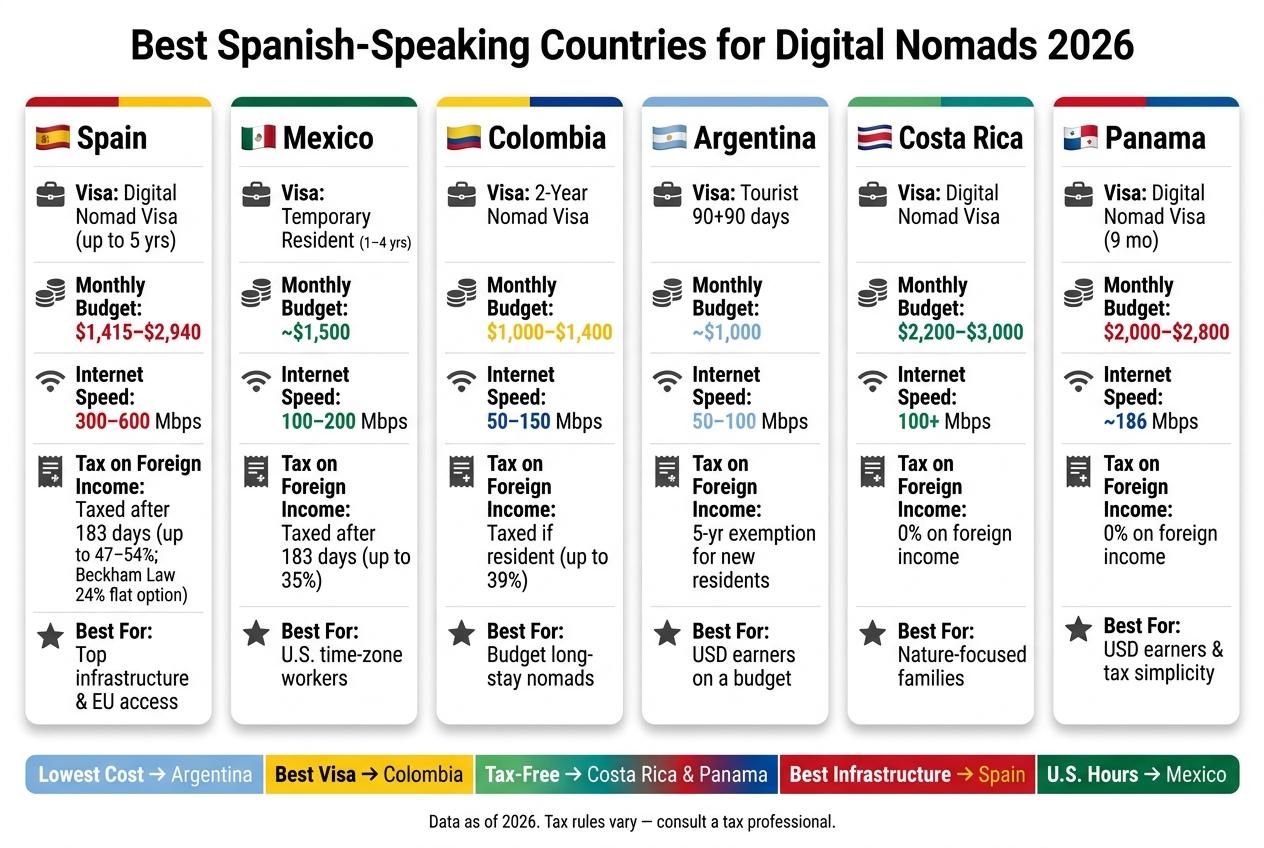
Quick Comparison
| Country | Visa path | Monthly budget | Internet | Tax angle | Best for |
|---|---|---|---|---|---|
| Spain | Digital Nomad Visa | About $1,415 to $2,940 | 300 to 600 Mbps in many cities | Tax residency after 183 days | People who want top city systems |
| Mexico | Temporary Resident Visa | About $1,500 in Mexico City | 100 to 200 Mbps | Global income may be taxed after 183 days | U.S.-based workers |
| Colombia | 2-year nomad visa | About $1,000 to $1,400 | 50 to 150 Mbps | Global income may be taxed if resident | Lower-budget long stays |
| Argentina | Tourist stay + extension | About $1,000 | 50 to 100 Mbps | New residents may get a 5-year foreign-income break | Short- to mid-term savings |
| Costa Rica | Digital Nomad Visa | About $2,200 to $3,000 | 100+ Mbps in main hubs | Foreign income not taxed | Nature-first living |
| Panama | Digital Nomad Visa | About $2,000 to $2,800 | About 186 Mbps in Panama City | Foreign income not taxed | USD earners who want simple tax rules |
If you want the safest all-around choice, I’d start with Spain. If you want the best value with a legal long stay, I’d look at Colombia first. If your top goal is paying less month to month, Argentina still stands out.
sbb-itb-39d39a6
1. Spain
Spain ranks #8 in the world for digital nomads and posts a digital infrastructure score of 89.3/100. If fast internet is high on your list, Spain makes a strong case. Fiber covers more than 90% of urban areas, and common speeds land between 300 and 600 Mbps. In the big cities, coworking spaces are easy to find, and most fiber plans cost about €30 to €55 per month.
When it comes to visas, there are two main routes.
- The Digital Nomad Visa (DNV) is meant for remote employees and freelancers. It requires at least 80% of your income to come from non-Spanish clients, and it can last up to three years, with renewals up to five years total. The minimum income bar is about €2,442–€2,850 per month.
- The Non-Lucrative Visa fits retirees or people living on passive income, but it does not allow active remote work.
One rule trips people up: you can’t turn a tourist stay into residency from inside Spain.
The big tradeoff is taxes. Spain fits nomads who want top-tier internet, strong city setup, and EU legal cover, but who are also ready for a stricter tax system. If you stay more than 183 days, you become a Spanish tax resident and may owe tax on your worldwide income. Rates can go as high as 47%–54%, depending on the region.
There is one big offset. DNV holders can apply for the Beckham Law, which sets a flat 24% tax rate on Spanish-source income up to €600,000 for six years. If you’re from the U.S., you still have to file U.S. tax returns no matter where you live, though the U.S.-Spain tax treaty can help cut down double taxation.
Costs shift a lot depending on the city. Valencia tends to offer the best mix of price and lifestyle, while Seville is the lowest-cost major city.
| City | 1-BR Rent (City Center) | Total Monthly Budget | Approx. USD |
|---|---|---|---|
| Madrid | €1,200–€1,600 | €1,800–€2,400 | $1,960–$2,620 |
| Barcelona | €1,300–€1,800 | €2,000–€2,700 | $2,180–$2,940 |
| Valencia | €800–€1,100 | €1,400–€1,900 | $1,525–$2,070 |
| Málaga | €900–€1,200 | €1,500–€2,100 | $1,635–$2,290 |
| Seville | €700–€1,000 | €1,300–€1,800 | $1,415–$1,960 |
Safety depends a bit on where you base yourself. Madrid scores well, with a crime index of 28.7, while Barcelona comes in higher at 51.9, mostly because of petty theft. On healthcare, Spain scores 77 out of 100 for quality, and private health insurance for people under 40 usually runs about $87 to $131 per month.
Spain is the premium pick in this group: higher cost, stronger internet and city setup, and EU legal protections. If that price tag or tax burden feels too steep, Mexico is the closest lower-cost alternative.
2. Mexico
Mexico City is pulling in more nomads for a simple reason: it gives you a lot for less money. Costs are low, internet is strong, and the time zone works well for people based in the U.S. CDMX runs on CST (UTC-6), so it’s about two hours ahead of the West Coast. For many remote workers, Mexico feels like the lower-cost alternative to Spain, with day-to-day life that’s easier to manage from a U.S. work schedule.
Mexico doesn’t offer a dedicated digital nomad visa. Most remote workers go with the Temporary Resident Visa (Residente Temporal). It’s valid for one year and can be renewed for up to four years. To qualify in 2026, you need either about $4,500 to $5,200 per month in steady income over the past six months or about $75,000 to $85,000 in liquid savings over the past 12 months. You begin the process at a Mexican consulate, and after you enter the country, you have 30 days to turn the visa into a residency card.
The tourist permit is still around, but it’s not as dependable as it used to be. Immigration officers now often give stays shorter than the old 180-day maximum, and border runs aren’t something you should count on. If you want to stay for more than a short stretch, formal residency is the cleaner option.
Taxes are where things can get serious. If you spend more than 183 days in Mexico during a calendar year, you’ll generally become a tax resident. That means your global income can be taxed by the SAT at rates up to 35%. On the healthcare side, private health insurance is common and fairly low-cost, usually about $50 to $100 per month for healthy adults under 40.
Day-to-day costs are one of Mexico City’s biggest draws. A private studio in Roma or Condesa usually costs about $500 to $900 per month, and a practical monthly budget comes in around $1,500. Internet in CDMX is some of the best in Latin America. Fiber providers such as Telmex, Izzi, and Totalplay usually offer 100 to 200 Mbps speeds. If you like working around other people, the city has over 100 coworking spaces, with flexible memberships usually priced at $150 to $250 per month.
Safety depends a lot on where you live. Roma Norte, Condesa, and Polanco are seen as safer areas and tend to have a stronger police presence. Tepito and Iztapalapa are places to avoid. At night, use Uber or DiDi instead of street taxis.
Mexico works well for nomads who want U.S.-friendly hours, lower costs, and a big-city setup – as long as they sort out residency early. If Mexico still feels a bit pricey, Colombia is the next lower-budget option.
3. Colombia
If Mexico still feels a bit pricey, Colombia brings costs down another step without giving up the basics most nomads care about. It’s the lower-cost option that still gives you solid day-to-day setup. Medellín is the big magnet here, thanks to its mild weather all year and its large nomad scene. Bogotá can be a better fit if you want a bigger, more global city, but it’s cooler and gets more rain. In both places, fiber-optic internet is dependable, with speeds usually landing between 50 and 150 Mbps.
One of Colombia’s biggest selling points is the visa. The V-Nomada Digital visa allows a two-year stay and asks for about $1,300 in monthly income. You can apply online, the fee is about $200 to $300, and once you’re approved, you’ll need to get a local ID.
Costs stay low across the board. In Medellín, a furnished one-bedroom apartment usually runs about $400 to $700 per month, and a full monthly budget often falls between $1,000 and $1,400. Coworking memberships tend to cost $100 to $150 per month. Private health insurance through medicina prepagada plans usually comes in at $80 to $150 monthly.
The catch is taxes. Low day-to-day costs help a lot, but for longer stays, taxes become the main tradeoff. Colombia taxes residents on worldwide income at rates up to 39%. Once you cross that line, your worldwide income can fall into Colombia’s tax net.
Safety is better than the country’s old image suggests, but you still need to stay sharp. Use rideshare apps at night, don’t flash pricey devices, and be careful in nightlife areas. For neighborhoods, El Poblado is the easiest landing spot for expats, while Laureles feels more local and has flatter streets that are easier to walk.
Colombia fits best for nomads who want low costs, warm weather, and a simple two-year stay. It is one of several digital nomad opportunities in Latin America worth considering. It stands out because it pairs low monthly spending with a two-year nomad visa and an easy base-city setup. Argentina shifts the focus away from ultra-low costs and toward a bigger, more urban nomad scene.
4. Argentina
Buenos Aires is one of the better budget plays for U.S.-dollar earners. The weak peso is the big reason. If you earn in dollars, your money goes a lot further here. In Palermo or Recoleta, a furnished one-bedroom usually costs $300 to $600 per month. A full monthly budget comes in at about $1,000, coworking costs $80 to $120, and a good steak dinner runs just $8 to $15.
The catch is the visa situation. Argentina still doesn’t have one of the many visas for digital nomads as of 2026. Most nomads arrive on a 90-day tourist visa, then extend it once for another 90 days through Migraciones for $50 to $100. Remote work on a tourist visa sits in a legal gray area. In practice, it’s often tolerated, but it isn’t officially allowed. There is also a Rentista visa for people with passive income above $2,500 per month, but that route wasn’t built with remote workers in mind. So yes, Argentina can be a strong pick for short- to mid-term savings, but the paperwork side isn’t exactly smooth.
That tradeoff gets a bit easier to swallow when you look at taxes. New fiscal residents get a five-year exemption on foreign-sourced income before worldwide taxation starts.
Since the visa path is less clear-cut, internet reliability matters even more. Buenos Aires internet is usable, but it’s not as steady as what you’ll usually find in Mexico City or Medellín. Average speeds sit around 50 to 100 Mbps. Storms can knock service out, which is why many remote workers pair a coworking membership with a mobile hotspot backup. It’s not overkill. It’s just smart.
Safety is fairly solid by regional standards, with a homicide rate of about 5 per 100,000 people. Day-to-day, the bigger issue is motorcycle thieves. Keeping your phone out of sight is one of those small habits that can save you a headache. For the best mix of walkability, infrastructure, and coworking, Palermo, Recoleta, and Belgrano are the usual top picks. Buenos Aires is urban, low-cost, and workable, but it isn’t the easiest place to set up for a long stay.
If you want a beach-focused base with an easier path for residency planning, Costa Rica is the next place to look at.
5. Costa Rica
Costa Rica works well for nomads who care about stability, nature, and tax-free foreign income. The Digital Nomad Visa (Law No. 10008) calls for at least $3,000 per month for individuals or $4,000 for families from foreign sources. Costa Rica taxes only local-source income, which means foreign earnings stay untaxed, even if you remain there for more than 183 days. The catch is pretty simple: it’s not the cheap option, and the paperwork can be a slog.
There are a few other routes too. The Pensionado path needs $1,000 in monthly pension income. Rentista asks for $2,500 in passive income or a $60,000 deposit. Inversionista requires a $150,000 investment. Residency usually takes 12 to 18 months to process, and most people hire a local immigration lawyer. Fees usually land between $1,500 and $3,000. So while Costa Rica makes a strong case on lifestyle and tax treatment, it’s harder to justify if your main goal is keeping costs low.
Costs run 20% to 35% higher than Mexico. A mid-range monthly budget usually falls between $2,200 and $3,000, and a one-bedroom in Pacific beach towns like Tamarindo or Nosara often costs $900 to $1,500. Internet is solid in cities and well-known expat hubs, with fiber plans hitting 100+ Mbps for $30 to $50 per month. Go into rural or mountain areas, though, and service gets less steady.
Healthcare is one of Costa Rica’s big selling points. Residents pay about $70 to $150 per month into the CAJA (CCSS) public system. Private hospitals like CIMA Hospital and Clínica Bíblica in San José are JCI-accredited, and specialist visits usually cost $60 to $100. The homicide rate is about 11 per 100,000 people, and expat-heavy areas are generally rated as high safety. In day-to-day life, petty theft in San José is the more common issue.
For higher-budget nomads, Costa Rica offers a calm, nature-heavy base with solid political stability. Where it comes up short is urban infrastructure. You’re not getting Western Europe-level city systems here. If you want a similar sense of stability but with a more business-friendly, dollar-based setup, Panama is the next place to look.
6. Panama
Panama uses the U.S. dollar and taxes only income earned inside Panama. So if you earn in USD, you skip currency swings, and foreign income stays untaxed. That setup makes Panama a good match for nomads who care more about tax simplicity and steady prices than chasing the absolute lowest monthly spend.
There are a few main visa paths. The Digital Nomad Visa allows a 9-month stay and can be renewed once, with a minimum of $3,000 per month in foreign income. The Friendly Nations Visa gives citizens of 50 countries, including the U.S., a path to permanent residency. The Pensionado Visa is aimed at retirees with at least $1,000 per month in pension income. In all cases, applications must go through a Panamanian lawyer.
A mid-range monthly budget in Panama City usually lands between $2,000 and $2,800. For housing, a one-bedroom apartment in areas like El Cangrejo or Punta Pacifica tends to cost about $800 to $1,400 per month. Internet in the capital is strong, with average speeds of 186 Mbps and fiber plans around $40 to $60 per month. Coworking is also well set up in Panama City. Step outside the capital, though, and things change a bit: connectivity gets weaker, and rural areas may depend more on 4G LTE.
Panama is safer than most countries in the region, with a homicide rate of 11.7 per 100,000 people. The UTC-5 time zone also lines up well for calls with U.S. East Coast clients. The startup scene is thin, so Panama makes more sense for tax planning and city comfort than for founder meetups or tech circles. If you’re weighing visa access, U.S.-friendly working hours, and costs that are easier to predict, Panama feels more like a premium, low-friction base than a budget pick.
Pros and Cons of Each Country at a Glance
No country wins on every factor. Each one gives you something and asks you to give something up in return. In most cases, that tradeoff comes down to cost, visa ease, tax treatment, or day-to-day lifestyle.
Spain is the strongest all-around pick for infrastructure. But that comes with a higher price tag and a heavier tax burden.
Argentina flips that deal. It’s the cheapest major-city option in this group, especially for USD earners, but economic instability can make long stays harder to plan.
Colombia works well if you want a lower-cost base with a built-out nomad scene. Mexico is often the better fit for people who need U.S. time-zone overlap and stronger city infrastructure.
Costa Rica leans toward nature, stability, and lighter tax treatment. Panama stands out for its USD-based economy and business-friendly setup.
The table below gives the fast version, with each country’s main upside and main downside side by side.
| Country | Key Pros | Key Cons | Best Fit |
|---|---|---|---|
| Spain | Strongest infrastructure, Beckham Law tax perk | Higher cost, slower immigration processing | High earners who want EU infrastructure |
| Mexico | Best U.S. time-zone alignment, strong city infrastructure | Safety is neighborhood-specific | U.S.-based remote workers |
| Colombia | Lowest cost with a built-out nomad scene, 2-year DN visa | Petty crime risks | Budget-conscious nomads |
| Argentina | Cheapest major-city option for USD earners | Economic instability, inconsistent internet | Budget travelers comfortable with uncertainty |
| Costa Rica | 0% tax on foreign income, stable democracy, nature access | Higher costs than neighbors, weaker rural infrastructure | Families, nature-focused nomads |
| Panama | USD economy, territorial tax system | Less built for nomads | USD earners who want a business-friendly base |
Which Spanish-Speaking Country Fits Your Nomad Setup?
The right pick comes down to your main goal: lower monthly costs, an easier visa, lighter taxes, or stronger internet and day-to-day systems. After looking at visas, living costs, internet, safety, taxes, and lifestyle, there isn’t one country that wins for everyone.
If you want a place to stay put for a while, Colombia stands out. Its Digital Nomad Visa lasts two years and has a low income threshold. If your job depends on overlap with U.S. clients, Medellín and Panama City both run on UTC-5, which makes scheduling much easier.
For taxes, Costa Rica and Panama are the clearest low-tax picks because both treat foreign income lightly or don’t tax it at all. Costa Rica has the edge if your focus is foreign-income tax treatment plus a steady lifestyle.
Use the matrix below to line up your top priority with the clearest match.
| Your Priority | Best Fit | Why |
|---|---|---|
| Lowest budget | Argentina | About $1,000/month is a realistic average in Buenos Aires |
| Long-term visa | Colombia | 2-year Digital Nomad Visa with a low income floor |
| U.S. time-zone match | Mexico or Colombia | Good work-hour overlap with U.S. clients |
| Tax optimization | Costa Rica or Panama | 0% tax on foreign-sourced income |
| Best infrastructure | Spain | Fiber-optic coverage above 90% in urban areas, plus strong safety and stability |
| Business-friendly base | Panama | USD economy and a territorial tax system |
FAQs
Which country is best for first-time digital nomads?
Mexico City is often the top pick for first-time digital nomads. The reason is pretty simple: it makes the move feel less hard. You get an easy entry process with a 180-day visa, a big nomad scene, and internet that’s dependable enough for day-to-day work.
It also hits a sweet spot between big-city energy, great food, and deep local life, which makes it an easy place to settle into if you’re just getting started. And if Spanish is part of the plan, that helps too. Many learners see the local accent as especially clear.
How long can I stay before taxes become a problem?
In many Spanish-speaking countries, 183 days in a calendar year is the line where you may become a tax resident. Cross that line, and you may have to report and pay tax on your worldwide income.
There are some exceptions. Costa Rica generally does not tax foreign-source income, while Spain and Colombia apply extra rules that can change how this works. And if you’re a U.S. citizen, you’ll still usually need to file a tax return each year back home.
What monthly income do I need to qualify for a visa?
Monthly income rules change from country to country. As of 2026, Spain asks for at least $3,040 per month. Costa Rica requires $3,000 for individuals or $4,000 for families. Mexico requires at least $2,500, and Colombia usually asks for about $1,300 to $1,400.
Before you apply, always check the current rule with the relevant official consulate.
