
A trust can help in divorce, but only if the assets were kept separate, moved at the right time, and left out of your control. If you still control the trust, mixed trust money with marital money, or transferred assets when divorce was near, a court may still count those assets or unwind the transfer.
Here’s the short answer in plain English:
- Revocable trusts usually do little or nothing for divorce protection.
- Irrevocable trusts can help if they were funded with premarital assets, gifts, or inheritances.
- Third-party discretionary trusts with a spendthrift clause are often harder for a spouse to reach.
- Trust income and distributions may still count when courts set alimony or child support.
- Late transfers can trigger fraudulent transfer claims and get reversed.
- In some states, moving marital assets into a trust close to filing can come back into the case within 3 years.
If I had to boil the whole issue down to one line, it would be this: courts care less about the word "trust" and more about who funded it, who controls it, and how the money was used.
Quick comparison
| Trust type | Usual divorce protection | Main problem |
|---|---|---|
| Revocable living trust | Low | You still control it |
| Irrevocable trust | Higher | Problems start if funds were mixed |
| Third-party discretionary trust | Higher | Income may still matter for support |
| Domestic asset protection trust | Mixed | Not every state respects it |
| Offshore trust | Higher on paper | Timing, control, and court pressure still matter |
I’d look at five things first: timing, source of funds, control, distribution rights, and commingling. Those five points usually tell you whether a trust is likely to help or fail in a divorce fight.
sbb-itb-39d39a6
When a trust is more likely to protect assets during divorce
Trusts tend to work best when separate property goes in early and the beneficiary doesn’t hold the reins.
Irrevocable trusts funded with separate property before marriage or conflict
An irrevocable trust funded with premarital assets, an inheritance, or a third-party gift gives a court the clearest basis to treat those assets as off-limits. Once assets move into an irrevocable trust, the grantor no longer owns them legally. The trust stands on its own, and that legal separation is exactly what courts want to see.
The paper trail matters just as much as the trust setup. If every dollar in the trust can be traced back to a separate-property source, and none of that money was mixed with marital funds, the case for protection gets much stronger. Mix those assets with joint accounts or shared household spending, and the shield starts to crack. Protection turns on clean tracing and no mixing with marital funds.
Third-party discretionary and spendthrift trusts for family wealth
Trusts set up by a parent or grandparent for one spouse’s benefit are often among the hardest for a court to reach. The spouse going through the divorce didn’t put the assets into the trust, so those assets were never part of the marital estate in the first place.
Two drafting features help a lot here:
- Discretionary language
- A spendthrift clause
Together, they limit the beneficiary’s enforceable claim and make that interest harder to divide. An independent trustee strengthens both points. In McGinn v. McGinn (Georgia, 2001), the Georgia Supreme Court ruled that a husband’s interest in a family trust was shielded from his wife’s claims for equitable distribution because he was not the sole trustee. The trust corpus was protected. Even so, trust income can still matter when a court looks at support.
Offshore trusts set up early and run by independent administrators
Offshore asset protection trusts, such as those formed in the Cook Islands, add a layer of distance that domestic trusts usually can’t match. A foreign trustee is harder for a U.S. court to reach directly.
Here, timing is everything. Offshore transfers made close to a divorce can trigger fraudulent transfer claims. But when the trust is created well in advance and managed by independent administrators, a spouse faces major practical hurdles in trying to reach those assets. That said, those protections can fade fast if control stays too close to the beneficiary, the timing looks bad, or the asset trail gets messy.
When trust assets can still be exposed or counted in divorce
Trusts can help, but they’re not a magic shield. Protection often falls apart when the person who set up the trust still controls it, mixes trust money with shared money, or moves assets into the trust too late.
Revocable trusts, retained control, and self-settled structures
A revocable living trust offers little to no protection in divorce. Since the grantor can revoke or change the trust, courts often treat those assets as if the grantor still owns them. That means the assets may still be divided.
Self-settled trusts run into a similar issue. If a spouse creates a trust, names themselves as a beneficiary, and then tries to rely on a spendthrift clause, courts in many states may look past the setup. In those cases, courts may treat the ex-spouse like a creditor and reach the amount the settlor can receive.
How commingling trust money with joint accounts and shared expenses creates risk
Even an irrevocable trust can lose protection through commingling. Once trust distributions get mixed into joint accounts, used for shared bills, or tied to jointly owned property, it becomes much harder to argue that the money stayed separate.
A few common examples show how this happens:
- Depositing trust distributions into a joint bank account
- Using trust money to pay shared household expenses
- Paying down a joint mortgage with trust funds
- Using trust money to renovate a home both spouses own
Each step makes the line between separate and marital property less clear.
In community property states, the problem can get worse fast. Mixing separate trust income with marital funds can reclassify the entire trust as community property.
Timing brings another problem. Transfers made when divorce is on the horizon can be reversed.
Late transfers and fraudulent transfer claims
Timing is one of the first things a divorce attorney looks at. If someone moves assets after the marriage starts breaking down, or just before filing for divorce, that transfer can look like an attempt to hide property. Courts may undo the transfer and bring the assets back into the marital estate.
In In re Marriage of Anderson, an Illinois appellate court pierced a $4.2 million self-settled spendthrift trust because the husband had funded it with marital assets only six months before filing for divorce.
Illinois law lets courts reverse trust transfers made within three years of a divorce filing if the intent was to defeat a spouse’s property rights.
Support awards can still reflect trust distributions too. So even if a court can’t directly reach the trust assets, it may deal with that by giving the other spouse a larger share of the marital estate.
Those limits are why the type of trust matters so much next.
Which trust types offer the most divorce-related protection
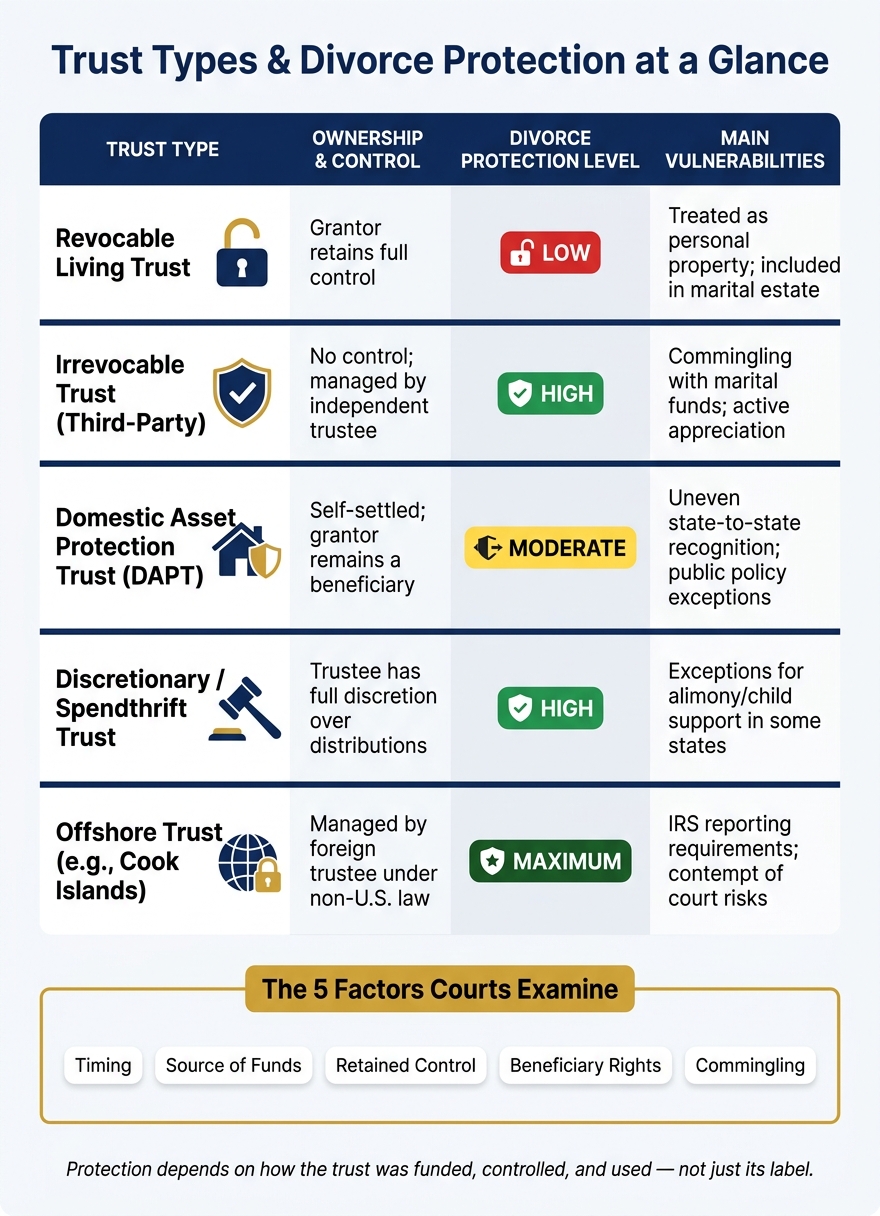
The strongest divorce protection tends to come from trusts that strip away a spouse’s ownership, control, and any clear right to force distributions. Put simply: if the spouse can still control the assets or demand money, the protection gets much weaker.
Irrevocable trusts and domestic asset protection trusts
An irrevocable trust with an independent trustee can create a strong wall between the grantor and the assets. Once the grantor gives up legal ownership and control, courts often view those assets as belonging to the trust, not to the individual spouse.
In Nelson v. Nelson, a Florida appellate court held that assets transferred into an irrevocable trust during marriage were trust property, not divisible marital property.
Domestic asset protection trusts (DAPTs) work a bit differently. The grantor funds the trust but can still remain a beneficiary. These trusts are available in states such as Nevada, South Dakota, and Delaware. The catch is that their divorce-related strength is uneven. Some states will not honor out-of-state DAPT statutes when local public policy points the other way.
Discretionary trusts with spendthrift clauses
A discretionary trust gives the trustee full control over distributions. That matters a lot in divorce. If the beneficiary has no enforceable right to demand money, it becomes much harder for the other spouse to argue that the trust corpus should be split.
Spendthrift clauses add another shield by stopping a beneficiary from transferring their interest, whether by choice or by force. Even so, there are limits. Many states still allow claims tied to alimony or child support.
Revocable living trusts vs. offshore trusts
Revocable living trusts usually do little or nothing for divorce protection. Since the grantor can change or cancel the trust at any time, courts usually treat those assets as personal property.
Offshore trusts create a practical enforcement hurdle that domestic trusts usually can’t match. A foreign trustee working under non-U.S. law is tougher for a U.S. court to force into action. At the end of the day, these trust types differ mainly in one thing: how much control the spouse still keeps.
| Trust type | Ownership/control | Divorce protection | Main vulnerabilities |
|---|---|---|---|
| Revocable Living Trust | Grantor retains full control | None to low | Treated as personal property; included in marital estate |
| Irrevocable Trust (Third-Party) | No control; managed by independent trustee | High | Commingling with marital funds; active appreciation |
| Domestic Asset Protection Trust (DAPT) | Self-settled; grantor is a beneficiary | Moderate | Uneven state-to-state recognition; public policy exceptions |
| Discretionary/Spendthrift Trust | Trustee has full discretion | High | Exceptions for alimony/child support in some states |
| Offshore Trust (e.g., Cook Islands) | Managed by foreign trustee | Maximum | IRS reporting; contempt of court risks |
Next, the real test is whether the trust was funded, managed, and documented cleanly enough to hold up in divorce.
How to assess a trust before or during divorce planning
The 5 factors courts usually examine
Courts usually look at five simple things to decide whether a trust still feels separate or starts to look like marital property.
- Timing – Was the trust funded before the marriage or close to the start of conflict?
- Source of Funds – Were the assets inherited, gifted, or earned during the marriage?
- Retained Control – Does the spouse act as trustee or hold the power to revoke the trust?
- Beneficiary Rights – Are distributions mandatory or discretionary?
- Commingling – Have trust funds been mixed with joint accounts or used to pay marital bills?
If the trust fails any of these tests, a court is more likely to treat it as marital property.
This is where paperwork stops being just paperwork. A trust can look proper on paper and still fall apart in court if the spouse treats it like a personal checking account. That’s the problem. Judges look at how the trust was used, not just what the document says.
The practical steps are pretty plain: use an independent trustee, keep a separate trust account, and hold on to tracing records. Put trust money in an account titled only in the trust’s name. Don’t deposit marital earnings or joint funds into that account.
It also helps to add divorce-trigger provisions. These can remove a spouse as co-trustee or suspend beneficiary rights once a divorce begins.
Conclusion: Trusts work best when ownership, timing, and use are clean
The main issue isn’t whether a trust exists. It’s whether the spouse still looks like the real owner. Courts tend to respect clean separation, not trust labels.
FAQs
Can a trust protect assets once divorce talks start?
Yes, but trusts created or changed after marital problems begin are often at high legal risk.
Courts tend to look very closely at trusts set up shortly before or during a divorce. Why? Because they may see those trusts as an attempt to hide assets or get around marital property rights.
If that happens, the court may invalidate the trust or impose sanctions.
Will trust payouts affect alimony or child support?
A trust may shield the assets inside it from being split in a divorce. But that doesn’t mean it shields the beneficiary from alimony or child support.
Courts often look at actual trust distributions when they decide what someone can afford to pay. In some cases, they also look at expected future distributions. If trust money helped pay for your marital lifestyle, a court may treat that as income. And once the money is distributed, it becomes your property and may be garnished.
Does putting inherited money into a trust keep it separate?
A trust can help keep inherited money separate, but it doesn’t protect those assets on its own. In most cases, it works best when the trust is irrevocable and set up by a third party.
Control and handling matter too. If trust distributions get mixed with marital funds, spent on shared household costs, or the person receiving the money has too much control over the trust, those assets may end up subject to division.
