
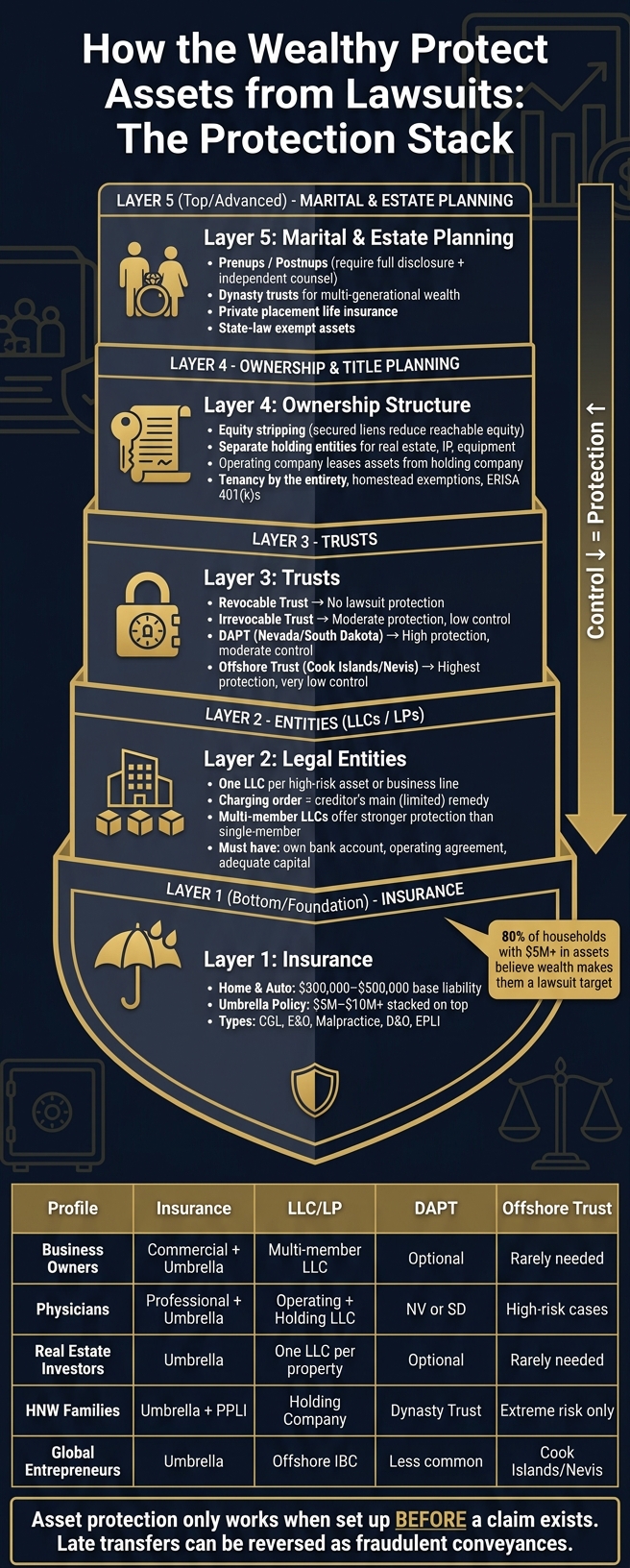
Yes – wealthy people usually protect assets from lawsuits with layers put in place before any claim starts. In plain English, that often means high insurance limits, separate LLCs, irrevocable trusts, and careful ownership rules that make collection slower, harder, and less worth the fight.
If I had to sum up the article in a few points, it would be this:
- Insurance pays first, often with $5 million to $10 million+ umbrella coverage on top of home, auto, or business policies.
- LLCs split risk so one rental, one business line, or one bad event does not hit everything else.
- Irrevocable trusts can move legal ownership out of a person’s direct name, while revocable trusts do not stop lawsuits.
- Domestic and offshore trusts only work when done early. Under fraud-transfer rules and bankruptcy law, late transfers can be undone. This is why understanding the nuances between offshore trusts and private interest foundations is critical for long-term security.
- State law matters a lot. Homestead rules, tenancy by the entirety, charging-order rules, and trust law can change the result.
- Control is the trade-off: the more control someone keeps, the less lawsuit shielding they often get.
Here’s the short version: the wealthy do not rely on one trick. They use a stack – insurance, entities, trusts, and title planning – and they keep each layer clean, funded, and separate.
| Method | Main job | Key limit |
|---|---|---|
| Insurance | Pays common claims first | Policy limits can run out |
| LLCs / LPs | Box risk into one asset or business | Weak setup can fail |
| Irrevocable trusts | Move ownership out of personal name | You must give up control |
| DAPT / offshore trusts | Add more creditor friction | Timing and reporting matter |
| Prenups / exempt assets | Protect specific property classes | State rules vary |
If you want the core answer fast, it’s this: the wealthy protect assets by separating ownership, separating risk, and planning early enough that courts do not treat the move as a dodge.
Start with insurance layering
Insurance should pay the everyday claim before anyone gets near your personal balance sheet. In plain English: before an LLC or trust ever faces a court test, a properly sized policy should take the first hit. That matters because many plaintiffs’ attorneys work on contingency. If insurance covers the loss, there’s less money-driven reason to keep digging into personal assets.
Once that base layer is set, the next move is to separate assets into the right legal entities.
Home, auto, and umbrella coverage
Many affluent households begin with homeowners and auto liability limits of $300,000 to $500,000, then stack umbrella coverage of $5 million to $10 million or more on top. That helps with common risks, like a guest getting hurt on your property or a car accident caused by a family member.
That’s where an umbrella policy comes in. It fills the gap above the underlying limits. For high-net-worth households, $5 million to $10 million in umbrella coverage can handle losses that go past the base policies. From a plaintiff’s attorney’s point of view, there’s already a clear pool of money to recover from, so the push to go after personal assets, trusts, or business entities tends to drop.
Business, professional, and executive policies
Different roles bring different liability risks. Each one calls for its own policy.
| Policy Type | Who Needs It | What It Covers |
|---|---|---|
| Commercial General Liability (CGL) | Business owners | Slip-and-fall incidents, bodily injury, and property damage at a business location |
| Errors & Omissions (E&O) | Consultants, advisors, service providers | Claims of professional mistakes or failure to perform professional duties |
| Malpractice | Physicians, dentists, medical staff | Professional negligence and clinical errors |
| Directors & Officers (D&O) | Board members, executives | Personal liability for decisions made on behalf of a company |
| Employment Practices Liability (EPLI) | Any business with employees | Wrongful termination, harassment, discrimination claims |
A physician who sits on a hospital board, for example, may need both malpractice and D&O coverage. An entrepreneur with employees and clients may need CGL, EPLI, and E&O. These policies do not overlap. Each covers a separate type of risk.
How to size coverage against net worth and risk
The right amount starts with a simple exercise: list the assets you could lose in a claim. Rental properties bring slip-and-fall risk. Operating businesses bring employee disputes and other business claims. And the concern is not abstract – 80% of households with over $5 million in investable assets believe their wealth makes them an attractive lawsuit target.
A practical way to handle this is to map each source of liability, then match coverage to it. Insurance pays first. Entities and trusts take the layer above policy limits. If an asset sits inside an LLC or trust, make sure the entity is named as the insured or an additional insured.
After insurance, the next step is entity separation.
sbb-itb-39d39a6
Use entities to separate assets from liabilities
After insurance, entity structure picks up where insurance stops. The goal is simple: keep risk boxed in. Put liabilities inside the entity that created them, and keep personal wealth outside that blast radius.
LLCs for businesses, rentals, and asset holding
An LLC can help on both sides. It can protect you from claims tied to the asset itself, and it can also help separate claims against you from assets held inside the entity. That’s why many people use one LLC for each high-risk asset or business line. If one property or business gets hit with a claim, the damage is less likely to spread across everything else you own.
That said, the shield is only as good as the way you run it. The LLC needs its own bank account, a properly drafted operating agreement, and enough capital to function as a real business. If you mix personal and business money, a court may decide the LLC is just an extension of you and let a claimant go after your personal assets instead.
Charging order protection and multi-member structures
A charging order is usually the main remedy a creditor gets against an LLC interest. In plain English, that means the creditor can receive distributions that would have gone to the member, but can’t vote, manage the company, or force a sale of the LLC’s assets.
So the creditor may have a right to distributions, but it usually can’t make the company send them out. In some situations, the creditor may even owe tax on profits allocated to it without getting any cash at all. That’s the ugly part: taxable income without cash distributions.
Single-member LLCs often give less creditor protection than multi-member LLCs. Once you see how creditor remedies work, the next step is figuring out which entity gives you the strongest wall.
LLCs vs LPs vs corporations: a direct comparison
The best entity depends on two things: how much control you want and how hard you want it to be for a creditor to get in.
| Feature | LLC | Limited Partnership (LP) | Corporation |
|---|---|---|---|
| Liability Shield | Protects personal assets from business debts and vice versa | Protects limited partners; General Partner has full personal liability | Protects shareholders from business debts if formalities are met |
| Creditor Remedy | Charging order (often exclusive in many states) | Charging order (exclusive remedy) | Creditors can often seize and sell shares directly |
| Control | Flexible: member-managed or manager-managed | General Partner controls everything; limited partners are passive | Board of Directors and Officers manage the company |
| Typical Use | Active businesses, rentals, asset holding | Family investment vehicles and estate planning | Large-scale businesses, high-growth startups |
| Formalities Required | Moderate | Moderate | High: bylaws, annual meetings, board minutes |
Corporations tend to be less protective in this context because creditors can often reach shares directly. There’s another wrinkle too: the law where the asset is located can override the law of the state where the entity was formed.
Entities help limit exposure. Trusts deal with a different question: who owns the asset next.
Use trusts to move ownership beyond personal reach
Trusts do more than shift liability around. They change legal ownership.
With a trust set up the right way, title moves to an independent trustee instead of staying in your personal name. If an LLC or corporation helps box in risk, a trust tackles a different issue: who owns the asset in the first place.
Revocable trusts vs irrevocable trusts
A revocable living trust can help you avoid probate. But it does not protect assets from a lawsuit, because you still control the trust and the property inside it.
An irrevocable trust is different. Once you transfer assets into it, an independent trustee takes legal control. That gap between you and the asset is what can make it harder for a creditor to reach. Put simply: the less control you keep, the more protection you may get.
That line is what decides whether a trust offers real creditor resistance.
Domestic asset protection trusts and offshore trusts
A Domestic Asset Protection Trust (DAPT) is a self-settled irrevocable trust allowed in a small group of states, including Nevada and South Dakota. It can make sense for U.S. residents who want domestic protection without sending assets offshore.
If the risk level is higher, or the creditor threat is broader, some people look at offshore planning next.
Offshore asset protection trusts generally offer the strongest creditor resistance. Trusts in places like the Cook Islands or Nevis can put assets beyond the reach of U.S. courts, but only if the settlor actually gives up control.
There’s a hard stop here: transfers made after a claim is known, or reasonably foreseeable, can be reversed as fraudulent conveyances.
So the right setup comes down to two things: how much protection you want and how much control you’re willing to surrender.
Choosing the right trust for your situation
| Trust Type | Creditor Protection | Control | Cost | Best For |
|---|---|---|---|---|
| Revocable Trust | None | Full | Low | Probate avoidance only |
| Irrevocable (Standard) | Moderate | Low | Moderate | Estate tax planning and legacy transfers |
| DAPT (US-based) | High | Moderate | Moderate | U.S. residents with moderate liability risk |
| Offshore Trust | Highest | Very Low | High | High-net-worth individuals facing aggressive litigation |
One catch that trips people up: asset location can override trust location. In plain English, the law where the asset sits may control the result.
The next layer is the way you title and hold the assets themselves.
Make valuable assets harder for creditors to reach
Once assets are in the right entities or trusts, the next step is simple: limit how much value a creditor can get to. That usually means lowering reachable equity and keeping risk boxed into one place. Equity stripping, separate entities, and marital-property planning all aim at that same target.
Equity stripping and layered real estate ownership
Equity stripping means putting lawful secured debt or liens on a property so that, on paper, there is little or no equity left for a creditor to pursue. Since a senior lienholder gets paid first, a creditor may look at the numbers and decide the fight just isn’t worth the cost.
This often goes hand in hand with a one-property-per-LLC setup. Each rental or investment property sits inside its own LLC. So if there’s a slip-and-fall at one property, the equity in the others is not pulled into the same mess.
Separate operating companies, IP, equipment, and real estate
For assets that can’t simply be moved, it helps to split active business risk from passive holdings. Put another way: keep day-to-day business exposure away from personal wealth.
A common setup places the operating business in one entity, while real estate, equipment, and intellectual property sit in separate holding entities. Those holding companies then lease the assets back to the operating company. If the operating company gets sued, the underlying assets are still held elsewhere and are less exposed to the claim.
Prenups, postnups, and state-law exempt assets
Prenups and postnups can separate marital property from separate property, but they only hold up when there is full disclosure, independent counsel, and early execution.
Some assets may also get protection under state or federal law. Examples include:
That said, protection is not absolute. Some claims can still reach assets that look protected at first glance. Many states allow alimony and child-support claims to reach DAPTs, while Nevada stands out because it does not carve out those claims.
The main point is fit. These layers need to line up with the owner’s actual liability profile.
Build a layered plan based on your risk profile
Once you know which tools you’re using, the next step is to match them to your risk profile. Start with insurance. Then move to entities. Trusts come after that. Ownership structure and marital or estate planning usually come last. The right mix shifts based on income source, asset type, and jurisdiction.
A typical structure for business owners and professionals
A founder or physician will often pair high-limit professional liability insurance with a multi-member operating LLC, a separate holding entity for other assets, and a DAPT in Nevada or South Dakota for personal exposure. A prenuptial or postnuptial agreement can also help keep marital property from muddying the setup.
A typical structure for real estate investors and global entrepreneurs
For a real estate investor, the stack usually starts with one LLC per property, plus umbrella insurance across the portfolio. If a property has a lot of equity, equity stripping may add another layer.
Cross-border owners have one extra issue to deal with: jurisdiction. Offshore trusts in places like the Cook Islands or Nevis add another legal barrier by increasing cost, delay, and jurisdictional friction for any creditor trying to reach those assets.
Conclusion: layers, timing, and discipline are what protect wealth
Asset protection works only when it’s in place before a claim exists. The structure needs to fit the asset, the jurisdiction, and the risk profile at the same time, because asset location can override trust domicile.
Here’s the shortest way to map common profiles to the right stack:
| Profile | Insurance | LLC / LP | DAPT | Offshore Trust | Prenup / Postnup |
|---|---|---|---|---|---|
| Business owners | Commercial + umbrella | Multi-member LLC (WY/NV) | Optional | Rarely needed | Situational |
| Physicians / professionals | Professional liability + umbrella | Operating LLC + holding entity | NV or SD DAPT | High-risk cases | Recommended |
| Real estate investors | Umbrella | One LLC per property | Optional | Rarely needed | Situational |
| High-net-worth families | Umbrella + private placement life insurance | Holding company | Dynasty trust | Extreme litigation risk | Recommended |
| Global entrepreneurs | Umbrella | Offshore international business company | Less common | Cook Islands / Nevis | Situational |
FAQs
When is it too late to protect assets from a lawsuit?
By the time a lawsuit gets filed – or even when a legal threat is clearly taking shape – it’s often too late to move assets around safely.
If you transfer assets during a dispute, or right before one, a court may treat that move as a fraudulent transfer. That means the court can reverse the transfer and let the creditor go after those assets anyway.
That’s why asset protection usually needs time to work. In many cases, domestic trusts need a seasoning period of two to four years. So the setup and funding need to happen well before any specific claim or creditor threat shows up.
Which assets are already protected by law?
Some assets come with built-in protection under federal or state law if you face bankruptcy or a legal judgment. In many cases, that includes:
- A primary home, up to your state’s exemption limit
- Retirement accounts like IRAs and 401(k)s
- In many states, pensions, life insurance, and basic household property
That said, those protections only go so far. Cash, taxable brokerage accounts, business ownership stakes, and non-exempt real estate are often still open to creditor claims unless you put extra legal planning in place.
How much control do I lose with an irrevocable trust?
With an irrevocable trust, you hand legal ownership and direct control of the assets to an independent trustee. In plain English, those assets are no longer yours to control day to day. You usually can’t ask for the principal back, require distributions, or change the trust terms by yourself.
That trade-off is what gives the trust its protective effect. In some setups, you can still be named as a discretionary beneficiary. But there’s a catch: the independent trustee must keep sole control over distribution decisions.
