
If you can move to Andorra and run your company from there, you may cut your tax bill to levels that are hard to match in Europe. I’m talking about up to 10% personal income tax, 10% corporate tax, 4.5% IGI, and 0% wealth, inheritance, and gift tax.
Here’s the short version:
- You do not get zero tax
- You usually need Andorran tax residency
- You need real local presence for your company
- Dividends from an Andorran company to an Andorran resident are often tax-free
- U.S. citizens still face U.S. tax filing and may still owe U.S. tax
- A low headline rate means little if your move, company setup, or paperwork is weak
For many founders, the pitch is simple: pay tax at 10% instead of 25% to 45%+ in places like Spain, France, or Germany. But that only works if you live there, manage the business there, and back it up with records.
Quick comparison
| Item | Andorra | Spain | France | Germany |
|---|---|---|---|---|
| Top personal income tax | 10% | Higher | Higher | Higher |
| Corporate tax | 10% | 25% | 25% | ~30% |
| VAT / IGI | 4.5% | 21% | 20% | 19% |
| Wealth tax | No | Yes / can apply | No general wealth tax, but other high-tax rules | No general wealth tax |
| Inheritance / gift tax | No | Yes | Yes | Yes |
I’d sum it up like this: Andorra can work well for mobile founders, consultants, investors, and company owners who can move their life and business there for real. If you can’t do that, the tax math may fall apart fast.
How Andorra taxes individuals and companies
The headline rates only show part of the picture. What you actually pay depends on the type of income, company profit, indirect tax, and social contributions.
Personal income tax: bands, effective rates, and common income types
Andorra’s personal income tax uses a simple progressive system:
- 0% on the first €24,000 of income
- 5% on income from €24,001 to €40,000
- 10% on income above €40,000
That setup matters because it keeps the effective rate below 10% for many people. For example, a founder earning €120,000 per year would pay an effective rate of about 7.3%. As income climbs above €40,000, the rate paid across total income moves closer to the 10% top band.
One of the main asset protection for the entrepreneur tax perks is dividend treatment. Dividends from an Andorran company paid to an Andorran tax resident are exempt from personal income tax. In plain English, that means many founders can pay themselves a modest salary and take the rest as dividends.
Capital gains from selling shares are generally taxed at 10%, but there are a couple of big carve-outs. If you own less than 25% of the company, or if you’ve held the shares for more than 10 years, the gain is tax-free.
Corporate tax and capital gains: where the 10% business case comes from
Andorra’s standard corporate income tax rate is 10% on net profits. There is also a lower rate for some new businesses: if annual revenue is under €100,000, the company can pay 5% on the first €50,000 of taxable profit during its first three years.
Corporate gains from share sales are also usually taxed at 10%, with exemptions based on ownership level and holding period.
For many founders, that 10% company rate is the part people remember. But it isn’t the whole math. IGI and social security can still shape the final cost.
IGI and social security: the taxes many founders overlook
IGI is Andorra’s VAT-style tax. At 4.5%, it’s the lowest indirect tax rate in Europe. The standard 4.5% rate applies to most goods and services, while some categories get lower rates or a 0% rate.
| IGI Category | Rate |
|---|---|
| Food, books, non-alcoholic drinks | 1% |
| Art and tour operator services | 2.5% |
| Standard goods and services | 4.5% |
| Banking and financial services | 9.5% |
| Education, healthcare, medicine | 0% |
That lower IGI rate can help with pricing and cash flow, especially for local services and day-to-day operating costs.
Then there’s CASS, which many founders miss on the first pass. Total contributions are about 22% of gross salary, split between 15.5% paid by the employer and 6.5% paid by the employee. If you’re self-employed and operating through your own company, the cost is usually a flat monthly payment of around €550 to €600.
Those tax and payroll rules can look simple on paper. They only work as planned if you also meet residency and substance rules.
sbb-itb-39d39a6
Residency, compliance, and substance requirements
Andorra’s low tax rates only work if you become a tax resident and can show real local substance. That’s the two-part test. Residency gets you in the door. Substance is what keeps the structure standing up under review.
Tax residency rules and residency paths for entrepreneurs
The main residency test is simple: spend more than 183 days per year in Andorra. There’s also a second test. If your center of vital interests – meaning the place where your main personal and economic life sits – is Andorra, that can also make you a tax resident.
For most entrepreneurs, the usual route is active residency. That means forming an Andorran SL, owning at least 34% of it, serving as a director, and depositing €50,000 with the AFA.
Passive residency is more for investors who don’t plan to run a business from Andorra. That option calls for at least 90 days of presence each year and a €1,000,000 investment in Andorran assets.
Both routes come with some standard checks:
- A clean criminal record
- Proof of housing
- Registration with CASS for active residents
- Private health insurance for passive residents
Housing isn’t a small side detail either. A one-bedroom apartment in a sought-after area often runs from €1,100 to €2,050 per month.
It also pays to think ahead. Moving from a higher-tax country can set off exit taxes or departure-year rules, so planning 12 to 18 months in advance is often the smart move. And even after the move, the company still has to show that it’s operating from Andorra in a real way.
Business substance: management, office, staff, and local presence
This is where many people trip up. Andorra wants substance that looks and feels real: a dedicated office, at least one full-time equivalent employee, and management decisions made locally.
A home address or virtual mailbox usually won’t cut it. Inspectors can check whether the office is actually in use and whether the business is active on an ongoing basis.
The same goes for management. Strategic decisions – board meetings, contract signings, and key management calls – need to happen in Andorra and be recorded in a detailed minute book. In plain English, it’s not enough to say the business is there. You need paperwork that backs it up.
Evidence of substance can include:
- Utility bills
- Invoices from local accountants and lawyers
- Records showing contracts were signed in Andorra
Once annual profits go above €500,000, a substance audit applies. If the business fails that review, the penalties can be steep: fines of up to €12,000 and even company closure.
Once residency and substance are set up the right way, the next step is to look at how those tax savings stack up across Europe.
Andorra vs higher-tax Europe: what the tax savings can look like
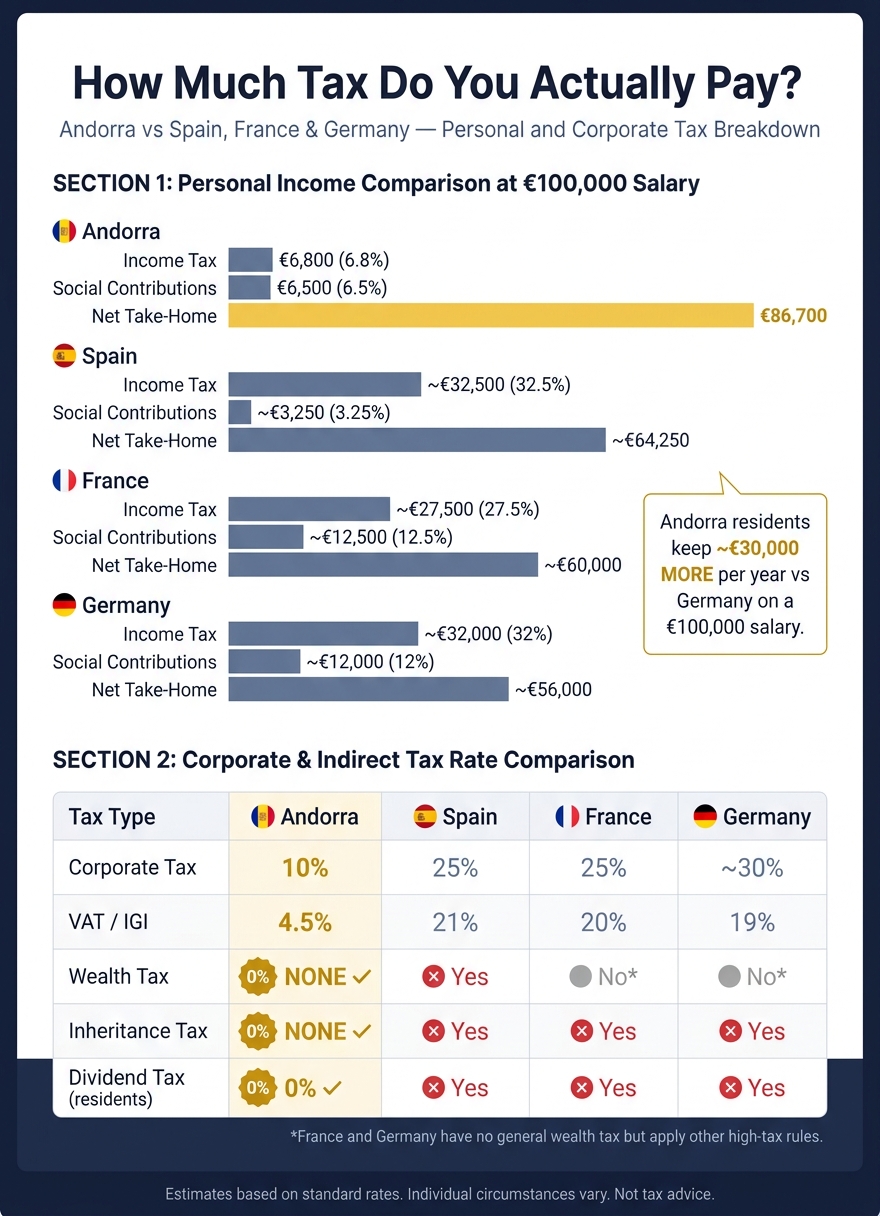
Once residency and substance are set up, the next thing most founders want to know is simple: how much do you actually keep?
Personal tax comparison: Andorra vs Spain, France, and Germany
If a founder pays themselves €100,000 in salary, the difference is hard to miss.
In Andorra, personal income tax comes to about €6,800, and employee social contributions add about €6,500. That leaves estimated take-home pay of €86,700. In Germany, that same €100,000 salary leads to about €32,000 in income tax plus about €12,000 in capped social contributions, which cuts take-home pay to around €56,000.
| Country | Gross Income | Personal Income Tax (Approx.) | Social Contributions (Employee) | Net Take-Home (Est.) |
|---|---|---|---|---|
| Andorra | €100,000 | €6,800 (~6.8%) | €6,500 (6.5%) | €86,700 |
| Spain | €100,000 | ~€30,000–€35,000 | ~€2,500–€4,000 | ~€61,000–€67,500 |
| France | €100,000 | ~€25,000–€30,000 | ~€10,000–€15,000 | ~€55,000–€65,000 |
| Germany | €100,000 | ~€32,000 | ~€12,000 | ~€56,000 |
Put plainly, Andorra lets a much bigger share of that salary stay in your pocket.
And the spread gets much bigger as income climbs. At €400,000 per year, an Andorran resident pays about €36,800 in total tax. In France, the total goes past €226,500 once social contributions are added. On top of that, Andorra has no wealth tax and no inheritance tax.
The same idea carries over to companies too. A lower company rate changes what it costs to pull money out of the business.
Corporate tax, IGI, and total burden comparison
On the company side, the math is just as clear.
Andorra applies a 10% flat corporate tax. That is well below the 25% rate in Spain and France and the roughly 30% combined rate in Germany. And because resident dividends are exempt, profits taken out often face tax only at that 10% company layer.
| Country | Corporate Tax Rate | Standard VAT / IGI | Other burdens |
|---|---|---|---|
| Andorra | 10% | 4.5% | None (no wealth or inheritance tax) |
| Spain | 25% | 21% | Wealth tax, high social security costs |
| France | 25% | 20% | High payroll taxes, exit tax |
| Germany | ~30% | 19% | Trade tax, high social security, exit tax |
There’s also the indirect tax angle. For businesses that sell to consumers, this can matter a lot. Andorra’s 4.5% IGI is the lowest in Europe. Compare that with 21% in Spain, 20% in France, and 19% in Germany.
That doesn’t mean Andorra works for everyone. But for mobile founders and high earners, the tax gap can be big enough to change the whole picture.
Who benefits most from Andorra and what the trade-offs are
Profiles that fit an Andorra move or structure
After the tax comparisons, the next question is simple: who can use Andorra well in practice?
Andorra works best for entrepreneurs who can actually move and run their business from there. The best fit tends to be mobile founders, consultants, freelancers, and holding company owners who can shift their main business base to Andorra. For this group, the mix can be very attractive: a 10% corporate rate, 0% tax on dividends paid from Andorran companies to Andorran residents, and no wealth, inheritance, or gift tax. Put together, those rules can cut your total tax bill by a large margin.
Investors and holding company owners can also be a strong match, especially if they hold large share portfolios. Capital gains on shares held for more than 10 years are often taxed at 0%, and holdings below 25% of a company often get the same treatment. If a big part of your net worth sits in shares, that can matter a lot.
Things look very different for U.S. citizens. The U.S. taxes its citizens on worldwide income no matter where they live. And because there is no treaty, U.S.-source dividends can face 30% withholding, while U.S. reporting duties still remain in place. In plain English: for U.S. citizens, Andorra makes more sense as an asset-protection and lifestyle move than as a pure tax play. The 0% wealth and inheritance tax still has clear appeal, but IRS filings, FBAR, and FATCA reporting do not disappear.
Main trade-offs and key takeaways
The tax upside is there. But it only works if you’re willing to take on the residency rules and the substance burden.
That is the main trade-off: compliance. You need to meet the residency tests and run the company with real local substance. This isn’t a paper setup. Local substance is mandatory, and inspections are strict.
Banking can also be the slowest part of the process. Compliance checks are tough, and Andorra’s private banking sector asks for thorough documentation before opening accounts. Day-to-day logistics matter too: Andorra has no airport, so the nearest options are Barcelona and Toulouse.
For entrepreneurs who can commit to the lifestyle, build real substance, and deal with the compliance side the right way, Andorra can live up to what the numbers suggest. If that commitment isn’t realistic, the structure is much less likely to stand up under scrutiny.
FAQs
Do I have to live in Andorra full-time to get the tax benefits?
To get Andorra’s personal tax perks, you need to become an official tax resident. In most cases, that means living in Andorra for more than 183 days per year.
You can own an Andorran company without living there. But that alone doesn’t let you claim resident tax treatment. If you want things like the 10% income tax cap or dividend exemptions, you must meet Andorra’s residency rules and show real physical presence plus economic ties in the country.
What counts as real business substance in Andorra?
Real business substance in Andorra means showing actual economic activity through:
- a dedicated office
- appropriate staff
- effective management
In plain English, the company needs to look and operate like a real business, not just exist on paper.
That usually means having commercial premises in Andorra, with utilities in the company’s name. It also means having an Andorra tax-resident decision-maker who lives there for at least 183 days a year and is actually running the business. On top of that, the company should have a viable business plan that makes sense for what it says it does.
Authorities also look at staffing. The team should match the nature and scale of the business, rather than suggesting a shell company with little or no day-to-day activity.
Is Andorra still tax-efficient for U.S. citizens?
Yes, but it takes careful planning because the U.S. taxes citizens on worldwide income.
That means an American in Andorra can still run into double-tax risk if the same income is taxed in both places. The risk can be higher without a double taxation treaty, especially for dividends.
There are ways to cut that tax hit. U.S. citizens may use the foreign earned income exclusion, foreign tax credits, and the right business structure. At the same time, they can benefit from Andorra’s 10% top personal income tax rate, 10% corporate tax rate, and no wealth, inheritance, or gift taxes.
Full IRS and FBAR compliance is a must.
