
If I had to sum it up in one line: there is no single “tax-free” country for every nomad, and for Americans, moving abroad does not end U.S. tax filing.
Here’s the short version:
- Zero personal income tax: UAE, Bahamas, Bermuda, Cayman Islands, and Monaco
- Territorial tax: Panama and Georgia, with Costa Rica offering a foreign-income break for those using digital nomad visas
- Low-tax residency for some income types: Cyprus, mainly for dividends and passive income
- Best low-cost picks: Georgia and Costa Rica
- Best for high earners: UAE
- Best for EU access: Cyprus or Monaco
- Best for U.S. time-zone fit: Panama, Costa Rica, and the Bahamas
The big point is simple: “tax-free” can mean three different things. Some countries tax personal income at 0%. Others tax only local income. Others give low tax only under a residency rule. That means two places can sound similar but give very different results once you look at where your income comes from, where you do the work, and how long you stay.
For U.S. citizens, there’s one more layer. The IRS still taxes worldwide income, even if you live abroad. In 2026, the Foreign Earned Income Exclusion is $132,900, which can cut federal tax, but it does not remove filing duties.
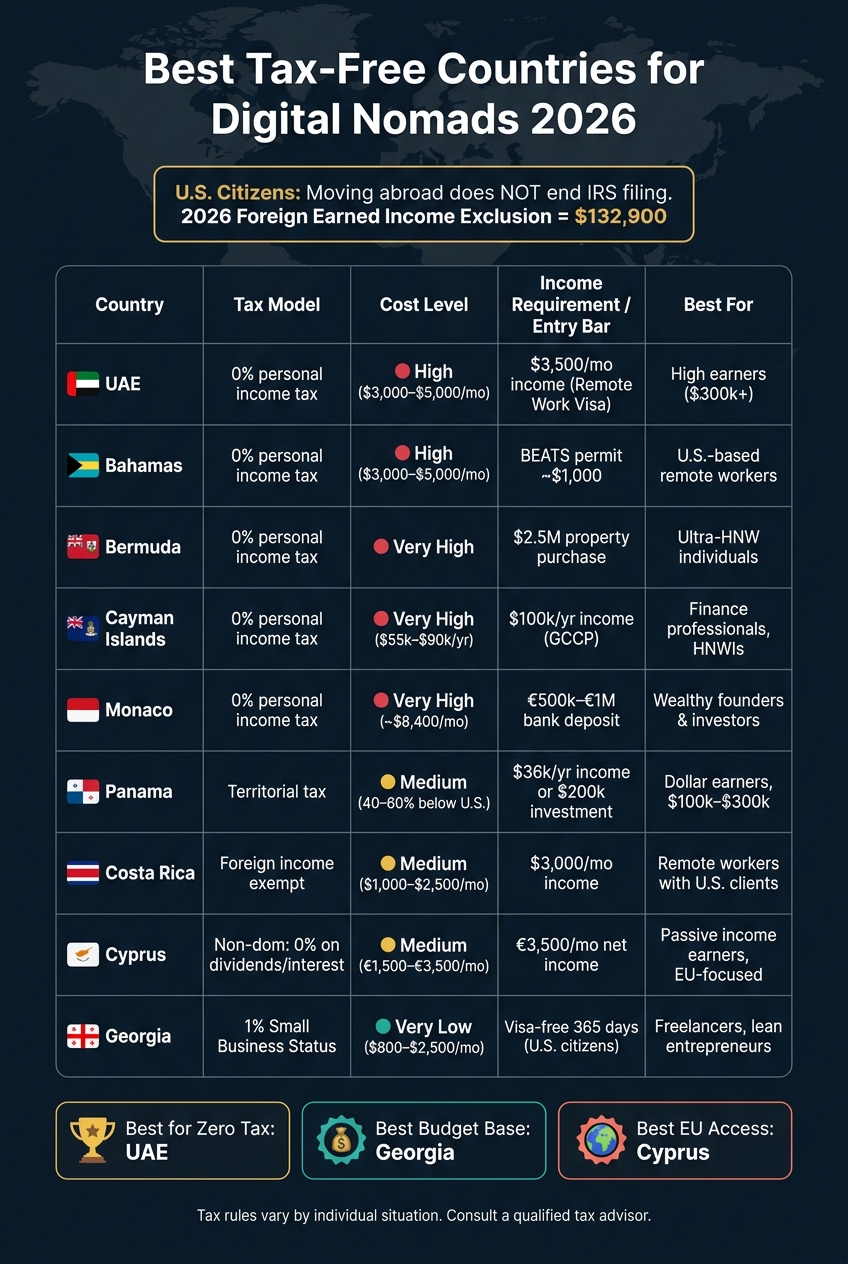
Quick comparison
| Country | Tax model | Main cost level | Main entry path | Best fit |
|---|---|---|---|---|
| UAE | 0% personal income tax | High | Remote Work Visa / Freelancer Visa | High earners |
| Bahamas | 0% personal income tax | High | BEATS permit | U.S.-based remote workers |
| Bermuda | 0% personal income tax | Very high | High-cost residency routes | Wealthy residents |
| Cayman Islands | 0% personal income tax | Very high | GCCP | High-income remote workers |
| Monaco | 0% personal income tax | Very high | Carte de Séjour | Wealthy founders and investors |
| Panama | Territorial tax | Medium | Remote Worker Visa / Friendly Nations | Dollar earners wanting lower costs |
| Costa Rica | Foreign income exempt for nomad visa holders | Medium | Digital Nomad Visa | Remote workers with foreign clients |
| Cyprus | Low tax for non-doms | Medium | Digital Nomad Visa / tax residency | Passive income earners |
| Georgia | Territorial rules + 1% small business option | Low | Visa-free stay / IE setup | Freelancers and lean operators |
My takeaway: if you want the cleanest zero-tax setup, I’d look at the UAE first. If I wanted low costs, I’d look at Georgia or Costa Rica. If I wanted a middle path with EU access, I’d look at Cyprus. And if I were American, I’d treat this as a tax and residency solutions, not a way to stop filing with the IRS. You should also consider how tax residency and CRS impact your global accounts.
sbb-itb-39d39a6
1. United Arab Emirates (UAE)
The UAE has no personal income tax on salary, freelance income, dividends, capital gains, or investment returns. That makes it one of the clearest zero personal income tax setups for digital nomads. There is a 9% corporate tax, but it applies only to business profits above AED 375,000. For most solo nomads, the main tax question is simple: are you working as an individual or through a company?
Of course, tax rules are only part of the story. You also need a way in. The UAE offers three main residency paths. The Remote Work Visa is the most direct option. It calls for $3,500 per month in income, lasts one year, and can be renewed. Many self-employed nomads go with a Freelancer Visa through a Free Zone, which usually costs $2,000 to $4,100 per year. If you want a longer runway, the 10-year Golden Visa requires a property investment of about $545,000 and has no minimum stay rule.
The trade-off is cost. Dubai is not cheap. A comfortable solo lifestyle usually lands around $3,000 to $5,000 per month, and a one-bedroom apartment often runs $1,360 to $2,450 per month. Private health insurance is also mandatory, which adds about $1,500 to $4,000 per year.
Then there’s the day-to-day side of life. The 8- to 12-hour time difference from the U.S. can make live calls rough, especially if your clients are stateside. Summer is another factor. From May through September, temperatures often hit 104°F to 122°F. In plain terms, the UAE works best for higher earners who want zero personal tax and don’t mind paying more to get it.
For nomads who want zero tax without the same cost pressure, the next options are worth a look.
2. Bahamas
The Bahamas doesn’t charge personal income tax, capital gains tax, inheritance tax, or tax on personal earnings, whether that income comes from inside the country or abroad. Instead, the government brings in money through a 12% VAT, import duties, and tourism. That tax setup gets a lot of attention. But for most remote workers, the bigger issue is simpler: how easy is it to live there legally?
For many nomads, the usual path is BEATS (Bahamas Extended Access Travel Stay). It’s a one-year permit, it can be renewed, and it costs about $1,000. If you’re thinking longer term, there’s also a property-based fast-track path to permanent residency. As of January 2025, the minimum investment is $1,000,000. So yes, BEATS can work. The catch is that island life here isn’t cheap, and that changes the equation fast.
Nassau is only 50 miles from the Florida coast, with direct flights to Miami, New York, and many other U.S. cities. That’s a big plus if you need easy access back to the States. Internet in Nassau is dependable enough for remote work, though service gets less steady on the more remote Out Islands. Banking is also well developed, but opening an account usually takes 4 to 8 weeks because of tighter compliance checks.
The biggest downside is cost. Since almost everything is imported, prices climb fast. A comfortable monthly budget for one person is usually $3,000 to $5,000, while a family of four should plan on roughly $90,000 to $150,000 per year. Hurricane season runs from June through November, which can bring travel issues, property risk, and higher insurance costs. In return, Nassau tends to work better for nomads who want stronger infrastructure, hospitals, and schools.
If you’re a U.S. citizen, there’s one thing you can’t sidestep: you still owe U.S. tax on your worldwide income. So Bahamian residency can ease local tax issues, but it doesn’t remove U.S. filing duties.
For nomads who want another zero-tax island option with a different residency profile, Bermuda is next.
3. Bermuda
Bermuda doesn’t levy personal income tax, so salaries, freelance earnings, dividends, and capital gains aren’t taxed locally. On paper, that sounds great. In practice, the bigger issue is getting in.
This is not the easy-entry, low-cost path that many remote workers look for. Bermuda tends to fit ultra-high-net-worth residents and people in finance. Permanent residency usually calls for a property purchase of at least $2.5 million. That puts it in a very different lane from the UAE or the Bahamas, where lower-cost visa options are available for working nomads.
For remote work, Bermuda’s biggest plus is its reliable high-speed subsea cable connectivity. If your work depends on stable internet, that matters a lot. The island also sits in the North Atlantic and has a well-developed banking sector tied to its international insurance industry.
The catch is cost. Bermuda has a high cost of living, so the math isn’t just about paying no local income tax. Housing and residency-related costs can carry as much weight as the tax upside. So while Bermuda can work well for nomads who have deep pockets and want dependable connectivity, it’s not a natural fit for remote workers trying to keep costs down.
4. Cayman Islands
The Cayman Islands charge 0% personal income tax. There’s also no capital gains tax, inheritance tax, wealth tax, or VAT. That applies to both foreign income and Cayman-source personal income, and you don’t need to file a personal tax return.
For remote workers, the main path in is the Global Citizen Concierge Programme (GCCP). It lets you stay for up to 2 years with unlimited entries and exits. But there’s a catch: you must work for a company outside the Cayman Islands and meet these minimum annual income levels:
- $100,000 for individuals
- $150,000 for couples
- $180,000 for families with children
The fee is $1,469 per year for the main applicant, plus $500 per dependent. Processing usually takes 3 to 4 weeks. If you want to establish tax residency, you’ll generally need to spend 183 days or more per year on the islands. So the permit itself is fairly simple. The bigger hurdle is what it costs to live there.
On the lifestyle side, Cayman has a lot going for it. Internet speeds can reach 300 Mbps, USD is widely accepted alongside the Cayman Islands dollar, and Grand Cayman has year-round direct flights to the U.S. East Coast. That said, this is NOT a budget base. A single person can expect annual costs of $55,000 to $90,000, while a family of four may spend $120,000 to $200,000 per year.
A big reason prices run high is import duty. Most goods face duties of 22% to 27%, which pushes up day-to-day expenses. And if you’re thinking past a remote work permit, long-term permanent residency comes with a steep bar: at least $1.2 million invested in real estate or a local business.
Cayman makes the most sense for high earners who want a simple zero-tax base and can handle island-level prices. After this, the trade-off changes. The next countries swap premium island costs for different residency and tax setups.
5. Monaco
Monaco charges 0% personal income tax for most residents. There’s one big exception: French nationals who moved there after 1957 still owe French tax under the bilateral treaty. In plain English, Monaco tends to suit high-income nomads who care more about zero local income tax and Schengen access than low living costs. It’s less of a classic nomad base and more of a residency play.
There’s no digital nomad visa in Monaco. Most remote workers go through the standard Carte de Séjour route. That means you’ll need a 12-month registered lease or a property deed, police clearances from every country where you’ve lived during the past five years, and a bank reference from a Monegasque bank. If you’re non-EEA and non-Swiss, you must first get a French Long-Stay Type D Visa before applying for Monaco residency. And here’s where things get serious: Monaco banks often ask for a €500,000 deposit, and some ask for €1,000,000.
Monaco also requires 183 days of physical presence each year to keep residency. The permit path moves in stages:
- A one-year temporary permit at first
- Annual renewals for three years
- Then a three-year "Ordinary" permit
- Then a ten-year "Privileged" permit after a decade of continuous residency
The initial application fee is just €80, which sounds tiny next to the banking and housing costs.
Daily life in Monaco is expensive. A single person spends about $8,400 per month. Rent brings another layer of cost because tenants pay a 1% leasehold tax on annual rent, and most goods and services come with 20% VAT. So yes, income may be untaxed, but spending still adds up fast.
Monaco’s tax treaty network is small, with just 10 countries covered. That can create withholding-tax friction for investors with U.S. or Swiss holdings. On the lifestyle side, the setup is strong: Monaco has 100% fiber-optic coverage, and average download speeds run between 232 and 267 Mbps. Safety is also top-tier, rated 10/10, with one of the highest police-to-resident ratios in the world.
U.S. citizens still have to file with the IRS while living in Monaco. For nomads who want low-tax residency without Monaco’s steep price, territorial-tax jurisdictions are often a more practical option.
6. Panama
Panama changes the comparison a bit. Instead of a zero-tax island setup, you’re looking at a lower-cost territorial tax system.
Here’s the key point: Panama taxes only Panama-source income. So if your clients are abroad, that income is usually tax-free in Panama. But there’s an important catch. If the work is physically done in Panama, authorities may treat it as Panama-source income, even when the clients are outside the country. That’s why clean records matter. Your contracts, invoices, and work history should clearly show where the services were delivered and used.
Residency is the next hurdle, because your tax treatment depends on staying in the country legally and being able to document the source of your income.
The Short Stay Remote Worker Visa is built for digital nomads. It’s valid for 9 months and can be renewed once, for a total of 18 months. To qualify, you need at least $36,000 per year in foreign-source income. The visa also comes with a $250 application fee, plus $50 on approval. It does not lead to permanent residency.
If you want a longer-term route, the Friendly Nations Visa may be the better fit. It applies to nationals from more than 50 countries, including the U.S., UK, and Canada, and it leads to permanent residency after a 2-year provisional period. To qualify, you need a minimum $200,000 investment in either real estate or a fixed-term bank deposit held for at least three years.
Tax residency itself usually means spending more than 183 days in Panama during a calendar year.
| Visa Option | Min. Income / Investment | Duration | Leads to Permanent Residency |
|---|---|---|---|
| Short Stay Remote Worker | $36,000/year | 18 months (9 months + 9-month renewal) | No |
| Friendly Nations | $200,000 investment | 2-year provisional period | Yes |
Panama uses the U.S. Dollar as its main currency. Living costs in Panama City are roughly 40% to 60% lower than in similar U.S. cities, which can make a big difference if you’re billing in dollars. The time-zone match with the U.S. East and Central coasts also makes day-to-day work easier for people serving North American clients.
One friction point is banking. Opening an account can take 3 to 5 months because of strict KYC, FATCA, and CRS checks.
For holding companies, Panama’s 0% tax on foreign passive income now comes with a stricter test. You need real substance, such as an office, staff, and records. Shell companies no longer qualify.
That leaves Panama in a strong spot for nomads who want lower living costs and more residency paths than the island options above.
7. Costa Rica
Costa Rica goes a step beyond the usual territorial setup by spelling out the digital nomad tax break in plain terms. Under Law No. 10008, the visa taxes only local income and gives eligible digital nomads a 100% exemption on foreign-earned income. You also don’t need a local company to apply.
To qualify, you need to show at least $3,000 per month as an individual or $4,000 per month for a family. The visa lasts one year and can be renewed once for a second year. It does not lead straight to permanent residency, although Costa Rica does have separate long-term routes if you want to stay beyond that.
Living costs usually fall between $1,000 and $2,500 per month, depending on where you live and how you like to live. That range can look very different in practice. A simple setup outside the main hubs will cost less, while beach towns and places set up for expats can push spending higher.
Costa Rica also lines up well with U.S. working hours, which is a big plus if your clients or employer are based in the United States. That time-zone overlap makes same-day meetings, Slack replies, and live calls much easier to handle.
Next is Cyprus, where tax results depend more on residency and remittance rules than on a pure territorial system.
8. Cyprus
Cyprus sits in an interesting middle ground. It isn’t a pure territorial-tax country, and it isn’t a zero-tax haven either. Instead, it offers low tax treatment for a very specific type of resident. If your setup leans toward passive income and you’re willing to meet the residency rules, it can look pretty attractive.
Here’s the basic idea: the non-dom regime is open to tax residents who are not domiciled in Cyprus and who have not been Cyprus tax residents for 17 of the last 20 years. The deal is pretty straightforward. Passive income can be close to zero, but earned income is still taxed, and you need residency to use the regime.
Under non-dom status, dividends and passive interest are taxed at 0% for 17 years. There is still a 2.65% healthcare contribution, capped at €4,770 per year. On top of that, foreign shares and bonds are generally exempt from capital gains tax.
If you earn money from remote work, Cyprus treats that income differently. Employment and similar earned income are taxed on a progressive scale. As of January 1, 2026, the first €22,000 of taxable annual income is taxed at 0%. And if you’re an eligible first-time employee earning more than €55,000 per year, you may claim a 50% income tax exemption.
Cyprus also gives you a 60-day tax residency rule, which is one of the more flexible parts of the system. To use it, you need to keep a permanent residence in Cyprus and maintain local ties there. A 2026 reform dropped the old rule that required you to prove you were not tax resident in another country.
For non-EU nomads, the Digital Nomad Visa sets a fairly clear bar. You need €3,500 in net monthly income, the visa lasts one year, and you can renew it for up to two more years. If you’re thinking longer term, permanent residency has a much higher entry cost: it requires a new-build real estate purchase of €300,000 plus VAT.
From a day-to-day standpoint, Cyprus is also fairly easy to navigate for many remote workers:
- English is spoken by more than 80% of the population
- Fiber internet in urban areas usually runs from 80 to 120 Mbps, with some plans going up to 1 Gbps
- EU single-market access can help if you work with clients across Europe
| City | Monthly Cost Range (EUR) |
|---|---|
| Limassol | €2,500–€3,500 |
| Nicosia | €2,000–€2,800 |
| Paphos | €1,800–€2,500 |
| Larnaca | €1,500–€2,200 |
The main appeal here is easy to see: strong treatment for dividends and passive interest, paired with an EU base. The friction point is just as clear. You need to be comfortable with the residency rules, and if most of your income comes from active work, the tax outcome won’t look as light.
Georgia offers a simpler territorial alternative for nomads who want lower taxes with less administrative burden.
9. Georgia
Where Cyprus leans more toward passive-income planning, Georgia is often the simpler low-tax base for people doing active remote work.
Here’s the key thing: Georgia generally does not tax foreign-source income. But if you perform services while you’re physically in Georgia, that income can be treated as Georgian-source income. That’s why many remote workers set up as an Individual Entrepreneur with Small Business Status.
Under that setup, you can pay a 1% flat tax on gross turnover up to 500,000 GEL. If your turnover goes above that amount, the excess is taxed at 3%. There are also no social security contributions under this status. For IT businesses that serve only foreign clients, the Virtual Zone regime can cut corporate income tax to 0%, with a 5% dividend withholding tax.
Entry is one of Georgia’s big draws. Citizens of more than 95 countries, including the U.S., can stay visa-free for up to 365 days. Tax residency usually starts after 183 days in any 12-month period.
There’s a new wrinkle, though. As of March 1, 2026, Georgia requires most foreign nationals working in Georgia to hold a Special Labour Activity Permit. Starting May 1, 2026, enforcement includes fines of GEL 2,000 for both the worker and the employer.
If you want a residence route, Georgia also offers an IT Residence Permit for people with at least $25,000 in annual income and 2+ years of IT-sector experience.
On the ground, Tbilisi is still a low-cost base. Comfortable monthly living costs usually land between $800 and $2,500, and a central one-bedroom apartment often costs $600 to $1,000 per month. Fiber internet commonly hits 100 to 300 Mbps, 5G is live in central areas, and the city has a solid coworking scene along with a strong food and wine culture.
There are tradeoffs. Safety is decent, with a 7.5/10 SafetyShield Index score. English can be limited outside expat circles. The GMT+4 time zone is handy for Europe, but it can be awkward if your team is based in the U.S. Banking works, but opening accounts has gotten tougher for newcomers. Big banks such as TBC Bank and Bank of Georgia have tightened non-resident onboarding since 2023. Georgia also joined the Common Reporting Standard in 2024 and still doesn’t have a modern U.S. tax treaty, which can make things messier for American nomads.
| Feature | Detail |
|---|---|
| Foreign Income Tax | Generally exempt for individuals under territorial rules |
| Small Business Status Rate | 1% on turnover up to 500,000 GEL; 3% above |
| Virtual Zone (IT) | 0% corporate tax / 5% dividend withholding |
| Visa-Free Stay | Up to 365 days for citizens of 95+ countries, including the U.S. |
| Tax Residency Trigger | 183 days in any 12-month period |
| Monthly Cost of Living | $800 to $2,500 in Tbilisi |
| Internet Speed | 100 to 300 Mbps fiber in Tbilisi |
| Time Zone | GMT+4 |
That makes Georgia a strong fit for nomads who want low taxes, low costs, and a simple base – not a pure zero-tax haven.
Pros and cons by digital nomad profile
No single jurisdiction fits every nomad. The best choice depends on three things: how much you make, how often you move, and what you need day to day. Income is usually the fastest filter, because higher earners can handle higher residency and setup costs.
If you earn under $100,000 per year, Georgia and Costa Rica stand out. Georgia’s Small Business Status taxes turnover at just 1% up to 500,000 GEL, and day-to-day costs stay low. Costa Rica exempts foreign-source income and has a simple digital nomad visa path, similar to the Portugal digital nomad visa.
For those in the $100,000 to $300,000 range, Panama and Cyprus tend to hit the best mix of tax treatment and day-to-day setup. If you run a business, the UAE starts to make sense too, since its 9% corporate tax kicks in only above AED 375,000 (about $102,000).
Once income moves past $300,000, the numbers start to point much more clearly toward zero-tax jurisdictions. The UAE, Bahamas, Monaco, and Cayman Islands all have 0% personal income tax, but the cost to get in and live there is much higher. These are not light moves. They take planning, cash, and a clear reason for being there.
Income isn’t the whole story, though. Residency paperwork can make or break the tax upside. You need a clear tax residency position. If you try the perpetual-traveler route, things can fall apart fast if your home country still sees you as a tax resident.
The table below gives a fast fit check by profile.
| Country | Main advantages | Main drawbacks | Best for | Poor fit for |
|---|---|---|---|---|
| UAE | 0% personal tax; strong infrastructure; Golden Visa | High cost; extreme summer heat | High earners ($300k+) | Budget-conscious nomads |
| Bahamas | 0% tax; Eastern Time Zone; 50 miles from Florida | High cost of imported goods; high property minimum | Ultra-high-net-worth individuals; U.S.-based executives | Low-to-mid earners |
| Cayman Islands | 0% personal income tax | Permanent residency requires $1.2M+ property investment | Ultra-high-net-worth individuals; crypto investors | Nomads without significant capital |
| Monaco | 0% tax; European access and security | €500,000 bank deposit; world’s most expensive real estate | Ultra-high-net-worth individuals | Most digital nomads |
| Panama | Territorial tax; USD economy; strong U.S. flight links | Friendly Nations residency requires $200,000 investment | U.S. nomads; $100k–$300k earners | Those seeking European lifestyle |
| Costa Rica | Foreign-source income exempt; straightforward digital nomad visa | Slower bureaucracy; higher costs than Georgia | Remote workers with U.S. clients | High-frequency traders needing ultra-fast infrastructure |
| Cyprus | 0% on dividends and interest for 17 years; 60-day stay rule; EU access | Company maintenance costs; 1,000-permit nomad cap | Passive income earners; EU-focused nomads | Those with high local-source employment income |
| Georgia | 1% Small Business Status tax; 365-day visa-free stay for U.S. citizens | Limited banking; political uncertainty; language barrier | Freelancers; budget-conscious nomads | High-net-worth individuals requiring top-tier banking |
Conclusion
These nine options fit into three tax setups and a few clear lifestyle profiles. At the highest level, the choice comes down to zero-tax jurisdictions, territorial systems, and special residency regimes.
For high earners who want a 0% personal-tax base, the UAE is still the clearest pick in 2026. The downside is the cost of living. Even so, it offers a mix of access and tax clarity that very few places can match. Among the zero-tax island choices, the Bahamas is easier to get into than Bermuda or the Cayman Islands, though all three come with premium living costs and high residency bars.
If the island path feels out of reach, territorial systems give you a lower-cost way to cut taxes legally. Georgia, Panama, and Costa Rica stand out as the best territorial-tax or near-territorial options for budget-conscious nomads.
For people who care more about EU access than pure tax elimination, Cyprus lands somewhere in the middle. Cyprus is the middle ground: useful for EU access and passive income, but not a true tax-free base.
Monaco works best for wealthy residents and founders who want a premium European base; the UAE gives many of the same tax upsides with easier economics.
The table below works as a quick decision grid built around the three factors that shape most final choices.
| Country | Tax Efficiency | Affordability | Residency Practicality | Best For |
|---|---|---|---|---|
| UAE | High (0% personal) | Low | High (Freelancer/Golden Visa) | Remote professionals |
| Bahamas | High (0% personal) | Medium | Medium | High earners, U.S.-based |
| Bermuda | High (0% personal) | Very Low | Low | Ultra-high-net-worth individuals |
| Cayman Islands | High (0% personal) | Very Low | Low | Finance professionals, HNWIs |
| Monaco | High (0% personal) | Very Low | Low | Wealthy founders |
| Panama | High (territorial) | High | High (Friendly Nations Visa) | Budget nomads |
| Costa Rica | High (territorial) | Medium | High (Digital Nomad Visa) | Remote workers with foreign clients |
| Cyprus | Medium (non-dom) | Medium | High (60-day rule) | Passive investors, EU-focused nomads |
| Georgia | High (1% tax) | Very High | Very High (easy registration) | Lean entrepreneurs, freelancers |
U.S. citizens still have to file on worldwide income, so moving abroad changes residency treatment, not the filing duty.
FAQs
What does “tax-free” really mean for digital nomads?
For digital nomads, tax-free can mean three different things:
- True zero-tax countries
- Territorial tax systems that don’t tax foreign-sourced income
- Non-domicile regimes where foreign income may go untaxed unless it’s remitted
That sounds simple at first. But here’s where people get tripped up: a digital nomad visa by itself does not guarantee tax-free status.
Tax rules usually depend on more than your visa. In many cases, staying more than 183 days can trigger tax residency. And once that happens, your tax picture can change fast.
There’s also a big catch for Americans. U.S. citizens are still taxed on worldwide income, even if they live abroad. The FEIE may help, but it doesn’t erase the rule.
Do I owe tax where I live or where I work?
It depends on your citizenship, your tax residency, and where your income comes from.
U.S. citizens owe federal tax on their worldwide income no matter where they live. That said, the FEIE may let them exclude up to $132,900 of foreign-earned income.
In many other countries, tax is tied to residency instead. A common rule kicks in after 183 days in the country.
Some territorial-tax countries usually tax only income earned locally. And places like the UAE have 0% personal income tax if you meet the residency rules.
How can U.S. citizens lower taxes while living abroad?
U.S. citizens still owe U.S. tax on worldwide income even while living abroad.
One of the main tax breaks is the Foreign Earned Income Exclusion. If you qualify, you can exclude up to $132,900 in foreign-earned income for the 2026 tax year.
To qualify, you need to meet either the Physical Presence Test or the Bona Fide Residence Test.
If you combine that with a low-tax jurisdiction like the UAE, your tax bill may drop even more.
That said, the rules can get tricky fast. It’s smart to work with an expat-tax specialist to stay on top of FATCA and FBAR compliance.
