
Most countries have no annual net wealth tax in 2026. But that does not mean low tax overall. I’d look at income tax, capital gains, inheritance, property taxes, and residency rules before treating any country as a low-tax move.
Here’s the short answer:
- Only a small group of countries still charge a broad annual wealth tax
- Many places with 0% wealth tax still tax property, gains, or estates
- If you’re a U.S. citizen or green card holder, the IRS can still tax your worldwide income even after you move
The article’s main list covers these 20 no-wealth-tax places:
- UAE
- Singapore
- Monaco
- Hong Kong
- Portugal
- United Kingdom
- Cyprus
- Malta
- Andorra
- Bahrain
- Qatar
- Bahamas
- Cayman Islands
- British Virgin Islands
- St. Kitts and Nevis
- Costa Rica
- New Zealand
- Australia
- Germany
- Sweden
My takeaway: if you want a place with no wealth tax, the list is long. If you want a place with low total tax, clean residency rules, and a setup that works for your citizenship and assets, the list gets much shorter.
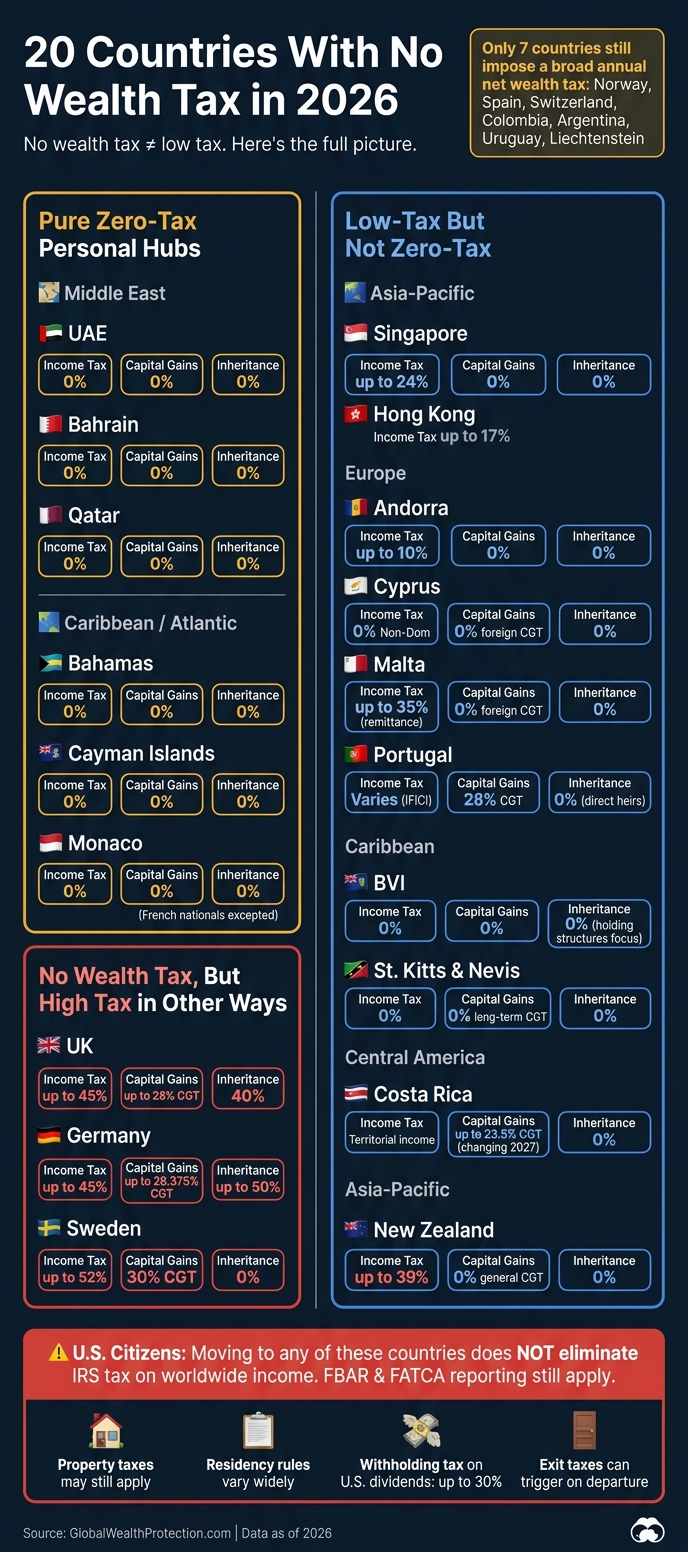
Quick Comparison
| Country | Wealth Tax | Personal Income Tax | Estate / Inheritance | Main Watch-Out |
|---|---|---|---|---|
| UAE | 0% | 0% | 0% | Tax residency rules still matter |
| Singapore | 0% | Up to 24% | 0% | Foreign buyers face high property taxes |
| Monaco | 0% | 0% | Limited | High cost of entry |
| Hong Kong | 0% | Up to 17% | 0% | Source rules can tax trading gains |
| Portugal | 0% | Varies | 0% for direct family | AIMI on high-value property |
| UK | 0% | Up to 45% | 40% | Inheritance tax can hit hard |
| Cyprus | 0% | Up to 35% | 0% | Local income rules still matter |
| Malta | 0% | Up to 35% | 0% | Remittance rules drive the result |
| Andorra | 0% | Up to 10% | 0% | Residency needs physical presence |
| Bahrain | 0% | 0% | 0% | VAT and property transfer fees |
| Qatar | 0% | 0% | 0% | Succession rules need planning |
| Bahamas | 0% | 0% | 0% | Property and indirect taxes |
| Cayman Islands | 0% | 0% | 0% | High residency costs |
| BVI | 0% | 0% | 0% | More useful for structures than relocation |
| St. Kitts and Nevis | 0% | 0% | 0% | Short-term gains can be taxed |
| Costa Rica | 0% | Territorial | 0% | Local-source income still taxed |
| New Zealand | 0% | Up to 39% | 0% | Foreign investment rules can bite |
| Australia | 0% | Up to 47% | 0% | CGT and exit rules matter |
| Germany | 0% | Up to 45% | Up to 50% | Exit tax and transfer tax |
| Sweden | 0% | High | 0% | Capital gains still taxed |
If I were narrowing this down fast, I’d split the list into three groups:
- Pure zero-tax personal hubs: UAE, Bahrain, Qatar, Bahamas, Cayman
- Low-tax but not zero-tax options: Singapore, Hong Kong, Andorra, Cyprus, Malta
- No wealth tax, but still high-tax in other ways: UK, Germany, Australia, Sweden, Portugal
That’s the part most people miss: “no wealth tax” is only the first filter, not the answer.
sbb-itb-39d39a6
What ‘No Wealth Tax’ Actually Means in 2026
A net wealth tax is a direct yearly tax on your total net worth: the market value of everything you own, minus your debts and other liabilities. The big idea is the yearly part. You owe it each year whether your assets produced income or not, and whether you sold anything or not. It goes after built-up wealth, not current income.
That’s different from income tax, capital gains tax, property tax, estate and inheritance taxes, gift taxes, and transfer taxes. Those taxes apply to earnings, sales, property, transfers, or other transactions, not to your full net worth. And that difference matters. Some countries don’t tax net worth directly, but they still tax assets in other ways.
The Netherlands’ Box 3 system is a good example. It taxes a presumed return on savings and investments, so in practice it works a lot like a wealth-style tax, even though it is not a separate net wealth tax. So when you hear “no wealth tax,” it doesn’t always mean asset owners get a free pass.
As of 2026, only seven countries still impose a broad recurring annual net wealth tax:
- Norway
- Spain
- Switzerland
- Colombia
- Argentina
- Uruguay
- Liechtenstein
That’s the frame for the list below: countries that do not impose a broad annual net wealth tax in 2026, with notes on the other taxes that can still hit wealth.
Why U.S. Readers Need to Look Beyond the Label
The U.S. does not impose a federal annual net wealth tax, and it taxes citizens and green card holders on worldwide income no matter where they live. So if another country has a 0% wealth-tax rate, that sounds nice on paper, but it does not change how the U.S. taxes you. That’s the key point. A no-wealth-tax country is just one piece of the puzzle.
There’s also the reporting side. Foreign accounts and foreign companies can still trigger FATCA, FBAR, and CFC filing rules. In plain English: more offshore assets usually mean more paperwork, not less. This complexity is often the trade-off for offshore asset protection and long-term financial security. On top of that, state tax rules may still create exposure even after you move abroad. And if you give up U.S. citizenship, Section 877A can impose an exit tax on unrealized gains.
So the country list below is about local wealth-tax rules, not complete U.S. tax relief. With that frame in place, the next section looks at places that do not impose a net wealth tax.
1. United Arab Emirates
The UAE is one of the clearest no-wealth-tax choices in 2026. Individuals pay no net wealth tax, no personal income tax, and no inheritance tax.
That said, it’s not a zero-tax system across the board. Other taxes still come into play:
- A 9% federal corporate tax applies to business profits above AED 375,000 (about $102,000)
- A 5% VAT applies to most goods and services
- Real estate deals come with a one-time transfer fee of 4% in Dubai and 2% in Abu Dhabi
Residency takes either documented physical presence or a qualifying investment. The Golden Visa is open to people with at least AED 2,000,000 (about $545,000) in property or fund investment. It gives you residency without a minimum stay rule, but it does not by itself make you a tax resident.
To get a Tax Residency Certificate, you’ll usually need 183 days in-country, or 90 days if you also have a permanent home and local ties. That can help you use the UAE’s 140+ double tax treaties, but it does nothing to change U.S. tax exposure.
For U.S. citizens, this is the part that trips people up. Moving to Dubai or Abu Dhabi doesn’t switch off the IRS. U.S. tax and reporting rules still apply, including FBAR and FATCA, no matter where you live.
Estate planning also needs attention here. At death, account access can freeze. Non-Muslims should register a DIFC or ADJD will if they want to control inheritance and avoid delays.
2. Singapore
Singapore is another major no-wealth-tax jurisdiction, but it takes a different approach. There’s no annual net wealth tax, no capital gains tax, and no inheritance or estate duty as of 2026.
Its tax system is territorial. That means most foreign-sourced income isn’t taxed for individuals. Foreign dividends, rental income, and business profits earned outside Singapore are generally not taxable, even when remitted. Dividends from Singapore-resident companies are also tax-free under the one-tier corporate tax system.
That said, local taxes still carry weight. Personal income tax tops out at 24% on income above SGD 1 million, and the corporate tax rate is a flat 17%. Residential property can get expensive from a tax angle too: foreigners pay 60% ABSD, while entities and trusts pay 65%.
Tax residency usually starts after 183 days. Singapore also has investor and work-pass paths for people who want to move there, though citizenship comes with a big trade-off: applicants must renounce any other nationality.
3. Monaco
Monaco is famous for its tax setup, and the headline is simple: no net wealth tax, no personal income tax, no capital gains tax, and no annual property tax.
That said, “tax-free” doesn’t mean cost-free. Monaco still applies 20% VAT, about 6% in property purchase fees, and a 25% business profits tax for companies that earn most of their revenue outside Monaco. Inheritance and gift taxes apply only to Monaco-situs assets. Direct-line transfers are taxed at 0%.
There’s also an important catch for some people. French nationals still fall under French income tax rules because of the 1963 treaty. And if you’re a U.S. citizen or green card holder, Monaco doesn’t wipe away your U.S. tax bill or filing duties. You still owe U.S. tax and still have to file.
For residency planning, the tax pitch is only part of the story. Substance matters more than the headline. In practice, banks often ask for a €500,000 deposit, and some private banks want €1 million or more. On top of that, getting a residence card is not the same as becoming a tax resident. Tax residency calls for a separate certificate and Monaco to be your main home base, often backed by 183+ days per year in the principality.
Next: Hong Kong, another no-wealth-tax jurisdiction, but with a very different setup for income and property rules.
4. Hong Kong
Hong Kong has no net wealth tax and no estate, gift, or inheritance taxes. It also uses a territorial tax system, which means it taxes only income and profits sourced in Hong Kong. That setup makes Hong Kong appealing for many investors. But it isn’t tax-free in day-to-day life.
The main taxes people still run into are:
- Salaries tax of up to 17%
- Property tax of 15% on net assessable rental value
- Stamp duty on stock and property transfers
There’s also an important gray area around asset sales. If the government views a sale as part of trading activity, the gain can be taxed as trading profits. So the difference between an investment gain and a trading profit isn’t just legal fine print – it can change the tax result in a big way.
For investors, residency rules matter just as much as headline tax rates. Under the New Capital Investment Entrant Scheme, applicants need HKD 30 million in eligible investments, or about $3.85 million.
For U.S. citizens, the picture gets more complicated. They still owe U.S. tax on worldwide income, even if they live in Hong Kong. And because Hong Kong does not have a full tax treaty with the United States, some income may face higher withholding.
Next: Portugal, which takes a different approach for people who live and invest across borders.
5. Portugal
Portugal does not have a broad annual net wealth tax. The big exception is high-value real estate.
The country’s main wealth-style charge is AIMI, a surtax on high-value residential property. Individuals get a €600,000 exemption, and amounts above that are taxed each year at 0.7% to 1.5%. For married couples who own property jointly, that exemption can effectively rise to €1.2 million. Property used for tourism, commerce, or industry is exempt.
Portugal also stands out in estate planning because it handles transfers differently than annual wealth.
Inheritance and gift taxes were abolished in 2004 for direct family members. That means spouses, children, grandchildren, and parents pay 0%. Transfers to non-direct heirs are generally subject to a 10% stamp duty.
Portugal replaced NHR with IFICI in 2024. IFICI offers a 20% flat rate for eligible science, tech, and innovation roles. The D7 and Golden Visa routes still matter for residency planning, and tax residency usually starts after 183 days, often triggering Common Reporting Standards for financial accounts. For U.S. readers, this can lower local tax exposure, but it does not change IRS rules.
U.S. citizens still owe IRS tax on worldwide income, though Portugal’s tax treaties may help reduce double taxation.
6. United Kingdom
The UK belongs on this list, but not because it charges an annual net wealth tax. It doesn’t, at least not in 2026. Instead, the wealth hit comes from transfer rules, capital gains, and property taxes.
The two main taxes to watch are Inheritance Tax (IHT) and Capital Gains Tax (CGT). IHT is charged at 40% above the £325,000 nil-rate band. There is also a £175,000 residence band for homes left to direct descendants. That means up to £500,000 per person, or £1 million for couples, can be sheltered.
CGT is usually 18% or 24%, based on your income band. And starting in April 2026, Business Property Relief and Agricultural Property Relief will share a £1 million cap per estate.
Residency now matters just as much as the asset itself. The UK ended non-dom status on April 6, 2025, and switched to a residence-based system. If someone is new to the UK and was non-UK resident for the previous 10 years, they can use the FIG regime. That gives them four years of full relief on foreign income and gains.
After those four years, the picture changes. Worldwide income and gains become taxable at normal UK rates, including income tax of up to 45%.
For IHT, long-term residence is a big deal. If you’ve been resident for 10 of the previous 20 tax years, your worldwide assets can fall within the IHT net. And leaving the UK doesn’t shut that off overnight. The tail can run for 3 to 10 years, depending on how long you lived there before departure.
For U.S. readers, the UK-U.S. estate tax treaty matters a lot in planning. It uses the credit method to help reduce the risk that the same assets get taxed by both countries at the same time. That’s a big deal, especially since the U.S. has only about 15 treaties of this kind around the world.
7. Cyprus
Cyprus is a strong EU pick for people who want no annual wealth tax but still need a handle on income and investment taxes. In 2026, Cyprus has no net wealth tax, no inheritance tax, no gift tax, and no estate tax. Stamp duty was also abolished effective January 1, 2026.
The big appeal here is the Non-Dom regime. If you qualify, you can avoid Special Defence Contribution on dividends, passive interest, and rental income for 17 years. That’s a long runway. The main recurring charge is the 2.65% GHS contribution on most income.
Cyprus gives you two paths to tax residency:
- 183 days
- 60 days plus a permanent home and local business, employment, or directorship ties
Since Jan. 1, 2026, the 60-day rule no longer requires tax residency in no other country.
On capital gains, the rules are fairly narrow. Cyprus applies 20% capital gains tax to Cyprus real estate and to shares in companies that hold that real estate. Most other securities gains are exempt. Personal income tax starts at 0% up to €22,000 and goes to 35% above €72,000. Crypto profits face a new 8% flat rate in 2026.
For U.S. expats and mobile entrepreneurs, Cyprus offers EU access, a familiar legal framework, and no recurring wealth tax. Permanent residency calls for a minimum investment of €300,000 in real estate, Cyprus company shares, or units of a local investment fund. You also need to show annual income of at least €50,000 from abroad.
Next: Malta, another EU jurisdiction with a different mix of wealth-related taxes.
8. Malta
Malta sticks with the no-wealth-tax theme, but the main draw is a bit more specific: remittance-based taxation plus EU access.
There’s no net wealth tax, inheritance tax, estate tax, or gift tax in Malta. It also doesn’t charge an annual property tax. That sounds simple at first glance, but the tax result depends a lot on your residency setup. Malta treats non-doms differently from ordinary residents. For non-doms, foreign-source income is taxed only if you remit it to Malta, while foreign capital gains are exempt even when brought into the country.
In practice, residents usually spend 183+ days per year in Malta. And non-dom status turns on keeping a foreign domicile of origin. There’s also a floor to know about: if your foreign income is more than €35,000 and you don’t remit all of it, Malta applies a €5,000 minimum annual tax.
Malta’s personal income tax is progressive, ranging from 0% to 35%, with the top rate kicking in above €60,000. For people making a bigger move, Malta has residency routes with set tax and asset rules. Under the GRP, remitted income is taxed at 15%, with a €15,000 minimum annual tax. The MPRP calls for €500,000 in total assets, including €150,000 in liquid assets, plus either:
- a property purchase of at least €375,000
- or €220,000 if the property is in Gozo or South Malta
Malta also gives you EU residency and Schengen access. For U.S. citizens, one point doesn’t change: U.S. tax still applies under the savings clause.
9. Andorra
Andorra keeps things simple on a few big taxes. In 2026, it has no net wealth tax, no inheritance tax, and no gift tax.
Its personal income tax is also low by European standards. The top rate is 10%. The first €24,000 is exempt, and income from €24,001 to €40,000 is taxed at 5%. Capital gains on securities are generally taxed at 10%, though there are carve-outs for minority holdings under 25% or for assets held longer than 10 years.
Andorra also has IGI, its version of VAT. At 4.5%, it’s one of the lowest indirect tax rates in Europe.
Residency rules matter here, and Andorra doesn’t treat them as a box-ticking exercise. Active residency usually means spending more than 183 days in the country, and the tax authority checks border-entry data to confirm that presence. Passive residency works differently: it calls for at least 90 days per year in Andorra plus a €1,000,000 investment in Andorran assets.
There’s one more rule for self-employed people applying for active residency. They also need to place a €50,000 deposit with the Andorran Financial Authority (AFA).
If you’re moving from another country, don’t just look at Andorra’s side of the deal. Check the country you’re leaving for exit-tax and anti-avoidance rules before you make the move. That step can save a lot of pain later.
For business owners, the company side matters too. Andorran holding companies can receive foreign dividends tax-free if the subsidiary is taxed at at least 7.5%. To get that treatment, companies also need to meet local substance rules.
Next: Bahrain, which also has no wealth tax but a different tax setup.
10. Bahrain
Bahrain has no annual net wealth tax in 2026. It also has no personal income tax, no individual capital gains tax, and no inheritance tax. If you’re looking at the Gulf for a clean personal-tax setup, Bahrain stands out.
That said, it’s not a no-tax country across the board. Bahrain charges 10% VAT on most goods and services, plus a 2% property transfer fee when you buy real estate. And if a large multinational group brings in more than €750 million in annual revenue, it can face a 15% Domestic Minimum Top-Up Tax.
The main planning issue here isn’t just the headline tax rate. It’s residency. Permanent residency can begin at about $133,000 in property investment. Business owners also have another route: a Single Person Company. This setup can distribute profits without local corporate or personal tax. But the company needs a valid Commercial Registration, the right activity codes, and a registered office.
That gives Bahrain a clear use case. It’s a solid Gulf option for people thinking about asset protection and residency planning without layering on personal taxes.
For U.S. citizens, though, there’s a catch that matters. Moving to Bahrain does not end U.S. federal tax duties. The United States taxes citizens on worldwide income no matter where they live, so annual IRS filings and FATCA reporting still apply even if no tax is due in Bahrain.
Bahrain at a glance:
| Tax or Fee | Rate in Bahrain |
|---|---|
| Net Wealth Tax | 0% |
| Personal Income Tax | 0% |
| Capital Gains Tax (individuals) | 0% |
| Inheritance Tax | 0% |
| Annual Property Tax | 0% |
| Standard VAT | 10% |
| Property Transfer Fee | 2% of transaction value |
Next: Qatar.
11. Qatar
Qatar has no personal net wealth tax, no personal income tax, and no inheritance tax for individuals in 2026. Personal capital gains from real estate or securities are also exempt, unless those gains come from business activity.
That setup makes Qatar a strong option in the Gulf for people focused on personal tax treatment. But there’s a catch: that tax relief doesn’t carry over to every part of life or business.
On the business side, Qatar applies a flat 10% corporate income tax to foreign-owned businesses and to the foreign share of joint ventures. Oil and gas companies face a 35% rate. Qatar also does not currently charge VAT.
Low personal taxes don’t erase the usual planning issues around residency and inheritance. If you buy real estate worth at least QAR 728,000 – about $200,000 – you may qualify for long-term residency. To get a tax residency certificate, you’ll usually need to spend 183 days in the country.
Succession planning needs extra care here. Qatar applies Sharia-based succession rules by default. If you want a different estate distribution setup, the Qatar Financial Centre (QFC) framework can help, since it follows English common law.
For U.S. citizens and green card holders, none of this changes federal reporting duties. You still need to handle worldwide reporting, including FBAR and FATCA, no matter how Qatar taxes personal income.
| Tax Type | Qatar Rate |
|---|---|
| Net Wealth Tax | 0% |
| Personal Income Tax | 0% |
| Capital Gains Tax (individuals) | Exempt |
| Inheritance Tax | 0% |
| VAT | None |
| Corporate Tax (foreign-owned businesses) | 10% |
| Corporate Tax (oil and gas) | 35% |
Next: Bahamas.
12. Bahamas
The Bahamas charges no net wealth tax, no personal income tax, no corporate income tax, no capital gains tax, and no inheritance tax in 2026. So if you’re focused on annual taxes on worldwide assets, the headline is simple: there isn’t one.
That said, "tax-free" doesn’t mean cost-free. The country leans on indirect taxes and ownership costs instead. VAT is 10% on most goods and services, and some real estate deals can also face 10% VAT once they pass certain thresholds. On top of that, there are customs duties, annual real property tax, and a business license tax based on turnover.
For people moving there, the bigger issue is usually residency. Tax residency generally means 183 days of physical presence. If you’re looking at a longer-term path, Economic Permanent Residence calls for a $1 million investment in real estate or zero-coupon bonds, plus a fee of about $10,000, and the investment must be held for 10 years. Annual Residency Permits cost about $1,000 and can work well for remote workers and retirees, but that permit alone does not create tax residency.
Estate planning is also pretty straightforward by offshore standards. The Bahamas has no forced heirship rules, and trusts are a common tool for asset protection. Setting one up triggers a nominal BSD 50 trust duty. For U.S. citizens, though, the picture changes fast: IRS filing and worldwide tax rules still apply under citizenship-based taxation, no matter how the Bahamas treats your income or assets.
| Tax Type | Bahamas Rate |
|---|---|
| Net Wealth Tax | 0% |
| Personal Income Tax | 0% |
| Capital Gains Tax | 0% |
| Inheritance Tax | 0% |
| VAT (general) | 10% |
| Corporate Income Tax | 0% |
| Real Property Tax | Assessed annually |
Next: Cayman Islands, where the no-wealth-tax profile continues but the residency and indirect-tax rules shift.
13. Cayman Islands
The Cayman Islands charges 0% on net wealth, personal income, capital gains, inheritance, gifts, and VAT in 2026.
That sounds simple on the surface. But the government still collects money in other ways. Most of it comes from real estate stamp duty and import duties. Import duty is usually 22% on most goods, though the rate can fall as low as 5% or climb to 42% depending on the item.
Real estate comes with a one-time transfer tax. The standard stamp duty rate is 7.5%. Starting January 1, 2026, that rate moves to 10% for properties and land worth $2 million or more. After that, there are no annual property taxes. Corporate entities also generally face 0% tax, although some sectors must comply with economic substance rules.
That setup makes Cayman appealing for wealth structuring. Still, the tax side is only part of the story. Residency rules can make or break the plan.
Residency is tight. The Certificate of Permanent Residence for Persons of Independent Means (CPRIM) requires at least CI$1 million in local real estate, which is about $1.2 million. Applicants often need to show annual income of at least CI$120,000 ($144,000) and may also need to place CI$400,000 ($480,000) in a local bank.
There are other paths. The Business Presence route has a lower physical presence test and requires 90 days per year in Cayman. Exempted companies may also apply for Tax Concession Undertakings, which can lock in a no-tax position for as long as 30 years, even if Cayman later changes its tax laws.
There’s also more transparency here than many people assume. Under the Beneficial Ownership Transparency Act, which took effect in July 2024, most entities must register beneficial interests. Since 2025, people with a legitimate interest have been able to request some ownership records.
For Americans, this is where things get less glamorous. A Cayman address does not erase U.S. tax duties. U.S. citizens still owe IRS tax and reporting duties, even in Cayman.
| Tax Type | Rate in 2026 | Notes |
|---|---|---|
| Net Wealth Tax | 0% | |
| Personal Income Tax | 0% | |
| Capital Gains Tax | 0% | |
| Corporate Tax | 0% | Economic substance rules apply in some sectors |
| Stamp Duty (Standard) | 7.5% | One-time charge on real estate transfers |
| Stamp Duty (High Value) | 10% | Properties and land worth $2 million or more from January 1, 2026 |
| Import Duty | 22% avg. | Range of 5% to 42% depending on the goods |
| Inheritance/Gift Tax | 0% |
Next: St. Kitts and Nevis, another Caribbean jurisdiction with a different residency and asset-protection profile.
14. British Virgin Islands
The British Virgin Islands has no net wealth tax in 2026. For most readers, though, the main appeal isn’t personal tax relief. It’s the BVI’s role in holding structures and asset-protection planning. Put simply, the BVI is tax-neutral, not tax-free, and it leans on indirect taxes instead.
Payroll tax applies to remuneration above $10,000 per year. Class 1 employers pay 10%, Class 2 employers pay 14%, and employees usually pay 8%. Real estate also comes with a cost that foreign buyers need to watch. Non-Belongers pay 12% stamp duty on property transfers, while locals pay 4%. There is also annual house tax and land tax based on acreage.
This setup matters most when the BVI is used for entities, trusts, and cross-border holdings. The territory is the world’s largest offshore-company jurisdiction, with about 400,000 active BVI Business Companies. It’s a go-to option for joint-venture holding companies, fund spin-outs, and crypto-token issuers. Most BVI companies pay 0% corporate tax, although large multinational groups with consolidated revenue above €750 million face a 15% minimum rate under OECD Pillar Two rules.
Privacy is part of the appeal, but it doesn’t mean no oversight. The Beneficial Ownership Secure Search (BOSS) system requires registered agents to keep a secure, non-public database of beneficial owners, and BVI authorities can share that data with UK law enforcement. On top of that, the BVI has more than 100 Tax Information Exchange Agreements and has answered over 1,000 information requests.
"The designation ‘tax-neutral jurisdiction’ in no way corresponds to a jurisdiction nefariously used by individuals and companies to conceal income and assets… The BVI has implemented measures to comply with global standards." – Nicholas Kuria, Corporate Counsel, Conyers
For U.S. readers, the BVI tends to make more sense as a tool for holding structures and asset protection than as a path to wipe out personal taxes. The U.S. dollar has been the official currency since 1959, which makes planning simpler for U.S.-based investors. Residency is possible through a Self-Sufficient Resident Permit, but the full cost usually lands around $700,000 to $1.5 million+, including property, deposits, and fees. So this is more of a planning vehicle than a pure tax move, often requiring private consulting.
| Tax Type | Rate in 2026 | Notes |
|---|---|---|
| Net Wealth Tax | 0% | No wealth tax imposed |
| Personal Income Tax | 0% | No direct income tax |
| Capital Gains Tax | 0% | No tax on investment gains |
| Inheritance/Estate Tax | 0% | No tax on wealth transfers at death |
| Payroll Tax (Class 1) | 10% | Class 1 employers; remuneration above $10,000 |
| Payroll Tax (Class 2) | 14% | Larger employers |
| Corporate Tax (General) | 0% | Most BVI companies |
| Corporate Tax (MNEs) | 15% | Large groups above €750 million revenue |
| Stamp Duty (Non-Belongers) | 12% | On real estate purchases by foreigners |
| House Tax | 1.5% | On annual rental value |
Next, St. Kitts and Nevis offers a different Caribbean planning model.
15. St. Kitts and Nevis
St. Kitts and Nevis has no annual net wealth tax, no personal income tax, and no inheritance, estate, or gift taxes in 2026. That sounds simple at first glance. But if you’re planning where to hold assets, the fine print matters more than the headline.
The main catch is that short-term gains and property-related taxes still apply. A 20% capital gains tax applies to assets sold within 12 months, while assets held longer than that are exempt. So timing matters. Sell too soon, and the tax bill changes fast.
Property also comes with a few costs that can shape the math. Property tax is about 0.2% of assessed value, and stamp duty ranges from 6% to 10% on sales, usually paid by the seller. Non-citizens also face a 10% land-holding fee, although Citizenship by Investment participants can get that fee waived.
The St. Kitts and Nevis Citizenship by Investment program starts at a $250,000 non-refundable contribution to the Sustainable Island State Contribution, or a $325,000 approved real estate investment held for at least seven years. That said, citizenship and tax residency are not the same thing. You still need to look at physical presence, records, and how your setup is documented locally. That’s a big deal if you’re using St. Kitts and Nevis for residence planning or asset protection, not just for a passport.
Nevis has another angle that gets a lot of attention: asset protection. The Nevis International Trust Ordinance and Nevis LLC Ordinance give people strong legal structures for holding assets. For some planners, that’s the part that stands out most.
"Saint Kitts and Nevis operates one of the cleanest 0% personal-tax frameworks in the Caribbean." – Sebastian Sauerborn
| Tax Type | Rate in 2026 | Notes |
|---|---|---|
| Net Wealth Tax | 0% | No annual tax on net assets |
| Personal Income Tax | 0% | Applies to local and worldwide earnings for residents |
| Capital Gains (Long-term) | 0% | Assets held 12+ months |
| Capital Gains (Short-term) | 20% | Assets held under 12 months |
| Inheritance / Estate Tax | 0% | No tax on wealth transfers at death |
| Corporate Tax | 33% | Resident companies taxed on worldwide profits; non-resident companies taxed on Federation-sourced income only |
| VAT (Standard) | 17% | 10% for hotel and restaurant services |
| Property Tax | ~0.2% | Based on assessed residential value |
| Stamp Duty (Seller) | 6%–10% | Tiered by property location |
| Withholding Tax | 15% | On SK-source dividends and interest to non-residents |
If you’re a U.S. citizen, there’s one more layer: you still owe IRS tax and reporting duties unless you formally renounce.
Next: Costa Rica, which takes a different approach to the no-wealth-tax category.
16. Costa Rica
Costa Rica has no net wealth tax, inheritance tax, or gift tax in 2026. It also uses a territorial tax system, which means foreign-source income is generally exempt for residents. That’s the big draw. Local property taxes still apply, though.
There’s one catch on the business side. Costa Rican entities can be taxed on some foreign passive income unless they pass an economic substance test. In plain English, that means having a real office, local staff, and local management in Costa Rica. The Digital Nomad Visa sidesteps that issue for many people because it exempts foreign-earned income and avoids those corporate substance rules. To qualify, you need at least $3,000 per month in income, or $4,000 per month for families.
For income earned inside Costa Rica, the rules are more standard. Local personal income is taxed on a sliding scale from 0% to 25%, and the corporate tax rate is 30%. The VAT rate is 13%.
Residency is also more open than in many places on this list. The Pensionado Visa requires only $1,000 per month in pension income. The Rentista Visa requires $2,500 per month in income or a $60,000 deposit in a Costa Rican bank. Which path makes sense depends on whether you’re moving as an individual, with family, or through a business setup, and how it compares to the best digital nomad visas globally.
U.S. citizens don’t get a free pass here. They still owe U.S. tax on worldwide income and still have FATCA reporting duties. The Foreign Earned Income Exclusion can protect up to $132,900 of active foreign-earned income, but passive income and income earned through entities still need careful planning.
| Tax Type | Rate in 2026 | Notes |
|---|---|---|
| Net Wealth Tax | None | No annual tax on net assets |
| Foreign-Source Income | Exempt | Territorial system; generally exempt for residents |
| Local Personal Income Tax | 0% – 25% | Applies to Costa Rica-sourced income |
| Corporate Tax | 30% | Applies to locally sourced business income |
| Capital Gains (Foreign-Source) | 0% | Exempt on foreign-source assets |
| Inheritance / Gift Tax | None | No inheritance or gift tax |
| VAT | 13% | Standard rate |
Next: New Zealand, which takes a different approach to the no-wealth-tax category.
17. New Zealand
New Zealand does not have a net wealth tax, inheritance tax, gift duty, or a general capital gains tax in 2026. That sounds simple at first glance. But for wealth planning, the main issue isn’t whether the country has a wealth tax. It’s which assets can still create yearly tax exposure or a tax bill when you sell.
Two areas stand out.
The first is residential property. Under the bright-line test, gains can be taxed if you sell residential property within two years of buying it. The second is foreign investing. If you become a New Zealand tax resident, the Foreign Investment Fund (FIF) tax can apply to some foreign holdings.
There’s also a major rule for new arrivals. New migrants and returning residents who have been away for at least 10 years can get a 48-month transitional resident exemption on most foreign passive income. That can be a big deal. For U.S. citizens, though, it may create a strange result: there may be no New Zealand tax during that exemption period to offset U.S. tax.
New Zealand’s top personal tax rate is 39%, and trustee income is also taxed at 39%. On the other hand, Portfolio Investment Entity (PIE) funds can cap tax on dividends and interest at 28%. The corporate tax rate is a flat 28%, and GST is 15%.
| Tax Type | Rate (2026) | Notes |
|---|---|---|
| Net Wealth Tax | None | No annual tax on net assets |
| Inheritance / Gift Tax | None | No inheritance tax or gift duty |
| General Capital Gains Tax | None | No broad-based CGT |
| Bright-Line Property Rule | Varies | Applies to residential property sold within 2 years |
| Personal Income Tax | 10.5% – 39% | Top rate above NZD 180,000 |
| Corporate Tax | 28% | Flat rate |
| Trustee Income | 39% | Aligned with top personal rate |
| GST | 15% | Broad-based consumption tax |
If you’re looking at New Zealand for relocation or asset protection, residency rules matter just as much as the headline tax rates. Remote workers may also want to explore the New Zealand digital nomad visa options for a shorter stay. Tax residency begins after 183 days in any 12-month period or if you establish a permanent home there. Investor pathways start at NZD 3 million for Investor 2 and NZD 5 million for Active Investor Plus.
Australia is the next useful comparison because it keeps the no-wealth-tax theme but taxes capital gains more directly.
18. Australia
Australia doesn’t have a wealth tax. But that doesn’t mean it’s a light-tax country once you look past the headline.
In 2026, there is no net wealth tax, inheritance tax, or estate duty. Even so, Australia still hits residents hard on income, gains, and trust structures. And the rules on capital gains and discretionary trusts are shifting in ways that can make holding or selling assets much more expensive.
The biggest pressure point is capital gains tax. Right now, Australian tax residents can get a 50% CGT discount on assets held for more than 12 months. That changes on July 1, 2027. At that point, the discount is set to disappear and be replaced with cost-base indexation plus a 30% minimum tax on realized gains.
That is a big jump. For high-income earners, the effective tax rate on long-term gains can move from about 23.5% to 47% – made up of the 45% top rate plus the 2% Medicare levy. Put simply, someone sitting on a large unrealized gain has a clear planning window before June 30, 2027.
Discretionary trusts are also in the firing line. These trusts are widely used by Australian families for income splitting and estate planning. Starting July 1, 2028, they will face a new 30% minimum tax on taxable income. That change could undercut the old case for income-streaming through family trust structures, especially where the main goal was tax rate management.
Residency matters a lot here. Australia taxes residents on worldwide income and gains, and leaving the country can trigger a deemed sale at market value. In plain English: you may face tax as if you sold certain assets, even if you didn’t. Superannuation adds another layer, especially in cross-border cases.
So while Australia has no annual wealth tax, it can still create heavy tax exposure once residency, trusts, or asset disposals come into play.
| Tax Type | Rate (2026 / Post-2027) | Notes |
|---|---|---|
| Net Wealth Tax | None | No annual tax on net assets |
| Inheritance / Estate Tax | None | Abolished in 1979 |
| Capital Gains Tax (current) | Up to ~23.5% effective | 50% discount applies for assets held 12+ months |
| Capital Gains Tax (post-July 2027) | 47% on indexed gain | 50% discount abolished; 30% minimum floor |
| Top Personal Income Tax | 47% | 45% + 2% Medicare levy, income over $190,000 |
| Discretionary Trust Tax | 30% minimum (from July 2028) | New floor rate on trust taxable income |
19. Germany
Germany has not had a net wealth tax since 1997. So for wealthy residents, the main issue isn’t an annual tax on net worth. It’s how Germany taxes income, family transfers, and leaving the country.
Income tax can get steep. The top rate is 42%, and it rises to 45% for the highest earners. On top of that, a solidarity surcharge still applies to high-income taxpayers.
Inheritance and gift taxes tend to drive a lot of planning. The gap between family and non-family transfers is hard to miss. Spouses get a €500,000 exemption. Each child gets €400,000. Non-family members get only €20,000. After that, rates can climb as high as 50%.
There’s also a timing angle here. Gift tax exemptions reset every 10 years, which means a wealthy family can transfer €400,000 to each child per decade tax-free if they plan ahead. That can make a big difference over time.
Exit tax is another big deal, especially for founders. Under §6 AStG, anyone leaving Germany with a 1% or greater corporate stake can be taxed on unrealized gains at departure. In plain English: Germany may tax the paper gain even if the shares haven’t been sold yet.
Residency isn’t based on a simple day count either. Germany doesn’t just lean on a 183-day rule. Tax authorities look at where your life is centered, including housing, schooling, health care, and social ties. If your main base still looks German, the tax view may follow.
Germany also takes part in the Common Reporting Standard (CRS). So even without a wealth tax, offshore accounts are still reported to German tax authorities.
That setup makes Germany quite different from places where the main focus is an annual wealth charge. Here, the pressure points are transfers, residency, and exit events.
| Tax Type | Key Threshold | Rate |
|---|---|---|
| Net Wealth Tax | N/A | Abolished in 1997 |
| Top Income Tax | Varies | 42% |
| Top Income Tax Bracket | Highest earners | 45% |
| Inheritance/Gift Tax (Spouse) | €500,000 exemption | 7% – 30% |
| Inheritance/Gift Tax (Children) | €400,000 exemption | 7% – 30% |
| Non-family transfers | €20,000 exemption | 30% – 50% |
| Exit tax | 1%+ shareholding | Based on unrealized gains |
20. Sweden
Sweden scrapped its net wealth tax in 2007 and still doesn’t levy an inheritance tax.
Here’s the practical takeaway: there’s no annual wealth tax in Sweden, but most capital gains are still taxed at 30%.
For expats, that no-wealth-tax angle only matters if you become a tax resident. So the headline sounds good, but it doesn’t tell the whole story. Other taxes can still affect what you keep.
| Tax Type | Rate / Status |
|---|---|
| Net Wealth Tax | None |
| Inheritance Tax | None |
| Capital Gains Tax | 30% on most gains |
Sweden follows the same pattern seen across this list: no wealth tax, yet other asset-level taxes may still apply.
Countries That Still Tax Assets Even Without a Wealth Tax
No wealth tax doesn’t mean no asset taxes. In many places, asset-based taxes still show up through property rules, foreign asset charges, or investment account taxes.
Take France. It scrapped its broad wealth tax in 2018, but the IFI still applies to real estate above €1.3 million, with rates from 0.5% to 1.5%. That includes French property owned by non-residents too.
In Italy, there isn’t a broad wealth tax either. But residents still pay IVIE on foreign real estate and IVAFE on foreign financial assets.
Belgium takes a narrower route. It charges a 0.15% tax on securities accounts over €1 million.
Then there’s The Netherlands, which does something a bit different. Its Box 3 system taxes a deemed return on savings and investments. For 2026, the assumed return on investments ranges from 6.04% to 7.78%, and that amount is taxed at about 36%. So even if your portfolio earns less than that assumed rate, the tax bill can still be based on the higher deemed figure.
| Country | Asset Tax Name | What It Targets | Rate / Threshold |
|---|---|---|---|
| France | IFI | Real estate | >€1.3M; 0.5%–1.5% |
| Italy | IVIE / IVAFE | Foreign property / financial assets | 1.06% (property) / 0.2% (financial) |
| Belgium | Securities Account Tax | Large investment accounts | 0.15% on accounts >€1M |
| Netherlands | Box 3 | Savings & investments | ~36% on 6.04%–7.78% deemed return |
That’s why it helps to look past the “no wealth tax” label. Property tax, capital gains, and residency rules often tell you much more.
How to Compare No-Wealth-Tax Countries Beyond the Headline
No wealth tax is just the first screen. After that, you need to look at income tax, capital gains, and inheritance.
Income-tax systems differ a lot across no-wealth-tax countries. Some don’t tax personal income at all. Others, like Costa Rica, use a territorial system. And some still tax residents on worldwide income. That split matters. A country can have no wealth tax and still hit residents with steep taxes in other ways.
For U.S. readers, this gets even more serious. IRS rules follow you no matter where you live, and the FEIE covers only earned income. It does not cover dividends or capital gains.
Then there’s capital gains and inheritance. Capital gains rules often draw the line between a pure tax haven and a lower-tax country. Inheritance tax can still take a bite, even when there’s no wealth tax on the books.
Another layer: U.S.-source dividend withholding. In zero-tax places with no U.S. tax treaty, U.S.-source dividends may still face a 30% withholding tax at the source. One common fix is to hold Irish-domiciled UCITS ETFs, which can cut that withholding rate from 30% to 15%. So even if a place looks tax-free at first glance, the fine print can change the math.
Residency rules matter just as much. They decide whether the headline tax rate even applies to you. Low day counts don’t always keep you out of tax residency anymore. Many high-tax countries use life-center tests, which can keep you tied to their tax system even if you spend only a limited number of days there.
When you compare countries, focus on these five points:
- Income tax
- Capital gains
- Inheritance
- Treaty access
- Residency rules
Global Wealth Protection: Turning a Country Shortlist Into an Actionable Plan
Once you have a country shortlist, the next step is simple in theory and tricky in practice: how do you hold your assets without setting off tax or reporting problems you could have avoided? A low-tax country only helps when the legal setup fits your residency, your assets, and what you’re trying to do.
Global Wealth Protection, founded by Bobby Casey, works with high-net-worth individuals and globally mobile entrepreneurs to turn a country shortlist into a compliant relocation and asset-ownership plan. That matters because the same country can lead to very different outcomes based on how the assets are owned.
In many cases, assets should sit apart from personal ownership when the law and structure allow it. Properly structured offshore trusts in jurisdictions like Cook Islands or Belize, along with UAE Foundations for clients building a Gulf presence, are recognized legal tools for separating ownership, limiting exposure, and lining up the structure with local law.
That setup also has to hold up under today’s reporting rules. In 2026, cross-border reporting is broad, so every structure needs to be fully reportable and defensible. The focus is on compliant structuring, exit-tax risk, and tax-residency breakaway.
The best next move is to map out residency, asset location, and reporting before moving money or changing domicile. From there, start with a private consultation and build the entity, trust, or relocation plan around the result.
Quick Comparison Table: 20 Countries at a Glance
After the country-by-country breakdown, this table gives you the whole picture in one pass.
All 20 countries listed here do not have a recurring annual net wealth tax in 2026. From there, the big differences come down to income tax, capital gains, and estate or inheritance rules.
| Country | Region | Personal Income Tax | Capital Gains Tax | Estate/Inheritance Tax | Main Planning Use Case |
|---|---|---|---|---|---|
| UAE | Middle East | 0% | 0% | 0% | Entrepreneur & crypto base; 9% corporate tax above AED 375,000 |
| Singapore | Asia-Pacific | 0–24% (territorial) | 0% | 0% | Global investment portfolios; foreign income taxed only if sourced locally |
| Monaco | Europe | 0% | 0% | 0% | Ultra-high-net-worth residency; €500,000 bank deposit plus real estate required |
| Hong Kong | Asia-Pacific | 0–17% (territorial) | 0% | 0% | Regional business hub; foreign-source income not taxed |
| Portugal | Europe | Varies (IFICI) | 28% (standard) | 0% (direct heirs) | High-tech and research roles under IFICI; NHR no longer available for general use |
| United Kingdom | Europe | 0–45% | 10–28% | 40% | Business base; 10-year inheritance tax tail remains after leaving |
| Cyprus | Europe | 0% (Non-Dom) | 0% (foreign) | 0% | Passive income and dividends; 17-year Non-Dom window; 60-day presence required |
| Malta | Europe | 0–35% (remittance) | 0% (foreign) | 0% | EU residency and citizenship planning |
| Andorra | Europe | 0–10% | 0% | 0% | Low-tax European base close to Spain and France |
| Bahrain | Middle East | 0% | 0% | 0% | Gulf business hub; no personal income tax |
| Qatar | Middle East | 0% | 0% | 0% | Gulf residency; employer-sponsored model common |
| Bahamas | Caribbean | 0% | 0% | 0% | Zero-tax island base; 10% VAT and import duties apply |
| Cayman Islands | Caribbean | 0% | 0% | 0% | Offshore fund structures; CPRIM requires at least CI$1 million in local real estate |
| British Virgin Islands | Caribbean | 0% | 0% | 0% | Offshore holding companies and corporate structuring |
| St. Kitts & Nevis | Caribbean | 0% | 0% | 0% | Citizenship-by-investment; second passport planning |
| Costa Rica | Central America | Territorial | 0% (foreign) | 0% | Lifestyle residency; foreign income not taxed locally |
| New Zealand | Asia-Pacific | 0–39% | 0% | 0% | English-speaking base; no capital gains tax on most assets |
| Australia | Asia-Pacific | 0–45% | 0–23.5% | 0% | Lifestyle and business; deemed disposal CGT triggered on exit |
| Germany | Europe | 0–45% | 0–26.375% | 0–50% | Business substance; no wealth tax since 1997 |
| Sweden | Europe | 0–52% | 0–30% | 0% | Abolished wealth tax in 2007; high income tax remains |
A clear pattern shows up fast. The Gulf and Caribbean options sit at the low-tax end. European countries often come with stronger infrastructure and treaty access, but they can also bring higher income tax or inheritance tax.
If you’re a U.S. reader, there’s one big catch: this table still needs a federal tax lens. A country showing 0% in these columns does not wipe out IRS tax or reporting duties.
Conclusion
Most countries on this list won’t charge a recurring net wealth tax in 2026.
But that doesn’t mean taxes are low across the board. You can still face a big bill from income tax, capital gains tax, inheritance tax, property tax, and local residency rules.
For U.S. taxpayers, moving to a no-wealth-tax country doesn’t change the fact that the IRS taxes worldwide income. It also doesn’t remove the risk of foreign withholding.
Before you pick a jurisdiction, look at the full tax picture:
- Total tax exposure
- Residency rules
- Source-income withholding
The best fit is the country that lines up with your residency status, asset mix, and citizenship at the same time.
FAQs
Does no wealth tax mean low total tax?
No. No wealth tax doesn’t mean low taxes overall. You may still have to pay other taxes, like income tax, capital gains tax, inheritance tax, or property tax.
Take Singapore. It doesn’t have a wealth tax, but residents still pay progressive income tax on locally sourced earnings.
Some countries also use territorial tax systems or deemed-return models. So even without a formal wealth tax, they can still tax gains tied to wealth.
Which no-wealth-tax countries are best for U.S. citizens?
For U.S. citizens, no-wealth-tax countries like the UAE, Monaco, Singapore, and Panama can help with asset preservation. But they do not erase U.S. tax duties.
The reason is simple: the United States taxes its citizens on worldwide income, no matter where they live.
That means U.S. citizens still need to deal with FEIE, annual U.S. tax filing, FBAR reporting, and local tax rules. Singapore is a good example. It has no wealth tax, but it still taxes certain locally sourced income.
Can I still owe tax after moving abroad?
Yes. Moving abroad does not automatically end your tax duties.
You may still owe tax for a few different reasons. Some countries tax people based on citizenship, not just where they live. The U.S., for example, taxes citizens on worldwide income.
There may also be exit taxes to deal with. And even after you move, other taxes can still apply, such as:
- income tax
- capital gains tax
- property tax
- inheritance tax
On top of that, you might still count as a tax resident if you keep enough ties to your home country or if domicile rules still apply. That can happen even if you’ve already packed your bags and left.
Before you move, talk to a tax professional. This is one of those areas where a small mistake can turn into a big bill.
