
If you qualify, Greece can tax your foreign-source retirement income at a flat 7% for up to 15 years. But there are three big limits: you must receive a foreign pension, you must not have been a Greek tax resident for 5 of the last 6 years, and the 7% rate applies only to foreign-source income.
Here’s the short version:
- Rate: 7% flat tax on eligible foreign-source income
- Term: up to 15 consecutive tax years
- Deadline to apply: March 31
- Residency rule: usually more than 183 days in Greece in the year
- Greek-source income: taxed under normal Greek rates, up to 44%
- Payment date: one annual payment due by the last working day of July
- U.S. citizens and green card holders: still file with the IRS, including Form 1040, and may also have FBAR and FATCA reporting
That means this setup tends to fit retirees whose money comes mostly from pensions, dividends, interest, capital gains, or rental income from outside Greece. If much of your income comes from inside Greece, the tax result can look very different.
Before moving, I’d focus on four things: eligibility, residency, income source, and deadlines. Those four points decide whether the regime works for you or not.
Who qualifies for Greece’s 7% flat tax
Eligibility rules retirees must meet
To qualify, you need to meet three main rules.
- You must receive a foreign public or private pension.
- You must not have been a Greek tax resident for 5 of the last 6 years before you apply.
- You must be moving from a country that has either a tax treaty or an administrative cooperation agreement with Greece.
How Greek tax residency is established
Greek tax residency usually starts when you spend more than 183 days in Greece during a calendar year. But day count isn’t the whole story. If you divide your time between countries, Greek authorities may also look at your center of vital interests. In plain English, that means where your family life, finances, and social ties are strongest.
This is where paperwork matters. A travel log, lease agreement, and utility bills can help back up your position if your residency status is ever challenged.
Once residency is in place, the next step is figuring out which income sits inside the 7% regime.
What US persons need to keep in mind
For US citizens and green card holders, moving abroad doesn’t end US tax filing. The US taxes its citizens and green card holders on worldwide income no matter where they live, so you’d still need to file Form 1040, report foreign accounts on FBAR, and follow FATCA rules.
The US-Greece treaty may allow you to claim foreign tax credits for Greek tax paid, which can help reduce double taxation.
sbb-itb-39d39a6
What income is taxed at 7%, what is not, and how long the benefit lasts
Foreign income covered by the regime
Once you qualify, the next thing to pin down is simple: what income does the 7% rate cover?
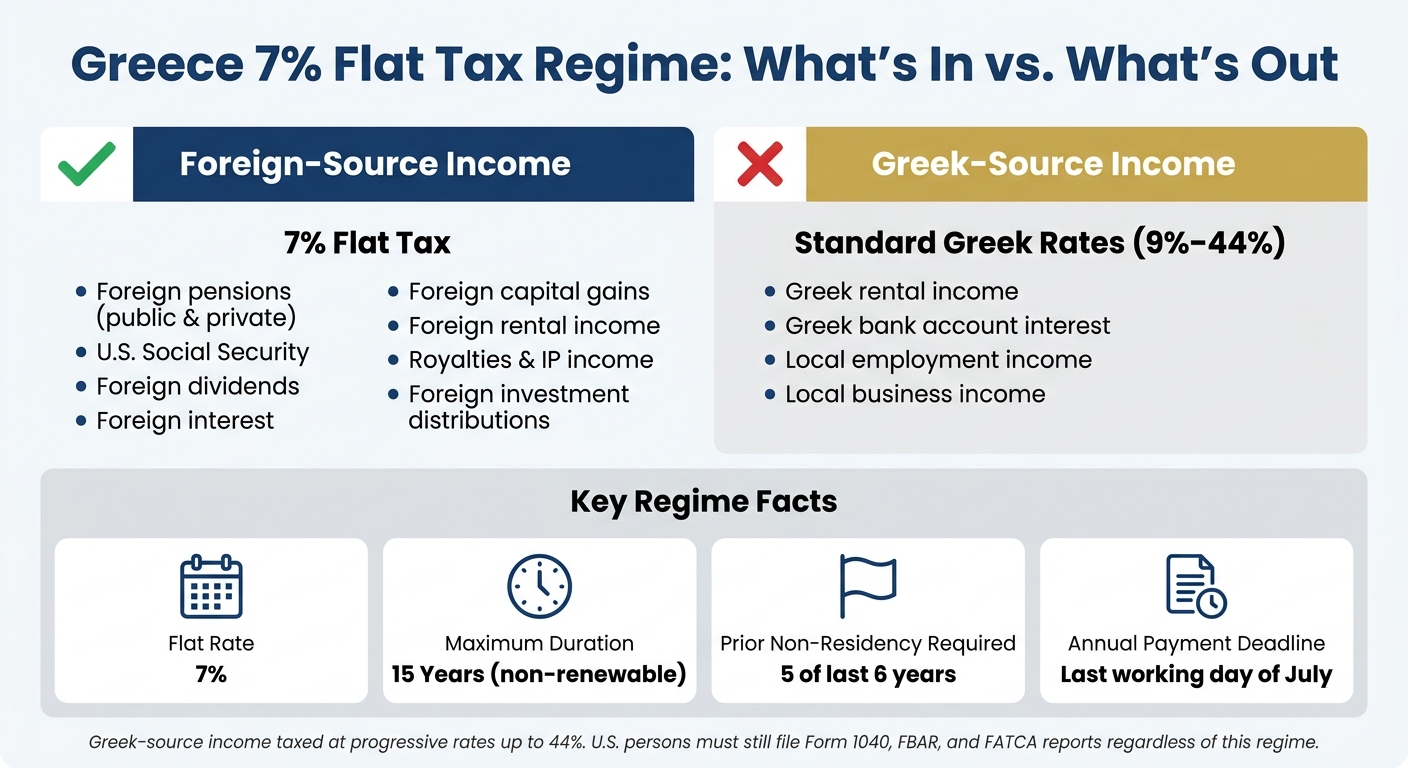
The 7% flat tax applies to all foreign-source income, including foreign pensions, Social Security, dividends, interest, capital gains, and foreign rental income. It also covers royalties, intellectual property income, and distributions from foreign investment vehicles.
That broad scope is a big deal for retirees with income coming from a few different places. If your cash flow comes from pensions, investments, and maybe a rental property abroad, this regime can keep things much simpler.
Income outside the 7% regime
Here’s the line that matters: the flat tax applies only to foreign-source income.
Greek-source income is taxed under Greece’s standard rules, with progressive rates ranging from 9% to 44% in 2026. That includes Greek rental income, interest from Greek bank accounts, and any local employment or business income.
So the split looks like this:
- Foreign-source income – pensions, Social Security, dividends, interest, capital gains, foreign rentals, and royalties: 7% flat tax
- Greek-source income – Greek rentals, Greek bank interest, local employment, and local business income: standard Greek rates
That makes the regime a strong match for retirees whose income remains mostly outside Greece.
Rate, duration, and payment timing
The 7% rate applies for up to 15 consecutive tax years. The annual tax must be paid in a single payment by the last working day of July each year.
This is one area where the rules are strict. Miss the payment deadline, and the regime can be terminated. If that happens, reinstatement is not available. After the 15-year period ends, or if you lose eligibility earlier, your income goes back under Greece’s standard tax rules.
Next comes the practical part: how to apply and keep the regime in place.
How to apply and stay compliant in 2026
Once you know the eligibility rules, the next step is filing the right way and keeping the regime active year after year.
Pre-move planning and documents
Start planning at least 12 months before your move.
The first practical step is getting a Greek Tax Identification Number (AFM). You need an AFM before you can open a bank account, sign a lease, or file documents with the Greek tax authority. If you’re a non-EU citizen, you also need the right visa and residence permit before filing.
After you have legal residence, start pulling together your paperwork. Foreign documents need to be apostilled and translated, including pension proof and background checks. You’ll also need official proof from your home country’s social security system or private pension provider showing that you qualify as a pensioner.
It also helps to time your move well. Your first year should include enough days in Greece to support tax residency.
Once your AFM and legal residence status are in place, you can file the Article 5B application with AADE.
Submitting the Article 5B application
Submit Form M1 and your supporting documents to AADE after securing your AFM and residence status. Include proof of pension income and prior nonresidency. AADE usually issues a decision within about 60 days.
Rules and admin steps can change from one year to the next, so check the filing window and document list with a qualified Greek tax advisor before you submit.
After approval, this turns into a yearly compliance task.
Annual filing and keeping your eligibility
Approval lasts only as long as you keep meeting the rules.
Each year, keep records showing your residence, travel days, and pension status. You should also keep a valid lease or property title on file.
A missed payment, loss of pension status, or broken residency can end the regime. If that happens, your income goes back to Greece’s standard progressive tax rates, which can go as high as 44%.
When the regime makes sense for retirees
Best-fit scenarios and examples
Once you know the filing rules, the next step is simple: does the 7% rate actually cut your retirement tax bill in a meaningful way?
In most cases, this regime works best when your foreign income is high enough that it would otherwise run into higher Greek tax brackets. At moderate to high foreign income levels, the 7% flat rate can lead to meaningful yearly tax savings.
That broad foreign-income coverage also makes the regime helpful for retirees who draw money from more than one source abroad. Think pensions, dividends, interest, foreign rental income, and capital gains.
That said, the upside fades fast when the income is local to Greece or when your residency position is shaky.
If your foreign income is on the lower side, the tax savings are often too small to make the residency rules and filing work worth the hassle.
Main limitations and common misunderstandings
This regime only works if both pieces stay in place: the income must qualify as foreign-source income, and you must keep Greek tax residency.
The mistake people make most often is thinking the 7% rate covers everything. It doesn’t. Income sourced inside Greece – such as rent from Greek property or interest from a Greek bank account – is taxed under the standard progressive system, not at 7%.
For U.S. citizens and green card holders, there’s another layer. This regime does not replace your IRS duties. You still have to pay U.S. federal tax on worldwide income, file Form 1040 each year, and meet FBAR and FATCA reporting rules. The U.S.-Greece tax treaty may let you use Greek tax as a foreign tax credit, which can cut or wipe out double taxation, but the filing duty stays.
Residency is another trouble spot. Some retirees think they can keep a Greek address on paper while spending most of the year somewhere else. That doesn’t fly. To keep the 7% deal, you must spend more than 183 days in Greece during the calendar year and remain a Greek tax resident. If you lose residency or miss a compliance step, the 7% treatment ends.
The 15-year term is also a hard stop. There is no renewal option. If you move to Greece in your early 60s, it makes sense to think ahead about what year 16 looks like.
Key takeaways before relocating to Greece
Use this snapshot to see whether Greece lines up with your income mix before you move.
| Feature | Detail |
|---|---|
| Qualification hurdle | Must not have been a Greek tax resident for 5 of the last 6 years |
| Foreign income treatment | 7% flat rate on foreign pensions, dividends, interest, foreign rentals, and capital gains |
| Duration | 15 consecutive years, non-renewable |
For retirees with sizable foreign income who can spend more than 183 days a year in Greece, this can be a solid tax planning opening. It tends to work best when a tax advisor who knows both U.S. and Greek rules helps line up the two systems from day one.
FAQs
Can I qualify if I split my time between Greece and another country?
Yes, but you must meet Greek tax residency rules. To get the 7% flat tax, you need to establish and keep Greek tax residency. In most cases, that means spending at least 183 days per year in Greece.
Greek authorities may also look at your center of vital interests. That includes things like where your family lives, where your main home is, and where your personal ties are strongest.
How does Greece determine whether my income is foreign-source or Greek-source?
Greece looks at where your income comes from and what activity produced it.
Foreign-source income generally includes pensions, dividends, interest, capital gains, and rental income generated outside Greece.
By contrast, income tied to work, business activity, or assets in Greece is treated as Greek-source income. That includes things like local employment, business conducted there, or interest from Greek bank accounts. This income is taxed at Greece’s standard progressive rates, which range from 9% to 44%.
What happens if I miss the July tax payment or lose residency later?
If you miss the annual tax payment by the last working day of July, you lose access to the 7% flat tax regime right away.
The same thing happens if you later lose Greek tax residency – for example, if you don’t meet the required 183-day stay during the year. At that point, you move to Greece’s standard progressive tax system, and the 15-year benefit cannot be renewed or brought back.
