
Here’s the short answer: a “tax-free” crypto cash-out in 2026 depends less on the country name and more on your tax status, your holding period, your trading pattern, and whether the IRS still taxes you.
If I had to boil the whole article down, I’d say this:
- U.S. citizens and most green card holders usually can’t escape IRS tax just by moving abroad.
- Non-U.S. investors often have a cleaner path if they end old tax residency and set up new residency for real.
- Some places offer 0% local tax on crypto gains, but many draw a hard line between private investing and business trading.
- In 2026, reporting is tighter: Form 1099-DA now gives the IRS more direct crypto data, and CARF/DAC8 push more country-to-country data sharing.
The article compares eight places:
- UAE
- Singapore
- El Salvador
- Switzerland
- Germany
- Portugal
- Cayman Islands
- Bermuda
And it measures each one using four simple tests:
- Local crypto tax rule
- Residency threshold
- U.S. tax exposure
- Best fit
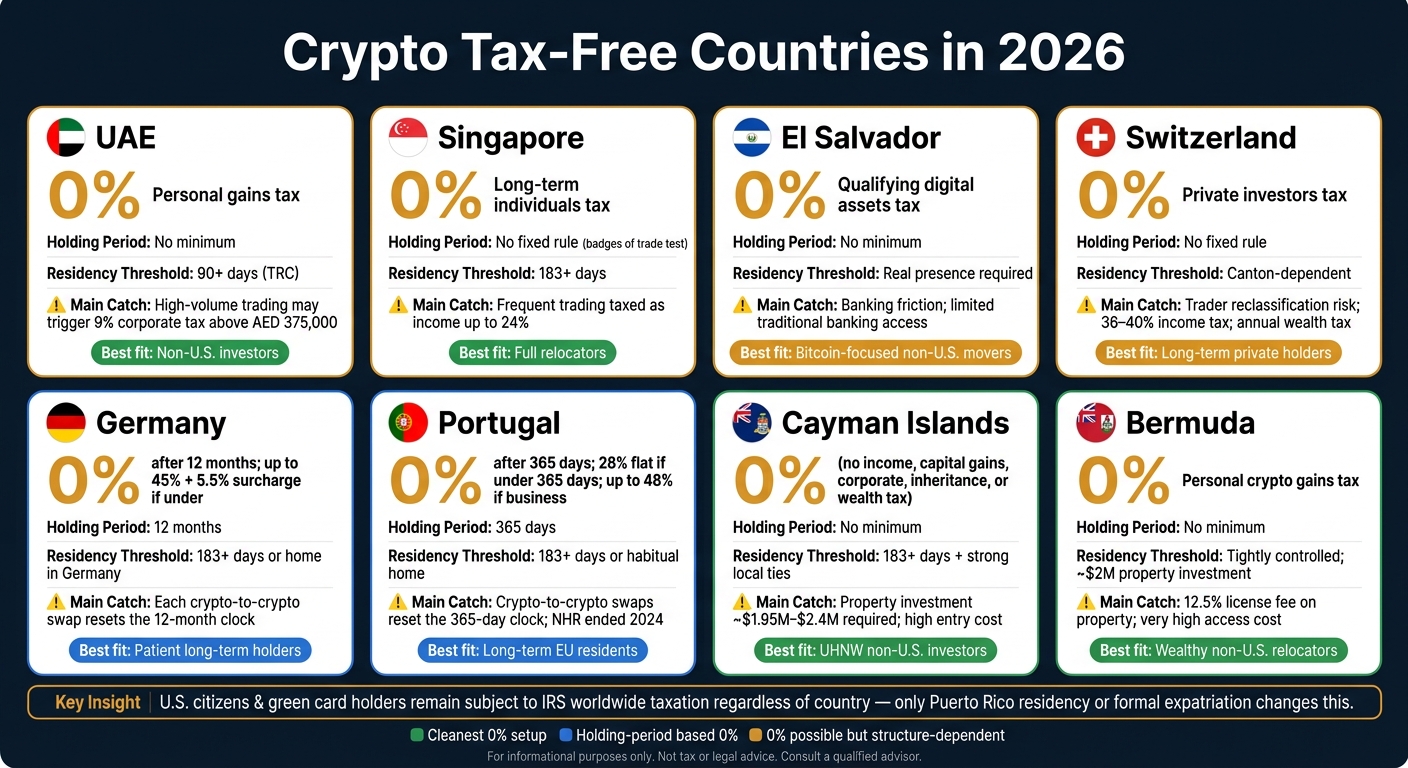
Quick Comparison
| Jurisdiction | Local Tax on Crypto Gains | Main Catch | Residency Angle | Best Fit |
|---|---|---|---|---|
| UAE | 0% for personal gains | Trading can shift into business/corporate tax | Usually needs a real move and tax proof | Non-U.S. investors |
| Singapore | Usually 0% for long-term individuals | Frequent trading can be taxed as income | Usually 183+ days | Investors who fully relocate |
| El Salvador | 0% on qualifying digital-asset gains | Banking and proof-of-funds issues | Residency must be more than paper | Bitcoin-focused non-U.S. movers |
| Switzerland | Often 0% for private investors | Wealth tax and trader reclassification risk | Canton and facts matter | Long-term private holders |
| Germany | 0% after 12 months | Short-term sales taxed up to 45% plus surcharge | German tax residency needed | Patient long-term holders |
| Portugal | 0% after 365 days | Short-term sales taxed at 28%; business treatment can hit 48% | Usually 183+ days or habitual home | Long-term residents |
| Cayman Islands | 0% | High entry cost and strict residency facts | Usually 183+ days plus strong ties | UHNW non-U.S. investors |
| Bermuda | 0% | High property and access costs | Residency is tightly controlled | Wealthy non-U.S. relocators |
My takeaway: the cleanest local 0% options are UAE, El Salvador, Cayman, and Bermuda. But if you want a lower-friction rule tied to time held, Germany and Portugal stand out. And if you’re a U.S. person, the biggest issue is still the IRS – not the foreign country.
So if you’re asking, “Where can I cash out crypto tax-free in 2026?” the honest answer is: it depends on who you are before it depends on where you go.
sbb-itb-39d39a6
1. United Arab Emirates
The UAE taxes personal crypto gains at 0%. But that headline rate only helps if your residency is REAL and your activity stays personal.
Local tax treatment
Personal crypto holdings, staking, and mining are tax-free unless the activity is treated as a business. If you trade at high volume or run a systematic strategy, the tax picture can change fast. In those cases, profits above AED 375,000 (approximately $102,000) can fall under the 9% corporate tax.
There’s another line to watch: annual revenue above AED 1,000,000 can also push the activity into business treatment. So the main issue isn’t just crypto. It’s whether the authorities see what you’re doing as personal investing or business activity.
Residency threshold
Getting a UAE Tax Residency Certificate (TRC) requires at least 90 days of physical presence. That sounds simple enough, but there’s a catch. Many high-tax home countries want to see 183+ days abroad before they treat your old tax residency as broken.
People usually get UAE residency through:
- Property
- A free zone company
- A freelance permit
- A Golden Visa
This is where a lot of people trip up. On paper, the UAE may give you 0% tax. But if your home country still treats you as a tax resident, that 0% rate doesn’t fix much.
U.S. tax exposure
For U.S. citizens, the UAE is far less simple than it looks. The FEIE does not protect capital gains, and self-employed U.S. citizens still owe 15.3% self-employment tax unless a totalization agreement applies.
That means the UAE tends to make more sense for non-U.S. investors or former U.S. persons who have fully ended U.S. tax status.
Best fit
Best for non-U.S. investors who can show real UAE residency. In practice, residency proof matters more than the eye-catching 0% tax rate.
2. Singapore
Singapore doesn’t have a general capital gains tax for individuals. So for individual investors, long-term crypto gains are usually not taxed. That’s the simple headline.
But here’s where people get tripped up: the details matter. A lot. Like the UAE, Singapore is for people who actually move. It doesn’t work as a paper relocation.
Local tax treatment
The Inland Revenue Authority of Singapore (IRAS) looks at the "Badges of Trade" test to decide whether your crypto activity counts as investing or running a business.
If your activity starts to look like trading for income, gains can be taxed as ordinary business income. That can happen if you have:
- High transaction frequency
- Short holding periods
- Use of leverage
- Automated trading strategies
- Crypto as your main source of income
If IRAS treats the activity as a business, income is taxed at progressive rates up to 24% for income above SGD 500,000.
Staking and mining rewards are also generally taxable if they’re regular or tied to a business. And while digital payment tokens are generally GST-exempt, NFTs and tokenized services may not be.
Residency practicality
To be treated as a tax resident, you generally need to spend at least 183 days in Singapore each year. So this is a real relocation move, not a mailbox play.
High-net-worth investors may use the Global Investor Programme (GIP), which calls for an investment of at least S$2.5 million. Other people may need an Employment Pass or EntrePass. Both require real activity in Singapore, not just paperwork.
Compliance burden
Singapore has signed on to the OECD’s Crypto-Asset Reporting Framework (CARF). Data collection starts in 2027 for the 2026 tax year.
On top of that, all Digital Token Service Providers now need licenses under tighter KYC and AML rules. Banks also want full source-of-wealth documents before they process large crypto cash-outs. That becomes a big deal when it’s time to take money off the table, because banks and licensed exchanges often ask for complete source-of-wealth records.
U.S. tax exposure
U.S. citizens and green card holders still owe IRS tax on worldwide income. So moving to Singapore does not remove U.S. filing duties or U.S. tax exposure.
Switzerland offers a different kind of low-tax exit: still favorable, but more dependent on structure and classification.
3. El Salvador
Among crypto-friendly places, El Salvador is the clearest Bitcoin-focused 0% setup. But there’s a catch: your residency has to be real.
El Salvador taxes qualifying Bitcoin and digital-asset gains at 0% for residents and foreign investors. After the 2025 IMF agreement, Bitcoin is still legal tender, but merchants no longer have to accept it, and taxes must be paid in U.S. dollars. If you spend Bitcoin on goods or services, that usually does not create a separate asset-sale tax event under the local rules.
That said, this does not wipe out IRS duties for U.S. persons. So this setup is far more useful for non-U.S. investors and former U.S. persons who have already ended U.S. tax status.
Local tax treatment
The 0% exemption applies only to qualifying digital assets covered by the Digital Assets Law. If your activity starts to look like a business, the picture changes. Professional trading, mining, or token issuance can be taxed as business income.
And that 0% rate only helps if you can show that you actually live there.
Residency requirements
El Salvador has residency and citizenship routes, including permanent residency for a 3 BTC investment and citizenship through a $1,000,000 BTC donation.
But on paper isn’t enough. To get the tax upside, you need real local ties, such as:
- Physical presence
- A lease
- Local bank accounts
- Clean source-of-funds records
- Clean crypto records
Those records matter. So does banking access. Even if you have residency, getting money in and out still depends on whether banks will work with you.
Banking friction
This is where things can get messy.
Traditional banks often turn down crypto-related businesses, so local banking access may be limited. That’s the main tradeoff here. The tax angle may look simple, but cash-out planning needs attention before any move.
El Salvador is also not a participant in the OECD’s Crypto-Asset Reporting Framework (CARF). In plain English, that means it currently sits outside the automatic data-sharing system used by many major financial jurisdictions.
U.S. tax exposure
If you’re a U.S. citizen or green card holder, moving to El Salvador does not get you out of IRS taxation.
Who can use this setup more cleanly?
- Non-U.S. investors who fully end tax residency in their home country and build real presence in El Salvador
- Former U.S. persons who have renounced citizenship, as long as they are not treated as "covered expatriates" under U.S. exit tax rules
El Salvador makes the most sense for investors who want a narrow Bitcoin-specific 0% regime and can back that up with genuine residency. Switzerland is easier on the banking side, but the tax outcome there depends much more on structure than on a simple 0% rule.
4. Switzerland
Switzerland can be a strong place to cash out crypto if you’re a private investor. In many cases, capital gains are taxed at 0% when you hold and sell as an individual. But there’s a catch: the outcome still depends on how you trade and which canton you live in. This setup fits non-U.S. investors best, along with former U.S. persons who have already ended U.S. tax status. Once your activity starts to look like a business, that tax edge can vanish.
Private investor tax treatment
Switzerland tends to suit long-term holders who trade now and then and stay away from leverage. If you keep things simple, your gains may fall under private investor treatment.
That said, not all crypto receipts get the same treatment. Staking rewards, airdrops, and mining income are generally taxed as ordinary income when received, rather than treated as tax-free capital gains.
Trader classification risk
This is the part that matters most. If Swiss tax authorities decide your activity looks like professional trading, your gains can be taxed as income at roughly 36% to 40%, depending on the canton. Social security contributions can also apply.
A few things tend to increase that risk:
- High-frequency trading
- Leverage
- Short holding periods
- Using crypto as your main income source
So yes, Switzerland can be tax-light for private holders. But for active traders, it can turn into a very different story. Once that classification changes, your canton becomes the next big tax factor.
Cantonal differences
Tax rates vary a lot by canton.
| Canton | Wealth Tax (approx.) | Max Income Tax (approx.) |
|---|---|---|
| Appenzell Innerrhoden | 0.15%–0.3% | ~18% |
| Schwyz | 0.2%–0.4% | ~22% |
| Zug | 0.3%–0.5% | ~23% |
| Lucerne | 0.3%–0.5% | ~24% |
| Zurich | 0.4%–0.7% | ~30% |
| Geneva | ~1.0% | ~45% |
Zug is home to "Crypto Valley", which has more than 1,100 blockchain companies. It has also accepted Bitcoin and Ethereum for tax payments since 2021. Schwyz and Appenzell Innerrhoden have the lowest wealth tax rates in Switzerland.
Wealth tax impact
Unlike places that only tax income, Switzerland also applies an annual net wealth tax at the cantonal level. That means your year-end crypto valuation matters. If you don’t track those numbers with care, tax filing can get messy fast.
U.S. tax exposure
For U.S. citizens and green card holders, Switzerland changes local tax treatment. It does not remove IRS exposure. In plain English, the move may help on the Swiss side, but the U.S. tax net still follows you.
Switzerland is better seen as a low-tax cash-out option for disciplined private holders, not for active traders. It also delayed CARF implementation in November 2025. Data collection starts in 2027, and the first exchange happens in 2028.
Portugal shifts the focus from wealth tax to residency-based treatment of crypto gains.
5. Germany
Germany takes a much simpler route than Switzerland. It uses a straight 12-month holding rule. If you’re a German tax resident and you sell private crypto after holding it for more than 12 months, the gain is tax-free.
For U.S. citizens, though, that doesn’t solve the IRS problem. You can still owe U.S. tax on the gain even if Germany taxes it at 0%. So this setup works best for non-U.S. investors and former U.S. persons who have already ended U.S. tax status.
The 1-year holding rule
Germany treats qualifying crypto as a private asset. Hold it for 12 months, and a sale can be tax-free. Sell before that mark, and gains are taxed at progressive rates up to 45%, plus a 5.5% solidarity surcharge.
One catch: each crypto-to-crypto swap starts the 12-month clock over again. That can trip people up. On paper, the rule looks simple. In practice, active trading can make it messy fast.
The 12-month rule applies to private sales only. Crypto activity that looks more like income gets different treatment. Staking, mining, and airdrops are taxed as income when received, while short-term gains under €1,000 per year are exempt.
| Transaction Type | Tax Treatment |
|---|---|
| Private sale held >12 months | 0% (tax-free) |
| Private sale held <12 months | Progressive income tax (up to 45% + 5.5% surcharge) |
| Staking / mining / airdrops | Taxed as income upon receipt |
| Short-term gains below €1,000/year | Exempt |
Residency relevance
You need German tax residency for this to work, usually by having a home there or spending more than 183 days in the country. Trying to rely on paper residency is risky and can lead to audits and penalties.
Best use case
Germany makes the most sense for non-U.S. long-term holders who want an EU base with a clear rule for cashing out. But there’s less room now for sloppy reporting. Starting in 2026, German tax authorities will get automated transaction data from exchanges under the EU’s DAC8 directive. That means clean records aren’t optional.
Portugal and Germany have different tax frameworks. There, the tax outcome depends more on residency and sourcing than on a fixed holding period.
6. Portugal
Portugal keeps the EU approach pretty simple: hold for 365 days, and gains can be tax-free. If you sell after that mark, long-term gains are taxed at 0%. Sell before then, and the gain is taxed at a flat 28%.
That’s the big split. And unlike Germany, Portugal does not offer a short-term exemption.
The 365-day holding rule
The 0% rate is meant for private investors. But there’s a catch. If your activity looks frequent, organized, or business-like, the tax authority can treat those gains as business income instead. In that case, rates can go as high as 48%.
Other crypto activity follows its own rules:
- Staking and lending rewards are usually taxed as income at 28%
- Mining income is treated as self-employment income and taxed at progressive rates
Crypto-to-crypto swaps are usually not taxable, which sounds great at first. But there’s an important detail: the swap resets the 365-day clock for the asset you receive.
| Transaction Type | Tax Treatment |
|---|---|
| Long-term sale (held >365 days) | 0% (exempt) |
| Short-term sale (held <365 days) | 28% flat rate |
| Staking / lending rewards | 28% income tax |
| Mining income | Progressive rates (self-employment) |
| Professional trading | Progressive rates up to 48% |
Residency relevance
To use this setup, you need Portuguese tax residency. In most cases, that means spending 183+ days in Portugal or having a habitual home there.
Portugal’s NHR regime ended in 2024. Its replacement, IFICI, does not change the standard 0% / 28% crypto rules. So this only works if you can show real residency, not just a paper move.
There’s also a reporting shift on the way. Starting January 1, 2026, EU exchanges must report user transaction data to Portuguese authorities under DAC8. That makes recordkeeping a big deal. You’ll want clean proof of:
- acquisition dates
- cost basis
- holding period
And if you’re a U.S. citizen, Portugal isn’t the whole story. You still owe IRS tax on worldwide income.
If you’re after a more aggressive setup with no local tax, the next section gets into that.
7. Cayman Islands
If Portugal and Germany hinge on holding periods, the Cayman Islands offer a cleaner zero-tax setup for investors who can meet the residency bar.
The Cayman Islands levy no personal income tax, no capital gains tax, no corporate profit tax, no inheritance tax, and no wealth tax. That’s the big draw. The catch is simple: the tax result only helps if you can actually become resident there.
Best fit
This setup tends to suit institutions, hedge funds, family offices, and ultra-high-net-worth individuals. It isn’t a low-cost move. In most cases, residency and permanent residency routes call for property purchases in the mid-six-figure to low-seven-figure range, plus legal fees.
For U.S. citizens and green card holders, there’s another issue. They still owe IRS tax no matter where they live. So in practice, this route makes the most sense for non-U.S. investors.
Tax residency requirements
Cayman tax residency usually means spending 183+ days in the country and showing a clear center of vital interests there. You also need to end tax residency in your prior country before the new tax year begins.
In plain English, you can’t just buy property, visit now and then, and expect the tax result to hold up. The residency story has to be real and well documented.
Asset protection and structure
Cayman structures are often used for privacy and asset protection. The idea is to keep liquid assets in a low-tax setting with legal structuring that adds another layer of protection. In some cases, these structures can also give long-term tax certainty under current rules.
"The key advantage of the Cayman Islands is privacy through legal structure, not secrecy." – Robert Stukes, Finance Researcher
CARF and what’s changing in 2026
The tax rate isn’t changing, but reporting is. CARF reporting starts in 2026, so exchange KYC needs to match your actual tax residency.
| Residency Route | Minimum Investment | Duration |
|---|---|---|
| Independent Means | ~$1.95M | 25 years (renewable) |
| Permanent Residency | ~$2.4M | Permanent |
That leaves Cayman in its strongest position for non-U.S. investors who can show real residency and clean source-of-funds records.
8. Bermuda
Bermuda has the same 0% tax appeal as Cayman, but getting set up there is harder and costs more. It offers 0% personal tax on crypto gains, yet residency is tightly controlled and the price of entry is high.
Tax profile
The rule is straightforward: Bermuda taxes residents at 0% on personal crypto gains.
That said, Bermuda’s 0% local tax does not cancel U.S. tax for citizens and green card holders. Only a status change through expatriation or renunciation can do that, and an exit tax may apply.
Residency and cost of access
This is where Bermuda gets tough. Non-Bermudians need a government license to buy property, only certain properties are open to foreign buyers, and a 12.5% license fee applies to freehold purchases. A Permanent Residency Certificate usually calls for a property investment of about $2 million. Because of that, many expats come in through residential certificates or work permits instead of permanent residency.
There is one lower-commitment path. Bermuda offers a one-year Work From Bermuda digital nomad certificate, which can work as a trial step before a bigger move.
Asset protection
Bermuda’s legal system is based on English common law. Bermuda trusts are especially well regarded, and the rule against perpetuities has been abolished for trusts created after August 1, 2009, except for those holding Bermuda land.
That mix matters. You get zero local tax along with trust law that works well for more serious wealth structuring.
CARF and compliance
Even with a 0% rate, Bermuda is fully reportable. It has put the OECD Crypto-Asset Reporting Framework (CARF) in place, which means exchanges collect and report transaction data to authorities.
| Criterion | Bermuda 2026 |
|---|---|
| Personal Income Tax | 0% |
| Capital Gains Tax | 0% |
| Crypto-to-Crypto Swap Tax | 0% |
| Regulatory Framework | Digital Asset Business Act (DABA) |
| Reporting Standard | CARF operational |
| Property License Fee (Non-Bermudians) | 12.5% of property value |
This is not a casual relocation play. It fits non-U.S. investors and former U.S. persons who have already ended U.S. tax status. Bermuda works best for people who can clear the property and residency hurdles and want zero local tax paired with strong offshore asset protection law.
9. Global Wealth Protection

Once you know the country rules, the next problem is simple: can your residency, entity, and records hold up under review? That’s where many plans fall apart. The gap between a low-tax exit and a failed one often comes down to residency proof, timing, and structure.
Global Wealth Protection works with investors on these issues before they move. Founded by Bobby Casey, the firm offers private consultations, offshore company formation, offshore trusts, and relocation plans for strategic relocation. The goal is to put structures in place that can stand up to audit and reporting review.
Residency and relocation planning
Establishing tax residency is more than taking a flight and calling it done. Tax authorities now look at the OECD’s Common Reporting Standard (CRS), digital footprints, card spending, and device-location data when they test weak residency claims. Global Wealth Protection helps clients build a paper trail they can back up, such as property leases, local bank accounts, and utility records, to show defensible nonresidency in the home country.
Residency proof comes first. Structure starts to matter more when the activity looks less like personal investing and more like a business.
Offshore structuring and entity setup
Some investors need more than a move. In those cases, the firm sets up offshore companies and trusts in jurisdictions that fit the client’s facts. That matters most when personal investing starts to cross into business activity, because that shift can change whether income is treated as passive investing or business income.
For U.S. persons, the structure also needs to fit IRS rules.
U.S. persons and compliance
For U.S. citizens and green card holders, the firm focuses on lawful paths that may cut U.S. exposure without acting like a move alone makes it disappear. It also gives guidance on paths such as Puerto Rico’s Act 60, the Foreign Earned Income Exclusion, which is $132,900 for the 2026 tax year, and the formal process of renouncing citizenship for people weighing that permanent step.
With compliance pressure growing across more than 58 countries, professional planning is what helps keep the structure in place.
A consultation can help sort out whether your move, structure, and reporting line up before you cash out.
That brings up the main point: which moves change the tax result, and which ones only change the paperwork?
IRS Reality, Pros and Cons, and Legal Cash-Out Paths
After the country-by-country comparison, the hard part is figuring out who the IRS can still reach.
“Outside U.S. tax scope” doesn’t mean the same thing for everyone. For non-U.S. investors, it can be as simple as changing residency and ending tax residency in the old country. For U.S. citizens and green card holders, it’s a different ball game. In most cases, they stay in the U.S. tax net unless they use Puerto Rico residency rules or go through expatriation.
Here’s what each group is dealing with:
| Group | IRS Reality | Outside U.S. Tax Scope? | Primary Legal Path |
|---|---|---|---|
| U.S. Citizens | Taxed on worldwide income regardless of residency | Only through bona fide Puerto Rico residency or formal expatriation | Bona fide Puerto Rico residency with presence tests, or formal expatriation |
| Green Card Holders | Treated as U.S. persons for tax purposes | Not while they keep the green card | Surrender the green card; long-term residents may face exit tax |
| Former U.S. Persons | Generally only U.S.-sourced income remains in scope | Yes, for future global gains | Renunciation or green card surrender, then exit-tax compliance |
| Non-U.S. Investors | No IRS obligation unless U.S.-sourced income is involved | Yes | Relocate, establish non-U.S. tax residency, and fully end tax residency in your old country |
For many people, renouncing citizenship is the clearest way to end future U.S. crypto tax exposure. But there’s a catch. The IRS can treat it as if you sold your worldwide assets the day before expatriation. In 2026, the first $910,000 of net unrealized gains is excluded, and the Exit Tax can go as high as 23.8%.
You can also be treated as a covered expatriate if your net worth is above $2 million or if your average annual tax liability for the last five years is about $206,000 or more. That line matters a lot. Cross it, and the tax cost can change fast.
So the next step isn’t just picking a country. It’s picking the legal route that matches your status.
| Pathway | Best For | Key Rule | Anti-Avoidance Risk |
|---|---|---|---|
| Relocate before sale | Active traders | Move and establish residency before realizing gains | Physical presence tests, usually around 183 days |
| Hold longer | Patient investors | Qualify for tax-free treatment after the required holding period | Professional-trader reclassification |
| Offshore structure | High-volume traders and founders | Use an entity that matches substance and reporting rules | Economic substance requirements |
| Expatriation | High-net-worth individuals | Plan ahead so steps can help you stay below the covered-expatriate threshold | Covered-expatriate status can trigger the exit tax |
Each path has its own pressure points.
- Relocate before sale can work well for active traders, but only if the move is real. Tax agencies look at physical presence, and that usually means about 183 days.
- Hold longer can help patient investors in places that exempt gains after a set period, though active trading can still get recast as business income.
- Offshore structures may fit founders and high-volume traders, but the entity has to match local substance and reporting rules.
- Expatriation takes more planning than many people expect, especially if you’re trying to stay below the covered-expatriate line.
Even then, the old idea of a quiet offshore cash-out is getting harder to pull off. In 2026, reporting is tightening from both sides. CARF and DAC8 are pushing automatic exchange of crypto data across 58+ countries by 2027/2028, and Form 1099-DA gives the IRS direct visibility into U.S. exchange transactions.
That means paperwork matters just as much as the move itself. If the records are messy, even a legal tax-free exit can start to look shaky under review.
In 2026, status, timing, and records matter as much as destination.
Conclusion
The result still comes down to four things: residency, holding period, classification, and U.S. status. These places can cut local crypto taxes, but the answer changes by jurisdiction. The UAE and Singapore favor the right kind of resident. Germany and Portugal favor people who can wait. Switzerland keeps private gains lightly taxed, but it still applies wealth tax. Cayman, Bermuda, and El Salvador offer the cleanest 0% local-tax result for qualifying residents, though setup and residency costs can be material.
That said, local tax rates are only part of the picture. The bigger split is whether someone still falls inside the IRS net. For U.S. citizens and most green card holders, local tax savings do not remove IRS exposure. Only bona fide Puerto Rico residency or expatriation changes that result, and expatriation can still trigger exit tax. For non-U.S. investors, the main issue is whether tax residency in the home country has actually ended and real residency has been set up somewhere else.
The main point is simple: legal tax-free exits are still possible in 2026, but only when status, timing, and records line up. Tax residency, holding period, trader status, and U.S. exposure still drive the outcome. Proof of residency and a clean ownership structure matter just as much as the jurisdiction itself.
In 2026, the destination matters, but documentation decides whether the move holds.
FAQs
Can I avoid IRS crypto tax by moving abroad?
No. Moving abroad does not automatically end IRS tax on crypto. The U.S. taxes citizens on worldwide income, so you generally still owe federal reporting and tax on crypto gains no matter where you live.
Relocating by itself also does not end your filing, FBAR, or FATCA duties. For U.S. citizens, fully ending this tax tie usually means formally renouncing citizenship, and that can trigger an exit tax.
What proves real tax residency in a crypto-friendly country?
Real tax residency means showing actual physical and economic presence, not just holding a visa or using a mailing address.
In most cases, that means spending 183+ days in the country and being able to back that up with clear records. Think passport stamps, flight tickets, local card activity, housing records, and bank accounts.
Your day-to-day life should line up with your claim. And your paperwork should clearly support both your transactions and your source of wealth.
When does crypto investing become taxable business activity?
Crypto investing usually becomes taxable business activity when it looks more like a business than private investing.
That line is often crossed when someone trades at high frequency, uses systematic or automated strategies, handles a large volume of transactions, or earns their main income from crypto. At that point, tax authorities may view the activity as commercial, not personal.
In places like Switzerland, Singapore, and Portugal, private investors may be able to avoid capital gains tax. But that treatment doesn’t always hold. If trading becomes frequent enough, a person can be reclassified and taxed under income tax or corporate tax rules instead.
By contrast, long-term holding is rarely treated as business activity.
