
Yes, I can lower my U.S. tax bill by moving abroad – but only if I still file and use the right tax rules. The main tools are the Foreign Earned Income Exclusion (FEIE), the Foreign Tax Credit (FTC), state residency exit planning, and picking a country that fits my income mix.
Here’s the short version:
- I still file a Form 1040 as a U.S. citizen, even while living overseas.
- In 2026, I may exclude up to $132,900 of foreign earned income with the FEIE if I meet the day-count or residence rules.
- If I pay income tax to another country, I may use the FTC to reduce U.S. tax dollar for dollar.
- The FEIE does not cut self-employment tax. That can still be 15.3% unless a totalization rule applies.
- Passive income like dividends, interest, rent, and capital gains does not fit under the FEIE.
- If my foreign accounts go over $10,000 at any point in the year, I may need to file an FBAR.
- If I leave a high-tax state like California or New York without ending residency the right way, that state may still try to tax me.
In other words: moving abroad can lower tax, but only if I match the rule to the income. A low-tax country may help with salary under the FEIE, while a high-tax country can sometimes work better because the FTC can offset more U.S. tax.
Quick comparison
| Tool | What it helps with | Main limit | Best fit |
|---|---|---|---|
| FEIE | Foreign salary or self-employment income | Up to $132,900 in 2026; earned income only | People working abroad in lower-tax countries |
| FTC | Foreign taxes already paid | No fixed dollar cap; no double use with FEIE on same income | People in higher-tax countries or with passive income |
| State exit planning | Avoiding state income tax after leaving | Must cut residency ties | People leaving high-tax states |
| Country choice | Total tax outcome | Depends on local tax law and income type | Anyone moving abroad |
If I want the tax savings to stick, I need to plan before I move, keep records, and stay on top of U.S. filing rules after I leave.
Use the Foreign Earned Income Exclusion to cut federal income tax
The Foreign Earned Income Exclusion (FEIE) can let eligible U.S. citizens and resident aliens exclude up to $132,900 of foreign-earned income in 2026. You claim it on Form 2555.
The big issue is simple: do you qualify? In most cases, that comes down to the physical presence test or the bona fide residence test.
To use the FEIE, you need to pass one of those tests and have a tax home abroad. If your main home and strongest ties still sit in the U.S., you generally can’t claim it.
How to qualify under the physical presence and bona fide residence tests
These two tests do not work the same way. One is mostly about day counting. The other looks more at your life on the ground.
| Feature | Bona Fide Residence Test | Physical Presence Test |
|---|---|---|
| Requirement | Full calendar year (Jan 1 to Dec 31) | 330 full days in any 12-month period |
| How it works | Intent, visa status, and local ties | Day count only |
| Best for | Long-term expats with work or residency visas | Digital nomads, freelancers, short-term contractors |
| U.S. travel flexibility | More flexible after the first full year | Limits U.S. visits to about 35 days |
The Physical Presence Test is the more straightforward one. It is purely mathematical. If you are physically present in a foreign country for at least 330 full days during any consecutive 12-month period, you qualify. Only full 24-hour days abroad count. Travel days do not count.
The Bona Fide Residence Test is less mechanical. The IRS looks at whether you actually set up residence abroad, including things like your visa status and local ties. It also requires an uninterrupted period that includes one full calendar year. So if you move abroad in the middle of the year, this test usually won’t work for that first year. In that case, the Physical Presence Test is often the better fit.
What the Foreign Earned Income Exclusion covers, what it does not, and how the dollar cap works
The FEIE applies only to earned income from services you performed while you were physically in a foreign country.
That usually includes:
- Wages
- Salaries
- Commissions
- Bonuses
- Professional fees
- Self-employment income
What it does not cover is passive income. Dividends, interest, capital gains, rental income, and pension distributions are all outside the exclusion. U.S. government pay, including military pay, is also not eligible.
The FEIE can also work alongside a foreign housing exclusion or deduction for qualifying rent and utilities. For 2026, the standard housing base amount is $21,264, and the standard ceiling is $39,870. Some high-cost locations get higher limits, including $114,300 in Hong Kong and $102,600 in Geneva.
There’s also a tax detail that trips people up: the IRS uses a stacking rule. Any income that isn’t covered by the exclusion gets taxed at the higher marginal rates it would have reached if the excluded income were still included. So yes, the FEIE can cut taxable income, but it does not drop the rest of your income into a lower bracket by itself.
Why the Foreign Earned Income Exclusion does not remove self-employment tax
This is where many self-employed people get caught off guard.
The FEIE does not reduce self-employment tax. If you’re self-employed abroad, you still owe Social Security and Medicare tax, which is 15.3% on net earnings, unless another rule or treaty applies.
So moving abroad may lower your federal income tax, but it doesn’t wipe out every tax bill. And if the country where you live taxes your income at a high rate, the Foreign Tax Credit may work better than the FEIE in some cases.
sbb-itb-39d39a6
Use the Foreign Tax Credit when foreign taxes are already high
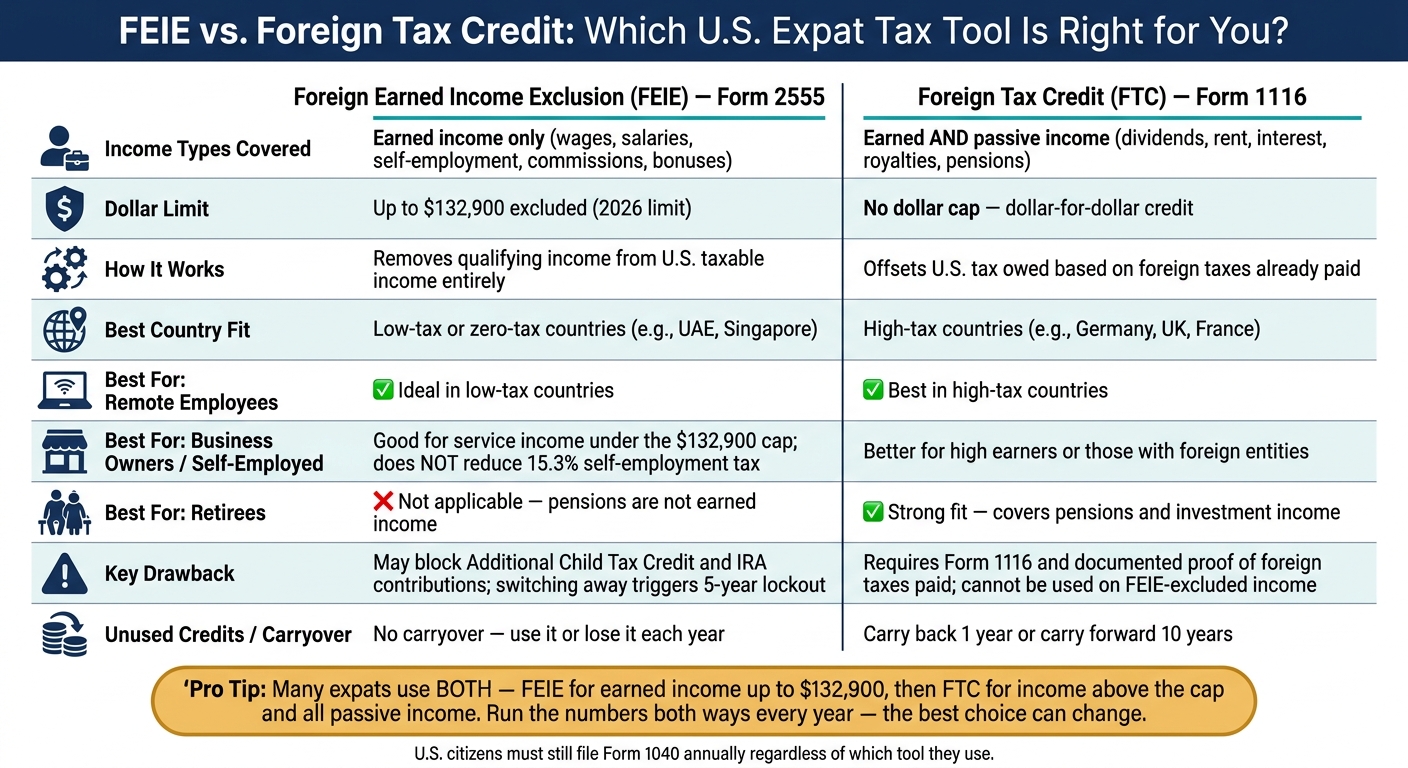
The Foreign Tax Credit (FTC) cuts your U.S. tax dollar for dollar based on foreign income tax you’ve already paid. You claim it on Form 1116. Unlike the FEIE, the FTC has no dollar cap and can offset both earned income and passive income.
There’s one big rule here: you can’t claim the FTC on income you already excluded under the FEIE. That’s why many taxpayers split the job. They use the FEIE for earned income up to the limit, then use the FTC for income above that cap or for passive income.
If you don’t use all of your credit in the current year, it doesn’t just disappear. Unused credits can carry back one year or forward 10 years.
When the Foreign Tax Credit works better than the Foreign Earned Income Exclusion
The FTC tends to win in three common situations.
- You live in a high-tax country. If local income taxes are steep, they may wipe out the remaining U.S. tax on that same income.
- You have passive income. Dividends, rental income, and royalties don’t qualify for the FEIE, so the FTC is the tool that applies there.
- You want to avoid FEIE side effects. Excluding all earned income under the FEIE can cost you the Additional Child Tax Credit or make you ineligible for IRA contributions. The FTC does not create those FEIE limits.
How to compare the Foreign Earned Income Exclusion and Foreign Tax Credit before choosing
The better option depends on three things: where you live, the type of income you earn, and the rest of your tax picture. A setup that worked last year may not be the best move this year. Income changes, local tax rules shift, and family tax credits can change the math. So it makes sense to run the numbers both ways each year.
For 2026, the FEIE limit is $132,900.
| Feature | Foreign Earned Income Exclusion (FEIE) | Foreign Tax Credit (FTC) |
|---|---|---|
| Income Types Covered | Earned income only (wages, self-employment) | Earned and passive income (dividends, rent, interest) |
| Main Benefit | Excludes up to $132,900 from taxable income | Dollar-for-dollar credit; no dollar cap |
| Main Drawback | May block Child Tax Credit and IRA contributions | Requires Form 1116 and proof of foreign tax paid |
| Best Fit: Remote Employees | Ideal in low-tax countries (e.g., UAE, Singapore) | Best in high-tax countries (e.g., Germany, UK) |
| Best Fit: Business Owners | Good for service income under the cap | Better for high earners or those with foreign entities |
| Best Fit: Retirees | Generally not applicable (pensions are not earned income) | Strong fit; covers pensions and investment income |
One more point matters here. If you’re using the FEIE now and later switch to the FTC, the IRS generally won’t let you go back and reclaim the FEIE for five years unless you get special approval. That can be a costly move if you switch too casually.
After you choose between the FEIE and FTC, residency and state-tax exit planning determine how much of that savings you keep. Exploring tax and residency solutions can help solidify your long-term strategy.
Plan residency, state tax exit, and income structure before you move
Choosing between the FEIE and FTC is only half the job. The other half is making sure your move actually changes your tax picture. That starts with cutting ties with your old U.S. state and looking hard at how your income will be taxed once you’re abroad.
How to properly cut state tax residency before leaving
State tax agencies can still come after you after you move. California, New York, New Jersey, and Virginia are known for tough residency rules. They don’t just take your word for it. If you keep a home there, hold onto your driver’s license, stay registered to vote, or leave a spouse or dependents behind, the state may still say you’re a resident and tax your worldwide income.
Breaking domicile means moving your legal home out of that state in a real, documented way. That can include:
- Selling or renting out your main home
- Updating your driver’s license
- Changing your voter registration
- Moving your bank accounts
California does offer a safe harbor for people working abroad under an employment contract for at least 546 straight days, but you need strict records to use it.
The issue is simple: can your old state still make a case that you never left?
Before you go, it often helps to set up residency in a no-tax state such as Florida, Texas, or Nevada by getting a local driver’s license and voter registration.
How remote workers, business owners, and retirees face different tax outcomes
Once domicile is handled, the next question is income type. This is where many people get tripped up.
A remote worker living in a low-tax country may wipe out most or all federal income tax on salary with the FEIE, as long as they meet the physical presence test or bona fide residence test and their tax home is abroad.
A freelancer or self-employed business owner has a tougher setup. A Totalization Agreement can stop double Social Security coverage, but only if the country has one in place. Some do. Some don’t. That’s something to check before you choose where to live.
Retirees play by a different set of rules. Pension income, dividends, and interest do not count for the FEIE. In that case, the Foreign Tax Credit and treaty review are the main ways to cut double taxation on retirement income.
Why low-tax countries are not always the best choice
A zero-tax country can sound like the perfect move. On paper, it looks like a slam dunk. In practice, it can leave more U.S. tax on the table.
If you live in a zero-tax country, you pay no foreign income tax. That also means you get no Foreign Tax Credits to offset U.S. tax on income above the FEIE limit or on passive income such as dividends, rent, and interest.
By contrast, someone in a higher-tax country like Germany or the UK may pay more tax locally, but those tax payments can create FTC credits that offset U.S. tax on income above the FEIE cap and on passive income. The end result can be a lower total tax bill across both countries than living in a zero-tax place.
So the best country isn’t always the one with the lowest local tax rate. It’s the one where your income mix and the U.S. tax rules work together to bring down your total tax bill.
After you pick the country, the next move is making the relocation hold up on paper.
Build a compliant overseas tax plan and know when professional help is worth it
What a compliant action plan should cover before and after you leave
A lower tax bill comes down to execution. Before you leave, lock down your residency, income setup, and reporting.
Once you’ve picked where to live, the next step is making sure the tax savings actually stick. Before departure, confirm that your tax home will be in a foreign country. Then decide whether the FEIE or the FTC makes more sense based on your host country’s tax rate. You’ll also want to review self-employment tax exposure, get a Certificate of Coverage under a Totalization Agreement, formally end state residency, and look for GILTI exposure in foreign corporations and PFIC exposure in foreign funds.
Those last two can hit hard. Foreign corporations can trigger GILTI tax, with a 12.6% effective rate in 2026. Foreign mutual funds can trigger PFIC rules, and those rules can push effective tax rates to 50% to 70%.
After you move, compliance becomes the main job. Keep filing your U.S. tax return. File an FBAR when required. File Form 8938 when required too. If your foreign accounts total more than $10,000 at any point during the year, you must file an FBAR using FinCEN Form 114. A timely filed return also starts the three-year statute of limitations. If you’re a single filer and your foreign assets exceed $200,000 at year-end or $300,000 at any point during the year, Form 8938 is also required.
The penalties here aren’t small. Non-willful FBAR penalties start at $10,000 per year, and willful violations can lead to penalties of $100,000 or 50% of the account balance.
A simple travel log can save you a major headache later. Keep careful records of your travel days and passport stamps for the 330-day physical presence test. And if you’re using corporations, funds, or other layered setups, it usually makes sense to get tax and legal advice lined up early so all the moving parts work together.
Conclusion: the main legal ways Americans lower tax abroad
Moving abroad doesn’t end your U.S. tax filing duties. But it can give you legal ways to cut what you owe.
The four main levers are:
- The FEIE
- The Foreign Tax Credit
- State exit planning
- The country you choose
Put those pieces together the right way, and the tax outcome can look very different. The key is matching each lever to your income type and the way your finances are set up.
FAQs
Can I stop filing U.S. taxes if I move abroad?
No. Moving abroad does not end your U.S. tax filing duty.
The United States taxes citizens on worldwide income. So in most cases, you still need to file a federal tax return even if you qualify for the Foreign Earned Income Exclusion or the Foreign Tax Credit.
You also still need to stay on top of required reporting, including FBAR and FATCA.
Should I use the FEIE or the Foreign Tax Credit?
It comes down to how much you earn and which country you live in.
In a low-tax or no-tax country, the FEIE is often the better fit. In a higher-tax country, the Foreign Tax Credit is often the better deal because it gives you a dollar-for-dollar credit for foreign taxes you already paid.
The Foreign Tax Credit also has a bigger reach in one key area: it can apply to passive income like dividends and interest. The FEIE does not cover that type of income.
One catch: you can’t use both on the same income.
How do I end state tax residency before leaving?
Ending state tax residency usually means ending your legal domicile there. Just moving abroad usually isn’t enough.
Each state plays by its own rules, so you need to show that you meant to leave. That usually means moving your home, updating your driver’s license and voter registration, and shifting ties such as banking and primary employment.
Some expats also set up a new domicile in a no-income-tax state.
