
Yes, you still file a U.S. tax return while living abroad. But in many cases, you can cut or erase double tax by using the Foreign Earned Income Exclusion (FEIE), the Foreign Tax Credit (FTC), housing relief, and a few sourcing and treaty rules.
Here’s the short answer: if you earn wages or self-employment income abroad, you may exclude up to $132,900 for 2026 with FEIE. If you already pay income tax to another country, FTC may offset your U.S. tax instead. And some taxes can still remain, like self-employment tax, state tax, or Net Investment Income Tax.
What I’d check first:
- What type of income you have: earned income vs. passive income
- Where the income is sourced
- How much foreign income tax you paid
- Whether FEIE, FTC, or a mix gives the lower U.S. tax
- Whether you also qualify for housing relief
- Whether a tax treaty helps at all
A few rules matter more than most:
- FEIE only covers earned income
- FTC can apply to earned and passive income
- You can’t use FTC on income already excluded by FEIE
- FEIE does not remove self-employment tax unless a totalization rule applies
- FEIE-excluded income does not count for IRA or Roth IRA contribution purposes
- Revoking FEIE can trigger a 5-year wait before electing it again
Quick comparison
| Method | Best fit | Covers | 2026 limit | Main catch |
|---|---|---|---|---|
| FEIE | Low-tax or no-tax countries | Earned income only | $132,900 per person | No passive income; can affect IRA/Roth eligibility |
| FTC | Countries with higher income tax | Earned + passive income | No fixed dollar cap | Limited to U.S. tax on foreign-source income |
| Housing relief | Expats with high housing costs | Housing expenses tied to foreign earned income | Base amount $21,264; standard cap $39,870 | Must also meet FEIE rules |
| Treaties | Narrow cases like some pensions or Social Security issues | Depends on treaty | Varies | The saving clause often blocks relief for U.S. citizens |
Bottom line: I’d start with the income type, then compare FEIE vs. FTC using actual numbers. For many expats, that one step decides whether the U.S. tax bill drops to $0 or stays higher than it should.
Step 1: Use the Foreign Earned Income Exclusion when your income is earned abroad
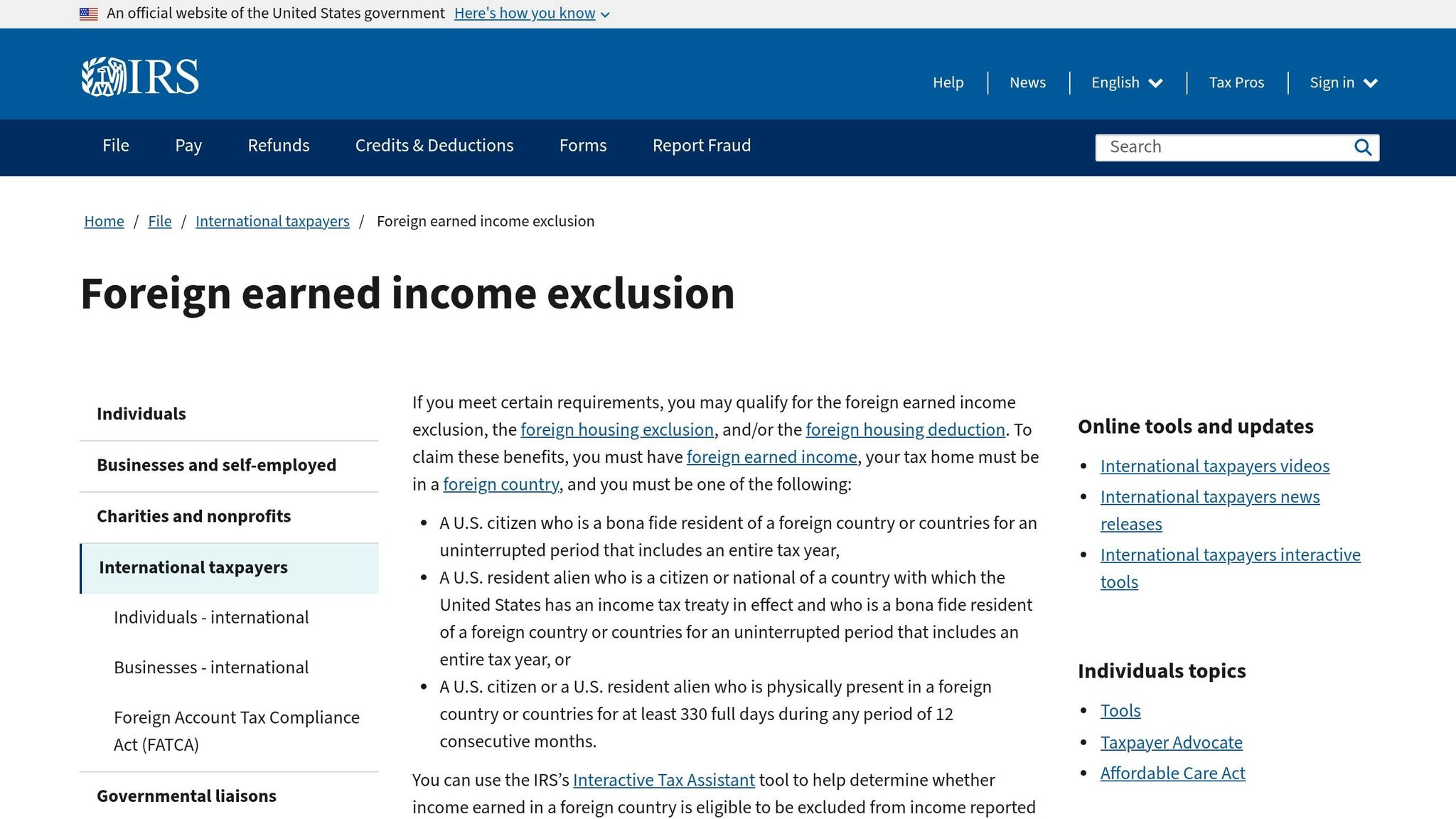
For 2026, the Foreign Earned Income Exclusion, or FEIE, lets you exclude up to $132,900 of foreign earned income per person.
Who qualifies for FEIE and what income it covers
To qualify, you need a tax home abroad and you must pass one of two residency tests.
The Physical Presence Test means spending 330 full days outside the U.S. during any 12-month period. Those 330 days don’t need to be in one country. You can spread them across several countries, which makes this test a good fit for digital nomads who move around a lot.
The Bona Fide Residence Test works differently. It’s based on your facts and circumstances. You need to be a real resident of a foreign country for an uninterrupted tax year. The IRS looks at things like whether you have a local driver’s license, utility bills, a long-term lease, and where your family and financial ties are centered.
FEIE applies to income you earn from services performed abroad, including:
- Wages
- Salaries
- Professional fees
- Commissions
- Bonuses
- Self-employment income
It does not apply to dividends, interest, capital gains, rental income, pensions, Social Security distributions, or pay from the U.S. government.
That’s why FEIE tends to work best when most of your foreign income comes from wages or self-employment income. If you’re already paying a lot of tax to another country on that same income, the Foreign Tax Credit may be the better play.
There’s one catch self-employed people need to watch closely: FEIE does not wipe out self-employment tax unless a Totalization Agreement applies. So you may get rid of U.S. income tax on earned income while still owing self-employment tax. In plain English, the relief can be only partial.
How to claim FEIE on Form 2555 and when it works best
To claim FEIE, file Form 2555 with Form 1040 even if the exclusion brings your U.S. income tax down to $0.
FEIE usually works best in low-tax or no-tax countries, because the Foreign Tax Credit often doesn’t do much in that setup. But if your host country taxes the same income at a high rate, the Foreign Tax Credit may give you a better result.
Step 2: Use the Foreign Tax Credit when you already pay substantial foreign income tax
If FEIE still leaves part of your income taxed abroad, the next thing to look at is the Foreign Tax Credit, or FTC.
When you already pay a lot of income tax to another country, FTC often beats FEIE. Why? Because it cuts your U.S. tax based on the amount of qualifying foreign income tax you paid. And unlike FEIE, it isn’t tied to a set dollar ceiling. The limit is based on your U.S. tax on foreign-source income, which can make FTC a better fit for people with higher income.
FTC also covers more ground than FEIE. FEIE only applies to earned income. FTC can apply to foreign-source earned income and passive income, such as dividends, interest, rental profits, royalties, and capital gains.
What qualifies for the Foreign Tax Credit and how Form 1116 works
Once FTC looks like the better option, the next step is matching the credit to the right tax and the right income category.
Not every foreign tax counts. The IRS allows a credit for foreign income taxes paid or accrued to a foreign government. But VAT, sales tax, property tax, and wealth taxes do not qualify.
To claim the credit, you file Form 1116 with your Form 1040. You also need to sort income into categories, most often general and passive. The IRS then applies a separate credit limit to each category using this formula:
(Taxable Foreign-Source Income ÷ Total Taxable Income) × US Tax Liability = Maximum Credit Allowed
That limit matters because FTC can only offset U.S. tax on foreign-source income.
If you paid more foreign tax than the formula lets you claim for the year, the extra credit isn’t always gone for good. You can carry it back one year or carry it forward for up to 10 years. That’s helpful if your foreign tax bill swings from year to year.
FEIE vs. Foreign Tax Credit vs. combining both methods
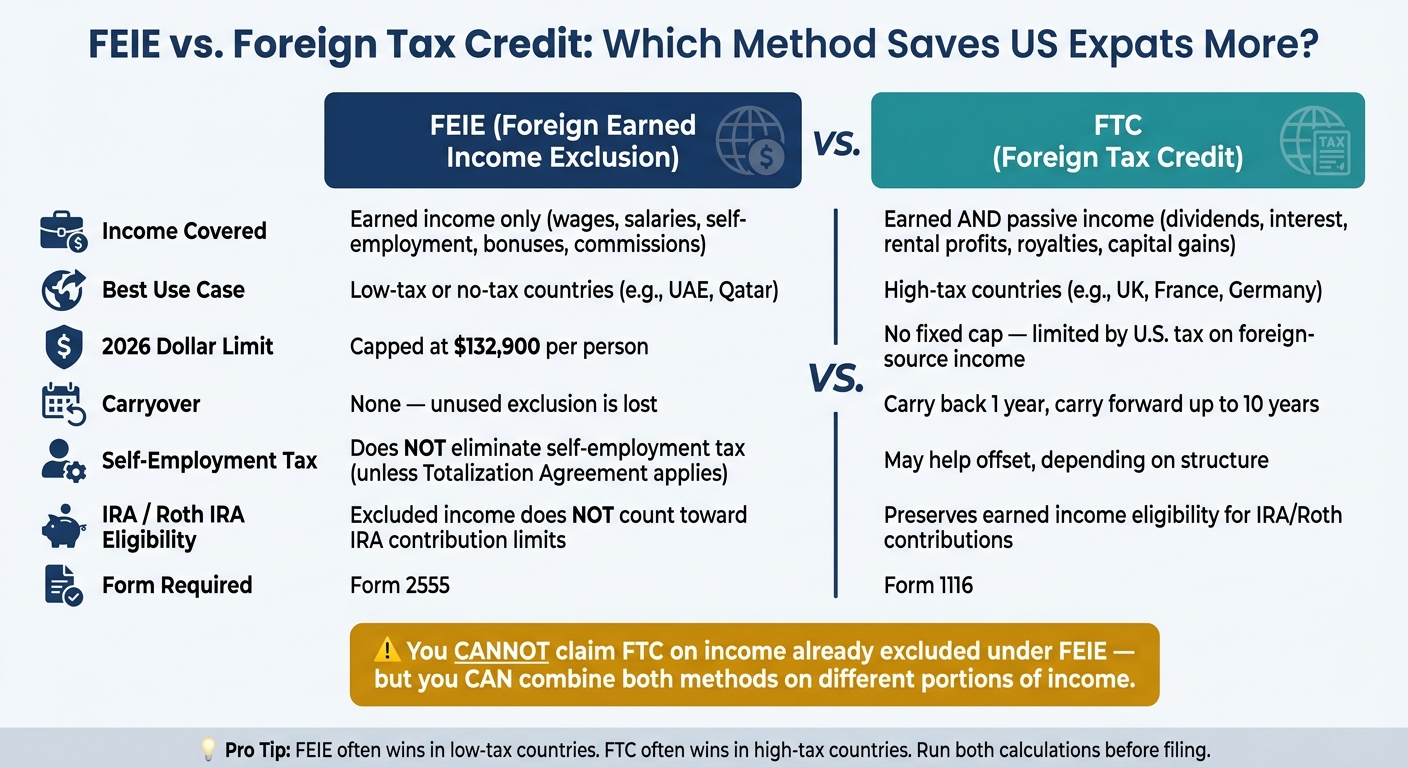
The best option depends on where you live and the kind of income you have. Here’s the side-by-side view.
| Consideration | FEIE | Foreign Tax Credit |
|---|---|---|
| Income covered | Earned income only (wages, self-employment) | Earned and passive income (dividends, interest, rental profits, royalties, capital gains) |
| Best use case | Low-tax or no-tax countries (e.g., UAE, Qatar) | High-tax countries (e.g., UK, France, Germany) |
| Dollar limit | Capped at $132,900 for 2026 | No fixed cap; limited by U.S. tax on foreign-source income |
| Carryover | None; unused exclusion is lost | Carry back 1 year, carry forward 10 years |
A common move is to use FEIE for the first $132,900 of earned income and then use FTC for foreign tax on income above that amount, plus passive income you didn’t exclude. There is one rule you can’t miss: you cannot claim FTC on income you’ve already excluded under FEIE.
Run both sets of numbers each year so you don’t pay more U.S. tax than you need to.
sbb-itb-39d39a6
Step 3: Apply housing, treaty, and income sourcing rules to close remaining gaps
If FEIE and FTC don’t wipe out the full tax hit, the next step is to use housing relief, treaty rules, and income sourcing rules to cut what’s left.
How the foreign housing exclusion or deduction can lower U.S. taxable income
If you qualify for FEIE, you may also qualify for housing relief. Employees use the foreign housing exclusion. Self-employed taxpayers use the foreign housing deduction. Both go on Form 2555 and follow the same FEIE residency rules.
For 2026, the base housing amount is $21,264, which is 16% of the $132,900 FEIE limit. The standard housing ceiling is $39,870, or 30% of that same FEIE limit. Some high-cost locations have higher caps.
Qualifying expenses include:
- Rent
- Utilities, not including phone and internet
- Renters’ insurance
- Furniture rental
- Residential parking
Some costs don’t count. Mortgage principal and interest, purchased furniture, and home renovations are out.
After you apply housing relief, treaty rules and sourcing rules decide whether any leftover income still gets taxed by the U.S.
When tax treaties help and when the saving clause limits their benefits
Tax treaties can assign taxing rights for wages, pensions, and investment income. But for U.S. citizens, there’s a catch: the saving clause usually keeps the U.S. right to tax its citizens anyway.
That means treaty relief is often limited for Americans abroad. Still, some carveouts can apply, especially for pensions and Social Security.
If you take a treaty-based position that overrides or changes normal IRS rules, you usually need to disclose it on Form 8833.
How income sourcing rules determine whether credits and treaty claims apply
If treaty relief doesn’t solve the issue, sourcing rules become the next filter. They decide whether income counts as foreign-source for FTC purposes.
That matters because the Foreign Tax Credit usually applies only to foreign-source income. So if income is treated as U.S.-source, you generally can’t use foreign tax credits to offset U.S. tax on that same income.
The main sourcing rules most expats deal with are pretty simple:
- Compensation is sourced where the work is performed
- Rental income, dividends, and interest are sourced based on the property’s location or the payer’s residence
- Capital gains are generally sourced by the seller’s tax home
This is where small details can change the outcome. Two people can earn the same amount, pay the same foreign tax, and still get different U.S. results just because the income is sourced differently.
Step 4: Build a filing and planning framework for long-term expat tax efficiency
A simple decision framework for choosing the right double-tax relief method
Once you know which relief tools may apply, use a clear order so nothing slips through the cracks. Start with the type of income and its source. Then look at foreign tax paid. After that, review FEIE, housing relief, and treaty relief.
A practical rule of thumb is simple: FEIE often fits low-tax countries, while FTC often fits high-tax countries. But you can’t use both on the same dollar. That part trips people up all the time.
You also need to model FEIE against your other income before you elect it. Why? Because FEIE can push up the tax rate on income that still stays on your return. On paper, the exclusion may look like an easy win. In practice, it can shift the math in ways that are easy to miss.
There’s another catch. A FEIE election usually carries forward into later years, and if you revoke it, you may face a five-year wait before you can elect it again. So this isn’t the kind of choice you make casually.
Then look at the ripple effects. If retirement saving matters to you, this part is a big deal: FEIE-excluded income does not count as earned income for IRA or Roth IRA contributions. FTC, on the other hand, can help preserve that eligibility. In plain English, the tax move that lowers your bill today can also limit what you’re able to set aside for later.
How cross-border structuring and Global Wealth Protection planning fit into the tax picture
For business owners and investors, the way income is held can change the U.S. tax result in a major way. Entity choice, fund selection, and trust structure all affect how foreign income flows onto your U.S. return.
This is where filing and planning meet. It’s not just about claiming a credit or an exclusion at tax time. The structure itself can change the tax outcome before the return is even prepared.
That’s why these rules need to be coordinated together. The goal is to avoid having the same income taxed twice at the structural level, not only at the filing level.
Conclusion: The core rules that help US citizens abroad avoid double taxation
The U.S. taxes its citizens on worldwide income no matter where they live. But the tax code also gives Americans abroad legal ways to avoid being taxed twice on the same dollar.
The basic framework is straightforward:
- Identify the income type and source
- Measure foreign tax paid
- Choose FEIE or FTC
- Add housing relief if it applies
- Check treaty positions last
Get that framework in place before you file. That’s what keeps a tax return from turning into a patchwork of missed credits, weak elections, and fix-it-later problems.
FAQs
Should I choose FEIE or the Foreign Tax Credit?
Neither one wins every time.
FEIE often makes more sense if you live in a low-tax or tax-free country. It lets you exclude foreign earned income from U.S. taxable income. But it doesn’t apply to passive income, and it can limit some tax breaks.
FTC often works better in a high-tax country. It gives you a dollar-for-dollar credit for foreign taxes paid, and it can apply to passive income too. You can’t use both for the same income.
Can I use FEIE and the Foreign Tax Credit together?
Yes, but not on the same income.
The IRS does not allow “double-dipping,” which means each dollar of income can be covered by only one method.
That said, you can still use both on the same tax return if they apply to different income. For example, you might use the FEIE for earned income up to the annual limit and the FTC for other income.
What taxes might I still owe after using expat tax relief?
Even if you use tax relief options like the FEIE or FTC, you might still owe U.S. tax on part of your income.
Here’s the catch: the FEIE only covers earned income. So income like dividends, interest, capital gains, and rental income can still be taxed by the United States.
If you’re self-employed, there’s another piece to watch. You may still owe the 15.3% self-employment tax for Social Security and Medicare.
And one more thing: state taxes don’t always disappear just because you live abroad. You may still have state tax obligations too.
