
If you have less than about €350,000 in annual foreign income, Italy’s flat tax often won’t pencil out. And for many high-net-worth families, the bar is closer to €1.5 million to €2 million once wealth-tax savings, family charges, and planning costs are added.
Here’s the short answer: this regime is built for people with large foreign income, large foreign assets, and limited Italian-source income. You pay a fixed annual amount – €200,000 for 2024–2025 entrants, €300,000 from 2026 – and in return, Italy can stop taxing much of your qualifying foreign income under its normal rules.
Before I’d even look at it, I’d check these points:
- Your entry date: it changes the annual fee
- Your income mix: foreign-source income helps; Italian-source income does not
- Your asset location: foreign assets may avoid IVAFE, IVIE, and foreign-asset reporting
- Your family setup: each added relative has its own extra charge
- Your estate plan: foreign assets can stay outside Italian inheritance and gift tax while the regime is active
- Your U.S. tax position: the lump-sum payment may not produce a usable foreign tax credit
The bottom line: if most of your income and wealth sit outside Italy, the fixed fee can save money. If your income is lower, your assets are mostly in Italy, or your household is large, the regime can get expensive fast.
| Item | Flat tax regime | Normal Italian tax |
|---|---|---|
| Annual cost | €200,000 or €300,000 fixed | Up to 43% IRPEF plus surtaxes |
| Foreign income | Usually covered by the fixed fee | Taxed under normal rules |
| Italian-source income | Not covered | Taxed under normal rules |
| Foreign wealth taxes | Exempt from IVAFE and IVIE | Usually applies |
| Foreign asset reporting | No Modulo RW | Required |
| Term | Up to 15 years | No fixed term |
If I were deciding, I’d treat this as a math problem first and a lifestyle choice second: Does the tax it replaces beat the fixed annual cost by a clear margin? If not, the regime is hard to justify.
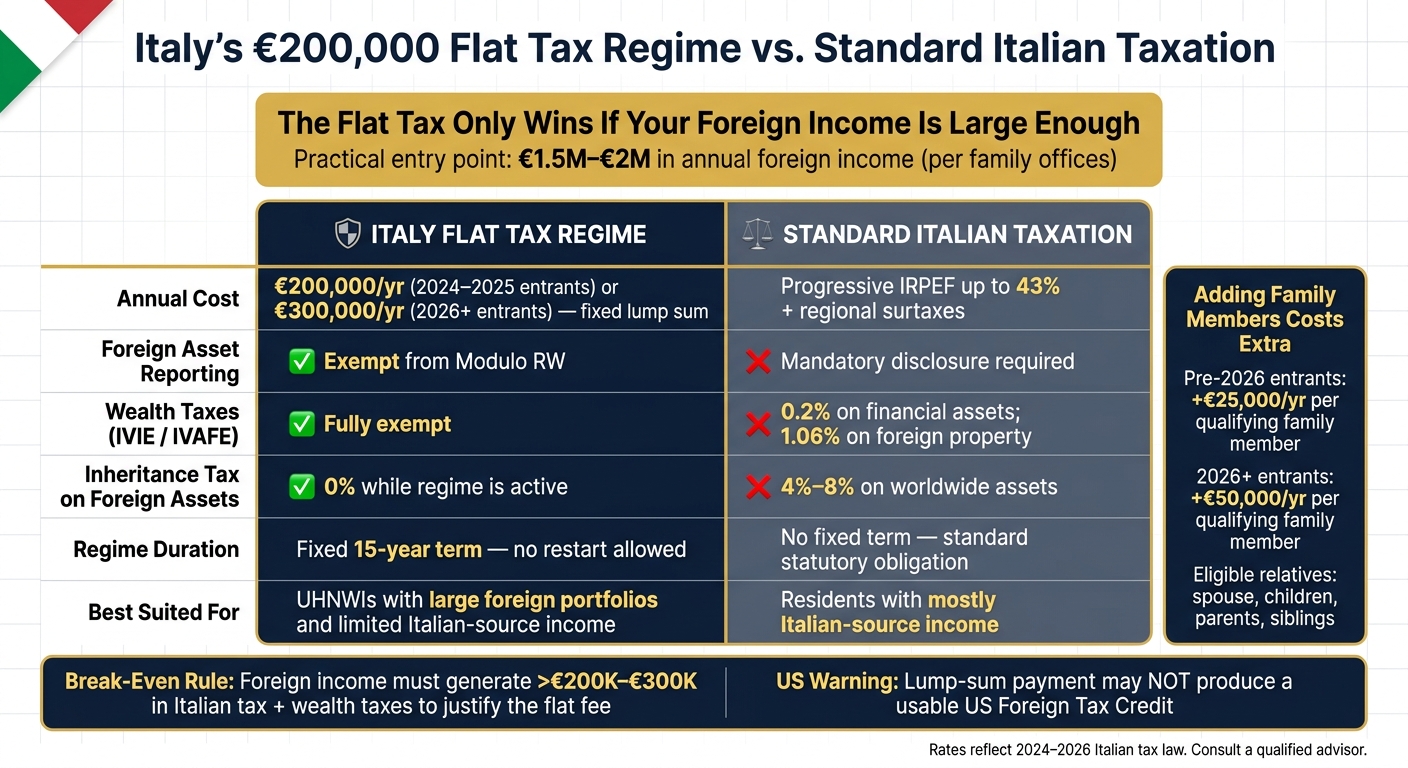
Italy Flat Tax vs. Standard Italian Tax: Key Differences for HNWIs
How Italy’s flat tax regime works
Italy’s flat tax regime works on a locked-in basis. New entrants will pay €300,000 per year starting in 2026. If you entered in 2024 or 2025, you locked in €200,000. Earlier entrants kept the €100,000 rate for the full 15-year term. Italy has stuck with that grandfathering approach, so people who got in at the lower rates keep them for the entire 15 years.
What matters most, though, is the trade-off: how much foreign income and wealth that fixed payment shields.
Eligibility, election, and the 15-year limit
You can use the regime only if you were not an Italian tax resident for at least 9 of the previous 10 years. Then you must become resident in Italy by meeting one of the usual tests: spending more than 183 days in Italy, establishing your domicile there, or registering in the Anagrafe.
To elect into the regime, you check the right box in the "NR" section of your first Italian income tax return, Modello Redditi PF. If your affairs are more involved, such as trusts, holding companies, or layered ownership, it’s common to file an interpello with the Agenzia delle Entrate before the move or soon after it. That gives you a formal read on whether you qualify.
The regime lasts for up to 15 consecutive years. Once it ends, or if you revoke it, that’s it. You can’t restart it or renew it later.
What the €200,000 payment covers and what it does not
The flat annual payment replaces normal Italian income tax on qualifying foreign-source income. That includes:
- Dividends
- Interest
- Rental income
- Employment income
- Capital gains
It also exempts participants from IVAFE, the tax on foreign financial assets, and IVIE, the tax on foreign real estate. On a large portfolio, that can be a big deal. In the example here, the same assets would otherwise face about €259,000 per year in wealth taxes alone.
But the shield is not total.
It does not apply to Italian-source income. So if you earn salary for work performed in Italy, make business profits from Italian operations, collect rent from Italian real estate, or receive dividends or capital gains from Italian companies, that income stays under the normal Italian system. That means progressive tax rates up to 43%, plus regional surtaxes.
There is also one rule that catches a lot of people on first read. Capital gains from qualified shareholdings are carved out. In general, that means holdings of more than 20% of voting rights or 25% of capital in an unlisted company. For the first five years of Italian residency, those gains are taxed at the standard 26% rate, even if you’ve elected into the flat tax regime.
Family members, foreign asset reporting, and inheritance scope
For families with large offshore holdings, this part can change the math in a big way.
You can extend the regime to qualifying family members, including a spouse, children, parents, and siblings. Each added family member gets the same treatment for their own foreign-source income, wealth taxes, and foreign asset reporting.
The added cost depends on when you entered:
- €25,000 per year for each added person if the main applicant entered before 2026
- €50,000 per year for each added person for new entrants from 2026 onward
Every taxpayer who opts in, including covered family members, is exempt from filing Modulo RW (Schedule RW), which is Italy’s standard disclosure form for foreign assets.
The regime also keeps non-Italian assets outside the scope of Italian inheritance and gift tax while the election is active. But Italian-situated assets still count. So a home in Rome or a local investment account remains subject to Italian inheritance tax, with rates ranging from 4% to 8%.
That last point is where the numbers either work in your favor or they don’t. The setup makes sense only when the tax saved is higher than the fixed annual cost.
sbb-itb-39d39a6
When the regime saves money and when it does not
Once you know what the regime covers, the next step is simple: does the fixed fee beat your normal Italian tax bill?
That’s the whole test.
The flat tax makes sense only when the tax it replaces would have been higher than the fee. At €200,000 per year, the regime works only if the tax it pushes aside is more than that amount.
Foreign dividends, interest, rents, and business profits
It helps to think of the flat tax as a ceiling on most foreign-source income.
The regime starts to make sense when foreign dividends, interest, rental income, royalties, and business profits would otherwise lead to more than €200,000 in Italian tax and related wealth taxes. If that foreign income base is too small, the fee can feel like paying for a seat you barely use.
Capital gains and Italian-source income
Capital gains need a closer look because some of them are not fully covered by the regime.
And there’s another big point: any income produced in Italy is still taxed under the ordinary Italian rules. That cuts into the regime’s upside right away.
So this setup tends to work best when most of your income is foreign-source and your Italian-source income is limited. If that balance shifts, the fixed fee can end up being more than the tax you save.
In plain English, the two things that matter most are income mix and where the assets sit.
The real trade-offs for wealthy families
Even when the tax math looks good, that doesn’t settle the decision. In practice, family setup, where assets sit, and how serious you are about living in Italy often carry more weight than the tax model itself.
Estate planning, foreign structures, and privacy
One of the most overlooked upsides of the regime is privacy around non-Italian assets. Flat tax residents do not have to file Modulo RW, which means foreign bank accounts, investment portfolios, and real estate stay outside Italy’s usual disclosure system. But that shield has a clear limit: foreign-situated assets remain outside Italian inheritance and gift tax while the election is in force, while Italian assets stay exposed.
Foreign trusts and holding companies need careful review before the move. Italy can treat a foreign-managed company as Italian tax resident under place-of-effective-management rules. And assets owned before residency may get a step-up in basis, which can lower future capital gains.
For many families, that all sounds good on paper. The harder question is simpler: after adding the household cost, do you still come out ahead?
Family size, lifestyle goals, and residency commitment
Family size can change the picture fast. Each added family member comes with a separate annual charge, so the regime works only when the tax savings are comfortably above the total cost for the household.
There’s another catch. Each family member has to meet the 9-of-10-year non-residency test on their own. If a spouse or child was recently an Italian tax resident, they may not qualify. In that case, their foreign income can fall under Italy’s ordinary progressive tax rates, which can go up to 43%.
This also isn’t a light-touch residency option. Italy has to become your actual center of life, and the 15-year period has an end date. So this tends to fit families who want a real base in the country for the medium to long run, not people looking for a brief stopover.
Why getting the implementation right matters
This is where many good plans either hold together or fall apart. If you’re a founder heading toward a major liquidity event, timing can change the result in a big way.
Pre-move restructuring matters just as much. It’s far easier to review foreign holding companies, trusts, and investment setups before becoming an Italian resident than to fix mistakes later. For US-connected individuals, that usually means doing tax planning before the move, since the lump-sum payment may not lead to the US foreign tax credit outcome many taxpayers assume.
Decision framework and conclusion
A yes-or-no checklist for affluent movers
Now that the mechanics and trade-offs are on the table, the last step is simple: compare the fixed fee with the tax you’d likely pay under the normal system.
Before you elect the regime, pressure-test five points: your foreign income level, your foreign-asset exposure, your income mix, your willingness to stay with the plan for 15 years, and your inheritance goals. If most of your answers are no, the flat tax is often too costly for your situation.
- Does your annual foreign-source income exceed the break-even level for your entry rate?
- Do you own large foreign assets that would otherwise fall under IVIE or IVAFE?
- Is most of your income foreign-source instead of Italian-source?
- Are you ready to plan around the full 15-year term?
- Is part of your plan to pass foreign wealth to heirs?
Use the same facts discussed throughout the article: where your income comes from, where your assets sit, and how your family is set up.
The table below compares the two paths:
| Factor | Italy Flat Tax Regime | Standard Italian Taxation |
|---|---|---|
| Annual cost | €200,000 or €300,000 lump sum, depending on entry date | Progressive IRPEF up to 43% + surtaxes |
| Foreign asset reporting | Exempt from Modulo RW | Mandatory disclosure |
| Wealth taxes (IVIE/IVAFE) | Exempt | 0.2% on financial assets; 1.06% on property |
| Inheritance tax on foreign-situs assets | 0% | 4%–8% on worldwide assets |
| Flexibility | Fixed 15-year term; no restart | Standard statutory obligation |
| Best for | UHNWIs with large foreign portfolios | Residents with mostly Italian-source income |
Key takeaways for US-connected high-net-worth readers
This regime tends to work only for people with very large income streams from outside Italy. At €200,000 or €300,000 per year, depending on entry date, it starts to make sense only when the foreign-income shield, the wealth-tax savings, and the inheritance-tax exclusion together beat that cost by a clear margin.
For US-connected readers, there’s one more wrinkle. The lump-sum payment often does not create a usable Foreign Tax Credit because it is not linked to specific income.
That point matters more than it may seem at first glance. On paper, the Italian regime can look clean and simple. But if the U.S. side doesn’t give full credit for that payment, the math can change fast.
Many family offices place the practical entry point at about €1.5 million to €2 million in annual foreign income, especially once relocation and advisory costs are added in. Below that range, the fixed fee usually costs more than the tax it saves.
FAQs
How do I calculate my break-even point?
Compare the regime’s fixed annual cost – €300,000, plus €50,000 for each participating family member – with what you’d otherwise pay under Italy’s standard rules on your foreign-source income.
In plain English: this regime tends to make sense when your usual tax bill on foreign income would be higher than the flat fee.
That said, don’t stop the math there. Italian-source income is still taxed separately. And the exemptions on foreign assets, inheritance, and gifts can be worth a lot too, especially if your wealth sits mostly outside Italy or you’re doing estate planning for family members.
What counts as foreign-source income under this regime?
Under Italy’s flat tax regime, foreign-source income usually means income earned outside Italy.
That can include:
- Dividends
- Interest
- Capital gains
- Foreign business profits
- Rent from real estate outside Italy
- Foreign pension income
- Returns from rights or assets held abroad
Italian-source income is not covered by this regime. Italy taxes that income under its ordinary tax rules.
What happens after the 15-year term ends?
After the 15-year term ends, you can’t use Italy’s substitute flat tax regime anymore. At that point, you move into Italy’s ordinary tax system, where the standard progressive tax rates apply, along with the usual reporting rules for your worldwide income and assets.
The regime can’t be renewed or extended, so it’s smart to plan ahead for that switch.
