
If I had to give the short answer, I’d say this: Monaco has the lowest headline tax at 0%, but for most people, the more usable low-tax options are Bulgaria, Cyprus, Malta, Andorra, Portugal, and Georgia.
The catch is simple: the lowest tax rate is not always the lowest tax bill. I’d look at income tax, dividends, capital gains, social charges, and residency rules before picking a country. In this list, Monaco wins on paper, Andorra stays low and simple, Bulgaria is the cheapest EU base for many workers, Cyprus is strong for dividend and interest income, Malta works when offshore income stays offshore, Portugal is now limited to people who qualify for IFICI, and Georgia is strong if most income is foreign-source.
Here’s the short version:
- Monaco: 0% personal income tax, but entry costs are very high
- Andorra: up to 10% income tax, plus low taxes on many investments
- Bulgaria: 10% flat tax, low-cost EU option, but payroll charges matter
- Cyprus: 0% tax on dividends and interest for non-doms for up to 17 years
- Malta: foreign income can stay tax-free if not remitted, but there’s a $5,000 minimum tax in many cases
- Portugal: no longer a broad low-tax pick; IFICI gives 20% for limited groups
- Georgia: foreign passive income is usually 0% for residents; small business tax can be 1%
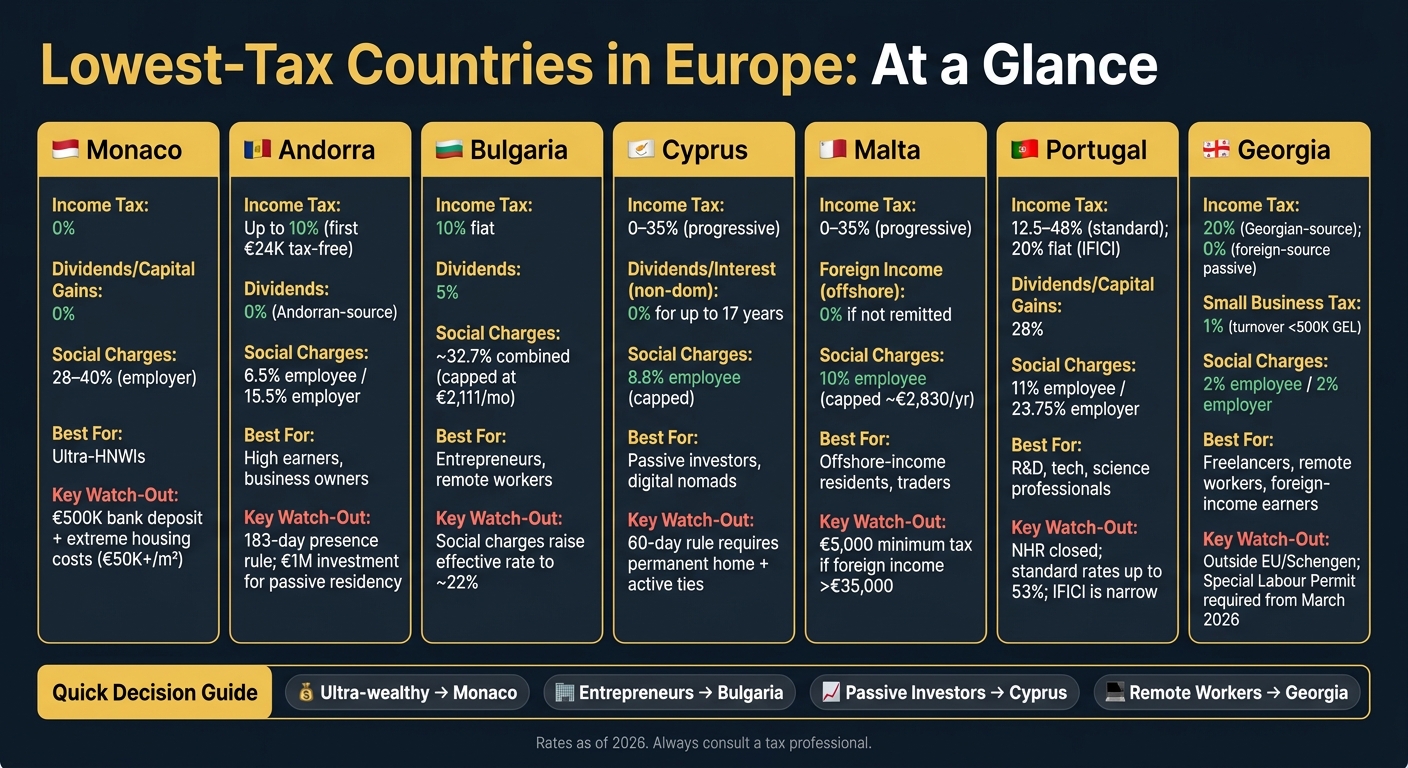
Quick Comparison
| Country | Main Tax Angle | Main Issue | Best Match |
|---|---|---|---|
| Monaco | 0% income tax | Very high housing and entry cost | Ultra-wealthy residents |
| Andorra | Up to 10% income tax | Time-in-country and investment rules | Owners, high earners |
| Bulgaria | 10% flat tax | Social charges on work income | Entrepreneurs, remote workers and those seeking tax and residency solutions |
| Cyprus | 0% on dividends/interest for non-doms | Need to meet residency tie rules | Investors, mobile founders |
| Malta | Remittance basis | Minimum tax and more admin | Offshore-income residents |
| Portugal | 20% IFICI for limited roles | Normal rates go up to 53% | R&D, tech, science roles |
| Georgia | 0% on much foreign passive income; 1% small business tax | Outside EU/Schengen | Freelancers, foreign-income earners |
For U.S. citizens, I’d keep one point front and center: moving abroad does not end U.S. tax filing. You still deal with worldwide income reporting, and the 2026 FEIE is $132,900 for foreign earned income only.
If I were comparing these countries for a move, I’d focus on one question first: How do you make your money? Salary, dividends, pension income, and business profits can lead to very different answers.
sbb-itb-39d39a6
1. Andorra
Andorra tops out personal income tax at 10%. The first €24,000 is tax-free, income from €24,001 to €40,000 is taxed at 5%, and anything above €40,000 is taxed at 10%. On a €120,000 salary, that comes out to an effective rate of about 7.3%. There’s also no wealth tax, inheritance tax, or gift tax.
Personal Income Tax
The setup is easy to follow, and the top rate stays low. For high earners, that’s the main draw: you keep a large share of what you earn.
Passive Income Taxes
Andorra is also attractive for some types of passive income. Dividends from an Andorran company paid to an Andorran tax resident are 100% exempt from personal income tax. Foreign dividends are taxed at 10%, with the first €3,000 per year exempt.
Interest and savings income are also taxed at 10%, with that same €3,000 annual exemption. Capital gains are usually taxed at 10%. There are carve-outs for share sales, though. Gains can be exempt if the resident owns less than 25% of the company or has held the stake for more than 10 years.
Real estate gains follow a sliding scale. The tax starts at 15% if the property is sold within one year and drops over time until it reaches 0% after 12 years.
Social Contributions
Employees pay 6.5% of gross salary into Andorra’s national social security system, CASS, while employers pay 15.5%. That puts the total social contribution at 22%.
For self-employed residents, the setup is different. They pay a fixed monthly amount of about €550, no matter their income level. Passive residents don’t pay into CASS, but they do need private health insurance, which usually runs from €650 to €2,000 per year.
Residency Access
There are two common paths: active residency and passive residency.
Active residency is aimed at entrepreneurs and self-employed professionals. It requires spending at least 183 days per year in Andorra, plus a €50,000 nonrefundable fee paid to the Andorran Financial Authority (AFA).
Passive residency is more geared toward retirees and investors. It requires a minimum stay of 90 days, a €1,000,000 investment in Andorran assets, and the same €50,000 nonrefundable fee. In January 2026, that investment threshold for passive residency increased from €600,000 to €1,000,000.
Andorra does check whether people are there in practice, not just on paper. Authorities verify residency through border crossing data, utility consumption records, and local bank transactions. So if someone plans to use the 183-day rule, they need to meet it for real.
Andorra tends to fit high earners and business owners who can spend actual time in the country. That’s the catch – and also the point. The low tax rate looks great, but it works best for people who can match the lifestyle to the rules.
2. Monaco
Monaco charges 0% personal income tax. That means residents generally pay nothing on employment income, self-employment income, dividends, interest, or capital gains. There’s also no wealth tax and no property tax.
There’s one big carveout: French nationals. Under the 1963 Franco-Monegasque convention, French citizens who moved to Monaco after October 13, 1957, usually still owe French income tax on their worldwide income as if they were living in France.
Passive Income Taxes
Here’s where the fine print matters. The main problem usually isn’t Monaco tax. It’s foreign withholding tax on income from outside Monaco.
Foreign-source income can still get hit with withholding tax, and that tax is often hard or impossible to recover because Monaco’s tax treaty network covers only about 10 to 13 jurisdictions. In practice, that can mean Monaco residents eat 30% on U.S.-source dividends and 35% on Swiss-source dividends with no credit to offset it.
So the 0% story is real, but it mostly works best for income earned in Monaco or income routed through treaty-friendly setups.
Social Contributions
If you work in Monaco, payroll charges still apply. Employers pay between 28% and 40% of gross salary into the Caisses Sociales de Monaco, and employees pay their share too.
Residents also need private health insurance. On top of that, tenants pay a 1% leasehold tax on annual rent.
Residency Access
Monaco’s tax setup comes with a steep price of entry. Applicants need:
- Proof of housing
- Clean criminal records from countries of recent residence
- At least €500,000 on deposit in a Monegasque bank
Non-EU applicants must also get a French Type D long-stay visa before they begin the residency process.
Tax residence is a separate test. In most cases, you’ll need to show more than 183 days per year spent in the Principality.
For many people, real estate is the biggest hurdle by far. Average prices are above €50,000 per square meter, and prime areas like Larvotto can top €71,000 per square meter.
Monaco tends to fit wealthy retirees and high earners who can handle the upfront cost. For digital nomads and mid-level founders, it often doesn’t add up. The tax upside is huge, but so are the housing costs and residency hurdles.
3. Bulgaria
Unlike Monaco, Bulgaria gives you an EU base with low taxes without sky-high housing costs. The big draw is its 10% flat personal income tax, the lowest in the EU, and it applies to worldwide income for tax residents. For people who want lower taxes and a lower-cost place to live, that combo stands out.
Resident Income Tax
For employees, the picture is a bit less simple than the headline 10% rate. Once social contributions are added, the total burden usually lands around 22%.
Freelancers tend to come out ahead. A standard 25% expense deduction cuts the effective rate to about 7.5% on gross income. Creators and musicians can do even better: they can claim a 40% deduction, which brings the rate down to 6%.
Passive Income Taxes
Passive income rules are also pretty friendly.
- Dividends are taxed at a flat 5%, with no social contributions added.
- General capital gains are taxed at 10%, while gains on securities listed on EU/EEA regulated markets are 0%.
- Real estate gains are exempt if you’ve held one residential property for more than three years, or up to two more properties for more than five years.
Interest on bank deposits dropped to 8% in 2026, down from 10%. Crypto gains are taxed at 10%, after a 10% cost deduction.
If you run a company, distributed profits face about 15% total tax.
Social Contributions
Combined employer and employee social contributions come to about 32.7%. That sounds heavy at first glance. But there’s a cap, and that’s where things change.
Contributions are calculated only on income up to the maximum monthly insurable income of €2,111.64 in 2026. So if you earn well above that level, your effective social contribution burden gets much smaller as a share of your total income.
Residency Access
For EU and EEA citizens, the process is mostly administrative and fairly direct.
For U.S. citizens and other non-EU nationals, there are a few paths. These include a D-Visa, temporary residence through company formation or employment, and the Bulgaria for digital nomads includes a visa introduced in 2025 for remote workers. Investment residency requires at least €500,000 in Bulgarian government bonds or €1,000,000 placed in a Bulgarian company.
Tax residency starts after more than 183 days in Bulgaria during a calendar year, or if your "center of vital interests" – meaning your home, family, and economic ties – is there. In plain English, Bulgaria wants to see that you have actual ties to the country, such as housing, a local bank account, and real time spent there.
There’s also a small perk at filing time: submit by March 31 and you can get a 5% tax discount.
4. Cyprus
Cyprus hits a useful middle ground. It’s in the EU, it uses a progressive income tax system, and its main draw is non-dom status. If you qualify, you can pay 0% SDC on dividends and interest for up to 17 years. That can matter a lot more than the headline income tax rate, especially if you live on salary, dividends, or both. In practice, Cyprus tends to fit salaried professionals and investors who can access non-dom treatment.
Resident Income Tax
As of January 1, 2026, personal income tax is set up like this:
| Chargeable Income (€) | Tax Rate |
|---|---|
| 0 – 22,000 | 0% |
| 22,001 – 28,000 | 20% |
| 28,001 – 36,300 | 25% |
| 36,301 – 72,000 | 30% |
| Over 72,000 | 35% |
New residents who earn more than €55,000 can deduct 50% of employment income for up to 17 years. So if a remote worker earns €80,000, the effective rate, including income tax and the General Healthcare System (GHS) levy, comes to about 13.2%.
That said, for many people, the bigger tax edge in Cyprus comes from dividends, interest, and capital gains.
Passive Income Taxes
For non-doms, the standout rule is simple: 0% SDC on dividends and interest. Domiciled residents, by contrast, pay 5% on dividends and 30% on passive interest. Cyprus also removed SDC on rental income in 2026, so rent now faces only personal income tax and the GHS levy.
If part of your income comes from investments, this is where Cyprus starts to look much stronger.
Capital gains on shares, bonds, and other securities are generally taxed at 0%, unless the company owns immovable property in Cyprus. There is also a new 8% flat-rate tax option for crypto-asset trading when that activity is treated as business income. On top of that, Cyprus has no inheritance tax, no gift tax, and no net wealth tax.
Social Contributions
Non-dom status doesn’t remove social charges. Residents still pay the GHS contribution of 2.65% on most income types, including dividends and interest, with an annual income cap of €180,000.
For work income, the numbers depend on how you’re set up:
- Employees pay 8.8% social insurance, capped at annual earnings of €68,904.
- Self-employed residents pay 16.6% social insurance and 4.0% for GHS.
From January 1, 2026, residents ages 25 to 70 must file an annual tax return, no matter their income level.
Residency Access
Cyprus gives you two main ways to become a tax resident. The standard route is the 183-day rule, which means being physically present for more than half the year.
The other route is what puts Cyprus on many remote workers’ shortlists: the 60-day rule. To use it, you need to:
- Spend at least 60 days in Cyprus
- Keep a permanent home there, whether owned or rented
- Hold a business, employment, or directorship in a Cyprus-resident company
- Avoid spending more than 183 days in any other single country
Non-dom status lasts 17 years. It can now be extended twice, for additional five-year periods, at a cost of €250,000 per extension. For qualified founders and investors, that gives Cyprus a long runway as a base.
Malta is next, and its tax appeal depends more on residency structure than on a flat low rate.
5. Malta
Malta stands out for one main reason: remittance-based taxation. If you’re a resident non-dom, you generally pay tax on Maltese income and on foreign income that you bring into Malta. Foreign income that stays offshore isn’t taxed in Malta, and foreign capital gains stay exempt even if you remit them.
That sounds great on paper, but there’s a catch. Malta only feels low-tax when your income remains outside the country. Once you start remitting money, the tax bill can climb fast. So in practice, Malta tends to work best for people who earn passive income abroad and can leave it offshore.
Key limitation: if a non-dom resident has foreign income above €35,000 per year, they face a €5,000 minimum tax even when none of that income is remitted to Malta.
Resident Income Tax
Maltese-source income is taxed at progressive rates:
| Annual Income | Tax Rate |
|---|---|
| €0 – €9,100 | 0% |
| €9,101 – €14,500 | 15% |
| €14,501 – €60,000 | 25% |
| Over €60,000 | 35% |
Passive Income Taxes
For non-doms, foreign dividends and interest kept outside Malta are taxed at 0% in Malta. Foreign capital gains are tax-free even if remitted.
Income from residential rental property in Malta can be taxed at a flat 15% instead of the progressive income tax scale. Malta also has no wealth tax, inheritance tax, or gift tax.
Social Contributions
Social security is capped, which helps keep payroll costs from running away.
- Employees pay 10%
- Employers match that with 10%
- The annual employee cap is about €2,830
- Self-employed residents pay 15% of annual income
Residency Access
These tax rules matter because Malta’s main residency routes are built around the remittance system, not around low headline tax rates. There are three main programs:
- Global Residence Programme (GRP): flat 15% tax on remitted foreign income, with a minimum annual tax of €15,000; applicants must buy property for at least €275,000 or €220,000 in South Malta or Gozo, or rent for at least €9,600 per year or €8,750 in South Malta or Gozo
- Nomad Residence Permit: for people earning at least €42,000 from foreign sources; tax-free in the first year, then 10% on remitted income
- Malta Retirement Programme (MRP): flat 15% tax on remitted foreign pension income
Put simply, Malta is a better fit for investors and retirees with offshore income than for people living mainly on salary. If you can handle the remittance rules well, Malta can be a strong EU base. If not, the minimum-tax rule cuts into the appeal.
6. Portugal
Portugal doesn’t belong on a generic low-tax shortlist anymore. The old NHR regime closed to new applicants on December 31, 2023, and what replaced it is much narrower. In plain English: Portugal is no longer a broad low-tax play for expats. It now works far better as a targeted option for people who can get into IFICI.
Resident Income Tax
Standard residents pay tax on worldwide income at progressive rates, with a personal allowance of €8,342.
| 2026 Income Tax Brackets (Mainland) | Tax Rate |
|---|---|
| Up to €8,342 | 12.5% |
| €8,342 – €12,587 | 15.7% |
| €12,587 – €17,838 | 21.2% |
| €17,838 – €23,089 | 24.1% |
| €23,089 – €29,397 | 31.1% |
| €29,397 – €43,090 | 34.9% |
| €43,090 – €46,566 | 43.1% |
| €46,566 – €86,634 | 44.6% |
| Over €86,634 | 48.0% |
On top of that, a solidarity surcharge adds 2.5% on income between €80,000 and €250,000, and 5% on income above €250,000. That pushes the top marginal rate to 53%.
Passive Income Taxes
For standard residents, dividends, interest, and capital gains on securities are taxed at a flat 28%. Rental income from residential property is taxed at 25%, while non-residential property rental income is taxed at 28%.
Property capital gains get a different treatment. Only 50% of the gain is added to taxable income, and that amount is then taxed at progressive rates. Portugal also has no general wealth tax and no inheritance tax for spouses, parents, or children. But there is a 10% stamp duty on assets that pass outside the direct family line.
Crypto gets a split treatment. Gains on assets held for more than 365 days are tax-free if the assets do not qualify as securities. If held for less than a year, gains are taxed at 28%.
The IFICI Regime (NHR 2.0)
The replacement program, officially called the Tax Incentive for Scientific Research and Innovation (IFICI), offers a 20% flat rate for 10 years on qualifying Portuguese-source income. It also exempts most foreign-sourced dividends, interest, rental income, and capital gains from Portuguese tax.
That sounds strong. The catch is eligibility.
IFICI is aimed at highly qualified people in specific fields, including R&D, higher education, health, tech startups, and certain executive roles. Retirees and passive-income earners usually won’t qualify. Foreign pensions are also not exempt. They’re taxed at normal progressive rates.
So the new regime is a very different animal from the old NHR. It’s built for qualifying professionals, not retirees or people living off investments.
For those who do qualify, the tax break can be meaningful. But payroll charges still matter, and they can take a solid bite.
Social Contributions
Employees pay 11% in social security contributions, while employers pay 23.75%. Self-employed residents pay 21.4% on 70% of their income, which works out to an effective rate of about 15%. New self-employed workers get a break here: they’re exempt from social security contributions for their first 12 months of activity.
Residency Access
Portugal generally treats you as a tax resident if you spend more than 183 days in a 12-month period in the country, or if you have a habitual residence set up by December 31. IFICI status is not automatic. New arrivals need to apply through the Tax Authority portal and show proof of qualifying activity.
Portugal is now a niche low-tax option. It can work well for qualifying professionals, but it’s a weak fit for most retirees and passive-income expats. The practical question is simple: do you qualify for IFICI?
7. Georgia
Georgia sits outside the EU, but its territorial tax system gives it a big edge: foreign-source passive income is generally tax-free for residents. If most of your income comes from abroad, that can make Georgia one of the strongest low-tax setups on the list.
Resident Income Tax
Income sourced in Georgia is taxed at a flat 20% personal income tax rate when the work is performed in Georgia. So the tax upside here usually comes from offshore dividends, interest, and royalties.
For people running a solo business, the main option is Small Business Status. Individual entrepreneurs with turnover under 500,000 GEL (~$180,000) pay 1% on turnover. If turnover goes above that level, the rate becomes 3%. There is also Micro Business status for people earning under 30,000 GEL (~$11,000) per year, with a 0% tax rate.
There is a catch. Consulting and legal services do not qualify, so the 1% setup tends to fit freelancers, remote workers, and online sellers better.
Passive Income Taxes
For residents, foreign-source dividends, interest, and royalties are exempt from Georgian tax. That is the main draw.
Georgian-source passive income gets different treatment. Dividends and interest are subject to a 5% withholding tax.
Residential rental income can also get a better rate. Instead of the standard 20%, you can choose a flat 5% rate, but that option comes without deductions. On top of that, capital gains on residential real estate held for more than two years are taxed at 0%.
Georgia also has no wealth tax, inheritance tax, gift tax, or estate tax.
Georgia’s main tax rates and exemptions are below.
| Tax Category | Rate | Condition |
|---|---|---|
| Personal Income Tax (Standard) | 20% flat | Georgian-source income |
| Small Business Status | 1% | Turnover up to 500,000 GEL |
| Micro Business Status | 0% | Turnover below 30,000 GEL |
| Foreign-Source Passive Income | 0% | Territorial exemption for residents |
| Georgian Dividends & Interest | 5% | Withholding tax |
| Residential Rental Income | 5% | Optional flat rate without deductions |
| Real Estate Capital Gains | 0% | Property held more than 2 years |
Social Contributions
Georgia’s social contribution load is low next to much of Western Europe. Residents usually pay 2% of salary into a pension scheme, with 2% matched by the employer and another 2% from the state.
Residency Access
Tax rates matter a lot more when the residency path is not a headache.
U.S. citizens can enter Georgia visa-free and stay for up to 365 consecutive days without a visa. For a longer stay, one route is the Real Estate Visa, which requires property ownership worth at least $150,000, up from $100,000 as of March 1, 2026.
Another route is the Investment Residence Permit. That requires a $300,000 investment in real estate or qualifying business activity and can lead to permanent residency.
There is also a separate path for High Net Worth Individuals. If you hold assets over 3,000,000 GEL (~$1.1 million) or earned more than 200,000 GEL (~$75,000) per year for the last three years, you can get Georgian tax residency without meeting the usual 183-day physical presence test. That can help if you need a tax residency certificate for treaty purposes.
There is one rule you should not brush past. As of March 1, 2026, foreigners who work or freelance in Georgia need a Special Labour Activity Permit, even when their clients are abroad. If they do not comply, both the worker and employer can be fined 2,000 GEL (~$720).
U.S. citizens also have a tax wrinkle here. There is no modern tax treaty between the U.S. and Georgia. The U.S. still applies a legacy 1973 USSR treaty, and Georgia does not recognize it.
For people who care more about total tax cost than EU membership, Georgia stands out. It tends to fit remote workers, entrepreneurs, and investors with foreign-source income especially well.
Pros and Cons by Country
After the country-by-country breakdown, the table below gives you the practical trade-off for each option. It’s the short version of a much bigger decision: low tax on one side, lifestyle and compliance on the other.
| Country | Biggest Tax Advantage | Main Drawback | Best For | Key Watch-Out |
|---|---|---|---|---|
| Andorra | 10% max income tax; 4.5% VAT | Landlocked; strict 183-day presence rule | HNWIs; mountain lifestyle | €1,000,000 investment for passive residency |
| Monaco | 0% personal income tax for non-French residents | Extreme rent and living costs | Ultra-HNWIs | About €500,000 in bank deposits plus local housing is needed |
| Bulgaria | 10% flat personal and corporate tax; euro adoption in 2026 | Social contributions around 32.7% | Cost-sensitive entrepreneurs; remote workers | Employment income can face a much higher effective rate |
| Cyprus | 0% tax on dividends and interest for 17 years | Corporate tax increased to 15% in 2026 | Passive investors; nomads | 60-day rule requires a permanent home and active ties |
| Malta | 5% effective corporate tax under the 6/7ths refund system | Refunds can take 12–18 months | International traders | €5,000 minimum annual tax if foreign income exceeds €35,000 |
| Portugal | 20% flat rate under IFICI for eligible roles | NHR closed; standard rates up to 53% | R&D and scientific professionals | Most general expats no longer qualify |
| Georgia | 1% small-business turnover tax; territorial treatment for foreign-source income | Outside EU/Schengen framework | Freelancers; remote workers | Best when your income is mainly foreign-source |
A few patterns jump out fast.
Monaco and Andorra are built for people with deep pockets. The tax side looks great, but the cost of entry is high. In Monaco, that means major banking and housing costs. In Andorra, the passive residency route calls for a €1,000,000 investment and a strict presence test.
Bulgaria, Cyprus, and Malta sit in a more mixed middle ground. They can work well, but the headline rate doesn’t tell the whole story. Bulgaria’s 10% flat tax sounds simple, yet social contributions of around 32.7% can change the math in a hurry. Cyprus gives passive investors a long 17-year break on dividends and interest, but the 60-day rule only works if you keep a permanent home and active ties there. Malta’s refund system can push the corporate rate down to 5%, though waiting 12–18 months for refunds can test your patience.
Then there’s Portugal and Georgia, which are much more case-specific. Portugal still has a path through IFICI with a 20% flat rate for eligible roles, but the old NHR door is shut for most people, and standard rates can go up to 53%. Georgia is often the low-cost wildcard: a 1% small-business turnover tax and territorial treatment for foreign-source income can be a strong setup for freelancers and remote workers, especially if most income comes from abroad.
That’s the core trade-off in plain English: the lowest-tax option isn’t always the easiest place to live, qualify, or operate from.
Conclusion
Headline tax rates and what you actually pay often aren’t the same thing. Monaco’s 0% personal income tax looks perfect on paper, but steep housing costs and banking barriers put it out of reach for most people. For most expats, the more realistic options are Bulgaria, Cyprus, Georgia, Malta, and Portugal.
The smart way to read this shortlist is by fit, not just by rate. Residency rules and the type of income you earn will shape which country saves you money in practice.
Bulgaria is the most straightforward EU option for cost-conscious entrepreneurs and remote workers. Cyprus is a strong match for passive investors and frequent travelers who can’t spend six months a year in one place. Georgia fits remote workers and entrepreneurs whose income is mostly foreign-source. Malta can work well for traders who are comfortable with more paperwork. Portugal is now aimed at R&D and innovation professionals through IFICI, not the general expat crowd.
Use this shortlist as a simple test for your income mix, your willingness to meet residency rules, and how much administration you’re ready to take on.
| Use Case | Best Fit | Key Benefit |
|---|---|---|
| Ultra-high-net-worth individuals | Monaco | 0% income, capital gains, and wealth tax |
| Entrepreneurs and remote workers | Bulgaria | Low-cost EU base for entrepreneurs |
| Digital nomads and passive investors | Cyprus | Good for passive investors and flexible residency |
| Remote workers and entrepreneurs | Georgia | Territorial tax treatment on foreign-source income |
| R&D and tech professionals | Portugal | Best for qualifying R&D and innovation professionals |
| Traders who can handle more administration | Malta | Works best when offshore income stays offshore |
Across every country on this list, the same pattern shows up: residency access, social charges, and income type matter more than the headline rate. The best low-tax country isn’t the one with the lowest number. It’s the one that lines up with how you earn, where you live, and what rules you can meet.
One last note for American readers: U.S. citizens still file on worldwide income. In 2026, the FEIE excludes up to $132,900 of foreign earned income, but it doesn’t cover dividends, interest, or pensions.
FAQs
Which low-tax country is best for my income type?
It depends on how you earn your money and where you want to live long term.
- Passive income, dividends, interest: Cyprus is often a strong fit. Under its non-dom regime, foreign-sourced dividends and interest can be taxed at 0%.
- Entrepreneurs, business owners: Bulgaria stands out for its simple 10% flat tax and 5% dividend tax. Malta can also work well if you want non-dom remittance-basis planning.
- High earners: Monaco offers a permanent zero-tax setup. Andorra has a 10% top rate. And Spain’s Beckham Law can help if you qualify and earn employment income.
The best pick usually comes down to one thing: are you living on investments, running a business, or earning a high salary?
How do social charges change the real tax cost?
Social contributions can push the actual tax bill well above the headline rate, especially for employment income. A country may advertise a low flat income tax, but mandatory social security or health payments are often stacked on top.
To see the true tax burden, look at the full picture:
- Income tax
- Social charges
- Any special levies
If you skip those extra charges, the total cost can appear lower than it is.
Do U.S. citizens still owe taxes after moving?
Yes. U.S. citizens still owe taxes to the United States after moving abroad because the U.S. taxes citizens on worldwide income, no matter where they live.
Moving to a low-tax European country might cut local taxes or even wipe them out. But it does not remove your U.S. federal tax filing and reporting duties. The Foreign Earned Income Exclusion can help in some cases, but you still need to report your global income to the IRS.
