
Yes – many countries have 0% inheritance tax in 2026. But that does not always mean heirs get assets with no tax cost. In some places, tax hits later through capital gains, stamp duty, probate fees, or forced-heirship rules that limit who can inherit.
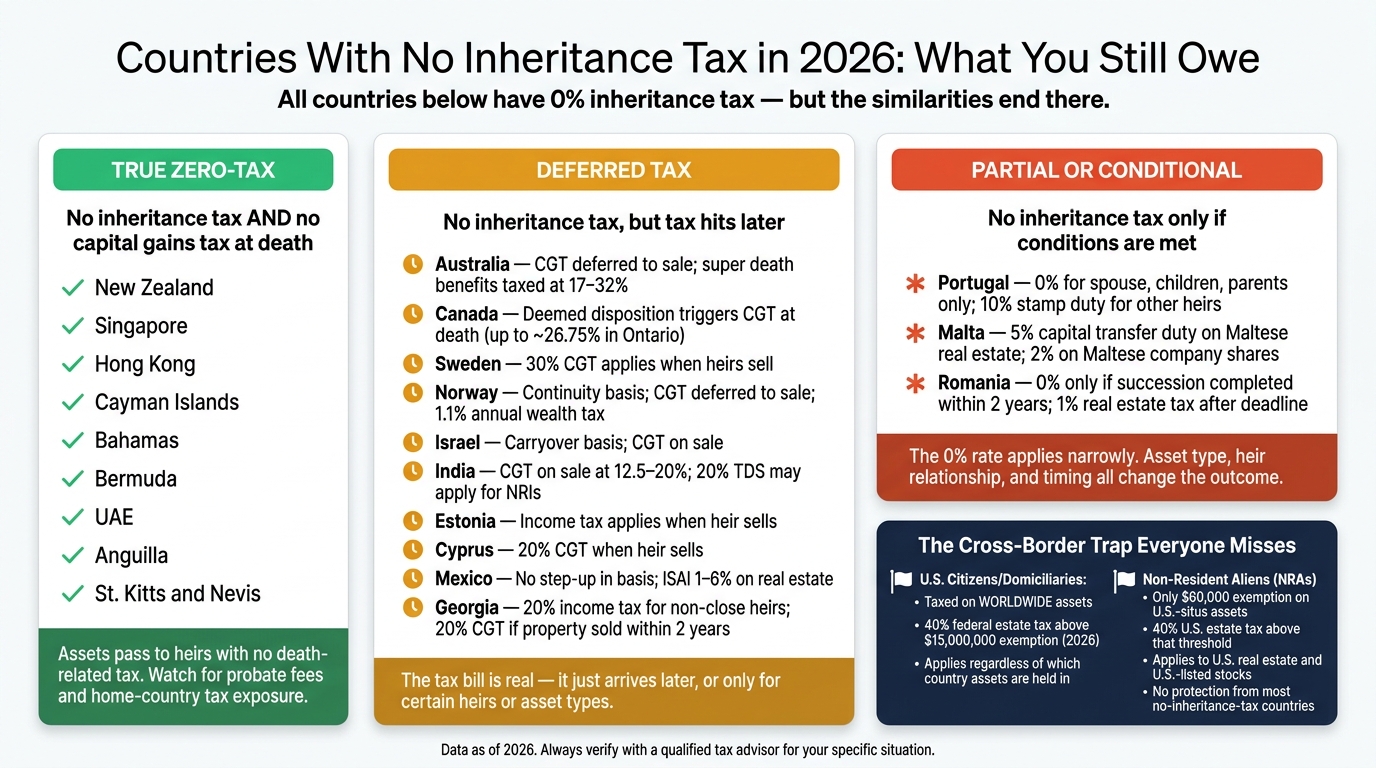
If I wanted the short answer, I’d group the article like this:
- Clear no-inheritance-tax places: Australia, New Zealand, Canada, Sweden, Norway, Austria, Israel, Singapore, Hong Kong, India, China, the UAE, Cayman Islands, BVI, Bahamas, Bermuda, Anguilla, St. Kitts and Nevis, Estonia, Slovakia, Cyprus, Georgia, Moldova, Andorra, and Mexico
- Partial no-tax cases: Portugal, Malta, and Romania
- Main trap: “No inheritance tax” can still mean CGT at death, CGT on sale, stamp duty, property transfer charges, or estate-level tax
- Main cross-border trap: U.S.-situs assets can still face up to 40% U.S. estate tax above $60,000 for many non-U.S. persons
Here’s the simplest way I’d read this article:
- Best pure no-death-tax systems: New Zealand, Singapore, Hong Kong, Cayman Islands, Bahamas, Bermuda, UAE
- No inheritance tax, but tax can still show up later: Australia, Sweden, Norway, Israel, India, Estonia, Cyprus, Mexico
- No inheritance tax, but death can still trigger tax: Canada
- No inheritance tax for close family only, or only if rules are met: Portugal, Malta, Romania, Georgia
Quick comparison
| Country/group | Inheritance tax in 2026 | What can still reduce the estate |
|---|---|---|
| New Zealand | 0% | Estate income tax, property bright-line rule |
| Australia | 0% | CGT later, super death benefit tax |
| Canada | 0% | Deemed disposition on death, probate fees |
| Singapore | 0% | Trust taxes, estate income tax, ABSD in some trust cases |
| Hong Kong | 0% | Probate, stamp duty, foreign estate tax exposure |
| UAE | 0% | Probate issues, Sharia default rules, foreign tax exposure |
| Portugal | 0% for close family | Stamp duty for other heirs |
| Malta | No inheritance tax | Capital transfer duty on some local assets |
| Romania | 0% if done within 2 years | 1% real estate tax after deadline |
| Georgia | 0% headline rate | 20% tax for some non-close heirs |
My takeaway: if you’re comparing countries in 2026, don’t stop at the headline. Check who gets taxed, when tax applies, where the asset sits, and whether a will can even control the transfer.
That’s the part that changes the final result.
1. Australia
Australia got rid of inheritance and estate taxes in 1981, and there’s still no inheritance or estate tax in 2026. So if you inherit money or property there, the issue usually isn’t an inheritance tax bill. The bigger issue is whether the assets later trigger capital gains tax (CGT) or tax through the superannuation system.
For capital assets like shares and property, CGT is the main thing to watch. In most cases, heirs inherit the deceased person’s cost basis for assets bought after Sept. 20, 1985, and the tax is usually pushed back until the asset is sold. Assets from before 1985 get a step-up to market value on the date of death. There’s one catch for nonresidents: if they inherit an asset that is not “taxable Australian property,” CGT applies at death instead of being deferred.
Superannuation is the other big exception. Death benefits are tax-free for dependents, but nondependents can face tax. That includes a 17% rate on super death benefits and 32% on super life-insurance payouts, both including the Medicare levy. On top of that, Division 296 adds an extra 15% tax on superannuation earnings for balances above $3 million, starting July 1, 2026.
The main residence exemption can also matter a lot. If the inherited home is sold within two years of death, the sale may be tax-free. But foreign residents who have been abroad for more than six years usually lose that break. And there may be more movement soon: a proposed July 1, 2027 CGT overhaul could change how inherited assets are taxed.
| Tax Type | Who It Applies To | Rate |
|---|---|---|
| Inheritance Tax | All heirs | 0% |
| Super Death Benefit | Nondependents, such as adult children | 17% incl. Medicare levy |
| Super Life Insurance Payout | Nondependents | 32% incl. Medicare levy |
| Division 296 Tax | Super balances over $3M | 15% on earnings |
| CGT on Inherited Assets | Heirs when they sell inherited assets | Marginal rates (30% minimum proposed from 2027) |
2. New Zealand
New Zealand is one of the cleanest no-inheritance-tax jurisdictions in 2026. There’s no inheritance tax, no estate duty, and no gift duty. It also has no general capital gains tax, so inherited assets usually pass at death without a tax bill.
That applies to assets such as cash, shares, property, and KiwiSaver balances. In most cases, they pass tax-free. Still, the estate has filing duties. The deceased’s final IR3 must be filed, along with any needed IR6 for estate income.
One area needs a closer look: residential property. New Zealand doesn’t have a general CGT, but the bright-line test can still apply, mainly when a home is resold after a short holding period. So while death itself doesn’t trigger inheritance tax, a later sale can still create a tax issue.
Rules also stay simple for non-residents, at least on the inheritance-tax side. They pay no inheritance tax on New Zealand-sited assets. But overseas assets don’t get a free pass just because New Zealand does. Those assets can still fall under the tax rules of another country.
Tax isn’t the whole story, though. Succession law can change who ends up with what. The Family Protection Act 1955 allows some family members to challenge a will if they think it failed to make proper provision for them. And the Property (Relationships) Act 1976 can give a surviving partner rights to relationship property that may override the will.
| Tax Type | Status in 2026 | Notes |
|---|---|---|
| Inheritance Tax | None | No estate duty or gift duty |
| Gift Duty | None | Abolished in 2011 |
| Capital Gains Tax | None | Bright-line test may apply to some residential property |
| Estate Income Tax | 39% trustee rate | Applies to undistributed income during administration |
3. Canada
Canada has no federal or provincial inheritance tax in 2026. So in most cases, heirs receive assets tax-free. But that doesn’t mean death passes with no tax at all. Canada handles this at the estate level, through the deceased’s final tax return, rather than by charging the beneficiary an inheritance tax.
The main rule to know is Canada’s deemed-disposition rule. Under section 70 of the Income Tax Act, the deceased is treated as if they sold capital assets at fair market value immediately before death. In 2026, 50% of the capital gain is taxable. In Ontario, that can push the effective tax rate on gains to about 26.75% at the top marginal rate. So even without an inheritance tax, the tax bill can still sting.
Registered accounts matter too. RRSPs and RRIFs are fully taxable unless they roll to a spouse or common-law partner. In that case, the full account balance is included as ordinary income on the final return and may be taxed at marginal rates as high as 53.53%. A TFSA works differently. If a spouse is named as successor holder, the account can continue tax-free without affecting the survivor’s contribution room.
For non-residents, Canada usually taxes only Canadian-source income and gains from taxable Canadian property, such as real estate. Foreign assets are outside Canada’s reach. In practice, that means probate charges can end up being one of the biggest estate costs.
| Province | Fee structure | Est. fee on $1M estate |
|---|---|---|
| Ontario | $15 per $1,000 over $50,000 | $14,250 |
| British Columbia | $14 per $1,000 over $50,000, plus a $200 fee | $13,450 |
| Alberta | Flat fee, capped at $525 | $525 |
| Quebec | Nominal court fees ($65–$107) for non-notarial wills | Under $200 |
| Nova Scotia | About $15.60 per $1,000 over $100,000 | About $14,040 |
Canada also follows testamentary freedom, which means people can usually leave assets to whomever they choose. That said, courts may step in and change a will if the deceased did not make adequate provision for legal dependants.
4. Sweden
Sweden is in the no-inheritance-tax camp. But that doesn’t mean heirs get the full estate without other rules stepping in. In 2026, Sweden has no inheritance tax.
That said, capital gains tax can still matter. It may apply at death or later, when heirs sell inherited assets. The rate is 30%.
For non-residents, the tax side is pretty simple. They generally don’t face Swedish inheritance tax on Swedish assets, including real estate, bank accounts, and shares.
Tax isn’t the whole story in Sweden. Succession law still shapes who gets what. Forced heirship rules set aside part of the estate for direct descendants. And if someone lives in Sweden, they can choose their nationality law under EU rules. The European Certificate of Succession can also make estate administration easier across EU member states.
| Tax Type | 2026 Status | Rate |
|---|---|---|
| Inheritance Tax | Abolished | 0% |
| Estate Tax | Abolished | 0% |
| Gift Tax | Abolished | 0% |
| Capital Gains Tax | Active | 30% |
| Non-Resident Exposure | None | 0% |
5. Norway
Like Sweden, Norway has no inheritance tax in 2026. But that doesn’t mean an heir is off the hook. The main issues are the asset’s tax basis, annual wealth tax, and Norway’s forced-heirship rules. Norway abolished both inheritance and gift taxes in 2014.
Norway follows a continuity system for tax basis. In plain English, heirs take over the deceased person’s original cost basis. So if they later sell the asset, capital gains tax is usually postponed until that sale happens. There is one key exception: a qualifying primary home or vacation cabin can step up to market value at death if the deceased could have sold it tax-free.
There is also an annual wealth tax. Norwegian residents pay it on worldwide net assets above NOK 1.7 million. Non-residents are usually taxed only on assets tied to Norway, with real estate being the main example.
Forced heirship matters here too. Two-thirds of the net estate must go to children, subject to a statutory cap for each child. A surviving spouse is entitled to one-quarter of the estate and may also keep the estate in undivided possession, or uskifte, when common children are involved. Stepchildren are not included by default.
| Tax Type | 2026 Status | Rate |
|---|---|---|
| Inheritance Tax | Abolished (since 2014) | 0% |
| Gift Tax | Abolished (since 2014) | 0% |
| Capital gains tax on later sale | Deferred under continuity | Varies |
| Annual Wealth Tax | Active | 1.1% above NOK 1.7 million |
| Non-Resident Exposure | Limited | Typically Norwegian-sited assets, such as real estate |
6. Austria
Austria got rid of inheritance and gift tax in 2008. So, as of 2026, there’s no inheritance tax or gift tax to pay there.
That said, "no inheritance tax" doesn’t mean "no cost at all." In Austria, the main expense usually comes from property transfer charges, not a tax on the inheritance itself. If someone inherits Austrian real estate, a Real Estate Transfer Tax (RETT) of 3.5% applies. On top of that, there’s a 1.1% land register fee to record the new owner.
Austrian succession law also puts limits on what a will can do. Under forced heirship rules (Pflichtteil), children and spouses can still claim a compulsory cash share from the estate, even if the will leaves them out. Those claims expire after three years.
For non-residents, Austria usually taxes only Austrian-sited assets, with real estate being the main example. Foreign cash, shares, and other movable property will usually fall outside Austrian tax for heirs who aren’t domiciled there.
| Tax or Fee | Rate | Notes |
|---|---|---|
| Inheritance / Gift Tax | 0% | Abolished in 2008 |
| Real Estate Transfer Tax (RETT) | 3.5% | Applies to inherited Austrian property |
| Land Register Fee | 1.1% | Required to register new ownership |
| Capital Gains Tax on Later Sale | 30% | Flat rate for non-residents selling Austrian real estate |
7. Portugal
Portugal scrapped inheritance tax in 2004. But that doesn’t mean every inheritance is tax-free.
As of 2026, close family can still inherit Portuguese-sited assets without tax. Other heirs, though, may owe Stamp Duty. So Portugal is only a partial no-tax option, not a full exemption across the board. And there’s another limit that matters: Stamp Duty applies only to assets located in Portugal. Foreign assets sit outside the Portuguese tax base.
Death itself does not trigger capital gains tax. The tax issue usually shows up later, when the asset is sold. At that point, residents and non-residents are taxed on 50% of the net gain, using progressive rates from 12.5% to 48%.
Tax is only part of the story here. Portugal also has forced heirship rules, which can shape who gets what no matter what a will says. Part of the estate is reserved for a spouse and direct descendants, often up to two-thirds. A will can choose the law of the testator’s nationality under EU Succession Regulation rules. For cross-border estates, that legal point can matter just as much as the tax bill.
| Heir Relationship | Stamp Duty Rate |
|---|---|
| Spouse / Civil Partner | 0% |
| Children / Grandchildren | 0% |
| Parents / Grandparents | 0% |
| Siblings / Others | 10% (10.8% for real estate) |
8. Israel
Israel is in the no-inheritance-tax camp, but that doesn’t mean heirs can ignore tax rules. The country scrapped its estate tax in 1981, and as of 2026, it has no inheritance tax, estate tax, or gift tax. So when property passes at death, the transfer itself isn’t taxed.
The main tax point comes later. Israel uses a carryover basis, which means the heir takes over the deceased person’s original cost basis. If the asset is sold down the road, capital gains tax can apply at that point. For Israeli real estate, the sale can also fall under real-estate appreciation rules, and a zoning-related betterment tax may come into play as well.
Residency matters next, because the rules shift once the heir starts earning income from the asset or decides to sell. Israel taxes residents on worldwide income. Non-residents, by contrast, are usually taxed only on Israeli-source income and gains. There is also a 10-year exemption for first-time residents and senior returning residents on foreign income and gains. But for people who arrive after Jan. 1, 2026, that break does not remove the duty to report foreign assets and income during those 10 years.
There is also a legal side to deal with. Local assets still need an Israeli probate order or inheritance order. And if the estate relies on a foreign will, that will needs a Hebrew translation and must meet Israeli formal rules.
| Asset Type | At Inheritance | At Sale | Basis Used |
|---|---|---|---|
| Israeli Real Estate | 0% | Capital gains tax; real-estate appreciation rules may apply | Original owner’s cost |
| Israeli Shares | 0% | Capital gains tax on sale | Original owner’s cost |
| Bank Cash | 0% | 0% (interest taxable going forward) | N/A |
| Foreign Property | 0% | Subject to local rules | Varies by jurisdiction |
In plain English, Israel is tax-free at the point of transfer, but the bill can show up later when the heir sells, especially with real estate and publicly traded securities.
9. Singapore
Singapore scrapped estate duty in 2008, and as of 2026 it still has no inheritance tax and no gift tax. That means core assets like cash, shares, and real estate usually pass to heirs tax-free, no matter where the owner or heir lives. On the surface, it looks simple. But the fine print matters once trusts, estate income, or family law enter the picture.
One big catch involves residential property held through a living trust. Moving that property into the trust can trigger 65% ABSD, although remission may be available if the trust satisfies specific legal rules. So while the inheritance itself may not be taxed, the structure used to hold the asset can still create a big tax bill.
There’s another point people often miss: income earned by the estate after death. That income is taxed at 17% at the trustee level unless it’s distributed to Singapore-resident beneficiaries, in which case those beneficiaries pay tax at their own personal rates. In plain English, the asset can pass tax-free, but income produced after death doesn’t always get the same treatment.
Succession rules can also limit how far a will can go. Muslims domiciled in Singapore must follow Syariah succession rules. For other heirs, Singapore generally allows broad freedom to distribute assets by will. Still, courts can order reasonable maintenance for dependents who were not properly provided for under the Inheritance (Family Provision) Act 1966.
CPF savings sit in their own lane. They cannot pass through a will. Instead, they require a CPF nomination or, if there isn’t one, the funds go to the Public Trustee under intestacy rules. That’s a detail many families overlook until it becomes a headache.
So yes, Singapore is very favorable for direct inheritance transfers. But that no-tax result is at its strongest when assets move in a straightforward way, not through every ownership setup.
| Asset Type | Tax at Inheritance | Tax at Sale | Notes |
|---|---|---|---|
| Cash / Bank Accounts | 0% | 0% | No tax on transfer |
| Listed and Private Shares | 0% | 0% | No capital gains tax |
| Singapore Real Estate | 0% | 0% | No capital gains tax; stamp duty may apply on transfer documents |
| Residential Property into a Living Trust | 0% | 0% | 65% ABSD may apply; remission may be available |
| Income Earned by the Estate After Death | N/A | N/A | Taxed at 17% at the trustee level, or at the beneficiary’s personal rate if distributed |
10. Hong Kong
Hong Kong is another major Asian jurisdiction with no inheritance tax, but its cross-border estate picture isn’t the same as Singapore’s.
Hong Kong abolished estate duty in February 2006 and, as of 2026, it still has no inheritance tax, estate tax, or gift tax. It also has no capital gains tax. Put those rules together with Hong Kong’s territorial tax system, and inheritance treatment stays pretty simple for most local assets. In practice, that 0% result applies to both residents and non-residents who hold Hong Kong-situs assets.
The part to watch is foreign exposure, especially U.S.-situs assets. Hong Kong has no estate tax treaty with the United States, so a Hong Kong resident who dies while holding U.S. real estate or U.S.-listed stocks gets only a $60,000 estate-tax exemption before U.S. federal estate tax can apply at rates of up to 40%.
| Tax Type | Hong Kong Status in 2026 |
|---|---|
| Inheritance / Estate Tax | 0% (Abolished February 2006) |
| Capital Gains Tax | None |
| Gift Tax | None |
| U.S. Estate Tax Treaty | No |
Probate is still required, and stamp duty can apply to Hong Kong real estate or certain share transfers during administration.
11. India
India has no inheritance tax in 2026. So if someone inherits cash, property, or shares, there’s no tax at the time of death. That sounds simple enough. But the tax issue usually shows up later, when the heir decides to sell the asset.
Here’s where it gets a bit more technical: the heir generally takes over the deceased person’s original cost basis, and the holding period also includes the time the deceased held the asset. In plain English, the tax bill is usually deferred, not erased.
For property and shares acquired before July 23, 2024, long-term capital gains are taxed at 20% with indexation. For assets acquired after that date, long-term gains are taxed at 12.5% without indexation.
For NRIs, the inheritance itself is still tax-free. But a later sale can create friction. In many cases, a 20% TDS on the gross sale price may apply unless the seller gets a Lower TDS Certificate. That can affect cash flow in a big way, since the withholding is based on the sale price, not just the gain.
There are also transfer and money movement rules to watch. NRIs can repatriate up to $1 million per financial year through an NRO account. And for inherited securities, SEBI‘s Transmission to Legal Heir code can help keep the transfer classified as an inheritance rather than a sale.
Tax isn’t the only issue here. Indian succession law can still decide who actually gets the asset. Personal law still plays a major part: Muslim wills are limited to one-third, Goa follows the Portuguese Civil Code, and HUF assets follow coparcenary rules. On top of that, some wills may need probate, which can slow down distribution.
| Feature | Residents | NRIs |
|---|---|---|
| Inheritance tax | 0% | 0% |
| Tax on later sale | Capital gains tax applies | Capital gains tax applies; 20% TDS may apply on the gross sale price unless a Lower TDS Certificate is obtained |
| Repatriation of sale proceeds | – | Up to $1 million per financial year through an NRO account |
12. China
China has no inheritance, estate, or gift tax in 2026. That result does not change based on where the deceased lived or where the assets are located.
So the main pain point usually isn’t tax at death. It’s what happens when assets get moved into an heir’s name. For example, heirs may still run into administrative transfer fees when real estate is retitled. Those charges are not inheritance tax, but they can still add to the cost of the transfer.
Cash can pass without inheritance tax. But if an heir later sells inherited property or shares, that sale can still trigger capital gains tax.
That makes China fairly simple at the inheritance stage, even if things can get a bit more involved after the transfer.
Estate planning in China tends to center on asset protection and clear, well-drafted wills, since default succession rules still apply when a will is missing or unclear.
13. United Arab Emirates
The UAE charges no federal inheritance, estate, or gift tax in 2026. If someone dies holding assets there, the transfer at death is not taxed. That zero-tax treatment applies across all seven emirates, for both residents and non-residents.
So the tax side is simple. The probate side is not.
Bank accounts, including joint accounts, often freeze after death until a court issues probate orders. Real estate can also take extra work. Transfers must be registered with the Dubai Land Department, and a succession fee of about AED 1,000 per property may apply.
The main issue here is succession law, not tax. For Muslims, Sharia is the default system. That means fixed inheritance shares apply, and testamentary freedom is usually limited to one-third of the estate. Non-Muslims have more room to choose. They can opt for civil-law succession or use their home-country law through a registered will.
This matters even more for expats. A UK national, for example, may still face 40% UK Inheritance Tax on worldwide assets, including property or accounts in the UAE, and the UK-UAE treaty does not give inheritance tax relief. US citizens may also owe federal estate tax on amounts above the 2026 exemption of $15,000,000 per person.
For non-Muslims, the practical move is to register a will through the DIFC Wills Service Centre, the Abu Dhabi Judicial Department, or Dubai Courts. That can help keep control over UAE-sited assets.
14. Cayman Islands
Like many no-tax jurisdictions, the Cayman Islands still calls for careful estate planning. In 2026, Cayman has no inheritance tax, estate tax, or death tax. A death also does not set off capital gains tax on local assets, including real estate, bank accounts, and company shares.
Cayman law gives people broad freedom to decide who gets what. It also blocks foreign forced-heirship claims through firewall legislation. That said, this doesn’t shield foreign residents from tax in their home country. For example, U.S. citizens are still taxed on worldwide assets.
Even with that freedom, local probate still matters. Cayman assets can’t usually be transferred until the Grand Court issues a grant of probate or letters of administration. The probate filing should be made within six months of death. Miss that window, and you’ll need special leave from the Court. A Cayman-specific will can help cut delays.
15. British Virgin Islands
The British Virgin Islands (BVI) has no inheritance, estate, or gift tax in 2026. It also has no capital gains, wealth, or withholding tax. So if you’re looking at BVI from a death-tax angle, the tax side is pretty light.
The main catch is BVI land. That’s where transfer costs and succession rules start to matter more than tax.
If you buy or receive BVI land, stamp duty applies based on the higher of the purchase price or market value. Nonbelongers, meaning people who are not BVI citizens or belongers, pay 12%. Belongers pay 4%. A gift transfer to a belonger costs US$5 in stamp duty. Nonbelongers also need a government-issued license to hold BVI land.
Shares in a BVI company work differently. Those shares are treated as movable property, so the law of the deceased’s domicile will usually control succession. In plain English, BVI law may not be the only law that matters. Foreign forced-heirship rules can still affect shares and other movable assets.
This is where trusts come into play. BVI trusts have firewall protections, and a VISTA trust can hold BVI company shares in a way that bypasses probate on death. Because of that, the bigger issue is often not tax at death, but how the assets are owned and what the will says.
A BVI-specific will can help speed up probate for local real estate and for shares held in the owner’s name.
sbb-itb-39d39a6
16. Bahamas
The Bahamas does not levy inheritance, estate, gift, or capital gains tax in 2026, whether the person is a resident or a non-resident. It also allows full testamentary freedom, so there are no forced heirship rules. If a non-resident owns assets in The Bahamas, a Bahamian will can be used under Section 7 of the Wills Act to deal with those local assets. Jointly owned assets with survivorship pass outside probate.
That said, real property can still bring costs. Transfers to spouses, children, and parents are usually exempt. Other beneficiaries, though, may face a 10% stamp duty based on the property’s value. Changes made in 2024 also narrowed trust-transfer exemptions for Bahamian real property. On top of that, there is a BSD 50 duty to create a trust, and land held in trust still carries annual property tax.
So for heirs, the main issue in The Bahamas is usually property transfer duty and trust treatment, not inheritance tax. In the next places, that mix changes again, with probate and property taxes sometimes mattering more than death taxes.
17. Bermuda
Bermuda charges no inheritance tax, estate tax, succession duty, gift tax, or capital gains tax in 2026. That means inherited cash, shares, and real estate can pass without Bermuda tax. But taxes are only one part of the story. The will still decides how those assets move.
What makes Bermuda stand out is how clean the tax treatment is. It doesn’t tax the transfer itself, the estate, or a later sale of the inherited asset. Unlike Canada or Australia, Bermuda does not tax death transfers or later capital gains on inherited assets.
If a non-resident inherits Bermuda-situs assets, including real estate, there is still no Bermuda inheritance tax. That said, the heir’s home country may tax the inheritance, so cross-border tax exposure depends on where the beneficiary lives.
Bermuda follows common law and, in most cases, allows full testamentary freedom. So a valid will matters a lot. Without one, intestacy rules take over. When assets are spread across more than one country, the big headache is usually making sure the documents line up properly.
18. Anguilla
Anguilla is another no-death-tax jurisdiction with a simple common-law succession setup. In 2026, it charges no inheritance, estate, or gift tax, and that applies to residents, non-residents, and citizens alike. Its common-law system also recognizes testamentary freedom, which means there are no forced-heirship rules that require fixed shares for children or spouses.
19. St. Kitts and Nevis
St. Kitts and Nevis is another Caribbean jurisdiction with no death tax. In 2026, the country has no inheritance tax, no estate tax, and no gift tax.
That means inherited cash, shares, and real estate can generally pass to heirs without a local death tax.
20. Estonia
Estonia is one of the plainest no-inheritance-tax jurisdictions in Europe. It has never had a formal inheritance tax at the national level, and in 2026, the inheritance tax rate is 0% for both residents and non-residents.
That means inherited cash, real estate, shares, business interests, and precious metals are not taxed when the heir receives them, according to the Estonian Tax and Customs Board. The tax point usually comes later. If the heir sells the asset, that sale can trigger income tax on the gain.
The legal side matters just as much. Heirs step into the deceased’s rights and obligations, including tax debts, which can affect asset protection. There is also a strict timing rule: heirs have three months to renounce a succession after becoming aware of their right to inherit. If they do nothing, the succession is treated as accepted.
Cross-border estates can get tricky fast. If an inheritance from a foreign estate is more than $100,000, the recipient will generally need to file Form 3520 with the IRS. And for heirs dealing with more than one country, Estonia follows the EU Succession Regulation, which usually applies the law of the deceased’s habitual residence unless the deceased made a valid nationality election.
21. Slovakia
Slovakia scrapped inheritance and gift taxes in 2004. In 2026, heirs pay 0% inheritance tax on Slovak assets. The tax side is simple. The inheritance rules are where things get more complicated.
That 0% rate applies to both residents and non-residents who inherit Slovak assets, including real estate, company shares, and bank accounts. The main cost to watch is a 3% property registration fee on real estate transfers.
| Tax Type | 2026 Rate | Notes |
|---|---|---|
| Inheritance Tax | 0% | Abolished in 2004; applies to all heirs |
| Gift Tax | 0% | No tax on lifetime transfers |
| Estate Tax | 0% | No tax on the total estate value |
| Property Registration Fee | 3% | Fee applied on property transfer |
Non-residents also pay 0% Slovak inheritance tax, but that doesn’t always end the story. Their home country may still tax the transfer. For example, U.S. citizens or residents may still face U.S. federal estate tax on worldwide assets, although the $15 million exemption in 2026 shields most estates.
The main limit here isn’t tax. It’s succession law. Slovakia follows a civil law system, which means direct descendants have reserved shares and a person can’t leave everything however they want by will. Under the EU Succession Regulation (Brussels IV), people may choose the law of their nationality to govern succession, but that choice does not change Slovak tax rules.
22. Cyprus
Cyprus has no inheritance tax in 2026 for residents or non-residents. It also has no gift tax, no wealth tax, and no annual immovable property tax. So the tax side is simple. The harder part is succession law.
When someone dies, the main costs are administrative. Inherited real estate may qualify for reduced Land Registry registration and transfer fees, and probate stamp duty is usually just €5 to €30. Capital Gains Tax (CGT) at 20% does not apply when the inheritance passes to the heir. Instead, the heir takes over the deceased’s original cost base. CGT is due only if the heir later sells the property and makes a gain from that original base. In practice, the bigger issue is often control: who gets the asset, and under which legal rules.
| Tax or Fee | 2026 Rate | When It Applies |
|---|---|---|
| Inheritance Tax | 0% | Abolished January 1, 2000 |
| Gift Tax | 0% | Abolished in 1975 |
| Capital Gains Tax | 20% | When the heir later sells inherited property |
| Land Registry Transfer Fee | Reduced rates | Applies to inherited real estate |
| Probate Stamp Duty | €5 to €30 | Nominal administrative fee |
Cyprus gives the same 0% inheritance tax treatment to residents and non-residents. But that doesn’t always end the story. The heir’s home country may still tax the transfer under its own rules. For example, a UK-domiciled person may still face UK inheritance tax on worldwide assets if they remain UK-domiciled.
Under the Wills and Succession Law (Cap. 195), Cyprus sets aside 75% of the net estate for a spouse and children. That leaves only 25% freely disposable. For cross-border families, this can be the part that changes everything. Non-Cypriot nationals may get around these forced heirship rules by adding a choice-of-law clause to their will and electing the law of their nationality under EU Regulation 650/2012.
A Cyprus International Trust can also hold assets outside the personal estate, which may help avoid forced heirship and probate.
23. Malta
Malta taxes transfers at death through duty, not inheritance tax. In 2026, it has no inheritance tax, estate tax, or death duty. But it does charge capital transfer duty on some assets passed on at death. So Malta isn’t a pure no-tax setup. It’s more limited than that.
The duty mostly applies to Malta-situated real estate and shares in Maltese companies. In most cases, inherited Maltese real estate is charged at 5% of market value, while shares in a Maltese company are usually charged at 2%. What matters most is where the asset is located, not where the heir lives. By contrast, bank accounts, personal belongings, and foreign property are generally exempt. Put simply, Malta is only "no inheritance tax" for some asset classes. Local property and company shares can still trigger a bill.
The upside in Malta comes from its reliefs. A surviving spouse who inherits a jointly owned primary home is generally exempt. Children who inherit a parent’s primary residence get a €250,000 allowance, and any amount above that is taxed at 3.5%. There is also a Family Business Transfer Scheme. For qualifying transfers to close family members, the rate drops to 1.5%, and that scheme has been extended through December 31, 2026.
Paperwork matters here too. Heirs must file a Causa Mortis declaration through a notary within one year of death. File late, and 4% annual interest applies to the duty due. Malta also applies forced heirship rules under its Civil Code. That means a spouse and children have a reserved share. Still, non-Maltese nationals can choose the law of their nationality in their will under EU Succession Regulation 650/2012. And in cross-border estates, foreign death taxes may still come into play.
| Asset Type | Duty Rate | Key Relief |
|---|---|---|
| Maltese Immovable Property | 5% | 0% for a surviving spouse on a jointly owned primary home; €250,000 allowance for children on a primary residence, with 3.5% on the excess |
| Shares in Maltese Companies | 2% | 1.5% for qualifying family business transfers |
| Bank Accounts, Personal Belongings, and Foreign Property | 0% | Generally exempt; foreign property is not subject to Maltese capital transfer duty |
24. Romania
Romania follows a civil-law setup that looks a lot like several other EU countries: no inheritance tax if the estate is settled on time, but strict limits on who can be left out.
Here’s the key tax rule. Romania charges 0% inheritance tax if the heirs complete the succession before a notary within 2 years of the date of death. If that deadline is missed, a 1% real estate transfer tax applies. This tax treatment does not depend on where the heirs live. The 1% charge is linked to Romanian real estate.
That said, tax on inheritance is only one piece of the puzzle. If the inherited property is sold later, or if it starts producing rent, that income is still taxed under Romania’s standard income tax rules.
Romania also has forced-heirship rules, known as Rezerva Succesorala. These rules protect children, the surviving spouse, and parents. They must receive at least 50% of the intestate share. If a will goes beyond the part the deceased was free to leave, reserved heirs can bring an actiune in reductiune to recover their protected share.
As an EU member state, Romania applies EU Succession Regulation 650/2012. That means a person can choose the law of their nationality to govern succession instead of the law of their habitual residence. In practice, probate is usually handled by a public notary and often takes 6 to 12 months. Heirs living outside Romania can also ask for a European Certificate of Succession, which can help with access to bank accounts or the sale of real estate from abroad.
| Feature | Rule in 2026 |
|---|---|
| Inheritance Tax Rate | 0% if finalized within 2 years |
| 1% Real Estate Transfer Tax | Applies to inherited real estate after 2 years |
| Forced Heirship | Yes (Rezerva Succesorala) |
| Reserved Portion | 50% of the intestate share |
| Tax on Later Sale | Standard income tax on capital gains or rental income |
25. Georgia
Georgia has no inheritance tax, estate tax, or succession tax as of 2026. So the transfer itself is simple: if you inherit cash, real estate, company shares, or listed securities, there’s no tax triggered by death at the moment you receive the asset.
Where things get a bit more specific is the heir’s relationship to the deceased. Close family members – spouses, children, parents, siblings, grandparents, and grandchildren – do not pay income tax on inherited cash or property. But aunts, uncles, cousins, and unrelated beneficiaries may owe 20% income tax on inherited assets. The same rule can hit unmarried partners. Since they are not legal heirs, assets left to them under a will may also be taxed at 20%.
Real estate has its own timing rule. If inherited property is sold within two years, the gain is taxed at 20%. If it’s sold after two years, the sale is tax-free. There may also be annual property tax if household income is above 40,000 GEL. In plain English: Georgia works best for heirs who plan to keep inherited property for a while instead of flipping it right away.
For non-residents, Georgia usually does not impose inheritance tax. Still, that doesn’t always end the story. The person’s home country may tax the transfer under its own rules.
| Asset Type | Tax at Inheritance | Tax on Later Sale |
|---|---|---|
| Cash / Bank Deposits | 0% | N/A |
| Real Estate | 0% | 0% if held >2 years; 20% if sold <2 years |
| Listed Securities | 0% | 0% |
| Cryptocurrency | 0% | 0% |
| Unlisted Company Shares | 0% | 20% on gains |
26. Moldova
Moldova follows a pattern you see in a few other civil-law countries: no tax when assets pass at death, but normal tax rules can apply later.
In 2026, Moldova has no inheritance tax, estate tax, or succession tax. That means heirs can receive cash, real estate, bank accounts, and business interests without a death tax.
That said, heirs may still need to cover administrative transfer fees.
Once the inheritance has been transferred, any income the asset produces is taxed under Moldova’s standard income tax rules. So if inherited property brings in rent, or inherited funds earn interest, or shares pay dividends, that later income can be taxed.
There’s another point to watch: foreign tax can still apply under the heir’s home-country rules. And local succession law may still shape who gets what. In Moldova, rules on forced heirship and intestacy can override a will.
| Asset Type | Tax at Inheritance | Notes |
|---|---|---|
| Cash / Bank Deposits | 0% | Interest earned later taxed as income |
| Real Estate | 0% | Administrative transfer fees may apply |
| Company Interests | 0% | Dividends taxed under standard income tax |
| Listed Securities | 0% | Income from shares taxed as income |
27. Andorra
Andorra has no inheritance tax, estate tax, or gift tax in 2026. That makes it a simple local no-tax jurisdiction for both residents and non-residents.
In plain English, heirs can receive cash, Andorran real estate, company shares, and bank assets held in Andorra without a death-related tax bill.
There’s another point worth noting. Capital gains triggered at death are generally exempt from Andorra’s Personal Income Tax (IRPF) for the transferor. That exemption also applies to family gifts up to the third degree. The main carveout is property located outside Andorra, where the local inheritance rules of that country can still apply.
That cross-border issue matters. Foreign assets remain subject to the source country’s inheritance rules, and Andorra’s tax treaties usually do not cover inheritance or gift tax. So if an Andorran resident inherits Spanish real estate, Spain’s Inheritance and Gift Tax (ISD) can still come into play.
Tax may be absent, but full freedom is not. Andorra still uses forced-heirship rules. Under Act 46/2014, 25% is reserved for children, or for ascendants if there are no children. Another 25% may be reserved for a surviving spouse with limited resources. Outside those reserved portions, testamentary freedom is broad.
| Asset Type | Tax at Inheritance | Notes |
|---|---|---|
| Cash / Bank Deposits | 0% | No inheritance, estate, or gift tax in Andorra |
| Andorran Real Estate | 0% | Transfers must be notarized and registered |
| Company Shares | 0% | Capital gains realized at death are generally exempt from IRPF |
| Foreign Real Estate | 0% in Andorra | The source country’s inheritance rules apply |
28. Mexico
Mexico does not impose a federal inheritance, estate, or gift tax in 2026. On top of that, inherited assets are generally exempt from Mexican income tax at death.
That sounds simple at first. But with Mexico, the bigger issues often show up later, especially with real estate.
Mexican real estate can still trigger local transfer tax and future capital gains tax. When property passes by inheritance, local authorities may charge Real Estate Acquisition Tax (ISAI) of 1% to 6% of the property’s value. Mexico also does not give resident heirs a step-up in basis at death. In plain English, the heir takes over the deceased person’s original cost basis, not the current market value. So if the property is sold later, the taxable gain is measured from the original purchase price. That makes Mexican property a bigger tax concern than inherited cash or shares.
For non-residents, the rules can be less forgiving. They are usually exempt only for transfers between spouses or between parents and children. In other cases, Mexican-source assets can be taxed at up to 25% on Mexican-source gains, though the basis is generally reset to fair market value at death.
Tax isn’t the only thing that matters here. Succession law can still shape who ends up with the asset. Mexico allows less freedom than many people expect because court-ordered support claims can override part of the plan. Minor or disabled children, dependent parents, and spouses or common-law partners who lack enough support may claim continued financial support from the estate.
Probate can also drag on. Without a Mexican will, the process can take 18 to 48 months and cost $20,000 to $80,000 in legal fees. By contrast, a Mexican will prepared by a local Notario usually costs $200 to $800 USD and may help avoid that mess. For a side-by-side look at how Mexico compares with other no-inheritance-tax places, see the table below.
| Asset Type | Resident Heir | Non-Resident Heir |
|---|---|---|
| Mexican real estate | Exempt from income tax; ISAI may still apply | Exempt between spouses or parent-child for income tax; otherwise may face up to 25% income tax on Mexican-source gains, and ISAI may still apply |
| Shares in Mexican companies | Exempt from income tax | May face up to 25% income tax unless exempted by family relationship |
| Cost basis for future sale | Historical cost (carry-over) | Fair market value at the time of inheritance |
How These Countries Compare in Practice
Not all “no inheritance tax” countries work the same way. That headline sounds simple, but the rules underneath it are not. And if you lump these countries together, it’s easy to make an expensive mistake.
There are three different setups hiding under that same label.
True zero-tax jurisdictions like New Zealand, Singapore, Hong Kong, the Cayman Islands, the Bahamas, and the UAE impose no inheritance tax, no estate tax, and no capital gains tax at death. In plain English, assets pass to heirs without tax at death.
Then you have deemed-disposition jurisdictions like Canada. Canada does not charge inheritance tax, but it still taxes accrued gains at death through deemed disposition. Australia works differently again. It falls into the deferred-capital-gains camp: there is no tax at death, but heirs inherit the original cost basis, which means the gain is taxed later when they sell the asset.
The table below shows how the main jurisdictions in this article compare across the four points that matter most for planning.
| Country | Inheritance/Estate Tax | Tax at Death or Later Sale | Residency Effect | Succession Constraints |
|---|---|---|---|---|
| New Zealand | None | None | No special residency rule | Testamentary freedom |
| Australia | None | CGT deferred until sale | Worldwide (if domiciled) | Broad testamentary freedom |
| Canada | None | Deemed disposition (CGT) | Worldwide | Testamentary freedom |
| Singapore | None | None | No special residency rule | Testamentary freedom |
| UAE | None | None | UAE-sited assets | Sharia forced heirship |
| Portugal | 0% for spouse, children, and parents; stamp duty may apply to other heirs on Portuguese-sited assets | None at death | Worldwide | Forced heirship |
| Sweden | None | None | No special residency rule | Forced heirship |
| Cayman Islands | None | None | No special residency rule | Testamentary freedom |
A tax-free transfer does not always mean you can leave assets to anyone you want. That’s where many people get caught. The issue is often forced heirship, not tax.
In the UAE, Sharia succession rules apply to local assets by default, so expats should register a non-Muslim will if they want to opt out. Several European jurisdictions on this list, including Sweden, Norway, Austria, and Portugal, also limit full testamentary freedom through succession rules.
For U.S. persons, local inheritance rules don’t cancel out U.S. estate tax. U.S. citizens and domiciliaries are taxed on worldwide assets. Nonresident aliens, by contrast, can face a 40% federal estate tax on U.S.-situs assets above $60,000. So even if a country has no local inheritance tax, a U.S. link can still change the picture.
| Asset Type | U.S. Citizen/Domiciliary | Non-Resident Alien (NRA) |
|---|---|---|
| U.S. real estate | Exempt up to $15M | Taxed at 40% above $60,000 |
| U.S. company shares | Exempt up to $15M | Taxed at 40% above $60,000 |
| Worldwide assets | Taxed at 40% above $15M | Generally exempt (unless U.S. situs) |
| Marital deduction | Unlimited (if spouse is a U.S. citizen) | Requires a QDOT for non-citizen spouse |
Pros and Cons by Jurisdiction Type
These places don’t differ as much on the headline tax rate as many people think. The bigger issue is when tax applies and who receives the assets. That’s the part that tends to shape the outcome.
Use the comparison below to match each jurisdiction type to your asset mix and the heirs you plan to leave assets to.
| Jurisdiction Type | Key Pros | Key Cons | Best Fit | Main Caution |
|---|---|---|---|---|
| Developed no-inheritance-tax jurisdictions (e.g., Australia, New Zealand, Canada) | Stable law; transparent administration; no inheritance tax | Canada taxes accrued gains at death; Australia defers gains to sale | Families seeking stable long-term residency | Tax-free transfer does not mean tax-free gains |
| Offshore hubs (e.g., UAE, Singapore, Cayman Islands, Bahamas) | No inheritance, estate, or death-related capital gains tax | Limited treaty networks; home-country anti-avoidance rules may apply | High-net-worth individuals with mobile, globally held assets | U.S.-situs assets can still trigger U.S. estate tax above $60,000 |
| Partial-exemption European jurisdictions (e.g., Portugal, Austria, Sweden) | 0% or near-zero for spouses and children; EU legal framework | Higher rates for unrelated heirs; forced heirship limits testamentary freedom | Retirees passing wealth mainly to a spouse or direct children | Stamp duties on local real estate and forced heirship can still apply |
In plain English, a "no inheritance tax" label doesn’t tell the whole story. Canada, for example, can still tax accrued gains at death, while Australia pushes that tax event to a later sale. So the transfer may be free of inheritance tax, but the gain itself may still face tax.
Offshore hubs can look clean on paper, especially for people with mobile wealth spread across countries. But there’s a catch: local rules aren’t the only rules that matter. Treaty coverage may be thin, home-country anti-avoidance rules can still come into play, and U.S.-situs assets may trigger U.S. estate tax once they go above $60,000.
Partial-exemption European systems often work well when assets pass to a spouse or direct children. That’s the sweet spot. The problem shows up when wealth goes to unrelated heirs, or when forced heirship rules limit what a will can do. Add local real estate stamp duties, and the path gets less simple than the headline rate suggests.
The practical choice turns on three things: where the assets sit, where the heirs live, and whether forced-heirship rules restrict the will.
Conclusion
The right no-inheritance-tax country in 2026 depends on what you’re trying to do.
If your main goal is relocating to a country with no inheritance tax and no capital gains tax, New Zealand stands out. If you need a holding jurisdiction for assets spread across multiple countries, Singapore, Hong Kong, and the UAE offer zero inheritance, estate, and gift taxes.
In practice, the headline tax rate often matters less than the tax bill that shows up at death or when an asset is sold. Some countries are zero-tax from start to finish. Others don’t remove the tax at all – they just push it to another point in the process through capital gains at death, carry-over cost basis rules, stamp duties on local property, or forced-heirship rules that can override a will.
There’s another layer too: assets held abroad can still trigger tax in places outside the heir’s home country. U.S. citizens and domiciliaries are taxed on worldwide assets, and nonresident aliens can face U.S. estate tax on U.S.-situs assets above $60,000. So yes, a country with no inheritance tax can remove one layer of exposure. But it usually doesn’t wipe the slate clean. You still need to look at where the assets sit, who the heirs are, and whether citizenship or domicile keeps following you across borders.
FAQs
Does no inheritance tax mean heirs pay no tax at all?
No. A country with no inheritance tax can still apply other taxes or fees to inherited wealth.
For example, Canada and Australia may tax inherited assets under capital gains rules. Portugal may charge stamp duty when the heir is not an immediate family member. The final tax bill can also depend on where the heir lives and where the assets are held.
Which no-inheritance-tax countries still tax gains at death or sale?
Some countries don’t charge inheritance tax, but that doesn’t mean an estate passes tax-free.
In some cases, the tax shows up in a different form. Instead of taxing the inheritance itself, a country may tax capital gains at death or later, when the heirs sell the asset.
- Canada taxes gains at death under a deemed disposition rule.
- Australia taxes gains when heirs later sell the asset, using the deceased’s original cost basis.
- Portugal and Malta may charge stamp duty or transfer taxes on some inheritances, especially when the assets pass outside the direct family line.
Can U.S. estate tax still apply in a no-inheritance-tax country?
Yes. U.S. estate tax can still apply even if you live in a country that doesn’t have inheritance tax.
Here’s the key point: U.S. estate tax is based on citizenship, domicile, and where the asset is located – not just where you live.
For U.S. citizens and people domiciled in the U.S., the tax can apply to worldwide assets.
For non-U.S. citizens who are not domiciled in the U.S., U.S. estate tax may still apply to U.S.-situs assets. That includes things like U.S. real estate and U.S. stocks.
And the gap in exemptions is huge:
- $60,000 threshold for non-U.S. citizens who are not U.S. domiciliaries
- $15,000,000 exemption for U.S. citizens and domiciliaries in 2026
So even if your home country doesn’t tax inheritances at all, U.S. estate tax can still come into play if you hold U.S. assets or have U.S. citizenship or domicile.
