
No – Act 60 does not die in 2027, but it gets less generous for new applicants. If I file by 12/31/2026, I may still lock in 0% tax on qualifying post-move capital gains under the old rules. If I file on or after 01/01/2027, I move into a 4% tax rate on qualifying post-move gains, interest, and dividends instead.
Here’s the plain answer: 4% will not kill Act 60 for everyone. It can still make sense if I expect large post-move gains, especially compared with paying about 20% federal capital gains tax or more than 30% combined in a high-tax state like California. But if most of my gains happened before I move, or if I trade often and realize gains every year, the edge gets a lot smaller.
The key points are simple:
- Current decree holders keep the 0% rate on qualifying gains.
- New applicants in 2027 and after face 4% on qualifying post-move gains and some passive income.
- Only post-move appreciation qualifies. Pre-move gain can still face U.S. tax.
- I still must pass the IRS presence, tax home, and closer connection tests.
- Missing the residency or sourcing rules can mean standard federal tax rates up to 37% on ordinary income and 20% on long-term capital gains.
- For a $10,000,000 post-move gain, 4% tax is $400,000. At about 20% federal, that same gain could mean $2,000,000 in tax. In California, the bill could be about $3,330,000.
Quick Comparison
| Situation | Main Rate | Who It Applies To | What matters most |
|---|---|---|---|
| Act 60 before 2027 | 0% | Current holders and people who file in time under old rules | Must qualify as a bona fide Puerto Rico resident; only post-move gain qualifies |
| Act 60 in 2027 and after | 4% | New applicants | Same residency and sourcing rules; savings still depend on post-move growth |
| U.S. federal only | ~20% on long-term capital gains | Non-PR treatment | No Puerto Rico break |
| High-tax state example: California | ~33.3% combined | California residents | Federal plus state tax can take a much larger share |
My takeaway: Act 60 still works in 2027, but timing matters, residency matters, and the split between pre-move and post-move gain matters just as much as the 4% headline. If I am thinking about moving for tax reasons, the first question is not “Is Act 60 over?” It is: “Will my after-tax numbers still beat staying where I am?”
sbb-itb-39d39a6
How Act 60 works now and what changes in 2027
Current Act 60 tax treatment for capital gains and passive income
Under current Act 60, qualifying post-move interest, dividends, and capital gains can get 0% Puerto Rico tax.
There’s one line you can’t cross: only the appreciation that builds up after you become a bona fide resident can qualify. The part of the gain that existed before your move does not. So if a $2,000,000 position grows to $5,000,000 after you relocate, only the $3,000,000 post-move gain can qualify.
That setup is changing for new filings. That’s where the 4% rule comes in.
What changes for applications filed on or after 01/01/2027
For applications filed on or after January 1, 2027, the preferential rate on qualifying passive income moves from 0% to 4%. That 4% rate applies to qualifying post-move gains, dividends, and interest.
On paper, that sounds simple. In practice, the rate only helps if the income qualifies at all.
Why income sourcing and bona fide residency matter more than the headline rate
To qualify, you must pass the IRS Presence, Tax Home, and Closer Connection tests. Miss even one, and the result can be harsh: your income is taxed at standard U.S. federal rates, up to 37% on ordinary income and 20% on long-term capital gains, no matter what your decree says.
Then there’s income sourcing. Only Puerto Rico-sourced income qualifies for the preferential rate. Income tied to a U.S. trade or business does not. Gains from assets that went up in value before your move do not either.
And this isn’t just a box-checking exercise. The IRS has been auditing these claims. In July 2023, it identified approximately 100 high-income individuals for audits aimed at Puerto Rico residency and sourcing claims.
So the headline rate – 0% now for many current cases, 4% for new filings starting in 2027 – doesn’t tell the whole story. What matters is whether the gain is post-move, Puerto Rico-sourced, and backed by real residency. That’s the split between investors who keep the tax break and those who can lose it in a big way.
Who loses the most and who still benefits under a 4% rate
Investor profiles that take the biggest hit from 0% to 4%
The people who feel this shift the most are active traders and crypto investors. Why? Because they realize gains again and again, which means the 4% rate keeps showing up.
On $500,000 in annual realized gains, a 4% tax adds $20,000 per year, or $300,000 over 15 years. That chips away at the compounding edge each time gains are realized.
So the main split isn’t just about wealth level. It’s about behavior. People who lock in gains every year take repeated hits, while people planning one big exit face a very different set of numbers.
Investor and business-owner profiles that may still benefit
Long-term investors and founders sit in a different lane. Even at 4%, Puerto Rico can still beat high-tax states once you stack federal and state capital gains taxes together.
Founders with a large liquidity event on the horizon may still do well under this setup, especially when most of the growth happens after they become bona fide Puerto Rico residents. Here’s the plain-English version: if a founder builds a company from $0 to a $10,000,000 valuation on the mainland, then moves to Puerto Rico, the tax treatment splits in two.
If the company later sells for $50,000,000, only the $10,000,000 pre-move gain gets taxed at U.S. federal rates. The other $40,000,000 in post-move appreciation falls under Act 60. At 4%, that comes to $1,600,000 in Puerto Rico tax, compared with $8,000,000 or more at federal rates alone.
That’s a huge gap. So yes, the deal is less generous than 0%, but for the right person, the numbers can still work.
Comparison table: Who benefits most under 0% versus 4%
| Profile | Tax Sensitivity | Compliance Burden | Act 60 at 4% (Post-2027) |
|---|---|---|---|
| Long-Term Investor | Moderate | High | Clearly worthwhile – 4% is still roughly 75% lower than combined federal/state rates |
| Active Trader | High | High | Marginal – frequent 4% hits on gains reduce the compounding advantage |
| Founder (Pre-Exit) | Very High | High | Clearly worthwhile – on a $40M post-move gain, 4% ($1.6M) beats 20%+ federal exposure ($8M+) |
The pattern is pretty simple. If your gains are large, infrequent, and post-move, the 4% rate can still save a lot of money. If your gains are frequent and realized every year, the math gets tighter with every trade.
After-tax comparisons: current Act 60 versus a 4% capital gains rate
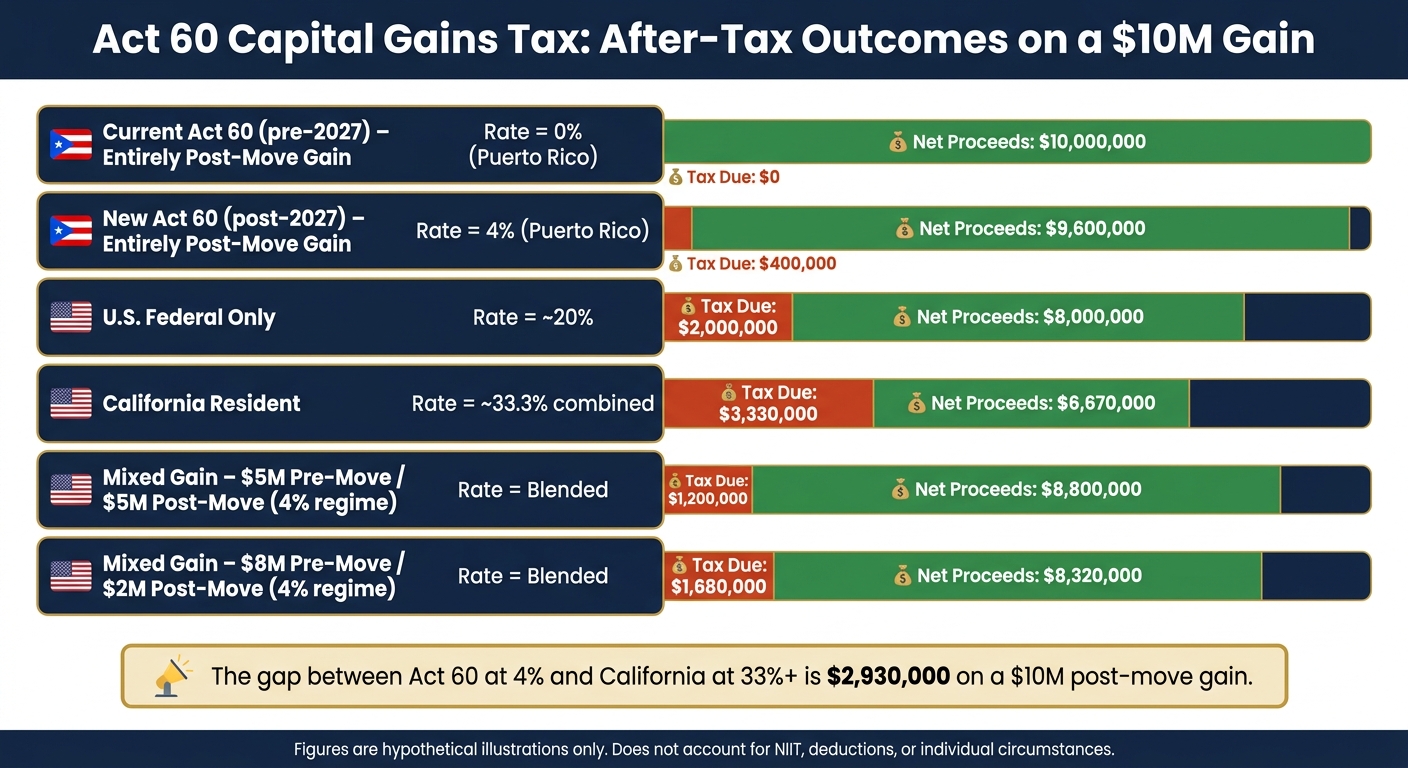
The clearest way to judge the new 4% setup is to focus on after-tax dollars.
Scenario 1: $10,000,000 post-move gain under 0%, 4%, and a California baseline
Take a long-term investor who becomes a bona fide Puerto Rico resident and later realizes a $10,000,000 gain that arose entirely after the move.
Under current rules, that investor owes $0 in Puerto Rico tax. Under the post-2027 regime, the tax bill is $400,000. A California resident in the same position faces about 33.3% combined federal and California tax, which puts total tax at $3,330,000 and net proceeds at $6,670,000.
That leaves a $2,930,000 gap between Puerto Rico at 4% and California at 33%+. That’s a big difference.
But that’s also the clean, best-case version. Once gains are split between pre-move and post-move appreciation, the math changes fast.
Scenario 2: Pre-move appreciation and why timing still matters
Only post-move appreciation qualifies. Pre-move gains stay subject to U.S. tax.
Say an investor holds an asset worth $5,000,000 at the time of the move and later sells it for $10,000,000. In that case, the $5,000,000 pre-move gain is taxed at about 20% federal for $1,000,000, while the $5,000,000 post-move gain is taxed at 4% under Act 60 for $200,000. Total tax: $1,200,000.
Now flip it. If the gain is $8,000,000 pre-move and $2,000,000 post-move, the federal bill alone climbs to $1,600,000, and Puerto Rico adds $80,000, bringing total tax to $1,680,000.
So the main driver isn’t just the headline rate. It’s how much of the gain actually qualifies under Act 60.
Comparison table: Side-by-side after-tax outcomes
All figures are hypothetical examples for illustrative purposes only. Tax estimates are based on representative rates and do not account for individual circumstances, NIIT, or deductions.
| Scenario | Gross Gain | Tax Treatment | Tax Due | Net Proceeds |
|---|---|---|---|---|
| Current Act 60 (pre-2027), entirely post-move gain | $10,000,000 | 0% (PR) | $0 | $10,000,000 |
| New Act 60 (post-2027), entirely post-move gain | $10,000,000 | 4% (PR) | $400,000 | $9,600,000 |
| U.S. federal only | $10,000,000 | ~20% | $2,000,000 | $8,000,000 |
| California resident | $10,000,000 | ~33.3% | $3,330,000 | $6,670,000 |
| Mixed gain: $5M pre-move / $5M post-move (4% regime) | $10,000,000 | Blended | $1,200,000 | $8,800,000 |
| Mixed gain: $8M pre-move / $2M post-move (4% regime) | $10,000,000 | Blended | $1,680,000 | $8,320,000 |
The table shows the point pretty plainly: the share of gain that built up after the move matters just as much as the stated rate. If most of the appreciation happened on the mainland, the effective tax hit can end up much higher than the 4% headline suggests.
That timing issue sets up the next planning step.
What to do before 2027 and whether Act 60 is still worth it
Planning steps for current decree holders and new applicants
The tax rate only helps if you get the filing window and residency rules right. That’s the part many people underestimate.
The main choke point is processing time. Approval often takes 6 to 12 months, so the usable window for locking in the 0% rate is already tighter than the calendar makes it look.
A simple move helps here: keep one clean compliance file for everything tied to your Puerto Rico status. That means your day count, residence proof, and local ties should all live in the same place. Put your banking records, housing records, and travel logs into one consistent file so you’re not scrambling later.
How Puerto Rico planning fits with broader asset protection structures
Once filing and residency are in order, the next layer is structuring. Act 60 can cut tax, but it does not replace separate asset-protection planning.
That distinction matters. A tax decree does not fix forced heirship issues under Puerto Rico’s civil law system, and those rules can override a mainland will.
So the smart way to look at it is in two layers:
- Tax planning through the decree
- Entity and trust planning for asset protection, estate issues, and control
Depending on the facts, that second layer may include a private U.S. LLC, an offshore company, or an offshore trust or private interest foundation. Puerto Rico planning sits inside a bigger wealth structure. Same picture, different jobs.
That leaves the last issue: whether 4% still makes sense for your situation.
FAQs
How do I prove bona fide Puerto Rico residency?
To prove bona fide Puerto Rico residency, you need to pass the IRS three-part test: physical presence, tax home, and closer connection.
In plain English, that usually means spending at least 183 days per year in Puerto Rico and showing that your life is based there, not on the mainland. The IRS looks at both personal and financial ties, so it’s not just about counting days.
That’s why good records matter. Keep clear documentation like flight logs, utility bills, lease agreements, and proof of social ties in case the IRS audits you.
What counts as pre-move versus post-move gain?
Under Act 60, the key difference comes down to when the asset went up in value.
Post-move gains are gains that build up after you become a bona fide Puerto Rico resident. Those gains may qualify for lower tax treatment under Act 60.
Pre-move gains are gains that built up while you were still a U.S. resident. Those gains still face U.S. federal tax.
That’s why good records matter. Clear documentation can help show which part of the gain happened after your Puerto Rico residency began.
Should I apply by December 31, 2026?
Yes. If you apply by December 31, 2026, you can lock in a 0% tax rate on interest, dividends, and capital gains for the full term of your incentive grant.
From January 1, 2027, new applicants will face a 4% preferential tax rate on that passive income. And because the application process can take several months, it makes sense to apply well before the deadline.
