
Short answer: no – Malta is not officially a tax haven in 2026. But if I set up my tax residency or company the right way, Malta can still lead to low tax outcomes, including about 5% corporate tax in some cases and no Malta tax on some foreign income or foreign capital gains for resident non-doms.
Here’s the plain-English version:
- Malta is an EU country with tax reporting, AML checks, and information exchange
- Individuals can get low tax only if residency, domicile, and remittance rules line up
- Resident non-doms are taxed on:
- Malta-source income
- Foreign income sent into Malta
- Foreign income kept outside Malta may stay outside Malta tax for non-doms
- Foreign capital gains are generally not taxed in Malta for resident non-doms
- Companies face a 35% headline rate, but Malta’s refund system can bring trading income down to about 5%
- Some holding company income can fall to 0% under the participation exemption
- U.S. citizens and U.S. owners still deal with U.S. worldwide tax, so Malta often does not create the same result for them
- None of this works well without real substance, records, and tax compliance
If I had to sum it up in one line, it would be this: Malta is not a tax haven by name, but it can still be low-tax by design.
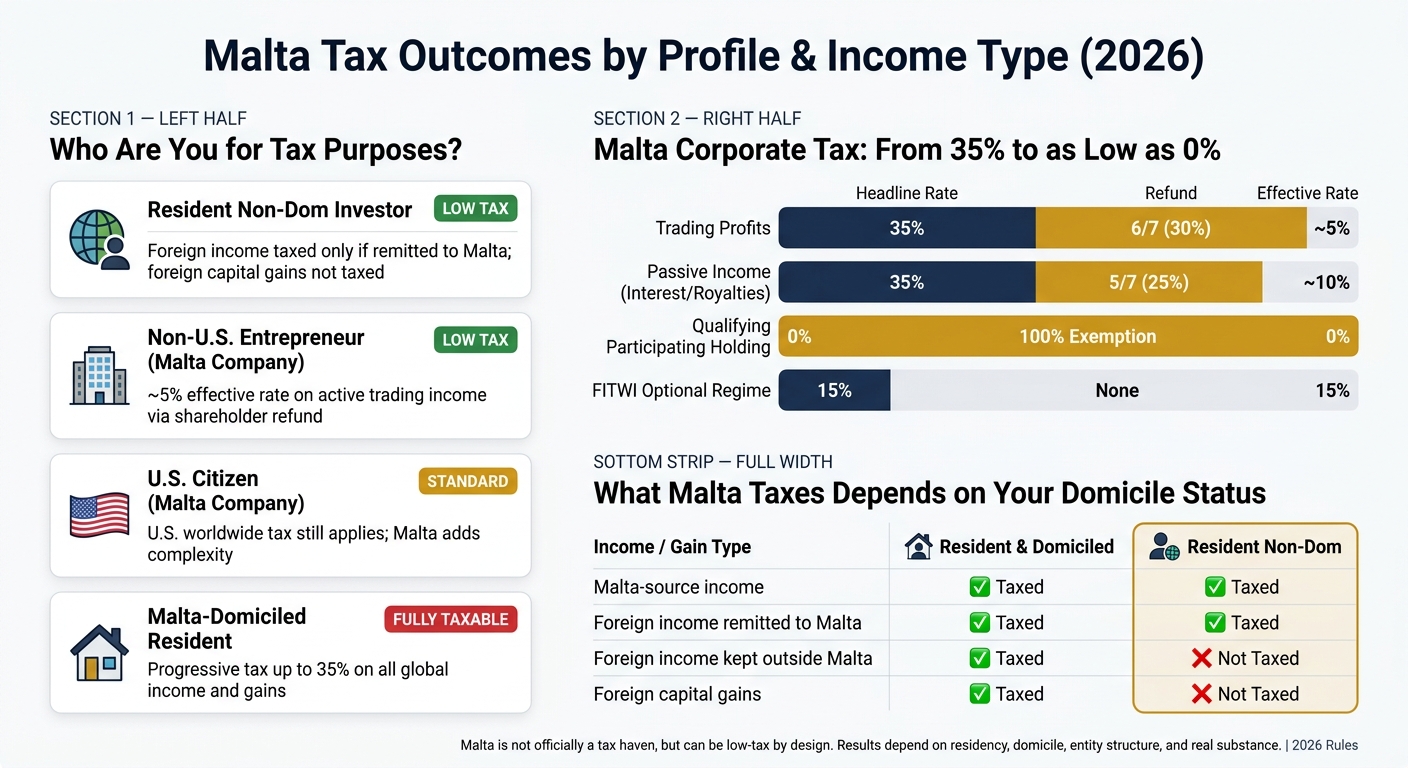
| Profile | Likely Malta Tax Result | Simple Take |
|---|---|---|
| Resident non-dom investor | Low tax on foreign income not remitted; foreign capital gains often not taxed | Low-tax setup |
| Non-U.S. business owner using a Malta company | Around 5% on trading profits in many cases | Low-tax setup |
| U.S. citizen or U.S.-connected owner | U.S. tax still applies | Malta is less tax-friendly |
| Malta-domiciled resident | Up to 35% on worldwide income | Fully taxable |
That’s the core answer. The rest comes down to one question: who you are for tax purposes, and how your setup is built.
Individual tax rules: residency, domicile, and the remittance basis
Moving to Malta can cut your tax bill, but only if residency, domicile, and the remittance basis work in your favor. That’s the key point. Malta works well for some new residents, but it doesn’t work the same way for everyone.
Residency is the starting line. Domicile and remittance rules do the heavy lifting when it comes to what you actually pay.
When you become a tax resident in Malta
The standard benchmark is more than 183 days in Malta during a calendar year. If you go over 183 days, you are generally treated as resident.
But that day count isn’t the whole story. Malta can also treat you as resident if your personal, social, or economic ties point there, even when you spend fewer than 183 days in the country. In plain English: tax residency depends on the facts on the ground, not just a passport stamp count.
That matters because residency by itself doesn’t settle the final tax result.
How non-dom status changes what Malta can tax
Most expats who move to Malta are treated as resident non-dom. And that’s where things start to shift.
Domicile is different from residency. It refers to your permanent home, or the country you’re tied to in the long run.
If you are a resident non-dom, Malta taxes only:
- Malta-source income
- Foreign income remitted to Malta
Foreign capital gains are not taxed in Malta, even if you remit the proceeds.
There’s another point that catches people’s attention: Malta has no deemed domicile rule. So a person may keep non-dom status for an unlimited period, unless the facts show that Malta has become their permanent home.
Who pays low tax and who stays fully taxable
The cleanest way to see the difference is by income type.
| Income or Gain Type | Resident and Domiciled | Resident Non-Dom |
|---|---|---|
| Malta-source income | Taxed in Malta | Taxed in Malta |
| Foreign income remitted to Malta | Taxed in Malta | Taxed in Malta |
| Foreign income kept outside Malta | Taxed in Malta | Not taxed |
| Foreign capital gains | Taxed in Malta | Not taxed |
Taxable items are charged at Malta’s progressive 0%–35% rates.
By contrast, a person who is both resident and domiciled in Malta is taxed on worldwide income, with the top bracket starting at income above €60,000. There is also a minimum annual tax of €5,000 for non-doms who earn at least €35,000 in foreign income but do not remit enough for normal tax rates to produce that minimum amount.
For U.S.-connected readers, there’s a second layer to think about. U.S. citizens still face U.S. worldwide taxation even while living in Malta. Malta’s double tax treaty with the U.S. can help reduce double taxation in some cases.
sbb-itb-39d39a6
Business tax rules: the 35% rate, refunds, and participation exemption
Individuals use Malta’s remittance rules. Companies follow a different setup built around refunds and exemptions. Malta’s corporate tax rate starts at 35%, but shareholder refunds and exemptions can push the effective rate much lower.
How Malta’s shareholder refund system lowers the effective tax rate
Malta gives credit for company tax against shareholder tax. In plain English, that means tax paid at the company level can lead to a refund after dividends are distributed. For non-resident shareholders, that refund can return most of the company tax in cash.
For trading income, the refund is 6/7 of the tax paid. That brings the effective rate down to about 5%. For passive income, such as interest or royalties, the refund is 5/7, which leaves an effective rate of 10%.
Malta also has FITWI, an optional 15% final tax regime. It comes with no refunds and requires a five-year minimum election.
| Income Type | Headline Rate | Refund | Effective Rate |
|---|---|---|---|
| Trading profits | 35% | 6/7 of tax paid | ~5% |
| Passive income (interest/royalties) | 35% | 5/7 of tax paid | ~10% |
| Qualifying participating holding income | 35% | 100% exemption | 0% |
| FITWI (optional regime) | 15% | None | 15% |
This refund system is a big deal for trading income. By contrast, holding structures often lean on the participation exemption instead.
When the participation exemption can reduce tax to zero
For holding companies and group structures, Malta offers the participation exemption. Dividends and capital gains from a qualifying participating holding are fully exempt from Maltese tax, which brings the effective rate to 0%.
To qualify, a Maltese company generally must either:
- Hold at least 10% of the equity in a subsidiary, or
- Hold shares with a total acquisition value of at least €1.16 million for an uninterrupted period of at least 183 days
This matters most for exits, dividend repatriation, and cross-border holding setups, not for a standard local trading business. Malta also charges no withholding tax on dividends, interest, or royalties paid to non-residents.
Where Malta works for U.S.-connected entrepreneurs and where it does not
For non-U.S. owners, Malta can be tax-efficient when the company has real substance and fits within the refund or exemption rules.
For U.S. owners, it’s a different story. They still deal with worldwide U.S. tax, possible CFC treatment, and FATCA reporting. On top of that, the U.S.-Malta Double Tax Treaty includes a Limitation on Benefits clause. So treaty access usually depends on showing genuine economic substance in Malta.
Malta is built to be efficient, but it is not an automatic zero-tax setup. The end result still turns on substance, reporting, and anti-avoidance rules.
Compliance limits: substance, anti-avoidance, transparency, and reputation
Malta’s low-tax outcomes work only when a structure meets substance, reporting, and anti-avoidance rules. Put simply, the tax result has to stand up to review. If the structure can’t pass a substance or reporting check, the tax result can fall apart.
What real substance looks like in Malta
Substance is a real test, not a paperwork exercise. A company is Maltese tax resident only if it is registered in Malta or managed and controlled there. In day-to-day terms, that means a real office in Malta, board meetings held there, documented decisions, and directors who have actual authority. Paper directors and nominal offices do not meet Maltese substance expectations.
This ties straight back to the tax outcomes discussed earlier. Residency, refund claims, and participation exemption treatment all depend on real presence, real management, and proper records.
And Malta backs that up with anti-avoidance and reporting rules.
The anti-avoidance and reporting rules that matter
Malta has implemented the EU’s ATAD I and II rules, including CFC, interest limitation, and exit-tax rules. Starting in FY 2024, transfer-pricing documentation applies to intra-group transactions where revenue is above €6 million or capital is above €20 million. So the job isn’t just setting up the structure. You also need the files, the analysis, and the facts to support it.
For large multinationals, a domestic minimum top-up tax took effect on January 1, 2026, in line with the OECD‘s Pillar Two framework for groups with consolidated revenue above €750 million. The U.S.-Malta Double Tax Treaty also has a Limitation on Benefits clause. That means treaty access depends on genuine economic substance, not just Maltese registration.
Why legal compliance matters more than the label
Malta was placed on the FATF grey list in 2021 due to AML weaknesses and removed in 2022 after strengthening its FIAU and AML enforcement. That history still matters. If a structure is weak, it can draw scrutiny, and the risks can include AML flags, denied refunds, and blocked treaty benefits.
So this isn’t about what the structure is called. It’s about whether it holds up when someone takes a hard look at it.
"The value here is in a legitimate structural rate reduction, not in information opacity."
In practice, Malta is efficient when the facts support the structure. It fits real operations, not paper setups.
Conclusion: When Malta is tax-efficient and when it is not
Malta’s tax result depends less on the label and more on how the setup is put together. Malta is not a tax haven in the legal sense, but its residency rules and company system can still lead to low-tax outcomes for certain people.
The key point is simple: the result changes based on who the taxpayer is.
| Profile | Tax Result | Bottom Line |
|---|---|---|
| Resident Non-Dom Investor | Foreign income taxed only on remittance; foreign capital gains stay untaxed | Low-tax |
| Non-U.S. Entrepreneur (Maltese company) | 5% effective rate on active trading income | Low-tax |
| U.S. Citizen (Maltese company) | Worldwide U.S. tax still applies; Malta mainly adds operating and compliance complexity | Standard |
| Malta-Domiciled Resident | Progressive tax up to 35% on all global income and gains | Fully taxable |
Put plainly, Malta rewards the right setup and taxes the wrong one in the usual way.
It works best when residency, domicile, entity type, and substance line up. If even one piece is off, the tax result can look very different. The same goes for asset protection. Malta helps only when the tax setup, legal substance, and reporting all point to the same outcome.
Before using Malta, test residency, domicile, entity structure, and substance together.
FAQs
How do I prove non-dom status in Malta?
In Malta, domicile is different from tax residency. It comes down to intent: do you mean to make Malta your permanent home?
To show non-dom status, you usually need to show that your permanent home is still in another country and that you haven’t built a permanent, open-ended tie to Malta. A residency card on its own does not mean you’re domiciled in Malta.
What counts as remitting foreign income to Malta?
Under the remittance-basis system, foreign income is taxed in Malta only when it is remitted. In plain English, that means the money is brought into Malta or used there.
For non-domiciled residents, tax usually kicks in only when those funds are transferred to a Maltese bank account or otherwise brought into the Maltese economy.
There’s an important distinction here:
- Foreign income: taxed only if remitted to Malta
- Foreign capital gains: not taxed in Malta, even if remitted
- Malta-source income: fully taxable
That split matters. Income from abroad may stay outside the Maltese tax net until you move it into Malta, but Malta-source income doesn’t get that treatment.
How much substance does a Malta company need?
Malta usually doesn’t require a full on-the-ground setup. In many cases, a company can run with a registered office, local records, and one annual board meeting held in Malta.
That said, the bar is higher for international investors, especially if they plan to rely on the U.S.-Malta tax treaty. In that case, the company needs to show genuine commercial activity or meet the relevant ownership or listing tests to qualify for treaty benefits.
