
If you’re earning income abroad and want to avoid paying taxes on it domestically, consider relocating to a country with territorial taxation. These countries only tax income earned within their borders, leaving foreign income untouched. The top eight options include Panama, Singapore, Hong Kong, Malaysia, Costa Rica, United Arab Emirates, Bahamas, and Cayman Islands. Each offers unique tax benefits, residency options, and lifestyle perks. Here’s a quick overview:
- Panama: No tax on foreign income, easy residency options, and U.S. dollar currency.
- Singapore: Exempts most foreign-sourced income, low corporate taxes, and strong financial infrastructure.
- Hong Kong: Foreign income untaxed if earned outside, simple residency rules, and no capital gains tax.
- Malaysia: Foreign income tax-free until 2036, affordable living, and multiple residency programs.
- Costa Rica: Foreign income untaxed with the Digital Nomad Visa, low property taxes, and a relaxed lifestyle.
- United Arab Emirates: No personal income tax, world-class amenities, and flexible residency options.
- Bahamas: No personal or corporate taxes, easy residency for investors, and a tropical lifestyle.
- Cayman Islands: No direct taxes, strong financial privacy, and straightforward residency for high-net-worth individuals.
These countries provide opportunities to save on taxes while preserving and growing wealth. However, U.S. citizens must still fulfill IRS obligations, including filing annual tax returns and reporting foreign accounts. Always consult a professional to ensure compliance and maximize benefits.
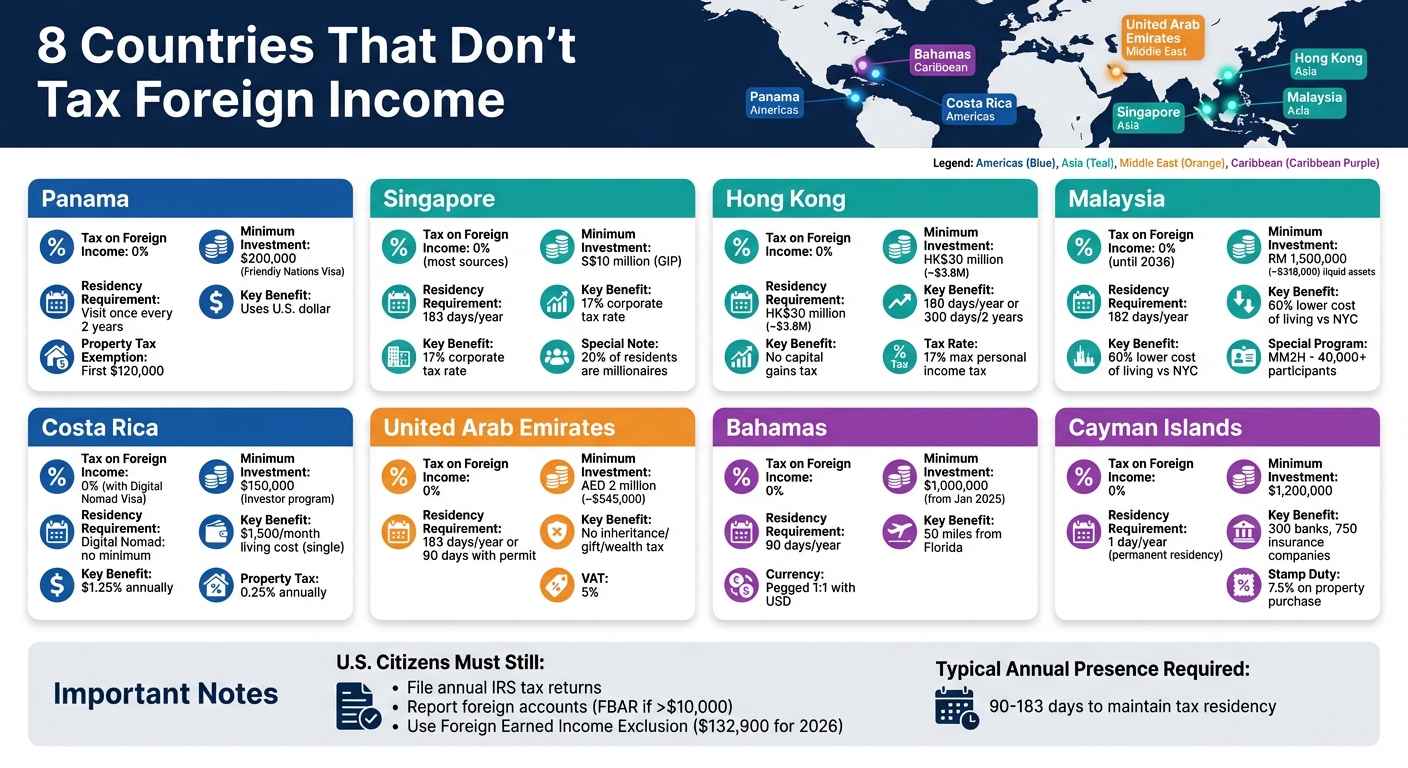
8 Countries With No Foreign Income Tax: Requirements and Benefits Comparison
1. Panama
Foreign-Sourced Income Tax Exemption Policies
Panama operates on a territorial tax system, meaning only income earned within its borders is subject to taxation. Income generated from foreign sources – such as consulting fees, dividends, rental income, and even cryptocurrency profits – remains entirely tax-free. Additionally, interest earned from savings accounts or time deposits in Panamanian banks is exempt from taxes.
For income earned locally, Panama uses a progressive tax structure. The first $11,000 is tax-free, income between $11,001 and $50,000 is taxed at 15%, and anything above $50,000 is taxed at 25%. This setup is particularly advantageous for individuals whose earnings primarily come from international sources.
Panama’s tax policies, combined with its residency and citizenship pathways, make it an attractive option for global investors seeking to reduce their tax burdens through a private family office.
Ease of Establishing Residency or Citizenship
Panama offers multiple residency options to suit different needs. The Pensionado Visa is a popular choice, requiring proof of a lifetime pension of at least $1,000 per month (plus $250 for each dependent). It provides immediate permanent residency. Another option is the Qualified Investor Visa, which grants fast-track approval within 30–45 business days for investments of $500,000 in real estate or stocks, or a $750,000 fixed deposit. The Friendly Nations Visa requires a $200,000 investment in real estate or a fixed-term deposit and includes a two-year provisional period before permanent residency is granted.
Applications must be processed through a licensed Panamanian attorney, with fees ranging between $2,400 and $17,000. To maintain permanent residency, individuals must visit Panama at least once every two years. For those seeking citizenship, a minimum of five years of permanent residency is required, along with passing Spanish language and civics exams. Citizenship applications also need presidential approval, which can take an additional one to five years.
Additional Financial or Lifestyle Benefits
Panama uses the U.S. dollar as its official currency, eliminating exchange rate risks. For property owners, the first $120,000 of a primary residence’s value is exempt from property taxes, and new constructions often qualify for tax breaks lasting 10 to 15 years. Pensionado visa holders enjoy additional perks like 25% off utility bills and airline tickets, as well as 50% discounts on movie tickets and hotels during weekdays (Monday–Thursday). Meanwhile, the general sales tax (ITBMS) is set at 7%.
These financial advantages make Panama an appealing choice for those looking to reduce living costs and preserve wealth for future investments.
"Establishing your tax residency in Panama is not an evasion strategy; it’s a smart optimization decision. It’s about legally structuring your finances to protect your assets and maximize your growth in a global economy." – Panama Way
Potential Challenges or Limitations
Panama’s banking sector has become stricter in recent years, with Know Your Customer (KYC) and Anti-Money Laundering (AML) checks now requiring extensive documentation. Opening a bank account can take up to eight weeks. To maintain the zero-tax status on foreign-sourced income, individuals must provide thorough documentation proving that services were performed outside Panama.
For U.S. citizens, there are additional reporting requirements. They must file Form 1040 annually and report foreign accounts through FBAR if the combined balance exceeds $10,000. Establishing tax residency in Panama typically requires spending more than 183 days in the country each fiscal year or demonstrating strong ties, such as owning permanent housing, having family connections, or conducting primary business operations there.
These considerations are crucial when evaluating whether Panama aligns with your financial and lifestyle goals, as we continue exploring other territorial tax jurisdictions.
sbb-itb-39d39a6
2. Singapore
Foreign-Sourced Income Tax Exemption Policies
Singapore follows a territorial tax system, meaning only income earned within or brought into Singapore is subject to taxation. Since January 1, 2004, residents have been exempt from nearly all foreign-sourced income received in Singapore, with the exception of partnership income. Non-residents can also remit foreign income to Singapore without facing tax liabilities.
For resident companies, exemptions apply to foreign dividends, branch profits, and service income, provided these are taxed abroad at a minimum rate of 15%. Additionally, Singapore does not impose taxes on capital gains, including long-term cryptocurrency profits, and has established around 100 Double Taxation Agreements to ease cross-border tax concerns. However, starting January 1, 2024, Section 10L of the Income Tax Act mandates taxation on gains from the sale of foreign assets if the entities involved lack sufficient economic substance in Singapore.
Now, let’s explore how Singapore’s residency and citizenship options enhance its appeal for tax planning.
Ease of Establishing Residency or Citizenship
To qualify as a tax resident, individuals must reside or work in Singapore for at least 183 days in a calendar year. However, administrative concessions allow foreigners to qualify through a three-year continuous work arrangement or by accumulating 183 days over two consecutive years.
Permanent residency is attainable through programs like the Global Investor Programme (GIP), which requires a minimum investment of S$10 million in a business or S$25 million in an approved fund. Additional costs include professional fees ranging from $4,000 to $8,000 and a business registration fee of about $300. Citizenship is available after two years of permanent residency, but applicants must renounce their previous citizenship, as Singapore does not allow dual citizenship.
Additional Financial or Lifestyle Benefits
Singapore offers more than just tax advantages – it provides a supportive environment for wealth preservation and financial growth. The one-tier dividend system exempts dividends from taxation, even if they originate from foreign income. The corporate tax rate is a competitive 17%, while individual income tax rates range from 0% to 22%, based on a progressive system. Notably, about 20% of Singapore’s 5 million residents are millionaires, reinforcing its reputation as a leading wealth management hub.
For income sourced from jurisdictions without a Double Taxation Agreement, Singapore provides Unilateral Tax Credits to reduce the impact of double taxation. Companies are also required to maintain detailed records, such as a Foreign Income Tracking Schedule, to justify their tax positions to the Inland Revenue Authority of Singapore.
Potential Challenges or Limitations
Despite its advantages, Singapore has some requirements that may pose challenges. Every Singapore-based company must have at least one resident director, and foreign investors purchasing residential property may face stamp duties as high as 30%. To qualify for treaty benefits, companies must conduct board meetings within Singapore.
Under the new Section 10L regulation, entities within multinational groups must demonstrate sufficient economic substance in Singapore to avoid taxation on gains from selling foreign assets. Income is considered "received" in Singapore not only when transferred to a local bank account but also when used to settle local liabilities or purchase movable property brought into the country.
3. Hong Kong
Foreign-Sourced Income Tax Exemption Policies
Hong Kong operates on a territorial tax system, meaning only income generated within its borders is subject to taxation. Whether income is taxed depends entirely on where it originates.
For individuals, employment income is fully exempt if all services are performed outside of Hong Kong. The "60-day rule" adds flexibility, allowing services performed within Hong Kong for up to 60 days per tax year to remain exempt. Additionally, there’s no capital gains tax on selling shares, property, or other assets, and dividends or interest payments to non-residents are not subject to withholding taxes.
However, changes introduced in January 2023 have altered the landscape for multinational enterprises (MNEs). Under the refined Foreign-Sourced Income Exemption (FSIE) regime, MNEs must meet specific conditions – such as the Economic Substance Requirement, the Nexus Requirement for intellectual property income, or the Participation Requirement for dividends – to maintain exemptions on foreign-sourced passive income like interest, dividends, intellectual property income, and disposal gains. These updates led to Hong Kong being removed from the European Union’s tax "grey list" on February 20, 2024.
These favorable tax policies also make establishing residency an attractive option, as outlined below.
Ease of Establishing Residency or Citizenship
Tax residency in Hong Kong is determined by time spent in the region: more than 180 days in a single tax year or over 300 days across two consecutive years. Foreign nationals have several pathways to establish residency, including the Quality Migrant Admission Scheme (a points-based system), the Talent program, and investment visas. For digital nomads, there’s a one-year visa option requiring a minimum annual income of $100,000.
Costs for professional assistance with residency typically range from $2,500 to $5,000, while forming a business can cost between $3,000 and $8,000. Permanent residency is available after seven years of continuous residence. However, naturalization as a Chinese citizen requires renouncing your original citizenship, as dual citizenship is generally not permitted.
Additional Financial or Lifestyle Benefits
Hong Kong’s tax system is highly competitive. Personal income tax is progressive, with a top rate of 17%. Corporate taxes follow a two-tiered system: 8.25% on the first HK$2 million of profits and 16.5% on the remainder. There’s no tax on dividends and no VAT or sales tax.
To prevent double taxation, Hong Kong has signed over 45 double taxation agreements. This framework supports broader strategies for structuring offshore trusts for asset protection. Property tax is set at a flat rate of 15% on the net assessable value of rental income. For stock transfers, a stamp duty of 0.26% applies, split equally between the buyer and seller at 0.13% each.
Potential Challenges or Limitations
The updated FSIE regime introduces stricter compliance requirements for MNEs. To retain tax-exempt status on foreign-sourced income like interest, dividends, or disposal gains, businesses must demonstrate "substantial economic presence" by employing qualified staff and incurring sufficient operating expenses in Hong Kong. Income is considered "received" – and therefore potentially taxable – if it is remitted to Hong Kong, used to settle local debts, or used to purchase movable property brought into the region.
For foreign dividends or equity disposal gains to remain exempt without meeting substance tests, a Hong Kong company must hold at least 5% of the foreign entity, and the income must be subject to a foreign tax rate of at least 15%. Banking compliance has also tightened since 2020, often requiring in-person visits and extensive documentation. U.S. citizens face additional hurdles, as Hong Kong’s territorial tax system does not exempt them from IRS obligations, which apply to worldwide income regardless of local tax exemptions.
4. Malaysia
Foreign-Sourced Income Tax Exemption Policies
Malaysia operates on a territorial tax system, meaning only income earned within its borders is taxable. For resident individuals, foreign-sourced income – excluding partnership income – is tax-free until December 31, 2036, provided it has been "subjected to tax" in the country of origin [50,52]. This term refers to income treated as taxed at its source, regardless of local tax rates or exemptions.
Companies and LLPs enjoy tax-free foreign dividends if the source country’s top corporate tax rate is at least 15%, or if they meet economic substance requirements [48,49]. Non-residents, on the other hand, are not taxed on any foreign-sourced income.
Only income brought into Malaysia is taxable, while funds kept offshore remain untaxed. This system encourages asset protection while requiring detailed documentation. However, income from work performed in Malaysia for a foreign employer is treated as Malaysian-sourced and is taxable.
Ease of Establishing Residency or Citizenship
Malaysia’s residency is straightforward to obtain under the "182-day rule", which grants tax residency to those who stay in the country for at least 182 days in a calendar year. The Malaysia My Second Home (MM2H) program has attracted over 40,000 participants from 130 countries. It requires applicants to demonstrate liquid assets of RM 1,500,000 (about $318,000), monthly offshore income of RM 40,000 (approximately $8,500), and a fixed deposit of RM 1,000,000 (around $212,000) [54,55,56].
"If you put six figures in the bank, you’ll get a residence permit, and there isn’t much needed in order to maintain it."
– Andrew Henderson, Founder, Nomad Capitalist
For those over 50, the Sarawak MM2H (S-MM2H) program offers reduced thresholds, requiring monthly income of RM 7,000 for singles or RM 10,000 for couples. Digital nomads can explore the DE Rantau Digital Nomad Pass, which demands a minimum annual income of $24,000. While permanent residency is an option for high-net-worth investors depositing at least $2 million in a Malaysian bank, citizenship is more complex. It requires 10 years of residency, a Malay language test, and renouncing prior citizenship.
Additional Financial or Lifestyle Benefits
Malaysia’s tax structure is appealing for residents, with progressive personal income tax rates ranging from 0% to 30%. Non-residents are taxed at a flat 30% on Malaysian-sourced income. The absence of inheritance, estate, wealth, and gift taxes adds to its financial appeal. Interest earned on deposits in licensed banks is also exempt from tax, and dividends under the single-tier system are not taxed in the hands of shareholders [52,54].
For business owners, the Labuan Offshore Financial Center offers a 3% tax rate on trading activities and 0% on non-trading activities such as holding investments. Foreigners can fully own land and property in Malaysia, although minimum purchase prices vary by state – from RM 350,000 in Sarawak to RM 2,000,000 in parts of Selangor [54,55]. With living costs estimated at just 60% of those in New York City, Malaysia combines affordability with tax advantages.
Potential Challenges or Limitations
Starting in 2025, a 2% tax will apply to annual dividend income exceeding RM 100,000 from resident companies. A similar 2% tax on LLP profit distributions above RM 100,000 is proposed for 2026. To maintain the exemption on foreign-sourced income, resident individuals must keep thorough records, such as tax receipts, dividend vouchers, or statements from foreign tax authorities, to prove the income was taxed at its source [48,51].
U.S. citizens may encounter additional hurdles. Many local banks decline American clients due to FATCA compliance costs, leaving international banks like HSBC Premier or Standard Chartered as alternatives. Additionally, U.S. citizens must file FinCEN Form 114 (FBAR) if their foreign account balances exceed $10,000 at any point in the year. Real Property Gains Tax (RPGT) for foreigners is 30% for properties sold within five years and 10% for those sold after six years. Tax credits for income already taxed abroad must be claimed within two years of the relevant tax year.
Malaysia’s combination of favorable tax policies and lifestyle perks makes it an attractive destination for wealth management, though careful planning is necessary to navigate potential challenges.
5. Costa Rica
Foreign-Sourced Income Tax Exemption Policies
Costa Rica uses a territorial tax system, meaning only income earned within the country is taxed. This means foreign-sourced income – like salaries, freelance payments, and pensions – is not subject to local taxes. However, as of October 2023, Law No. 10.381 imposes a 15% tax on foreign passive income (e.g., dividends, interest, royalties, rental income) for tax residents who do not hold a Digital Nomad Visa.
The Digital Nomad Visa offers a full exemption from such taxes. Holders are not classified as tax residents, even if they stay more than 183 days, and they are taxed at 0% on foreign earnings. This visa was introduced to help Costa Rica address concerns from the European Union about tax transparency. For multinational companies, foreign passive income is exempt only if the company demonstrates "economic substance" in Costa Rica – this includes having local employees, a physical office, and making strategic decisions within the country.
"Digital nomad visa holders… are NOT considered tax residents for tax purposes, even after 183+ days." – Explore Costa Rica
For U.S. citizens, it’s important to note there is no tax treaty between the U.S. and Costa Rica. To avoid double taxation, you’ll need to rely on the Foreign Earned Income Exclusion (FEIE), which is set at $130,000 for 2025, or use Foreign Tax Credits.
Costa Rica’s tax rules and residency options provide a range of opportunities to protect and grow wealth.
Ease of Establishing Residency or Citizenship
Costa Rica offers several residency programs tailored to different financial situations. The Pensionado program requires proof of a lifetime monthly pension of at least $1,000. The Rentista program mandates a monthly income of $2,500 or a deposit of $60,000 in a Costa Rican bank. Investors can qualify with a minimum investment of $150,000 in real estate, businesses, or venture capital.
The Digital Nomad Visa is another option, requiring a monthly income of $3,000 for individuals or $4,000 for families. Application fees are modest, at $100 for the application and $90 for processing. This visa grants a one-year stay, with the option to renew for a second year. After three years of temporary residency, you can apply for permanent residency. For those seeking citizenship, naturalization is available after seven years of legal residency, along with passing a language and history test.
| Residency Program | Monthly Income Requirement | Investment Requirement |
|---|---|---|
| Digital Nomad | $3,000 ($4,000 for families) | N/A |
| Pensionado | $1,000 (Pension) | N/A |
| Rentista | $2,500 | $60,000 deposit |
| Investor | N/A | $150,000+ |
Additional Financial or Lifestyle Benefits
While there is a dark side of living in Costa Rica, the country adds to its appeal with no wealth tax, no inheritance tax, and no exit tax. Property taxes are minimal, at just 0.25% of the registered value annually. The standard Value Added Tax (VAT) is 13%. While capital gains on local assets are taxed at 15%, primary residences are exempt if you live in them for at least 183 days per year.
These tax advantages are paired with a relatively low cost of living. For example, monthly expenses are about $1,500 for a single person and $2,500 for a couple. The country also boasts a robust healthcare system, offering both affordable private care and access to the public system (Caja) for residents. Additionally, Costa Rica has a thriving community of expats, with an estimated 120,000 Americans calling it home.
Potential Challenges or Limitations
To make the most of Costa Rica’s tax benefits, it’s crucial to track your residency days and understand local banking requirements. Spending more than 183 days in the country during a fiscal year (even non-consecutive days) triggers tax residency, potentially subjecting foreign passive income to the 15% tax unless you hold a Digital Nomad Visa. Be mindful of your cumulative days to avoid unintended tax consequences.
Banking can also pose challenges. A "Simplified Account" (Cuenta Simplificada), which requires only a passport and local phone number, is limited to $1,000 monthly. Full accounts often require proof of residency. Social security contributions are another consideration – employees pay 10.67%, while employers contribute 26.67%.
"Ensure all necessary documents, including birth certificates, are secured before departing your home country." – Javier Sauma, Attorney, Sauma Rossi Law Firm
Legal fees for residency applications range from $2,500 to $4,500, and setting up a business costs between $2,000 and $3,500. For those with foreign passive income, the Digital Nomad Visa remains the most straightforward way to maintain a 0% tax rate while avoiding the 183-day residency tax implications.
6. United Arab Emirates
The UAE stands out as a destination for offshore asset protection, offering a tax environment that’s hard to match.
Foreign-Sourced Income Tax Exemption Policies
One of the UAE’s most notable features is its lack of personal income tax on wages, investment income, or real estate earnings – whether domestic or international. This means salaries, dividends, interest, capital gains, and rental income are all untaxed.
"There is no personal income tax in the United Arab Emirates. As such, there are no individual tax registration or reporting obligations." – PwC
In June 2023, the UAE introduced a 9% corporate tax, applicable only to business profits exceeding AED 375,000. Individuals running businesses are subject to this tax if their annual turnover surpasses AED 1 million. For businesses with foreign subsidiaries, dividends and capital gains are exempt if the UAE entity owns at least 5% of the subsidiary for 12 months and the subsidiary is taxed at a minimum rate of 9% in its home country. Additionally, the UAE’s extensive network of over 140 Double Taxation Treaties helps minimize or eliminate foreign withholding taxes.
Ease of Establishing Residency
The UAE provides several residency options tailored to different needs. The Golden Visa offers 5 to 10 years of residency for individuals investing AED 2 million in real estate or an investment fund. The Green Visa allows freelancers or skilled employees to secure 5-year self-sponsored residency, with income requirements of AED 360,000 annually for freelancers or AED 15,000 monthly for skilled workers. Digital nomads can apply for a one-year Remote Work Visa, provided they earn at least $3,500 per month.
To qualify as a tax resident, individuals typically need to spend 183 days in the UAE within a 12-month period. Alternatively, spending 90 days in the country while holding a valid residency permit and maintaining a permanent home or business also meets the criteria. A Tax Residency Certificate from the Federal Tax Authority can be obtained to take advantage of double taxation treaties.
| Visa Type | Validity | Key Requirements |
|---|---|---|
| Golden Visa | 5 or 10 Years | AED 2M property investment or AED 2M in an investment fund |
| Green Visa | 5 Years | Bachelor’s degree; AED 360K annual income (freelance) or AED 15K/month (skilled) |
| Remote Work Visa | 1 Year | Employment outside the UAE; minimum monthly income of $3,500 |
These flexible residency options enhance the UAE’s reputation as a destination for tax-efficient wealth management.
Additional Financial and Lifestyle Benefits
The UAE’s financial perks go beyond the absence of personal income tax. There are no inheritance, gift, or wealth taxes. Investors can repatriate 100% of profits and capital without restrictions. The country also boasts a low 5% VAT rate and is regarded as one of the most crypto-friendly nations, with personal crypto trading income remaining untaxed. According to the 2025 Global Digital Nomad report, the UAE ranks 8th globally, reflecting its high quality of life and business-friendly atmosphere. Residents also enjoy freedom from reporting foreign income or bank balances.
Potential Challenges and Limitations
For U.S. citizens, the UAE’s tax-free regime comes with complications. U.S. citizens are still required to report worldwide income to the IRS due to citizenship-based taxation. While the Foreign Earned Income Exclusion can reduce some tax liability, it doesn’t eliminate the need to file annual returns.
Remote work for a foreign company while living in the UAE can also pose challenges. If an employee has the authority to finalize contracts, their employer might face Permanent Establishment (PE) risks, potentially exposing them to UAE corporate tax. Moreover, individuals relocating to the UAE should review any exit taxes or look-back rules in their home country, such as the UK’s 5-year temporary non-residence rule or Canada’s departure tax. Property-related costs in Dubai also deserve attention, with transfer fees averaging 4% and a 5% municipal tax on the annual rental value of residential properties.
7. Bahamas
The Bahamas is renowned as a tax haven, offering no personal income, corporate, capital gains, inheritance, or wealth taxes. This tax-neutral environment applies equally to both residents and non-residents, meaning most individuals won’t need to file local income tax returns.
Foreign-Sourced Income Tax Exemption Policies
Instead of relying on income taxes, the Bahamas generates revenue through a 10% value-added tax (VAT) on goods and services, alongside import duties that vary from 0% to 75%, depending on the item. Tourism plays a major role in the economy, accounting for about 50% of GDP, while financial services contribute around 20%. The Bahamian dollar is pegged 1:1 with the U.S. dollar, providing a stable currency for international investors. Furthermore, the Bahamas promotes transparency by maintaining Tax Information Exchange Agreements with over 30 countries.
Ease of Establishing Residency or Citizenship
The Bahamas supports straightforward residency options designed to complement wealth protection strategies. Starting January 1, 2025, obtaining permanent residency will require a minimum $1,000,000 investment in either real estate or zero-coupon bonds held for 10 years. Additionally, there’s a $15,000 government fee for the main applicant. To retain tax residency, individuals typically need to spend at least 90 days per year in the Bahamas while avoiding spending more than 183 days in any other single country.
For those not ready to commit $1 million, there are alternative options:
- Annual Residence Permit: $1,000 per year.
- Home Owner’s Residence Card: $500 annually for property owners (though this does not confer work rights).
For digital nomads, the BEATS program (Bahamas Extended Access Travel Stay) allows residency for up to one year, offering flexibility for remote workers.
Additional Financial and Lifestyle Benefits
Located just 50 miles from Florida, the Bahamas offers convenient access to the U.S.. Politically, it is a stable parliamentary democracy rooted in English common law. Property owners benefit from tax exemptions on the first $250,000 of their home’s value, with rates of 0.75% on the next $250,000 and 1% on values exceeding $500,000.
The Bahamas also supports cryptocurrency innovation. Under its Digital Assets and Registered Exchanges (DARE) Act, personal income from crypto trading is untaxed, making it an appealing destination for crypto investors. These financial perks, combined with the Bahamas’ broader asset protection benefits, enhance its appeal.
Potential Challenges and Limitations
For U.S. citizens, worldwide income must still be reported to the IRS. While the Foreign Earned Income Exclusion allows up to $130,000 to be excluded in 2025, U.S. citizens cannot claim a Foreign Tax Credit in the Bahamas due to the absence of local income taxes. Canadians, on the other hand, must formally sever residential ties to be considered non-residents for tax purposes.
It’s also worth noting that the Bahamas does not offer citizenship by investment. Citizenship typically requires 10 years of legal residency, and dual citizenship is generally not allowed for adults. These factors may limit certain long-term options for individuals seeking full citizenship.
8. Cayman Islands
The Cayman Islands is a tax-neutral jurisdiction, meaning individuals pay no direct taxes. This includes no personal income tax, capital gains tax, inheritance tax, gift tax, wealth tax, or property tax. Whether your income is earned locally or overseas, you keep 100% of it, as there’s no local tax deduction involved. Additionally, there are no withholding taxes on dividends, interest, or royalties – whether paid to residents or non-residents.
Foreign-Sourced Income Tax Exemption Policies
Instead of traditional taxes, the Cayman Islands funds its government through indirect taxes, such as import duties. These duties average around 22%, though they can range from 5% to 42% depending on the product. When buying real estate, there’s a one-time stamp duty of 7.5% based on the property’s market value.
The Cayman Islands Dollar (KYD) is pegged to the U.S. Dollar at a stable rate of 1 USD = 0.82 KYD, which ensures currency stability for international investors. The jurisdiction has also signed 19 Tax Information Exchange Agreements (TIEAs) and complies with both FATCA and the Common Reporting Standard (CRS).
Recent legislative updates include economic substance requirements for certain businesses and the Beneficial Ownership Transparency Bill, passed in September 2023, which enhances transparency around ownership structures.
Ease of Establishing Residency or Citizenship
The Cayman Islands offers residency options tailored to high-net-worth individuals. Minimum investments start at $1.2 million. For remote workers, the Global Citizen Concierge Program provides a straightforward option, requiring a minimum annual income of $100,000 for individuals ($150,000 for couples) and an annual fee of just $1,500. This program attracted over 200 families – around 430 individuals – in its first year alone (2020).
For permanent residency, an investment of $2.4 million in developed real estate is required, along with a one-time activation fee of $122,000. This option grants lifetime residency with only 1 day per year of physical presence required. Another option, the 25-year Residency Certificate, requires a $1.2 million investment (with at least $600,000 in developed real estate) and approximately $24,400 in fees. This path requires a 30-day annual presence.
Additional Financial and Lifestyle Benefits
The Cayman Islands offers much more than tax neutrality. Its financial infrastructure is top-tier, with nearly 300 banks, 750 insurance companies, and over 10,500 mutual funds operating there. As a British Overseas Territory, it benefits from political stability and a legal system rooted in English Common Law.
There are no restrictions on foreign property ownership, and property taxes don’t exist – only the one-time 7.5% stamp duty applies when purchasing real estate.
For those looking to deepen their ties, long-term permanent residents can pursue naturalization as a British Overseas Territories Citizen (BOTC) after five years of residence. This can eventually lead to eligibility for a UK passport. The Cayman Islands also boasts a GDP per capita that surpasses that of the United States, Canada, and the United Kingdom, offering a high standard of living.
Potential Challenges and Limitations
While the Cayman Islands offers tax advantages, U.S. citizens are still required to meet IRS obligations. This includes filing annual tax returns and complying with FBAR and FATCA reporting. However, the Foreign Earned Income Exclusion allows up to $132,900 to be excluded for the 2026 tax year.
Living costs are 30-50% higher than in many U.S. cities, largely due to the 22% import duty on most goods. Additionally, work permit holders must transition to permanent residency after 8 years or leave the territory for a year after 9 consecutive years of residence. Achieving full "Caymanian Status", which includes voting rights, typically requires 10-15 years of residence.
For those employed or self-employed, pension contributions are set at 5% each from employers and employees (or 10% for self-employed individuals), based on earnings up to KYD 87,000 annually.
What to Consider Before Relocating
Relocating to a zero-tax country involves much more than just considering the tax rate – it has to align with your lifestyle, budget, and long-term plans. Residency requirements differ significantly between countries. For instance, the UAE offers a Golden Visa starting at $150,000, making it an attractive option for Americans seeking an English-speaking business environment with modern infrastructure. On the other hand, Hong Kong’s Capital Investment Entrant Scheme requires assets amounting to HK$30 million (around $3.8 million), excluding real estate. Panama provides immediate permanent residency through its Qualified Investor Visa, while Malaysia caters to remote workers with dedicated visa options. These factors should complement the tax policies discussed earlier, ensuring that your move supports both your financial and personal goals.
Most zero-tax countries require you to spend between 90 and 183 days annually to maintain tax residency. It’s a good idea to visit during different times of the year to assess the climate and infrastructure. For example, while the UAE boasts incredible amenities, summer temperatures can soar to 113°F (45°C), and some challenges may only become apparent during an in-person visit.
Even after relocating, your U.S. tax responsibilities remain. The United States is one of the few countries that taxes its citizens on worldwide income, no matter where they live. In zero-tax jurisdictions, you can’t take advantage of the Foreign Tax Credit because no local taxes are paid, leaving the Foreign Earned Income Exclusion (FEIE) as your main option. For the 2026 tax year, the FEIE allows you to exclude up to $132,900 in foreign-earned income. Additionally, you’ll need to file an FBAR (Report of Foreign Bank and Financial Accounts) for any foreign accounts exceeding $10,000, with steep penalties for non-compliance.
Cutting ties with high-tax U.S. states is another critical step. States like California, New York, and Virginia may continue taxing your global income unless you cancel local licenses, close bank accounts, and establish residency in one of the nine U.S. states with no personal income tax. Setting up international banking relationships before moving is also essential, as doing so afterward can be much harder. In countries like Nicaragua or Belize, banking access may be limited due to de-risking policies.
Finally, consider living costs alongside tax savings to ensure a solid wealth protection strategy. Although you may save on taxes, monthly expenses can vary significantly. Living in Vanuatu might cost between $1,200 and $2,500 per month for a single person, while the UAE ranges from $2,500 to $5,000, and the Cayman Islands can run between $3,500 and $6,000. Many of these jurisdictions fund their governments through indirect taxes, such as Value Added Tax (VAT), steep import duties (averaging 22% or more), and, in some cases, corporate taxes like the UAE’s 9% rate on profits above AED 375,000. While zero personal income tax is a major draw, it’s just one part of a much larger financial picture.
How This Fits Into Your Wealth Protection Plan
Choosing to live in a no-tax country is about much more than just saving on taxes – it’s a key part of a larger wealth protection strategy. Combining territorial taxation with solid asset protection creates multiple layers of financial security. Establishing residency in places like Panama or the UAE provides a tax-neutral foundation, enabling you to reinvest untaxed dividends and capital gains more efficiently. This approach sets the stage for comprehensive international financial planning.
International diversification is another critical piece of the puzzle. By spreading your wealth across several jurisdictions, you reduce the risks posed by local economic or political instability and avoid putting all your financial eggs in one basket. Countries such as Uruguay and the Cayman Islands are attractive options because they offer territorial taxation along with strong financial privacy measures. These features make them ideal locations for holding companies that manage global assets. In fact, estimates indicate that between $7 trillion and $10 trillion in capital is held in tax havens, accounting for up to 10% of global assets. While global standards like the Common Reporting Standard (CRS) and FATCA have curtailed traditional banking secrecy, the focus has shifted toward legal, transparent structuring in low-tax jurisdictions.
For U.S. citizens, federal tax filing remains mandatory, but tools like the Foreign Earned Income Exclusion (FEIE) can help minimize obligations. In zero-tax countries, the Foreign Tax Credit isn’t an option since there are no local taxes to offset, making the FEIE a crucial tool. Statistics show that about 62% of U.S. expats owe no federal taxes because they strategically structure their income to minimize liabilities. However, to take advantage of these benefits, you must establish legitimate local economic activity – this includes securing housing, opening local bank accounts, and meeting physical presence requirements, which typically range from 90 to over 183 days annually.
Navigating these complexities requires private consultations. Professionals like Global Wealth Protection can ensure your relocation strategy aligns with tax optimization, asset protection, and estate planning. Rules can change quickly – Thailand, for example, revamped its remittance system in 2024, and Uruguay is considering threshold increases for 2025. Overlooking even small details could put your tax benefits at risk. Experts also help with U.S. reporting requirements like FBAR (FinCEN Form 114) and FATCA (Form 8938), where non-willful violations can result in penalties starting at $16,536 per form for the 2025 period. Additionally, they can guide you through the process of severing ties with high-tax states like California or New York, which may continue taxing your worldwide income unless you formally cancel licenses and close local bank accounts.
A robust wealth protection plan ties together residency, banking, business structures, and estate planning into a unified strategy. Global Wealth Protection offers services like offshore company formation in Anguilla, offshore trusts for high-net-worth individuals, and the GWP Insiders membership program for continuous internationalization strategies. This tailored approach helps you create a diversified and resilient financial framework that aligns with your long-term objectives.
Conclusion
Relocating to a no-tax country allows you to retain all your overseas earnings and potentially grow your wealth faster. With 29 jurisdictions offering territorial or remittance-based tax systems by 2026, the possibilities for reducing tax burdens are more accessible than ever. Whether you’re an entrepreneur reinvesting profits or a remote worker managing assets across currencies, these jurisdictions can provide a pathway to greater financial security.
That said, proper planning is essential. If you don’t fully sever ties with high-tax states, you could still face state-level taxation on your global income. Additionally, missing required filings could result in hefty penalties. Tax laws are constantly changing, as shown by Thailand’s 2024 remittance reforms and Oman’s planned 5% income tax set to take effect on January 1, 2028.
"Moving to a zero-tax country does not eliminate your U.S. federal tax obligations." – Mike Wallace, CEO, Greenback Expat Tax Services
These complexities highlight the importance of professional expertise. Navigating the intersection of U.S. expat laws and the specific regulations of your chosen jurisdiction requires specialized knowledge. Services like those offered by Global Wealth Protection can help – whether it’s forming an offshore company in Anguilla or creating a comprehensive wealth protection plan through their GWP Insiders membership. With the right support, you can align your relocation strategy with your goals for reducing taxes, safeguarding assets, and building long-term financial stability.
FAQs
Does moving to a territorial-tax country end my U.S. taxes?
U.S. taxes don’t stop just because you move to a territorial-tax country. As a U.S. citizen, you’re required to pay taxes on your worldwide income – no matter where you live. Even if you settle in a country that doesn’t tax income earned abroad, you still have to report and pay taxes to the IRS on everything you earn.
How do I prove my income is foreign-sourced?
To show that your income is foreign-sourced, you’ll need to present documentation like contracts, invoices, bank statements, or tax records that clearly indicate the income came from outside the country. In some cases, you might also need to provide affidavits or written statements confirming the income’s source. Make sure all documents explicitly highlight the foreign origin to satisfy verification requirements.
Which visa option fits remote work vs investing?
For remote work, options like a digital nomad visa or residency programs – such as Panama’s Friendly Nations Visa – are ideal. If your goal is investing, look into residency visas designed for investors or traditional residency programs, which cater to those aiming to build lasting financial connections in a specific country.
