
There is no single safest bank in the world. If I had to give the short answer, I’d say this: for large sums, safety comes from the bank + country + account structure, not from one famous bank name.
If you’re parking $250,000, deposit insurance may cover all of it. If you’re parking $2,500,000 or $25,000,000, the rules change fast. At that level, I’d look at:
- Bank capital like CET1
- Liquidity like LCR
- Bad-loan levels
- Country risk
- Deposit insurance limits
- Currency risk
- How the account or custody assets are legally held
The article’s bottom line is simple:
- Switzerland fits long-term wealth storage and CHF exposure
- Singapore fits Asia access and a stable banking base
- The U.S. fits liquidity, convenience, and deep markets
- No single bank is enough for very large cash balances
- Splitting money across banks, countries, and legal titles is often safer than chasing one “best” bank
A few facts stand out. The FDIC covers $250,000 per depositor. Switzerland covers CHF 100,000. Singapore covers S$100,000. And in past bank failures, uninsured depositors have taken losses, including a 47.5% haircut in Cyprus above insured limits. That’s why I would treat uninsured cash as credit exposure to a bank, not as risk-free storage.
Quick Comparison
| Option | Main strength | Main limit | Best fit |
|---|---|---|---|
| Switzerland | Safe-haven image, AAA sovereign, deep private banking base | Many banks are hard for U.S. persons to access; low deposit-insurance cap for big balances | Long-term reserves |
| Singapore | AAA sovereign, strong regulation, Asia diversification | U.S. client onboarding can be slow; deposit insurance is limited | Asia-linked wealth setup |
| United States | Deep liquidity, easy access for U.S. clients, strong banking tools | Keeps country and policy risk in one place | Daily cash and core banking |
If I were reducing the whole article to one line, it would be this: the safest place to park wealth is usually a spread-out setup, not one bank account.
sbb-itb-39d39a6
What actually makes a bank safe for large cash balances
Once you know the basic ratios, the next step is seeing how they hold up in the real world. That means looking at the bank itself and the country standing behind it.
Bank-level strength: capital, liquidity, funding, and asset quality
For large balances, safety starts with capital, liquidity, funding, and asset quality – not a famous brand name.
A higher CET1 ratio means the bank has more loss-absorbing capital before depositors are affected. The leverage ratio matters too because it gives you a non-risk-weighted backstop for overall capital strength.
It also helps to watch LCR trends, not just a single quarter. A one-time snapshot can look fine right up until things go wrong. Credit Suisse is a clear example that liquidity can break down faster than capital, even at a major institution.
Then look at the funding mix, NPLs, and loan-to-deposit ratios. Those numbers tell you a lot about balance-sheet discipline. A bank that depends too much on institutional deposits can be shaky in a crisis because institutional clients tend to move money far faster than retail depositors.
And there’s a catch many people miss: even a bank with a strong balance sheet can still be weakened by poor sovereign support or weak resolution rules.
Jurisdiction-level strength: sovereign risk, regulation, and deposit insurance
A bank’s safety ceiling is set by its jurisdiction. In plain English, the country matters: sovereign rating, reserves, political stability, and whether regulators are trusted to act well under stress.
Switzerland and Singapore both hold AAA ratings from all three major agencies. Switzerland holds about $908 billion in foreign exchange reserves – roughly 97% of GDP – and operates under a constitutional debt brake that prohibits structural deficits. Singapore’s official reserves stand at about $384 billion. Those figures point to each government’s capacity to backstop its financial system during a period of strain.
Deposit insurance helps, but for large balances, it only goes so far:
- The FDIC covers $250,000 per depositor in the U.S.
- Switzerland’s esisuisse scheme covers CHF 100,000
- Singapore’s SDIC covers S$100,000
For seven- and eight-figure balances, those limits protect only a small part of the total exposure. In Switzerland, custody assets are segregated and returned outside insolvency, while cash deposits are unsecured liabilities.
Even in a strong jurisdiction, depositors can still face bail-in risk, transfer controls, and currency risk.
Risks wealthy depositors still face after choosing a strong bank
Uninsured deposits can be hit by bail-in rules before a bank fully collapses. Major jurisdictions, including the U.S., EU, Switzerland, and Singapore, have moved from bail-outs toward bail-ins, where regulators can write down uninsured deposits to stabilize a failing institution. In the 2013 resolution of Laiki Bank in Cyprus, uninsured depositors took a 47.5% haircut on balances above the insured threshold.
There are other risks too. Large depositors can run into capital controls, sanctions exposure, and transfer restrictions that block access to funds even when the bank itself remains solvent. Currency exposure can also chip away at the real value of a balance held in a weakening currency.
And while license revocation is uncommon, it does happen. In February 2026, Swiss regulator FINMA revoked the banking and securities dealer licenses of MBaer Merchant Bank AG for serious and sustained violations of supervisory law, and client assets were frozen during liquidation proceedings overseen by KPMG.
That’s why the safest answer is usually a bank-jurisdiction pairing, not just a single institution.
Which banking jurisdictions are strongest for wealth preservation
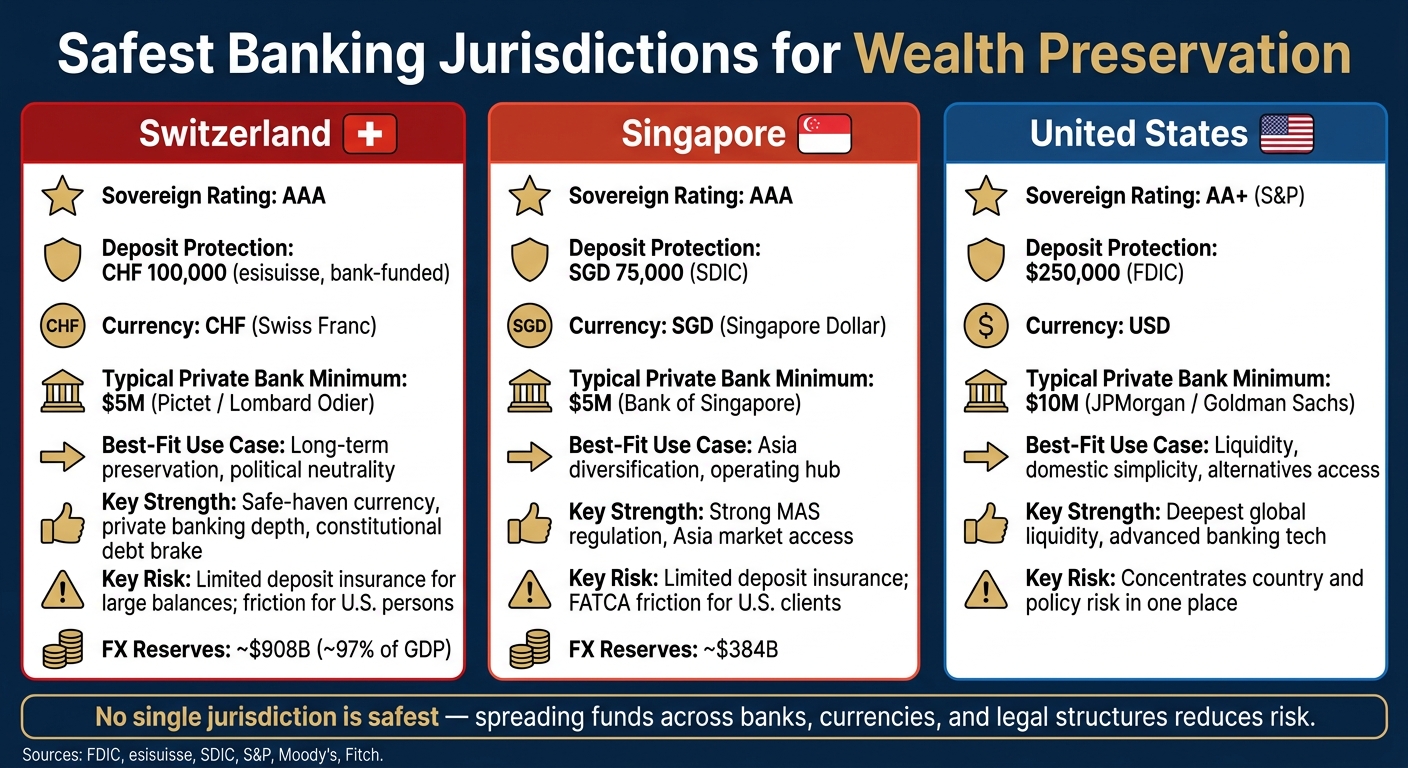
Safest Banking Jurisdictions for Wealth Preservation: Switzerland vs Singapore vs USA
If bank safety is a bank-jurisdiction pair, the jurisdiction sets the ceiling. So this part comes down to a simple issue: which place tends to hold up best when markets, politics, or the banking system get shaky?
For most U.S.-connected readers, the practical shortlist is Switzerland, Singapore, and the United States. None is safest in every scenario. Each one cuts risk in one area and adds it in another.
Switzerland: safe-haven currency, private banking depth, and strong institutional reputation
Switzerland fits best for long-term preservation and political neutrality. Its private banking bench runs deep, and that still matters when you’re thinking in decades, not quarters.
Pictet and Lombard Odier both set minimums at $5 million, while Union Bancaire Privée (UBP) starts at $1 million to $2 million. UBS Global Wealth Management reported $4.8 trillion in invested assets at FY2025. But there’s a catch: after the Credit Suisse deal, about 66% of all Swiss-managed assets now sit with UBS. That’s a real concentration risk because more of the system now leans on one institution than it did before.
For U.S. persons, old-school Swiss secrecy is no longer part of the pitch. CRS 2.0 and the Crypto-Asset Reporting Framework (CARF) went live worldwide on January 1, 2026, and they require verified self-certifications before an account can be opened. On top of that, many Swiss banks simply avoid American clients because FATCA compliance is costly and time-consuming. The banks that do take U.S. persons usually ask for detailed source-of-wealth records and often set higher minimums.
For U.S. clients, the upside is preservation. The downside is friction.
Singapore: strong regulation, political stability, and Asia diversification
Singapore works best for Asia diversification and day-to-day operating flexibility. The Monetary Authority of Singapore runs one of Asia’s toughest regulatory systems, which makes the country a strong base for active wealth management and for access to high-growth regional markets.
DBS Private Bank sets its full private banking minimum at $20 million. Bank of Singapore starts at $5 million, and Standard Chartered begins at $2.5 million. U.S. persons can still run into onboarding friction here too, since many banks have limited appetite for American clients due to FATCA compliance costs.
Singapore solves a different problem than Switzerland. It gives you strong regulation with better access to Asia.
Other solid options: select global banks in the U.S. and Europe
The United States is strongest for liquidity and domestic simplicity, not offshore risk reduction. For U.S. citizens, it’s the default base because it offers the deepest liquidity in the world and highly advanced tech integration across banking and brokerage systems.
JPMorgan and Goldman Sachs usually require $10 million for top private wealth tiers. The tradeoff is pretty plain: the U.S. gives you unmatched liquidity and access, but it also keeps your political and policy risk concentrated in one place.
That makes the U.S. the default for liquidity and simplicity, not the top offshore preservation choice.
| Jurisdiction | Sovereign Rating | Deposit Protection | Currency Exposure | Typical Private Bank Minimum | Best-Fit Use Case |
|---|---|---|---|---|---|
| Switzerland | AAA | CHF 100,000 (esisuisse; bank-funded) | CHF | $5M (Pictet/Lombard Odier) | Long-term preservation, political neutrality |
| Singapore | AAA | SGD 75,000 (SDIC) | SGD | $5M (Bank of Singapore) | Asia diversification, operating hub |
| United States | AA+ (S&P) | $250,000 (FDIC) | USD | $10M (JPMorgan/Goldman) | Liquidity, domestic simplicity, alternatives access |
Once the jurisdiction is chosen, the next step is to compare banks on capital, liquidity, and funding before moving any money.
How to compare specific banks without guessing
Once you’ve narrowed down the right jurisdictions, the next move is simple: compare actual banks using the same yardstick.
The point isn’t to pick the most famous name. It’s to find the bank that gives you the best mix of access, legal ownership, and lower concentration risk. At this stage, you’re no longer judging the country alone. You’re judging the institution inside it.
A practical scorecard for private and global banks
Use the same five checks for each bank: capital, liquidity, loan quality, funding mix, and custody structure.
CET1 ratio measures core capital against risk-weighted assets. Top-tier institutions often keep buffers of 15% or higher. Liquidity Coverage Ratio (LCR) shows whether a bank can cover 30 days of outflows under stress. Here, don’t get distracted by one quarter. Look for a stable or rising pattern across several quarters. NPL ratio shows loan book health. Lower is better, with a target below 1.5%. Funding mix shows how steady the deposit base is. A high share of institutional deposits is a warning sign because that money can leave much faster than retail deposits during a crisis. And custody structure tells you whether your assets stay off the bank’s balance sheet if the bank fails.
You should also verify the license yourself in the regulator’s public register, whether that’s FINMA’s public register or MAS’s public register. Make sure the institution has a full banking license, not just a securities dealer or e-money license. That detail matters more than many people think. A weak or invalid license can block access to cash even if the bank looks sound on paper.
Use the table below to score each bank on the same basis.
What a side-by-side bank comparison should include
A side-by-side comparison only works when every column means the same thing across every bank. If one bank reports one way and another is judged on a different basis, the whole exercise starts to wobble.
| Column | What to measure |
|---|---|
| Institution type | Commercial, private, cantonal, or custody-focused |
| Jurisdiction | Sovereign rating and political stability of the booking center |
| Primary currencies | Availability of CHF, USD, SGD, EUR |
| CET1 ratio | Core capital strength; target above 15% for top-tier safety |
| LCR trend | Stable or rising over the last 3 to 4 quarters |
| NPL ratio | Target below 1.5% |
| Deposit insurance | Local limit vs. structural guarantees, such as cantonal protection |
| Account minimum | Entry threshold for non-residents |
| Best use case | Operating liquidity, long-term reserve, or institutional custody |
Swiss cantonal banks carry a full, unconditional state guarantee with no deposit ceiling. That’s a structural layer of protection that brand-based comparisons often miss. You only see that difference when you review the custody agreement and the guarantee structure itself.
Mistakes that make a ‘safe’ bank choice less safe
The most common mistake is treating a famous bank name like a full safety plan.
In March 2023, $17 billion in Credit Suisse AT1 bonds were written down to zero overnight. “Too big to fail” is a policy preference, not a legal guarantee.
A few other mistakes keep showing up too:
- Overconcentration: Keeping all cash, custody, and borrowing capacity at one institution may feel safer because the name is familiar. In practice, it stacks operational and legal risk in one place.
- Currency mismatch: Holding long-term reserves in a currency that doesn’t match your preservation goals can quietly erode wealth through inflation and debasement.
- Exceeding insurance limits without a structural backstop: FDIC insurance covers $250,000. If you hold $5 million in one account at one bank, the other $4,750,000 rests on that bank’s balance sheet.
- Account-title errors: Holding accounts in the wrong legal name – personal instead of trust or entity – can create tax friction, complicate inheritance, and weaken asset protection even when the bank itself is sound.
Before you submit a formal application, do a compliance pre-qualification. Confirm that your source-of-wealth documents match the bank’s risk appetite. Singapore tightened its source-of-wealth standards after major money-laundering cases in 2023, and incomplete files can face delays of three to six months. A rejected application doesn’t just waste time. It can delay access and make future onboarding harder. If one bank still leaves you with too much concentration risk, the next move is to split cash across banks, jurisdictions, and legal entities.
A safer way to park wealth: spread funds across banks, jurisdictions, and ownership structures
The safest move is usually not finding one “perfect” bank. It’s building a banking setup that can take a hit and still work. After you rank banks by capital, liquidity, and jurisdiction, the next step is simple: give each account a job.
In practice, a two-bank setup is often the minimum that still feels workable. It gives you a balance between safety, day-to-day access, and relationship continuity.
A model allocation framework for U.S.-connected high-net-worth individuals
A good rule is to match the account setup to the size of the balance: operating cash first, reserve funds next, then multi-jurisdiction holdings as wealth grows.
At $250,000, one strong U.S. bank with FDIC coverage is usually enough for operating cash. For most people at that level, adding foreign accounts creates extra reporting and compliance work without adding enough protection to make it worth it.
At $2,500,000, a two-bank structure starts to earn its keep. Keep near-term liquidity at a strong U.S. bank, then place reserve funds at a second bank in a stable foreign jurisdiction if there’s a clear reason to do that.
At $25,000,000, a multi-jurisdiction setup is usually more resilient. Each account should have a defined role. That lowers concentration risk without making operating cash harder to reach.
| Wealth level | Primary U.S. bank | Reserve bank | Third position |
|---|---|---|---|
| $250,000 | Operating cash, FDIC-covered | Not needed | Not needed |
| $2,500,000 | Operating account | Foreign reserve funds | Not needed |
| $25,000,000 | Operating account | Swiss reserve/custody | Singapore or a third jurisdiction |
How legal structures can support banking safety and asset protection
Ownership is the next layer of defense. How the account is titled matters just as much as where the money sits.
A U.S. revocable trust with named beneficiaries can increase FDIC coverage by $250,000 per beneficiary at one institution. An LLC or holding company that is set up the right way will usually get its own separate insurance coverage at the same bank.
For larger balances, long-term reserves may be safer in sovereign bonds like U.S. Treasuries or German Bunds held in a separate custody account. That can offer more protection than cash deposits. These assets are legally segregated from the bank’s bankruptcy estate and aren’t subject to bail-in haircuts.
Structuring offshore trusts and foundations can create legal separation and help with succession planning, but they come with real tradeoffs. Expect deeper KYC review, onboarding timelines of three to four months, and annual compliance costs that can run from CHF 1,000 to $3,000 at Swiss institutions.
Use legal structures when they serve a clear planning purpose, such as:
- succession
- privacy
- liability separation
If the structure doesn’t solve a real problem, it may just add friction. Complexity for its own sake can create its own risks.
Key takeaways: the safest bank depends on your risk profile and the system around it
Bank safety comes from the setup around the bank, not from the bank by itself. Systemically important banks can offer resilience, but they don’t offer immunity, as the Credit Suisse AT1 writedown showed. The safer path is to spread funds across institutions, currencies, and legal structures, with each piece serving a clear role.
FAQs
How much cash should I keep in one bank?
For high-net-worth individuals, there isn’t one set cutoff. The right amount depends less on a single dollar figure and more on your risk profile, liquidity needs, and how the rest of your finances are set up.
Once cash goes above standard insurance limits like $250,000, the focus shifts. At that point, look closely at the bank’s capital strength, liquidity, and home jurisdiction.
Common ways to handle large cash balances include:
- Spreading funds across multiple banks
- Using deposit-network sweeps
- Holding U.S. Treasury bills for large cash reserves
Are Treasuries safer than bank deposits?
It depends on the kind of risk you’re talking about.
U.S. Treasuries are backed by the full faith and credit of the U.S. government. Bank deposit safety, on the other hand, depends on the bank’s capital, regulation, and the limits of deposit insurance.
For large cash balances, Treasuries usually offer stronger credit safety. Bank deposits are often better for day-to-day access and convenience, especially if you use a large, well-capitalized bank.
When does it make sense to use offshore banks?
Offshore banking makes sense when you want jurisdictional diversification instead of putting all your trust in one nation-state.
That matters for a few reasons. It can help cut counterparty risk, protect assets from local political or economic instability, and add a layer of security if your home country runs into a crisis.
It can also support legal tax optimization and wealth protection against currency debasement, sovereign default, or geopolitical weaponization. The core idea is simple: keep assets under physical and legal control outside a single regulatory framework.
