
Miss Form 8858 and the IRS can hit you with a $10,000 penalty per entity, per year. If you own a foreign disregarded entity, run a foreign branch, or file through a CFC or foreign partnership structure, I’d treat this form as a required part of the main tax return, not a side form.
Here’s the short version: I file Form 8858 with my federal return, use the foreign operation’s books to report income, assets, liabilities, and related-party transactions, and make sure the filing follows the tax owner and not just the legal owner. Even a dormant FDE can still need a filing. If the IRS sends a notice after a missed filing, extra penalties can grow up to $50,000 per entity.
Before I file, I’d make sure I can answer these points:
- Who files: U.S. persons with an FDE or foreign branch, plus some filers already filing Form 5471 or Form 8865
- When it’s due: With the main return, including extensions
- What goes on it: Income, deductions, balance sheet data, foreign taxes, and related-party transactions
- Where people go wrong: Wrong owner, skipped Schedule M, mixed exchange rates, or filing it separately
- Why it matters: Late or missing filings can keep the tax year open and trigger IRS penalties
If I had to boil the article down to one point, it would be this: Form 8858 is about matching the right foreign business activity to the right U.S. return, on time, with the right schedules attached.
What Form 8858 is and when it applies
Form 8858 reports the income, deductions, assets, and liabilities of foreign operations that are disregarded for U.S. tax purposes. Put simply, it covers foreign operations that the IRS treats as part of the U.S. owner rather than as a separate taxpayer.
Foreign disregarded entities and foreign branches defined
A foreign disregarded entity (FDE) is a business entity formed outside the U.S. that is treated as a separate legal entity under local law, but disregarded for U.S. tax purposes. That means the U.S. tax owner reports the entity’s income and expenses directly on their own return.
A foreign branch (FB) is a foreign business operation that is not a separate legal entity. In most cases, it exists through a fixed place of business outside the U.S. and keeps its own books and records.
Here’s the basic split between an FDE and a foreign branch:
| Feature | Foreign Disregarded Entity (FDE) | Foreign Branch (FB) |
|---|---|---|
| Legal form | Separate legal entity recognized in the foreign country | Not a separate legal entity; part of the U.S. person |
| U.S. tax treatment | Disregarded; income and expenses reported on the owner’s return | Treated as part of the U.S. taxpayer’s business |
| Filing trigger | Ownership of a foreign entity disregarded for U.S. tax | Foreign business operations with separate books and records |
Who must file based on tax ownership and structure
The IRS sorts Form 8858 filers into categories based on their link to the FDE or FB.
Category 1 filers are U.S. persons who are tax owners of an FDE or who operate a foreign branch. Category 2 filers are direct or indirect owners, through a tier of FDEs, of an FDE or FB. A tax owner is the person treated as owning the entity for U.S. tax purposes, and that person may be different from the legal owner.
Category 3 filers are U.S. persons who file Form 5471 for a CFC that owns an FDE or operates a foreign branch. In that case, Form 8858 is filed as part of the Form 5471 package. Category 4 filers are U.S. persons who file Form 8865 for a CFP that owns an FDE or operates a foreign branch.
Category 5 filers are partners in a partnership that owns an FDE or FB and applies Section 987 currency rules to those activities. Category 6 filers are certain domestic corporations that are partners in a U.S. partnership that made specific elections on Schedules K-2 and K-3 of Form 1065.
One point trips people up: a dormant FDE can still trigger a filing. Even if the entity had no activity during the year, Form 8858 is still required. The IRS does allow a simplified summary filing procedure for dormant entities, but the filing duty stays in place.
After you pin down your filing category, the next move is getting the records and deadline details the IRS expects.
How Form 8858 relates to Forms 5471 and 8865
Form 8858 can stand on its own, or it can sit inside a larger international filing package. It depends on how the foreign operation is owned.
If you directly own an FDE or operate a foreign branch as a U.S. person, Form 8858 attaches to your Form 1040, 1065, or 1120. If a CFC reported on Form 5471 owns an FDE or branch, Form 8858 is filed as part of the Form 5471 package. The same rule applies when a controlled foreign partnership reported on Form 8865 owns an FDE or branch.
A simple way to think about it: if you’re already filing Form 5471 or Form 8865, don’t stop at the top-level entity. Look underneath it. If that foreign corporation or partnership owns its own FDE or has a foreign branch, Form 8858 may be part of the filing stack too.
Once you know your category, you can move on to the records and filing deadlines needed to complete Form 8858.
Filing requirements and deadlines
Once you know Form 8858 applies, the next step is timing and recordkeeping.
You file Form 8858 with the related federal return. That means its due date tracks the deadline for the underlying return, including any valid extension.
| Filer | Underlying Return | Standard Due Date | Extended Due Date | Filing Method |
|---|---|---|---|---|
| Individual | Form 1040 | April 15 | Oct 15 | Attached to Form 1040 |
| U.S. individual abroad | Form 1040 | June 15 | Dec 15 | Attached to Form 1040 |
| Corporation | Form 1120 | April 15 | Oct 15 | Attached to Form 1120 |
| Partnership | Form 1065 | March 15 | Sept 15 | Attached to Form 1065 |
If you e-file, Form 8858 has to go in electronically. Mailing a paper copy after sending an e-filed return does not count.
Records to gather before completing the form
With the deadline pinned down, gather the records that feed the form.
You’ll want the FDE or branch’s legal name, address, TIN, country of organization or operation, functional currency, local financial statements, ownership chart, related-party transaction records, and support for the exchange rates used to convert amounts into U.S. dollars. Use one consistent conversion method across the form.
Under Treasury regulations, keep support records such as bank statements, invoices, and transfer-pricing records for at least seven years.
Main sections the IRS requires on Form 8858
The core schedules are Schedule C (income statement), Schedule F (balance sheet), Schedule G (general information questions), Schedule H (current earnings and profits), and Schedule J (foreign income taxes paid or accrued).
Schedule M reports transactions between the FDE or foreign branch and the filer or any related entities. Schedule G usually gets the most IRS scrutiny.
These schedules set up the step-by-step completion process below.
sbb-itb-39d39a6
How to complete and submit Form 8858, step by step
You can handle Form 8858 in three main moves: identify the filer, report the foreign operation’s numbers, and attach the form to the right U.S. tax return. The easiest path is to work through it in that order using the records and schedule list above.
Fill in the identification and tax owner sections first
Start with the basics. Enter the legal name, address, and TIN for both you and the foreign disregarded entity (FDE) or foreign branch (FB). You’ll also need the entity’s jurisdiction, functional currency, and principal business activity.
The tax owner is the person treated as owning the FDE or FB for U.S. tax purposes, even when the legal owner on paper is someone else. That’s where people can get tripped up. An ownership chart helps you verify the filing chain and confirm who the tax owner is before you move on.
Report income, balance sheet items, and Schedule M
Use the foreign operation’s local books to fill out the income and expense amounts on Schedule C. Then convert those amounts into U.S. tax figures. Those figures need to be stated in U.S. dollars, using the right exchange rates.
Schedule F reports the assets, liabilities, and equity of the FDE or FB as of the end of the tax year.
Schedule M is where you report transactions between the FDE or FB and you or other related parties. That includes items like:
- Sales of inventory
- Rents
- Royalties
- Commissions
- Interest
Keep support records ready for those related-party transactions.
Attach the form to your return and file on time
Attach Form 8858 to the related timely filed return – Form 1040, Form 1120, or Form 1065 – and include it in the e-filed return.
Next, review the penalties, common filing errors, and ownership scenarios.
Penalties, common errors, ownership scenarios, and a final checklist
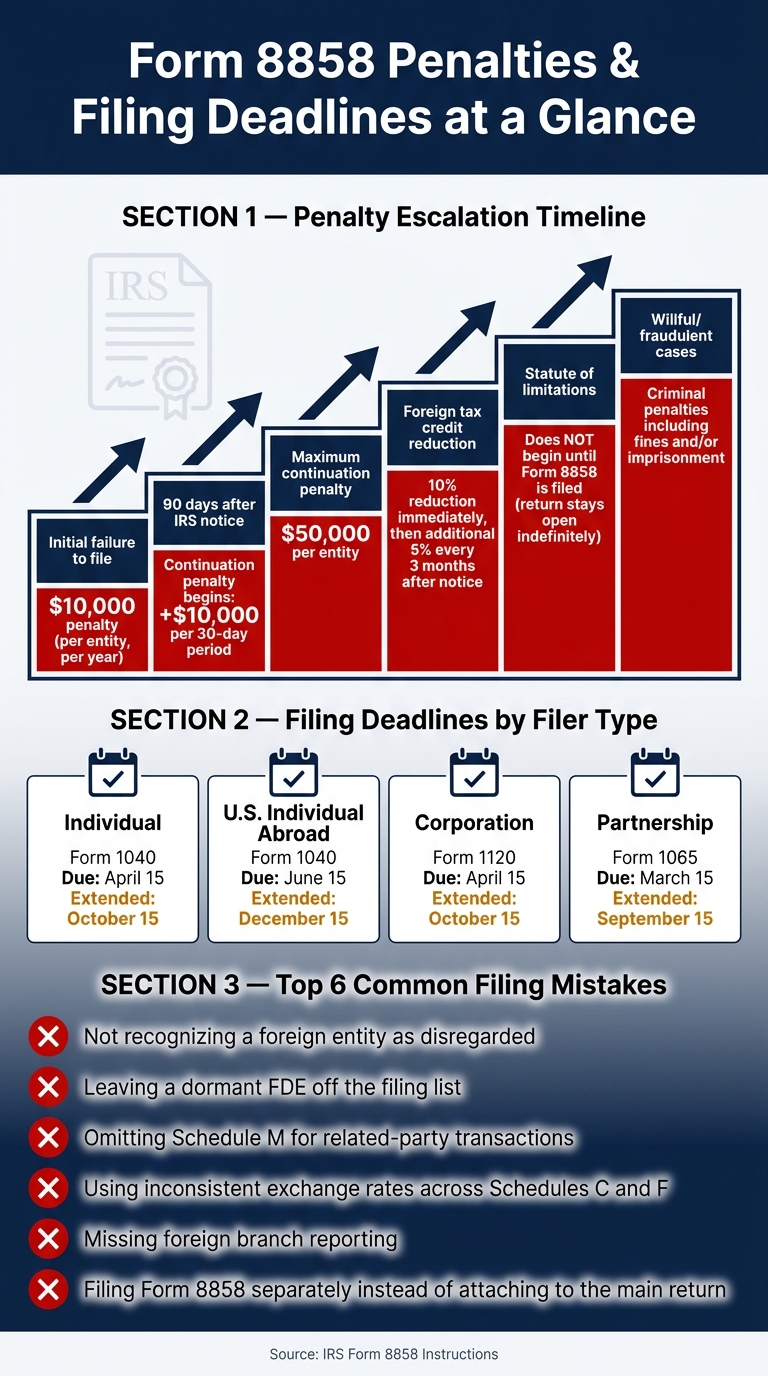
Once you finish the form, the big risks are pretty simple: filing late, reporting through the wrong ownership chain, or leaving out schedules that the IRS expects to see.
Penalties and how to request reasonable cause relief
Missing Form 8858 can lead to a $10,000 penalty for each annual accounting period. If the IRS sends a notice and the form still isn’t filed, the penalty can climb by $10,000 for each 30-day period, up to $50,000 per entity. On top of that, failing to file can cut foreign tax credits by 10%, with another 5% reduction every three months after notice.
| Penalty Type | Amount | Notes |
|---|---|---|
| Initial failure to file | $10,000 | Per entity, per annual accounting period |
| Continuation penalty | $10,000 per 30 days | Starts 90 days after IRS notice; max $50,000 per entity |
| Foreign tax credit reduction | 10% reduction | Additional 5% reductions may apply every 3 months after notice |
| Statute of limitations | Does not begin until the form is filed | The return remains open until Form 8858 is filed |
| Criminal penalties | Fines and/or imprisonment | Possible in willful or fraudulent cases |
There’s another issue people often miss: the statute of limitations does not start until Form 8858 is filed. In plain English, that means the return can stay open.
If you missed a filing, attach a reasonable cause statement to a delinquent or amended return. That statement should lay out the facts, explain why the failure happened, and show that it was not due to willful neglect.
Common filing mistakes that draw IRS notices
The same mistakes tend to lead to both penalties and IRS notices. Most of them come down to missed classifications, skipped schedules, or filing the form in the wrong place.
- Not recognizing a foreign entity as disregarded for U.S. tax purposes
- Leaving a dormant FDE off the filing list – dormant entities still need to be reported, even if there was no activity
- Leaving out Schedule M for related-party transactions
- Using inconsistent exchange rates across Schedules C and F
- Missing foreign branch reporting when the operation has its own books and records and works as a qualified business unit
- Filing Form 8858 separately instead of attaching it to the main return
Typical ownership scenarios and a final filing checklist
These common structures can help you confirm who files Form 8858 and where it belongs.
| Ownership Scenario | Filer | Main Return |
|---|---|---|
| U.S. individual with 100% ownership of a foreign LLC | U.S. individual | Form 1040 (Schedule C or E) |
| U.S. corporation with a foreign branch | U.S. corporation | Form 1120 |
| U.S. person owning a CFC that owns an FDE | U.S. shareholder | Form 5471 |
Before filing, check the tax owner, the ownership chain, the organization chart, Schedule M, currency conversions, and the correct return attachment. Then make sure it’s filed on time, or use the simplified summary procedure if the entity is a dormant FDE.
FAQs
Do I need Form 8858 if my foreign entity had no activity?
Yes. You may still need to file Form 8858 even if your foreign entity had no activity.
The key point is ownership and status, not whether the business made money or did anything during the year. If you’re a U.S. person who owned a Foreign Disregarded Entity or operated a Foreign Branch during the tax year, the filing rule may still apply.
In plain English: no activity does not automatically mean no filing.
That’s the part many people miss. A dormant entity can still trigger a filing duty. And if you skip the form when it’s required, the IRS can assess penalties starting at $10,000 per form.
How do I know if I’m the tax owner for Form 8858?
You’re the tax owner of a Foreign Disregarded Entity (FDE) when the IRS treats you, as a U.S. person, as the owner of that entity’s assets and liabilities for tax purposes.
And yes, this can apply even if you’re not the direct legal owner.
If the IRS sees you as the tax owner, you must report the entity’s financial details on Form 8858.
What exchange rate should I use on Form 8858?
If your foreign business records are kept in another currency, convert those amounts into U.S. dollars.
For Form 8858, the standard approach is:
- Use the average annual exchange rate for income statement items
- Use the year-end exchange rate for balance sheet items
Stay consistent with the exchange rates you use. Also document the conversion method you applied during the tax year.
