
If your foreign accounts go over $10,000 at any point in the year, I’d check FBAR first. Then I’d check Form 8938, which uses higher thresholds and also covers some foreign assets that are not accounts.
Here’s the short answer:
- FBAR is for foreign financial accounts
- Form 8938 is for foreign financial accounts plus certain foreign assets held directly
- You may need one form or both
- FBAR is filed with FinCEN
- Form 8938 is filed with your tax return
- FBAR has a flat $10,000 threshold
- Form 8938 thresholds range from $50,000 to $600,000, based on filing status and whether you live in the U.S. or abroad
The main mistake I see in this topic is simple: people assume Form 8938 replaces FBAR. It doesn’t. If both rules fit your situation, you file both.
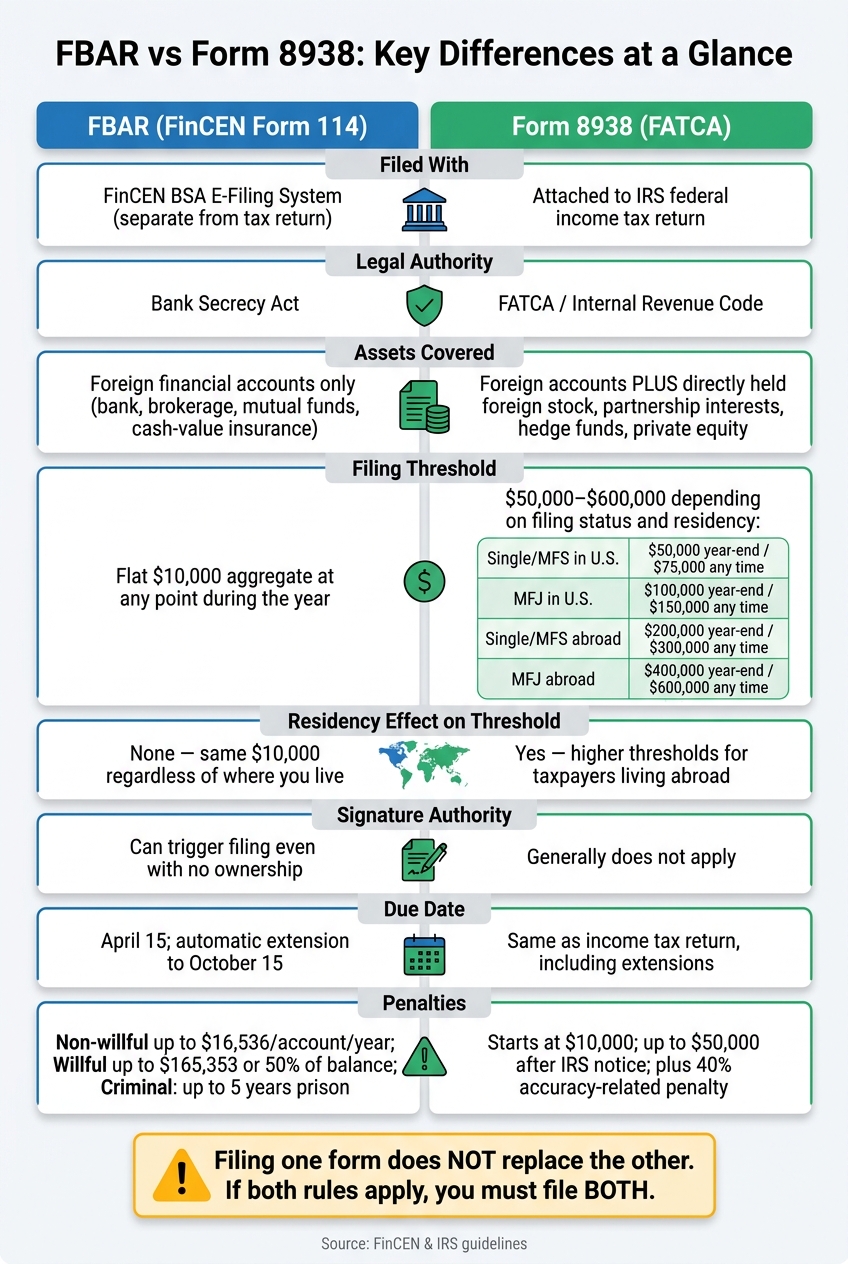
Quick Comparison
| Item | FBAR | Form 8938 |
|---|---|---|
| What it reports | Foreign financial accounts | Foreign accounts and certain foreign financial assets |
| Main threshold | More than $10,000 total at any time | $50,000 to $600,000 depending on status and residence |
| Where I file it | FinCEN BSA e-filing system | With my IRS tax return |
| Directly held foreign stock | No | Yes |
| Signature authority only | Can trigger filing | Usually no |
| Due date | April 15; automatic extension to October 15 | Same due date as tax return, including extensions |
In plain English: if it’s an account, I test for FBAR. If it’s an account or another foreign financial asset, I test for Form 8938 too.
sbb-itb-39d39a6
FBAR filing rules: who files and what gets reported
Start with FBAR, the account-based filing rule.
FBAR applies to U.S. persons with a financial interest in, or signature authority over, foreign financial accounts. That includes U.S. citizens, resident aliens, and certain domestic entities such as corporations, partnerships, LLCs, trusts, and estates. Residents of U.S. territories such as Puerto Rico, Guam, and American Samoa are included too.
The trigger is simple: if the aggregate value of your foreign accounts goes over $10,000 at any point during the year, you must file FBAR for all reportable foreign accounts.
Signature authority by itself can trigger filing, even if you don’t own the account. So if you manage a company’s foreign bank account as an employee and have no personal stake in it, you may still need to file. That said, some officers of regulated financial institutions may fall under an exception.
Foreign accounts covered by FBAR
FBAR is about foreign financial accounts, not every kind of foreign asset. The account must be held at a financial institution located outside the United States. That includes foreign branches of U.S. banks.
| Reportable Foreign Financial Accounts | NOT Reportable on FBAR |
|---|---|
| Bank accounts (checking, savings, time deposits) | Foreign real estate held directly |
| Brokerage and securities accounts | Foreign currency held directly outside an account |
| Foreign mutual funds | Precious metals held directly |
| Cash-value life insurance or annuity contracts | Foreign stock or securities held directly |
| Foreign branches of U.S. banks | Safe deposit boxes at foreign institutions |
| Commodity futures or options accounts | Accounts at U.S. branches of foreign banks |
| Foreign retirement or pension accounts, unless specifically exempt | U.S. IRAs and 401(k) plans |
A good way to think about it: if the offshore holding is an account, FBAR may apply. If it’s some other type of foreign asset, Form 8938 may come into play too.
How FBAR is filed and what penalties look like
FBAR is filed electronically through FinCEN’s BSA E-Filing System. It is separate from your federal income tax return, so you do not attach it to Form 1040. The standard due date is April 15, and there’s an automatic six-month extension to October 15 with no formal request needed.
You also need to keep records for each reported account for five years from the FBAR due date. That means account number, bank name and address, account type, and the account’s maximum value during the year.
The penalties are steep. Non-willful penalties can reach $16,536 per account, per year. Willful penalties can be the greater of $165,353 or 50% of the account balance. Criminal violations can bring fines and up to five years in prison. If you missed an FBAR, file it as soon as you can. Reasonable cause may reduce or wipe out penalties.
FBAR covers accounts only; Form 8938 goes further.
Form 8938 filing rules: broader asset coverage and higher thresholds
Form 8938, the IRS Statement of Specified Foreign Financial Assets, covers a broader set of offshore assets than the FBAR. You file it with your federal tax return. It applies to covered U.S. taxpayers and certain entities. If the FBAR is mainly an account test, Form 8938 is the broader asset test.
Assets commonly reported on Form 8938
Form 8938 covers specified foreign financial assets in two main groups: financial accounts held at foreign institutions and non-account foreign assets held for investment. It also picks up assets that the FBAR does not report.
| Asset Type | Form 8938 | FBAR |
|---|---|---|
| Foreign bank and brokerage accounts | Yes | Yes |
| Foreign mutual funds | Yes | Yes |
| Foreign-issued life insurance (cash value) | Yes | Yes |
| Foreign stock/securities held directly | Yes | No |
| Foreign partnership interests | Yes | No |
| Foreign hedge funds and private equity funds | Yes | No |
| Foreign real estate held directly | No | No |
| Foreign currency held as cash | No | No |
So the issue isn’t just what you own. You also need to ask whether the total value of those assets puts you over the filing threshold.
If another IRS form already reports the asset, such as Form 5471 for foreign corporations or Form 8865 for foreign partnerships, you still need to list that form in Part IV. The asset’s value still counts toward your threshold.
Form 8938 thresholds by filing status and residency
This is where Form 8938 splits from the FBAR in a big way. The FBAR uses a flat $10,000 trigger. Form 8938 uses thresholds based on your filing status and where you live.
| Filing Status and Residency | Year-End Threshold | Any-Time Threshold |
|---|---|---|
| Unmarried or Married Filing Separately, living in the U.S. | $50,000 | $75,000 |
| Married Filing Jointly, living in the U.S. | $100,000 | $150,000 |
| Unmarried or Married Filing Separately, living abroad | $200,000 | $300,000 |
| Married Filing Jointly, living abroad | $400,000 | $600,000 |
To use the higher abroad thresholds, you must be a bona fide foreign resident for the full year or spend at least 330 full days abroad during a 12-month period that ends in the tax year.
One point trips people up all the time: even if a foreign asset produces zero income during the year, it still counts toward your threshold.
Where Form 8938 is filed and what penalties apply
Form 8938 goes with your tax return. It is not filed as a separate submission.
The penalty for missing Form 8938 starts at $10,000. After IRS notice, another $10,000 can apply for each 30-day period, up to $50,000. On top of that, a 40% accuracy-related penalty and a six-year statute of limitations may apply.
That sets up the next step: comparing Form 8938 and the FBAR side by side.
FBAR vs. Form 8938: a direct comparison
FBAR is a Bank Secrecy Act filing sent to FinCEN. Form 8938 is a FATCA filing sent to the IRS.
| Feature | FBAR (FinCEN Form 114) | Form 8938 (FATCA) |
|---|---|---|
| Filing Agency | FinCEN (Treasury Department) | IRS |
| Legal Authority | Bank Secrecy Act | FATCA / Internal Revenue Code |
| Assets Covered | Foreign financial accounts only | Foreign accounts and other specified foreign financial assets |
| Threshold | More than $10,000 aggregate at any time during the calendar year | Varies by filing status and residency |
| Residency Effect | None | Higher thresholds for taxpayers living abroad |
| Where to File | FinCEN BSA E-Filing System, separate from the tax return | Attached to the annual income tax return |
| Due Date | April 15, with an automatic extension to October 15 | Same as the income tax return, including extensions |
The easiest way to think about it is this: FBAR is narrower, but its filing trigger is simple. Form 8938 covers more types of foreign assets, but the filing trigger depends on your filing status and where you live.
Next, match these rules to your own facts: account balance, asset type, filing status, and residency.
Foreign accounts vs. specified foreign financial assets: the key difference
FBAR only covers foreign financial accounts held at a foreign bank, brokerage, or other financial institution. Form 8938 goes a step further because it can also include assets you hold directly.
Here’s where people get tripped up. If you own foreign stock certificates directly, there may be nothing to report on FBAR. But those same shares may still need to go on Form 8938. The same basic rule applies to directly held foreign partnership interests.
FBAR looks at the account. Form 8938 can also look at the asset itself.
When both forms apply to the same taxpayer
A lot of taxpayers end up with overlapping filing duties. Filing one form does not cover the other. If both sets of rules apply, you file both.
For example, a taxpayer may have foreign accounts that trigger FBAR and also hold enough specified foreign financial assets to go over the Form 8938 threshold that matches their filing status and residency. In that case, both forms apply for the same tax year.
One more difference matters here: FBAR can require you to report accounts over which you have signature authority. Form 8938 usually does not.
With that distinction in place, the next step is figuring out whether your situation calls for FBAR, Form 8938, or both.
Which form do you file? A practical decision framework
Use these rules to figure out whether you need FBAR, Form 8938, or both.
Start with the account type and the total value. First, add up the highest combined value of all foreign financial accounts at any point during the year. If that number is more than $10,000, you generally need to file an FBAR. Then add up your specified foreign financial assets, including directly held foreign stock or partnership interests, and compare that total with the Form 8938 threshold for your filing status and where you live.
3 common filing outcomes
Most filing questions land in one of these three buckets.
| Outcome | Example | Why |
|---|---|---|
| FBAR only | U.S. resident with $12,500 in a foreign bank account | Exceeds the $10,000 FBAR threshold but stays below the $50,000 Form 8938 threshold |
| Form 8938 only | U.S. resident holding $85,000 in foreign stock certificates directly, no foreign bank account | Direct stock is not an FBAR-reportable account, but it is a specified foreign financial asset that exceeds the $50,000 Form 8938 threshold |
| Both forms | Married couple living abroad with $450,000 in a foreign brokerage account | Exceeds the $10,000 FBAR threshold and the $400,000 Form 8938 threshold for married couples filing jointly abroad |
One point trips people up all the time: Form 8938 does not replace FBAR. If both sets of rules apply, you file both.
Reporting requirements for offshore structures and wealth planning
Foreign trusts, estates, pension plans, and closely held entities can trigger Form 8938. Any foreign accounts tied to those assets can also trigger FBAR.
For both forms, convert values to U.S. dollars using Treasury’s year-end exchange rate.
Conclusion: the shortest way to avoid offshore reporting mistakes
FBAR and Form 8938 are separate filing duties. Check foreign accounts against the $10,000 FBAR test first. Then compare your specified foreign financial assets with the right Form 8938 threshold. If you live abroad, the Form 8938 threshold is higher. If both rules apply, file both.
FAQs
How do I value foreign accounts for these forms?
For both FBAR and Form 8938, report the highest value of each account or asset during the calendar year in U.S. dollars.
For the FBAR, use the combined maximum value of all foreign financial accounts to figure out whether you meet the $10,000 threshold.
For Form 8938, report the maximum value of specified foreign financial assets as well. If an asset is jointly held with a spouse, include one-half of its value when figuring the threshold.
Do jointly owned foreign accounts count for both spouses?
Yes. Jointly owned accounts can count for both spouses, but the rules are different for Form 8938 and the FBAR.
For Form 8938, spouses who file jointly report all specified foreign financial assets on a single form. If spouses file separately, each spouse uses half the value of a jointly owned asset when testing the filing threshold. But if filing is required, each spouse reports the full value of that asset.
For the FBAR, each spouse reports their interest in jointly owned accounts.
What should I do if I missed FBAR or Form 8938?
If you missed filing an FBAR or Form 8938, talk to a qualified tax professional as soon as you can. These are separate filing duties, and missing either one can lead to steep penalties.
Don’t assume that filing one covers the other. The IRS and FinCEN treat them separately, so a tax professional can help you deal with past misses and file more accurately going forward.
