
Yes, I can still open a Swiss bank account as an American in 2026 – but only in a narrow set of cases. Most Swiss retail banks won’t take U.S. persons who live outside Switzerland. In practice, I need to match my profile to the right bank type, clear FATCA and AML checks, and be ready for fees, tax filings, and a wait of about 4 to 8 weeks.
Here’s the short version:
- If I live in Switzerland: I may be able to open a normal local account, often with a residence permit.
- If I live outside Switzerland: My best shot is usually private banking, a high-minimum relationship, or a company account.
- If I’m a U.S. person: I should expect Form W-9, source-of-funds proof, ID checks, and bank review.
- If my total foreign accounts go over $10,000 at any point in the year: I likely need to file an FBAR.
- If I want investments: I should be careful with Swiss mutual funds and ETFs because of PFIC tax issues.
What Swiss banking still offers is not secrecy. It’s currency diversification, access to Swiss institutions, and in some cases a local banking option for daily life. But the old “hidden money” idea is gone. Swiss banks now report U.S. account data under FATCA rules.
If I were starting today, I’d focus on four things first:
- My residency status
- My asset level
- Whether the bank openly accepts U.S. clients
- Whether I can document where my money came from
A fast way to think about it:
| My situation | Most likely path | Main hurdle |
|---|---|---|
| U.S. citizen living in Switzerland | Retail or cantonal bank | Permit and local residency proof |
| U.S. citizen living outside Switzerland | Private bank or UBS-style private relationship | High minimum deposit |
| U.S.-owned business | Swiss corporate account | Entity docs and owner disclosures |
| Investor wanting Swiss funds | Custody account with care | PFIC tax treatment |
Bottom line: I should not start with “Which Swiss bank is best?” I should start with “Which Swiss bank will take my exact profile?” That one shift saves time, money, and a lot of rejected applications.
Who can open a Swiss bank account and what account types are available
The real issue is simpler than it sounds: which Swiss banking channel matches your residency status and asset level.
Eligibility rules for U.S. citizens and U.S. tax residents
Swiss banks treat U.S. citizens, green card holders, and other U.S. tax residents as U.S. persons under FATCA, no matter where they live. That label brings the same reporting rules across the board.
You should expect checks on:
- identity
- tax status
- address
- source of wealth
Swiss-resident Americans with a valid residence permit (L, B, or C) can usually open standard retail accounts at banks like ZKB, Raiffeisen, or PostFinance. By contrast, most Swiss retail banks will not take a nonresident U.S. person for a personal account.
Banks also look at industry risk, sanctions exposure, and whether beneficial ownership is clear. If the origin of funds is hard to trace, or the applicant has links to high-risk jurisdictions or layered ownership structures, the application often gets turned down.
Once you know whether you’re applying as a resident, nonresident, or company, the bank type tends to be the deciding factor.
Swiss bank categories Americans may still access
Not every Swiss bank is open to Americans in the same way. In practice, the bank category matters just as much as the account balance.
Large universal banks like UBS still accept U.S. persons for private banking relationships, but usually only at high asset levels. Vontobel Swiss Financial Advisers works with U.S. clients through an SEC-registered setup. Elite private banks such as Pictet tend to look for multimillion-franc relationships.
Retail and cantonal banks like PostFinance, ZKB, and Raiffeisen usually accept only U.S. persons who live in Switzerland and hold a valid permit.
For nonresident Americans, a Swiss company or corporate account is often the most workable path. FINMA-licensed digital banks like AMINA (formerly SEBA) and Sygnum may also accept corporate clients owned by U.S. persons under certain conditions, especially in digital asset business lines.
Minimum deposit requirements in 2026
| Bank Category | Example Institutions | U.S. Person Access | Minimum Deposit |
|---|---|---|---|
| Universal Banks | UBS | Private banking only | CHF 500,000+ |
| Private Banks | Vontobel SFA | High (SEC-registered) | CHF 750,000+ |
| Elite Private Banks | Pictet | Highly selective | CHF 3,000,000 to CHF 5,000,000+ |
| Retail / Postal | PostFinance | Swiss residents only | Low / no minimum |
| Digital Banking | Swissquote | Case-by-case | Low / custody fees |
| Crypto Banks | AMINA, Sygnum | Corporate clients only | Varies |
Meeting the deposit threshold doesn’t guarantee approval. Banks still run FATCA and KYC checks before they say yes.
sbb-itb-39d39a6
Compliance rules Americans must meet before account approval
Once you find a Swiss bank that will take U.S. persons, the next step is compliance. And this is where many applications slow down. Before any account opens, banks usually run FATCA, KYC, and AML checks at the same time.
How FATCA, CRS, and Swiss due diligence apply to Americans
Every regulated Swiss bank is a FATCA-compliant institution under an Intergovernmental Agreement (IGA) with the U.S.. Banks look for U.S. indicia, including a U.S. birthplace, U.S. phone number, U.S. address, or standing instructions to a U.S. account.
If any of those indicia show up, the bank will ask you to complete IRS Form W-9. That form confirms your U.S. taxpayer status and your SSN or ITIN. If you refuse to sign it, that is standard grounds for rejection or account closure.
CRS applies to most non-U.S. clients. FATCA applies to U.S. persons. As of 2026, Switzerland operates under a Model 2 FATCA agreement, which means Swiss banks report account data directly to the IRS with client consent.
KYC and source-of-funds documents banks actually review
The smoothest applications usually come with full source-of-funds records from the start. U.S.-person accounts often take longer because FATCA and KYC are reviewed as separate compliance checks. In many cases, the compliance stage alone takes 3 to 8 weeks, which makes up most of a 4- to 8-week onboarding timeline.
Here’s what banks usually ask for:
| Document Category | What Banks Want |
|---|---|
| Identity | Valid U.S. passport; video ID with NFC chip read or facial biometrics may be used |
| Tax Status | Signed IRS Form W-9; FATCA self-certification; SSN or ITIN |
| Residency | Utility bill or bank statement dated within the last 3 to 6 months; Swiss residence permit if applicable |
| Source of Funds | Two years of Form 1040; pay stubs; business sale contracts; inheritance records; brokerage statements |
| Professional Profile | Resume or CV; business plan for corporate accounts; professional references |
Two years of U.S. tax returns, especially Form 1040, usually carry the most weight because they show income, assets, and tax compliance in one file. If your money came from a business sale, inheritance, or an investment exit, expect the bank to ask for the matching contracts or legal records too.
If you apply through a Swiss entity, banks also ask for formation documents and beneficial-owner disclosures.
U.S. tax reporting obligations after the account is open
Opening the account is only part of the job. After that, you still need to track the main U.S. filing set: FBAR (FinCEN Form 114), Form 8938, and Form 8621 for any PFIC holdings.
The FBAR threshold is $10,000 total across all foreign accounts at any point during the year, not just on December 31. So if you have $6,000 in one foreign account and $5,000 in another, both accounts must be reported. Missing the filing can lead to major civil penalties.
Form 8938 is filed with your annual tax return. For U.S. residents, the filing threshold starts at $50,000 at year-end or $75,000 at any time during the year. For Americans living abroad, it starts at $200,000 at year-end or $300,000 at any time during the year.
One common trap: avoid Swiss-domiciled mutual funds or ETFs in the account. Those may be treated as PFICs under U.S. tax law, which can lead to harsh U.S. tax treatment and a separate Form 8621 filing for each fund. If you want to keep things simpler, stick with individual stocks, bonds, or U.S.-domiciled ETFs.
Interest earned in a Swiss account is taxable investment income, not foreign earned income. So it does not qualify for the Foreign Earned Income Exclusion (FEIE). You report that interest on Schedule B of Form 1040.
Many Americans also budget for outside tax help. CPA support often runs about $3,000 to $5,500 per year. Since these filing duties continue after approval, it makes sense to factor them in before you apply.
Step-by-step process to open a Swiss bank account in person or remotely
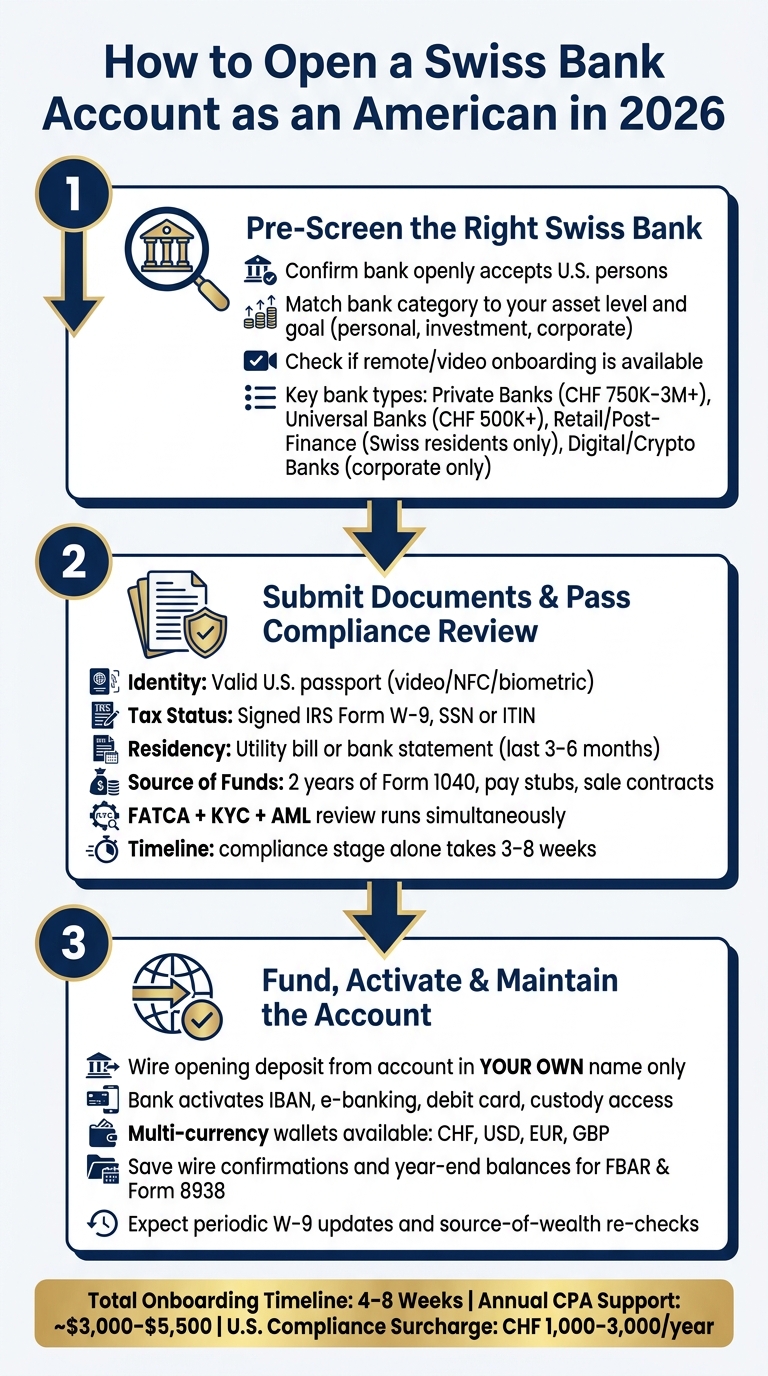
The compliance work from the previous section gets you to the starting line. But the application itself follows a set order. Miss a step or send an incomplete file, and you can easily add weeks to the process or end up with a flat-out rejection.
Step 1: Pre-screen the right Swiss bank before applying
Before you fill out anything, make sure the bank even accepts U.S. persons. That sounds obvious, but it’s where many people hit a wall. Most Swiss banks do not accept U.S. persons, so your shortlist should begin with banks that clearly say they do. It also helps to focus on banks with a team that handles U.S. clients and fits your asset level.
You should also match the bank to your goal. Some are a better fit for personal banking, some for investment custody, and some for corporate banking. On top of that, check whether remote opening is available. Many banks now use video identification and digital onboarding, while some top-tier private banks still want that first meeting face-to-face.
Once you confirm the bank fits your profile, the next step is the application packet and interview.
Step 2: Submit documents, complete interviews, and pass compliance review
After you’ve found a bank that will take your application, the bank will either send its application package or connect you with a relationship manager. From there, you’ll submit the requested identity, tax, residency, and source-of-funds documents.
If you apply remotely, identity checks usually happen through video verification, often with a passport chip scan or facial check. If you apply in person, you’ll bring original documents for on-site review. Either way, expect a relationship manager interview that covers your financial background, investment goals, and source of funds.
After that, your file goes into FATCA, KYC, and AML review. For U.S. persons, this stage often takes 3 to 8 weeks, which is why total onboarding often lands in the 4 to 8 week range.
If your file clears compliance, the bank will send funding instructions.
Step 3: Fund, activate, and set up ongoing account access
Once you’re approved, the bank sends funding instructions, your new IBAN, and the required opening deposit amount. The wire must come from an account in your own name. Third-party transfers are often rejected under AML controls.
After the deposit clears, the bank activates your IBAN, e-banking login, and any debit card or custody access tied to the account. Many banks also offer multi-currency wallets in CHF, USD, EUR, and GBP.
At this stage, it’s smart to keep clean records. Save wire confirmations and year-end balances for FBAR and Form 8938. You should also expect periodic W-9 updates, plus new source-of-wealth requests if your account activity changes.
After activation, keep the bank updated when your profile changes.
How to choose the right Swiss banking setup and avoid rejection
Compare account features, fees, and operational details
The type of Swiss bank you go after shapes almost everything: how much you need to deposit, what you’ll pay each year, and which services you can use as a U.S. person. So don’t look only at the entry number. Look at the total cost of keeping the account open.
| Bank Category | Best For | Typical Minimum | U.S. Acceptance | Annual Fees (Approx.) |
|---|---|---|---|---|
| Private Banks (Vontobel SFA, Pictet) | Wealth management, high-net-worth investors | CHF 750,000 to CHF 3,000,000+ | Available through SEC-registered advisory arms | CHF 1,500 to CHF 5,000 + U.S. compliance surcharge |
| Universal Banks (UBS) | Global reach, integrated services | CHF 500,000+ (non-resident) | By profile | CHF 1,500 to CHF 5,000 |
| Retail/Postal (PostFinance) | Expats, daily transactions | Low or none | Swiss residents only | CHF 25/month U.S. compliance surcharge |
| Digital/Crypto Banks (AMINA, Sygnum) | Digital asset businesses | Varies | Corporate accounts only | Varies |
There’s another cost many people miss: the U.S. compliance surcharge. Most banks add CHF 1,000 to CHF 3,000 per year on top of normal maintenance fees because of FATCA compliance. On top of that, custody fees usually run from 0.1% to 0.5% of assets per year.
If you want investment advice, check one thing before moving forward: the bank, or the bank’s advisory unit, needs to be an SEC-registered investment adviser. For U.S. residents, the two main options that meet this standard are Vontobel Swiss Financial Advisers and Pictet North America Advisors.
For U.S. clients, it’s usually safest to stay with individual stocks, bonds, or U.S.-domiciled ETFs.
Price matters, of course. But low fees won’t help if your file doesn’t pass compliance review.
Common reasons Swiss banks reject American applicants
Most denials come from a short list of predictable issues. The biggest one is not having enough assets. Right behind that is weak source-of-funds proof. Banks want your tax records, income records, and asset records to line up cleanly.
Other red flags include:
- Application details that don’t match across documents, such as different addresses or income figures
- High-risk business activity, including unregulated crypto or unregulated gambling
- Refusing to sign FATCA disclosure forms
- Unresolved U.S. tax filing issues
- A pending Swiss residence permit for retail account applications
You can lower these risks before you even apply. Make sure the bank has a dedicated FATCA compliance desk and openly accepts U.S. persons. Have your certified passport, proof of address dated within the last six months, and tax returns ready before first contact. If you’re opening a corporate account, include a business plan and projected transaction volumes.
Conclusion: Start with a clear plan and the right documentation
Americans can still open Swiss bank accounts in 2026, but only at banks that clearly accept U.S. clients and only with a complete, consistent compliance file. The process is slower and costs more than it does for many other nationalities, but it remains legal and manageable when handled the right way.
Match the bank type to your asset level, submit a clean file, and your odds of approval improve a lot. For asset protection, keep ownership, reporting, and tax compliance aligned from day one.
FAQs
Can I open one without living in Switzerland?
Yes. An American can open a Swiss bank account without living in Switzerland.
That said, there’s a catch: many Swiss retail banks only work with local residents. So in most cases, U.S. citizens need to look at private banks or international banks that accept non-resident clients.
The setup can often be done remotely, which makes things a lot easier. But FATCA rules still matter. You need to choose a bank that’s allowed to work with U.S. persons.
One more thing: private banks often set a high entry bar. Minimum deposits can range from $750,000 to $1,000,000.
What documents will a Swiss bank ask me for?
Swiss banks usually ask for a certified copy of your valid U.S. passport, proof of your home address, and a signed IRS Form W-9. You should also be ready to show where the money comes from. That often means documents like tax returns, employment contracts, business agreements, or transaction histories.
If you’re opening a business or trust account, the bank will also want entity documents and proof of beneficial ownership. In some cases, it may ask for professional references too. And if you live in Switzerland, you must provide a valid residence permit.
What U.S. tax forms will I need after opening it?
As a U.S. person, opening a Swiss bank account can set off yearly reporting rules. One big one is FinCEN Form 114 (FBAR). You must file it if the total value of your foreign accounts goes over $10,000 at any point during the year.
You may also need IRS Form 8938 if your foreign financial assets are above $50,000 at year-end for single filers or $100,000 for joint filers.
And if you own Swiss-domiciled funds, Form 8621 can come into play for each Passive Foreign Investment Company.
