
Yes, I can open some offshore accounts remotely in 2026 – but only if my profile, documents, and bank choice line up from the start. For most non-residents, the best path is to pick the right jurisdiction first, choose the right account type second, and submit a clean KYC file with matching address, tax, and source-of-funds records.
Here’s the short answer:
- Remote opening is possible, but not with every bank or country
- EMIs and fintech platforms are often easier to open from abroad than bank accounts
- Approval often depends on 3 things: my residency/citizenship, my business or income story, and my paperwork
- U.S. persons can still apply, but FATCA and FBAR rules add extra screening
- Bad document matches – like one address on the form and another on a utility bill – can stop the process fast
- Timelines vary a lot: some fintech accounts open in 1 to 5 days, while bank accounts can take 8 to 16 weeks
- First deposit review matters: approval does not always mean full account access on day one
If I want the best shot, I need to keep my setup simple: one clear business model, one clean ownership story, and documents that all point to the same facts. That’s what banks and EMIs are checking for.
A few numbers stand out:
- Non-resident bank onboarding can take 8 to 16 weeks
- Some EMI approvals can happen in 24 to 72 hours
- U.S. persons must file FBAR if foreign accounts go over $10,000 at any point in the year
- Deposit cover in Switzerland, for example, goes up to CHF 100,000 per client per bank through esisuisse
If I’m choosing between account types, this is the core difference:
| Account type | Best for | Main trade-off |
|---|---|---|
| Offshore bank account | Savings, long-term banking, lending access | More checks, more time, often higher minimums |
| EMI account | Remote setup, online business, multicurrency use | No lending, no interest, safeguarding instead of bank deposit insurance |
| Multicurrency account | Holding and sending different currencies | Usually a feature inside an EMI, not its own bank category |
Bottom line: if I need remote access without travel, I should stop thinking “Which bank looks best?” and start with “Which country and account type will even take my profile?”
That’s the frame for the rest of this guide.
Choose the right jurisdiction and account type before you apply
Pick the jurisdiction before you pick the bank. That one decision shapes almost everything that follows: which institutions will even look at your application, what documents they’ll ask for, and whether remote approval is a real option or just marketing language.
A simple way to narrow the field is to sort jurisdictions by three things: remote access, minimum balance, and institution type.
Jurisdictions where remote onboarding is sometimes available for non-residents
Not every offshore-friendly jurisdiction is easy to access remotely in 2026. Some still ask for an in-person visit or notarized documents sent by mail. That’s a very different process from fully digital onboarding.
| Jurisdiction | Remote Availability | Min. Deposit |
|---|---|---|
| Hong Kong | High (via fintech) | Low |
| Singapore | High (via fintech/app) | Low–Medium |
| Georgia | High | Low |
| Belize | Moderate | Low–Medium |
| Cayman Islands | Low/conditional | High |
| Switzerland | Low (except Swissquote) | High |
Georgia is one of the easier entry points. Banks like TBC Bank and Bank of Georgia accept non-resident applications remotely, and approvals can come through in a single business day. Hong Kong and Singapore fintech platforms can move fast too. One source reports a 96% approval rate within three business days for straightforward business profiles.
Choose the wrong jurisdiction, and you’ll usually pay for it in delays, extra fees, or both.
Once you’ve narrowed down the jurisdiction, the next step is choosing the right institution: a bank, an EMI, or an international private bank.
Bank vs. EMI vs. international private bank: which fits your needs
The type of institution you choose changes the whole experience, from approval speed to what the account can do after it’s open.
| Feature | Traditional Bank | EMI / Fintech |
|---|---|---|
| Onboarding | 4–12 weeks; often in-person | 1–5 days; fully remote |
| Deposit Protection | Deposit insurance | Safeguarding model |
| Lending / Credit | Yes | No |
| Min. Deposit | High | Low to zero |
| U.S. Person Acceptance | Selective | Generally welcoming |
For many founders, digital nomads, and expats in 2026, an EMI is the most practical place to start. The big draw is speed. A European EMI licensed in Lithuania, Luxembourg, or the Netherlands can approve a clean profile within 24 to 72 hours.
Traditional banks make more sense as a second step, once your business is up and running and you need lending, credit, or more long-term account stability.
International private banks sit in a different lane. They’re built around wealth management, not day-to-day operating cash flow. They also expect asset levels high enough to meet minimums before they’ll review an application.
How a U.S. LLC or offshore entity can help you qualify for banking
Your legal structure has a direct effect on which banks will take your application. Personal applications can work for savings or currency diversification. But if you run an e-commerce store, a SaaS business, or an international services company, a company structure is often needed to receive payouts from processors like Stripe or Amazon.
A clean U.S. LLC or offshore entity with a single Ultimate Beneficial Owner (UBO) can widen your banking options and improve approval odds. Simple company structures often move through review in 3 to 10 business days. More layered structures or nominee arrangements tend to trigger Enhanced Due Diligence, which can stretch the timeline to 3 to 8 weeks and bring a higher rejection rate.
Once you’ve picked a workable jurisdiction and entity, the next screen is your document package.
sbb-itb-39d39a6
Documents banks ask for when opening an offshore account remotely
After you pick the right bank and jurisdiction, the document file becomes the gatekeeper. Banks review the file first, and that first pass can make or break the application. If anything is missing, the process usually stalls or fails. Once the file is complete, the bank moves to pre-screening and KYC.
Personal identity and address documents
Most offshore banks, EMIs, and fintech platforms start with a valid passport. Many also ask for a second government-issued photo ID, such as a U.S. driver’s license. Most banks want a passport with at least 6 months left before expiration, while some ask for 18 months.
For proof of address, banks usually want a utility bill, bank statement, or official government letter dated within the last 90 days. A P.O. Box is almost never enough. If you don’t have a fixed address, some institutions may accept a tax residency certificate or other official government correspondence.
U.S. applicants also need to provide a Social Security Number (SSN) for personal accounts, or an Employer Identification Number (EIN) for a company account, to meet FATCA reporting rules. Some banks also request a CV or a short professional profile.
Certification rules change from one institution to another. EMIs and fintech platforms often accept high-resolution color scans along with live video KYC. More old-school offshore banks, especially in Switzerland or Singapore, may ask for notarized copies or an apostille stamp. The safest move is simple: use the exact certification method the institution asks for. Generic notarization often gets kicked back.
Source of funds and source of wealth evidence
Banks treat source of funds and source of wealth as two separate things, and both need proof.
Source of funds usually covers the money going into the account now. That can mean a recent bank statement showing the transfer, a pay stub, or sale papers from a property transaction. Source of wealth goes much deeper. Banks want a clear paper trail that explains how you built your money over the last 5 to 10 years. That often means 2 to 3 years of U.S. federal tax returns, brokerage or investment account statements, business contracts, or records from the sale of a business.
If some of your wealth came from cryptocurrency, expect a much heavier review. Many banks will ask for 12 or more months of blockchain transaction history and exchange statements. Loose descriptions like “consulting income” without contracts or invoices are a common reason files get rejected.
Corporate account documents and beneficial ownership records
Corporate accounts need formation records, ownership records, and proof that the business is active. All of that feeds straight into remote onboarding review.
The main company documents usually include:
- Certificate of Incorporation or Articles of Organization
- Operating Agreement
- Certificate of Good Standing for companies formed more than one or two years ago
- Register of Directors
- Register of Shareholders
- Board Resolution approving the account opening
- UBO declaration listing anyone with 10% to 25% or more ownership or control, depending on the institution
For U.S. LLCs, the IRS EIN confirmation letter is also required. On top of that, all directors and any shareholder with 10% or more ownership must provide their own passport and proof of address.
Banks also want proof that the business is active in the real world. That usually means sample invoices, client contracts, or supplier agreements. If the company already has operating history, 6 to 12 months of corporate bank statements are standard. You’ll also need to state expected monthly transaction volume and the countries the business sends money to or receives money from.
File prep matters more than most people think. Scan every document in color and at high resolution, then save each one as its own PDF. Name each file clearly, like EIN_Letter_LLC_2026.pdf or Passport_JohnDoe_2026.pdf. Sloppy file names can slow approval.
With the file assembled, the next stage is submission, verification, and approval.
How the remote application process works, step by step
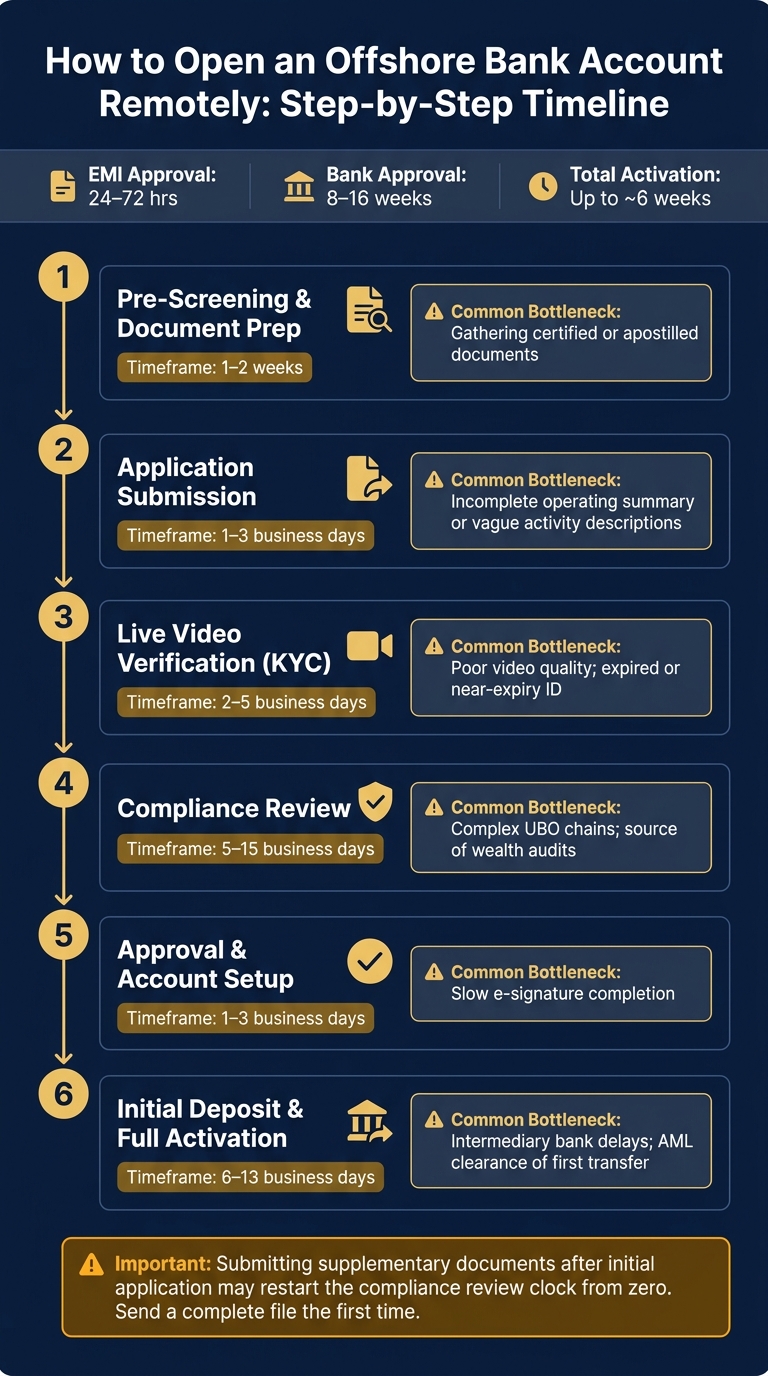
Remote onboarding starts with pre-screening, not form filling. So the first real step is figuring out whether the bank is likely to approve you in the first place.
Pre-screen the bank and your own profile before applying
Start by matching your profile to the bank’s approval criteria. Before an application is even processed, banks check applicants against sanctions lists, PEP registers, and adverse media. If your industry, residency, nationality, or ownership structure sets off a flag, the file often gets rejected early.
First, define what the account is meant to do. Is it for receiving client payments, holding reserves, or international investing? Then match the bank to where the company actually operates. In a remote process, this does the job that an in-person meeting with a banker used to do.
Before you submit anything formal, prepare a one-page operating summary that covers:
- your main client types
- payment corridors
- expected monthly volumes
This gives the compliance team the context it needs to make sense of your activity.
If you’re not sure how your profile will look on paper, use an AML risk score calculator or a professional pre-check to spot red flags like high-risk industries or residency issues before filing a formal application. If the fit looks weak, stop there.
Submit the application, certified documents, and video KYC
Once you’ve confirmed that the bank accepts remote non-resident applications and that your profile fits, the process usually follows a clear sequence. You fill out the online form, upload certified or notarized documents, describe your business activity in specific terms, and provide a detailed business profile or source of wealth narrative.
Vague answers can send your file straight into manual review or rejection. A generic label like "general business" tends to trigger extra scrutiny, so spell out your revenue sources, counterparties, and how funds will move through the account.
After document submission, the next step is live video verification. This takes the place of the in-person identity check. Expect live video verification with biometric checks. A stable internet connection matters here. Bad lighting or a blurry camera can slow the process down.
Enhanced due diligence starts automatically for certain profiles. If you work in a high-risk industry like crypto, if any beneficial owner has PEP status, or if the ownership structure has multiple layers, expect a longer review and more document requests. Speed matters at this stage. Replying to compliance follow-up questions within 24 to 48 hours can help keep the file moving. Slow replies may be read as disinterest or evasion. Once the file clears KYC, the bank moves to approval and activation.
Handle approval, initial deposit, and activation delays
Approval and activation are not the same thing. Conditional approval does not mean full access. In most cases, outbound wires stay restricted until the first deposit clears and compliance finishes its final review of that incoming transfer.
The table below shows the main stages, usual timeframes, and the bottlenecks that slow things down most often:
| Stage | Typical Timeframe | Common Bottleneck |
|---|---|---|
| Pre-screening and document prep | 1 to 2 weeks | Gathering certified or apostilled documents |
| Application submission | 1 to 3 business days | Incomplete operating summary or vague activity descriptions |
| Live video verification (KYC) | 2 to 5 business days | Poor video quality; expired or near-expiry ID |
| Compliance review | 5 to 15 business days | Complex UBO chains; source of wealth audits |
| Approval and account setup | 1 to 3 business days | Slow e-signature completion |
| Initial deposit and full activation | 6 to 13 business days | Intermediary bank delays; AML clearance of first transfer |
One detail catches a lot of people off guard: if you submit supplementary documents after the first application, the compliance review clock often restarts from zero. That’s why it makes sense to front-load everything and send a complete file the first time instead of trickling documents in later.
After activation, send a small test transfer first. Then make sure the account’s activity and documents stay aligned with the bank’s compliance profile. The application may be done, but the compliance review doesn’t just disappear.
Avoid rejections and keep your offshore account compliant after opening
The most common reasons remote offshore applications get rejected
Most remote offshore applications get turned down for the same reason: fixable compliance gaps.
In a remote process, small mistakes stand out fast. There’s no banker sitting across from you to smooth over a mismatch or fill in missing context. That’s why the smartest move is simple: spot each rejection risk before you apply, then fix it upfront.
A common issue is address mismatch. If your proof of address doesn’t line up exactly with the address on the application, the bank may send it to manual review or reject it outright. Your proof of address should be dated within the last 90 days and match the application address exactly.
Source-of-wealth files are another frequent problem. Banks often reject these when they don’t include tax returns, contracts, or financial statements. If you’re a U.S.-connected applicant, the path gets tighter. Bank options are fewer, and screening is stricter .
The good news? The weak spots are pretty predictable. Here’s how they usually show up, and what to do about them:
| Rejection Reason | Preventive Step |
|---|---|
| Inconsistent address | Utility bill under 90 days old, matching the application address exactly |
| Weak source of funds | 6 to 12 months of bank statements, tax returns, and specific contracts or invoices |
| Vague business activity | One-page summary with product description, client geographies, and website URL |
| Industry the bank won’t touch | Choose specialized crypto-friendly or high-risk institutions rather than general retail banks |
| Sanctions exposure | Screen all clients and suppliers against OFAC/UN/EU lists before the bank does |
| Poor document quality | High-resolution color scans as individual PDFs; no mobile photos with glare |
| Unrealistic transaction estimates | Base volume estimates on actual historical bank statements, not projections |
| Entity structure with no economic link to the banking jurisdiction | Ensure the incorporation jurisdiction has a clear economic link to the banking jurisdiction |
How a cleaner structure improves your approval odds
Documents matter, but they’re only part of the picture. The bank also wants to see whether your entity structure makes sense.
Compliance teams tend to approve structures they can understand fast. That means your business narrative should clearly explain what the company does, who it serves, which payment corridors it uses, and why the chosen jurisdiction fits that activity .
If your annual returns or tax filings have lapsed, that can lead to rejection or even closure later. And if the offshore company structure doesn’t match the business activity you’re actually running, that’s a fast way to get rejected at the start or shut down after opening.
Getting approved is only part one. What happens after the account opens matters just as much.
If your business activity, revenue sources, or transaction volume is about to change, tell the bank before it happens . Sudden large transfers with no context are one of the most common reasons accounts get frozen after opening. It helps to keep personal and business funds separate. It also helps to keep contracts, invoices, and tax returns in one folder so you can answer source-of-funds requests without scrambling .
Conclusion: The shortest path to a working remote offshore account
The process works when your prep lines up with what banks are checking for in the first place.
Start by choosing the right jurisdiction and the right type of institution based on your residency, business activity, and transaction needs. Then get your KYC documents in order and build a clear, documented source-of-funds story before you even open the application form. Be ready for video verification and follow-up questions, and make sure every detail is complete, consistent, and easy to explain.
For U.S.-connected applicants, this matters even more. A properly formed entity, a clear economic reason for the structure, and current filings give compliance teams what they need. The accounts that stay open are usually the ones set up to fit the bank’s risk rules from day one.
FAQs
Can I open an offshore account without a company?
Yes. You can open an offshore bank account without owning a company. Many banks and jurisdictions offer personal offshore accounts for non-residents, expats, and people who move between countries for work.
In most cases, personal accounts are easier to open than business accounts. The paperwork is usually more straightforward too. Banks will often ask for:
- A valid passport
- Proof of address
- Documents that show your source of funds
Some banks still want you to show up in person. That said, plenty now let you apply from abroad through video ID checks and online document submission.
What if my documents show different addresses?
Different addresses can create a logical inconsistency and set off a red flag during compliance review, which may increase the chance of rejection.
To keep verification smooth, make sure your documents show the same, current home address. If they don’t, be ready to provide clear, documented proof that explains the difference.
How do I choose between a bank and an EMI?
It comes down to a simple trade-off: stability vs. speed.
Traditional banks often give you more services and a stronger sense of long-term security. But there’s usually a catch. They can move more slowly, ask for higher minimum deposits, and sometimes still want you to show up in person.
EMIs, on the other hand, are usually much faster to open remotely. They often come with lower fees and stronger digital tools. That makes them a good fit for day-to-day use and multi-currency payments.
There is one thing to watch closely, though: EMIs do not hold deposits on their own balance sheets, and they can be more likely to freeze accounts without much warning.
