
There’s no legal dollar limit for a U.S. person to keep offshore. You can hold $20,000, $2 million, or more outside the U.S. if the money is lawful, your income is reported, and you file the forms the rules require.
What I’d focus on is simple:
- No fixed cap exists
- FBAR can apply once foreign accounts go over $10,000 total at any point in the year
- Form 8938 can apply at $50,000+ for many U.S.-based single filers, with higher limits for other filers
- Offshore companies and trusts can trigger extra IRS forms like Form 5471, Form 8858, and Forms 3520/3520-A
- Banks will ask where the money came from and who controls it
- The main risk is not the amount. It’s failing to report, file, or document the money the right way
Put another way: offshore asset protection is legal; hiding money is not.
Here’s the short version. If I keep money abroad in my own name, through a foreign company, or in a foreign trust, the amount itself usually isn’t the legal problem. The pressure point is the filing burden, tax treatment, and paper trail. That’s what decides whether an offshore setup stays on the right side of U.S. rules.
The Real Limits: U.S. Reporting Rules That Matter More Than Account Size
The practical limit isn’t a legal cap. It’s the reporting load that kicks in with FBAR and Form 8938. Those are the rules that set the real ceiling. Both are disclosure rules, which means filing them does not change what you owe. But skipping them can get expensive fast.
FBAR: The $10,000 Aggregate Trigger
FBAR applies when the combined maximum value of all foreign financial accounts goes over $10,000 at any point during the year. That threshold is aggregate, not per account. So if you have three accounts with $4,000 each at the same time, that adds up to $12,000 and triggers the filing rule.
The phrase "at any point in the year" catches a lot of people off guard. One deposit, or even a currency swing, can push your combined balance above $10,000 for just one day and still create a filing duty. FBAR is filed separately through FinCEN‘s BSA E-Filing System. It’s due April 15, with an automatic extension to Oct. 15.
Penalties can be brutal. For willful violations, the penalty is the greater of $100,000 or 50% of the account balance per violation. For non-willful violations, the Supreme Court’s February 2023 ruling in Bittner v. United States changed the picture. Those penalties are now capped at about $10,000 per annual report, not per account, which cut down the risk for people who missed one year with several accounts.
FATCA and Form 8938 Thresholds for U.S. Taxpayers
FBAR is only one part of the story. Form 8938 is filed with your annual individual tax return, and it covers a broader group of assets. That includes foreign bank and brokerage accounts, interests in foreign entities, foreign-issued life insurance or annuities with cash-surrender value, and foreign financial contracts. The filing thresholds depend on where you live and your filing status.
| Taxpayer Status | Living in the U.S. (Year-end / Highest during the year) | Living Abroad (Year-end / Highest during the year) |
|---|---|---|
| Single or Married Filing Separately | $50,000 / $75,000 | $200,000 / $300,000 |
| Married Filing Jointly | $100,000 / $150,000 | $400,000 / $600,000 |
Take a U.S. entrepreneur living in Chicago with $125,000 in a foreign brokerage account. That amount is above both the $50,000 year-end threshold and the $75,000 peak threshold for a single filer living in the U.S. So Form 8938 is required.
Failing to file Form 8938 starts with a $10,000 penalty. After IRS notice, that can climb by $10,000 every 30 days, up to $50,000. On top of that, a 40% accuracy penalty can apply to any tax understatement tied to undisclosed foreign assets.
Why Disclosure Burden Becomes the Practical Ceiling
As account balances grow, recordkeeping becomes the part that wears people down, and missing Form 8938 can also leave the statute of limitations open on the entire tax return. Both FBAR and Form 8938 ask for the maximum value reached during the year, not just the year-end balance. That’s a big deal.
It means you need to track the high-water mark for each account, convert those amounts into U.S. dollars using the U.S. Treasury’s year-end exchange rates, and keep records that can hold up if the IRS looks back years later. The money itself isn’t the hard part. The paper trail is.
Even when everything is filed the right way, banks and tax authorities still look at source of funds, ownership, and tax residency.
Compliance Risks That Can Make a Legal Offshore Plan Go Wrong
Even if you meet the filing thresholds, that doesn’t mean you’re in the clear. Banks and tax authorities still look at how the money was earned, who owns it, and where the taxpayer lives. Those are the three points where legal offshore plans most often break down.
Source of Funds, KYC, and AML Reviews by Banks
Offshore banks run detailed Know Your Customer (KYC) and Anti-Money Laundering (AML) checks before they accept large deposits. They want a paper trail that shows where the money came from and how it built up over time. That can include sale agreements, tax returns, closing statements, or inheritance records.
Current account statements usually aren’t enough. Banks often want records that trace the funds back to the original source. That’s why traceable wire or SWIFT transfers matter so much. Cash deposits or unclear transfers can set off red flags and lead to account freezes.
Once the bank clears the deposit, the focus often shifts to the legal structure behind it and whether that structure creates more reporting duties.
Beneficial Ownership, CFC, and Foreign Trust Exposure
Offshore companies and trusts do not erase U.S. reporting duties. The IRS still looks through the structure to find the real owner or beneficiary.
A foreign corporation becomes a Controlled Foreign Corporation (CFC) when U.S. persons own more than 50% of its total voting power or value. And individual U.S. shareholders who own 10% or more are generally subject to Subpart F and GILTI rules. That matters because a single missed Form 5471 can trigger a $10,000 penalty per year, per foreign corporation. In some cases, U.S. shareholders may owe tax on their share of foreign corporate income even when no cash is paid out.
Foreign trusts bring their own filing duties. Forms 3520 and 3520-A are part of the deal, and late or incomplete filings can lead to steep penalties. Shell entities with no real business activity, or nominee directors used to hide ownership, cross the line into concealment.
Even with clean paperwork, a structure can still fail if the owner remains subject to U.S. tax on global income.
Tax Residency and Worldwide Income Rules
U.S. citizens, green card holders, and substantial-presence taxpayers owe U.S. tax on worldwide income, no matter where the money sits. Green card holders stay U.S. tax residents until they formally give up that status by filing Form I-407.
Those rules shape which offshore setup makes sense for the amount you want to keep abroad.
sbb-itb-39d39a6
What Legal Offshore Setups Look Like in Practice
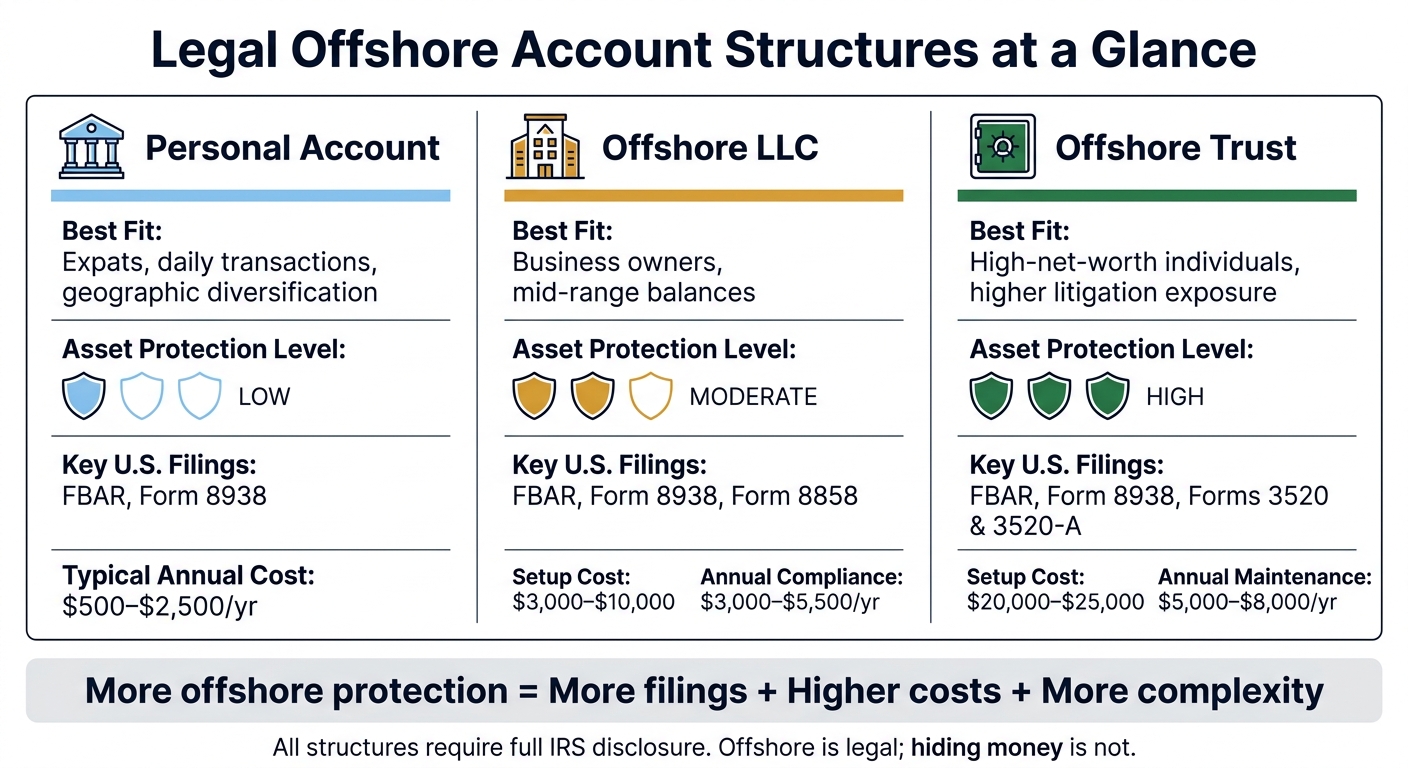
Once the money is legal and fully reported, the next step is picking a setup that fits your balance, your need for protection, and how much paperwork you’re willing to deal with.
Personal Foreign Bank and Brokerage Accounts
A personal foreign bank or brokerage account is the most direct compliant route. It tends to make sense when the reporting load is still easy to handle. Bank accounts are often a good match for expats who deal with more than one currency or for people who want to spread assets across countries. Brokerage accounts fit better for investors who want access to markets outside the U.S.
Opening an account usually means showing a passport, proof of address, and source-of-funds documents like tax returns, sale agreements, or inheritance papers.
The downside is simple: protection is limited. If the account is in your own name, a U.S. court can order you to bring the money back, and refusing can lead to contempt of court. And if you use an offshore brokerage account, foreign funds may trigger PFIC rules and Form 8621.
When a personal account starts to feel too exposed, or the balance gets large enough that holding it directly becomes messy, an entity may make more sense.
Offshore Entities and Holding Structures for Larger Balances
For balances in the mid-six figures, a standalone offshore LLC such as a Nevis LLC can be a practical next step. It offers charging-order protection, which means a creditor is generally limited to the LLC interest instead of reaching the assets inside the entity. On top of that, some offshore banks want an entity in place before they’ll open an account.
A Nevis LLC usually costs $3,000 to $10,000 to set up, plus $3,000 to $5,500 per year for compliance. The filing load also grows. A disregarded foreign LLC often brings Form 8858, while a foreign corporation with 10% or more U.S. ownership triggers Form 5471.
At that point, you’re trading more paperwork and cost for better insulation. For people with larger balances and more serious creditor risk, a trust may be the next move.
When Offshore Trusts or Foundations May Be Appropriate
For high-net-worth individuals with larger balances and real litigation exposure, a Cook Islands trust is a common choice. Here, a foreign trustee holds legal control, which can help support an impossibility defense if a U.S. court orders repatriation.
Setup costs usually run $20,000 to $25,000, with annual maintenance of $5,000 to $8,000. The annual reporting is also heavier, including Form 3520 and Form 3520-A.
The right setup depends on the size of the balance, how much control you want to keep, and how much filing work you’re prepared to take on.
| Setup | Best Fit | Asset Protection | Key U.S. Filings | Typical Cost |
|---|---|---|---|---|
| Personal Account | Expats, daily transactions, geographic diversification | Low | FBAR, Form 8938 | $500–$2,500/yr |
| Offshore LLC (e.g., Nevis) | Business owners, mid-range balances | Moderate | FBAR, Form 8938, Form 8858 | $3,000–$10,000 setup; $3,000–$5,500 annual compliance |
| Offshore Trust (e.g., Cook Islands) | High-net-worth, higher litigation exposure | High | FBAR, Form 8938, Forms 3520/3520-A | $20,000–$25,000 setup; $5,000–$8,000 annual maintenance |
More offshore protection usually comes with more filings, higher cost, and more moving parts.
Choosing the Right Structure and Staying Compliant
A Simple Framework for Deciding How Much You Can Keep Offshore
After FBAR, FATCA, and bank-compliance rules, the main call is about structure, not a dollar amount. The core issue is simple: can you keep the assets offshore and report them the right way?
A practical way to decide is to run through four tests:
- Is the money from a lawful source?
- Can you show proof of ownership and transfers?
- Can you handle the annual reporting burden?
- Does the setup create any added tax exposure?
If even one of those answers is missing, fix that first before picking a jurisdiction.
Once the funds are lawful and reportable, the focus shifts to control, asset protection, and filing load. Offshore banking tends to make sense for people with actual cross-border activity, meaningful balances, or creditor risk. A plain account can work in lower-risk cases. An entity may fit higher balances, or a private family office for comprehensive management. A trust can make sense when creditor exposure is serious and you’re willing to give up direct legal control in exchange for stronger protection.
Use an attorney for the structure and a CPA for the filings.
Then choose the simplest setup that fits your risk.
Key Takeaways
There is no fixed legal maximum for how much you can hold offshore. The limits come from disclosure rules, tax treatment, AML/KYC review, and the actual substance of ownership and control. For example, failure to file Form 8938 keeps the statute of limitations open on your entire tax return, not just the foreign assets. That risk has nothing to do with the account balance.
"The protection comes from legal architecture – the jurisdictional separation between the creditor and the assets – not from concealment." – Gideon Alper, Attorney
Legal offshore planning depends on transparency and structure. More complex setups can bring stronger protection, but they also come with more moving parts, higher costs, and heavier annual filings.
FAQs
Do offshore accounts lower my U.S. taxes?
No. Offshore accounts do not lower your U.S. taxes.
The United States taxes citizens and residents on worldwide income, no matter where the account is held.
So if you move money offshore, you don’t create a tax shelter or cut your tax bill. You still have to report all income and pay the same tax you would owe if those assets were kept in the U.S.
What documents do banks usually ask for?
Banks in well-regulated places usually ask for a certified copy of your passport and proof of your home address.
They also tend to ask for source-of-funds documents that show how the money was earned. That can include things like business sale records or past tax returns. In some cases, they may also want a professional reference from an attorney or accountant.
When should I use an offshore LLC or trust?
Consider an offshore LLC or trust when you need more asset protection than a simple account can offer, or when a foreign financial institution asks for an entity before it will let you open an account.
Unlike accounts held in your personal name, these setups can limit your direct legal control over the assets and put a stronger wall between those assets and potential claims. That said, they must be used for lawful purposes, reported to the IRS the right way, and they do not remove U.S. tax on worldwide income.
