
Short answer: for most U.S. users, probably not. A gold-backed debit card lets me spend from a gold balance, but each purchase may trigger fees, tax reporting, and counterparty risk that a normal debit card does not.
Here’s the simple version:
- I buy gold and hold it with the card provider.
- When I spend, the provider sells a small piece of my gold for U.S. dollars.
- That means each swipe can be a taxable sale.
- Costs may include buy/sell spreads, monthly fees, ATM fees, and storage fees.
- If I want gold for long-term holding, bullion is often simpler.
- If I want easy daily spending, a normal debit card is often better.
This setup may fit me if I already hold gold, travel often, and want card access to that balance. But if I want simple banking, low costs, and easy taxes, I’d usually skip it.
Quick Comparison
| Option | What I hold | Easy to spend? | Tax when I spend? | Main downside |
|---|---|---|---|---|
| Gold-backed debit card | Gold | Yes | Yes | Fees and tax work |
| Normal debit card | U.S. dollars | Yes | No | Inflation risk |
| Multi-currency account | Fiat currencies | Yes | No | Still fiat exposure |
| Physical gold | Coins or bars | No | Only when sold | Hard to use day to day |
So if I’m thinking about one of these cards, I’d treat it as a niche spending tool, not as my main account or my full gold plan.
sbb-itb-39d39a6
What a gold-backed debit card is and how it works
A gold-backed debit card lets you spend a gold balance through the Visa or Mastercard network. Your gold sits in vault storage, and when you make a purchase, the provider sells only enough gold to cover the charge in U.S. dollars at the point of sale.
That sounds simple. The catch is in the plumbing: custody, settlement speed, fees, and taxes.
The big thing to look at is custody and legal title. In plain English, do you own allocated gold in storage, or do you just hold a claim against the company? That difference matters for asset protection. Providers such as Glint and Kinesis use an allocated model. That means you hold title to specific vaulted gold instead of holding an unsecured claim on the provider. As a result, legal title, bankruptcy exposure, and jurisdictional risk can look very different.
Goldmoney works more like a metals storage platform than a card built around spending first. The payment flow can feel similar from the user side, but the custody setup is not the same.
How a purchase is settled behind the scenes
The whole process takes seconds, but a few steps happen in the background.
When you fund the account, your dollars buy gold at the current spot price. That gold goes into vault storage and shows up in your account as a weight, usually in grams. When you use the card at a store, the system checks the live gold price, figures out how much gold is needed for the purchase, sells that amount, and settles the payment with the merchant in dollars through Visa or Mastercard. Your gold balance then falls by the matching amount.
The same basic flow applies to online payments and ATM withdrawals. At an ATM, the provider sells enough gold to cover the cash withdrawal and any fees tied to it.
How these cards differ from ordinary debit cards and gold rewards cards
| Feature | Gold-Backed Debit Card | Ordinary Debit Card | Gold Rewards Card |
|---|---|---|---|
| Underlying balance | Physical gold (allocated) | Fiat currency (USD) | Fiat currency (USD) |
| Spending mechanism | Gold liquidated at point of sale | Dollars deducted directly | Dollars deducted; gold earned as a reward |
| Inflation protection | Tied to gold’s market value | Vulnerable to dollar inflation | Only the reward portion is in gold |
A standard debit card pulls dollars straight from your account. A gold rewards card also spends dollars, but gives you gold back as a rebate. A gold-backed card is different: the gold itself funds the purchase.
That one difference shapes almost everything else, from fees and liquidity to custody and tax treatment.
The real costs and trade-offs: fees, liquidity, custody, redemption, and taxes
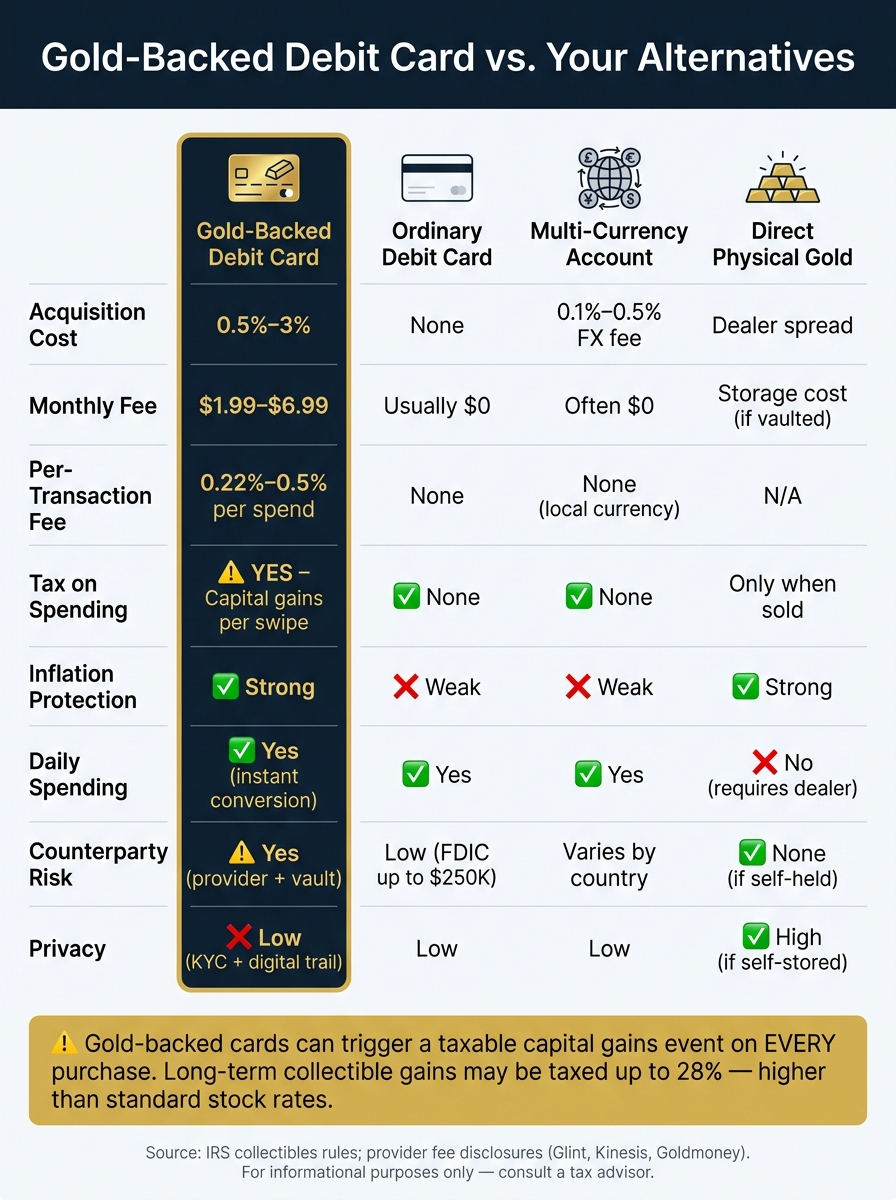
The real test is not whether you can spend gold, but whether the friction makes it worth it.
Fees and liquidity in everyday use
Inflation protection is the pitch. Fees are the trade-off.
In day-to-day use, gold-backed cards often come with more cost than people expect. You may run into spreads, monthly charges, transaction fees, ATM fees, and even extra weekend surcharges. That full cost stack looks very different from a plain debit card or a multi-currency account.
| Cost Category | Gold-Backed Debit Card | Ordinary Debit Card | Multi-Currency Account |
|---|---|---|---|
| Acquisition cost | 0.5%–3% | None | 0.1%–0.5% FX fee |
| Monthly fee | $1.99–$6.99 | Usually $0 | Often $0 |
| Per-transaction fee | 0.22%–0.5% per spend | None | None (if in local currency) |
| ATM withdrawal | $1.50+ flat fee | Varies | Varies |
| Annual storage | 0%–0.4% | None | None |
That means the sales pitch can sound simple, but the math usually isn’t. A card tied to gold may help you hold metal, yet each purchase can chip away at that idea through small charges that add up.
Cost matters, but custody is what tells you whether you control the gold at all.
Storage, custody, and redemption rights
Custody and legal title matter more than the marketing makes it seem.
The better providers use an allocated model. In plain English, that means you hold legal title to specific physical metal, not just a general claim on the company. That’s a big difference. If a firm can’t show current audit reports from an independent third party, that’s a red flag.
Jurisdiction matters too. Where the metal sits, which laws govern it, and who holds it on your behalf can shape what rights you have if something goes wrong.
Some platforms do allow physical redemption. On paper, that sounds great. In practice, it’s often too expensive and awkward for small balances. Handling charges, insurance fees per bar, and minimum redemption amounts can make small withdrawals a nonstarter for most U.S. users.
U.S. tax treatment and reporting risk
Even if the storage is allocated, each swipe can still create a taxable sale.
The IRS treats gold as a collectible asset. So when your card settles a purchase, the system sells a small piece of your gold. That sale counts as a taxable disposition. If your gold went up in value between the day you bought it and the day you spent it, you may owe capital gains tax on that difference.
There’s another catch: long-term gains on collectibles can be taxed at a maximum rate of 28%, which is higher than the standard long-term rate on stocks. So a tool that feels as easy as a debit card can produce a string of tax events in the background. Each one may need a U.S. dollar cost-basis calculation.
Foreign vaults add another layer. If the value of your foreign-held assets passes certain limits, you may also face FBAR or FATCA reporting duties. Some states exempt gold transactions from state tax, but federal rules still apply. Using one on a regular basis makes a lot more sense after getting tax advice on collectibles and foreign reporting.
Gold-backed debit cards versus other ways to hold and spend value
If fees, custody rules, and tax issues make a gold-backed card feel like a lot to deal with, it helps to compare it with simpler options. The right pick depends on what you care about most: easy spending, inflation protection, privacy, or long-term asset storage.
Ordinary debit cards and multi-currency accounts
A standard U.S. bank debit card is still the easiest option for day-to-day use. Your money sits in dollars, payments go through right away, and bank deposits are FDIC-insured up to $250,000. The downside is simple: cash loses buying power when inflation sticks around.
Multi-currency accounts fix a different issue. They help travelers and expats hold and spend in euros, pounds, or other local currencies without dealing with constant foreign exchange friction. But they don’t solve the inflation problem either. If fiat money weakens, those balances can lose buying power too.
A gold-backed card fits a narrower role. It isn’t meant to replace your checking account. It’s more like a spending tool for one slice of your wealth, where part of your usable balance sits in an asset that has, over time, held buying power better than cash.
| Feature | Ordinary Debit Card | Multi-Currency Account | Gold-Backed Debit Card |
|---|---|---|---|
| Primary asset | USD | Multiple fiat currencies | Allocated physical gold |
| Inflation protection | Weak | Weak | Strong |
| Daily liquidity | Instant | Instant | High, because gold converts at purchase |
| Deposit protection | FDIC coverage on deposits | Varies by country | Vault custody and insurance vary by provider |
| Foreign spending | FX fees apply | Designed for local fiat spending | Varies by provider |
| Tax on spending | None | None | Capital gains on each transaction |
Direct physical gold ownership
If you don’t need to spend your gold, direct ownership is simpler. When you own coins or bars outright, the metal is yours. You control it, and no outside firm sits between you and the asset. If you store it at home or in a private safe deposit box, it stays off digital ledgers completely. For privacy, that’s about as far as you can go.
The catch is liquidity. You can’t buy groceries with a gold coin. To turn physical gold into cash, you need to find a dealer, agree on a price, and wait for settlement. A gold-backed card tries to fix that problem by making gold usable for small daily purchases.
But that convenience comes with baggage. You take on custody risk, leave a digital transaction trail, go through KYC checks, and trigger a tax event every time you spend. So the trade-off is pretty clear. If you care more about direct control and privacy, physical gold has the edge. If you want spending access, the card is easier to use.
| Feature | Gold-Backed Debit Card | Direct Physical Gold |
|---|---|---|
| Liquidity | High (instant at point of sale) | Low (requires dealer sale) |
| Privacy | Low (KYC, digital transaction trail) | High (if self-stored) |
| Counterparty risk | Yes (provider and vault operator) | None (if self-held) |
| Daily spending | Yes | No |
| Inflation hedge | Strong | Strong |
| Tax on spending | Capital gains on sale | Capital gains only when sold |
Should you get one? A decision framework for globally minded U.S. investors
Who it fits and who should avoid it
If those trade-offs still line up with your goals, this simple filter can help.
A gold-backed debit card fits a pretty narrow job: letting you spend gold without having to sell it by hand first. It tends to make the most sense for expats and digital nomads who already keep gold as part of their wealth plan and want an easy way to use some of it overseas. Glint and Kinesis are geared toward international spending and convert gold at the point of sale. That setup can work well if you already want part of your spending balance held in gold, or if you prefer physical gold with card access.
Still, this kind of card starts to fall apart when fees, taxes, or low usage eat up the upside.
Avoid it if:
- You’re a low-volume spender; monthly fees between $1.99 and $6.99 can outweigh the benefit.
- You want simple tax reporting; each swipe can trigger a taxable sale.
- Your goal is the lowest-cost way to build a gold position; buy bullion instead of spendable gold.
Key points to review before you decide
The three checks that matter most are ownership, redemption, and tax reporting.
Before you sign up, make sure the gold is fully allocated and legally titled to you, not just a claim on the provider’s balance sheet. Also check whether you can redeem for physical metal or if you’re limited to cash settlement. And don’t skip the basics: many providers exclude U.S. residents, so confirm eligibility first.
A gold-backed debit card can make gold easier to spend. But that convenience comes with provider risk, fees, and added U.S. tax complexity. Think of it as a spending tool, not the main part of an asset-protection plan.
FAQs
How is my gold legally protected?
With a gold-backed debit card, you usually keep direct legal ownership of the physical gold linked to your account. In most cases, that gold sits in secure vaults, often outside the banking system, and the card provider or a third-party custodian handles storage.
That setup can matter. If the provider runs into trouble, your gold may be treated as your property, not just another company asset on a balance sheet.
Protection often includes:
- Regular independent audits
- Insurance against theft or loss
That said, the fine print matters. Coverage can differ from one issuer to the next, so check your provider’s terms for the exact rules around storage, insurance, and audits.
How hard is tax reporting for each purchase?
Tax reporting can get messy fast. In the United States, gold is a taxable asset, and spending it is usually treated like a sale.
That means each debit card purchase sells off a bit of your gold. If the price of gold went up after you bought it, that swipe may trigger a capital gains tax event.
So even if some states make things a little easier on the tax side, federal rules still apply. You may need to track your cost basis, plus any gain or loss, for every single transaction.
When does a gold-backed debit card make sense?
A gold-backed debit card can make a lot of sense if you want to keep part of your money in a physical asset that has long been used as a hedge against inflation, while still paying for day-to-day expenses.
It tends to fit people who worry about the long-term buying power of fiat currencies. Instead of leaving all their liquid funds in bank deposits, they’d rather hold some wealth in precious metals and still have easy access to spend it.
That’s the big appeal here: gold has always had one stubborn drawback in daily life. It can hold value, but it’s not easy to use at the grocery store, gas station, or online checkout. A gold-backed debit card helps bridge that gap by making gold easier to use for ordinary purchases.
