
Yes, I can still open a Panama offshore bank account in 2026 – but only if my file is clean, my source of funds is clear, and I pick a bank that still accepts my profile.
Here’s the short version:
- Non-residents can apply, but approval is case by case
- Personal accounts often need $5,000 to $25,000 for non-residents
- Corporate accounts often start around $10,000 and can go much higher
- Resident applicants may open with as little as $500 to $5,000
- Processing time is often 2 to 16 weeks for non-residents
- U.S. persons face extra FATCA checks, plus forms like W-9, FBAR, and sometimes Form 8938
- Banks often want an in-person interview
- A weak file, mixed details, or unexplained wires can lead to rejection or closure
In other words: Panama is still an option, but it’s no longer a casual setup. It remains a popular choice for offshore asset protection. I need matching documents, a clean banking history, a clear reason for the account, and activity that fits the profile I gave the bank.
Quick comparison
| Item | Personal account | Corporate account |
|---|---|---|
| Best for | Expats, retirees, remote workers, investors | Companies with Panama or cross-border business use |
| Usual deposit | $5,000–$25,000 for non-residents | $10,000–$100,000+ |
| Review focus | Identity, income, source of funds | Ownership, business activity, account use |
| Timeline | 2–16 weeks for non-residents | 4–16 weeks in many cases |
| Main risk | Weak proof of income or unclear money trail | No business substance or layered ownership |
My takeaway: if I want the best shot, I should choose the bank first, prep the paperwork before applying, and make sure every part of the file tells the same story. For high-net-worth individuals, this often involves structuring offshore trusts to provide an additional layer of security and clarity for the bank’s compliance team.
sbb-itb-39d39a6
Who can open a Panama offshore bank account in 2026
Non-resident individuals and entities can apply for a Panama offshore bank account in 2026. But approval is never automatic. Banks decide case by case, and the outcome usually comes down to your risk profile, source of funds, intended use of the account, and how strong your documents are. Applicants from restricted jurisdictions are generally not eligible.
One thing trips people up all the time: not every Panamanian bank wants non-resident foreign clients. In practice, only a small group of banks works with them on a regular basis. So the bank you choose can shape the whole process. After that, the main call is simple: do you need a personal account or a corporate one?
Non-residents, expats, and foreign entrepreneurs
Non-residents, expats, remote entrepreneurs, and foreign investors can all apply. What banks tend to care about most is whether you can show some kind of Panama connection. That might be residency, a Panamanian corporation, real estate, or active business activity in Panama.
That local link can make a big difference. It tends to make the file easier for compliance teams to understand, and it often helps smooth out the process. Still, it isn’t required by every bank in every case. Residency, though, usually helps approval odds and cuts some of the back-and-forth.
U.S. citizens can apply too, but their files usually get more attention because of FATCA. That often means extra checks and IRS paperwork, such as Form W-9. Larger banks are often in a better position to deal with that compliance work. So yes, U.S. applicants are possible, but their cases are often more review-heavy than most.
Personal accounts vs. corporate accounts
The right account type depends on how you plan to use it. Personal accounts usually fit retirees, digital nomads, expats, and individual investors. Corporate accounts make more sense when you’re banking through a Panamanian S.A. or SRL, or through a foreign company with business activity that needs an account in Panama.
The part below tends to matter most during review:
| Feature | Personal Account | Corporate Account |
|---|---|---|
| Best fit | Retirees, expats, digital nomads, individual investors | Panamanian or foreign companies with Panama business activity |
| Primary focus | Individual identity and income | Beneficial ownership and business operations |
| Due diligence level | Standard KYC/AML | Enhanced due diligence on all signatories |
A corporate account is usually far easier to open when the company has a clear reason to bank in Panama. If the entity has no active business, no solid paper trail, and no clear source of funds, a reputable Panamanian bank is unlikely to approve it.
Documents Panama banks typically require
Once you know if you need a personal or corporate account, the paperwork becomes the main hurdle. In many cases, non-resident applications get delayed or turned down because the file is incomplete or inconsistent. Banks don’t all ask for the exact same items, but most want recent copies. Depending on where you live and how you apply, they may also ask for notarization, apostilles, or certified Spanish translations.
Core documents for personal applications
Most personal applications ask for:
- A valid passport
- A second government-issued ID
- Proof of address dated within the last 3 months
- One or two bank reference letters from your current banks
You’ll also usually need six months of bank statements, proof of income, and a short explanation of your source of funds.
Additional documents for corporate accounts
Corporate files have a higher bar. Banks want to see who owns the company, who controls it, and whether it has actual business activity.
That means corporate applications usually include the Public Deed of Incorporation, a recent Certificate of Good Standing from the Public Registry if the company is more than one year old, a register of shareholders and directors, share certificates, and a board resolution authorizing the account opening.
Banks also require ID documents for each Ultimate Beneficial Owner (UBO) who meets the bank’s ownership threshold, which is often 10% to 25%. On top of that, you’ll need to show real business substance from the start. That can include a business plan, financial statements or projections, and operating records. Banks also ask for a transactional profile that lays out expected monthly volume, destination countries, and payment channels.
How to prepare documents to avoid rejection
Details need to match EXACTLY across the file. Names, addresses, and passport numbers should appear the same on every document. A small mismatch – say, between a utility bill and a bank reference letter – can be enough to stop the process.
Bank reference letters should be printed on bank letterhead, signed in ink, dated within the last 30 to 60 days, and confirm that the relationship has existed for at least two years and is in good standing.
Foreign documents often need to be apostilled or notarized, then translated into Spanish by a sworn translator in Panama before you submit them. It’s smart to bring more paperwork than you expect to need. If one item is missing, the review can slow down fast, or you may have to begin again.
Once the file is complete, the next hurdle is funding the account.
Minimum deposit and account funding expectations
Once your file gets through due diligence, money becomes the next sticking point. Minimum deposits change based on the bank, your residency status, the account type, and how the bank rates your risk. In plain English: banks don’t look at the deposit as just a setup step. They also use it to judge the account itself.
What non-residents should expect for initial deposits
Residency status has the biggest effect on how much a bank will want upfront. If you’re a resident, you can often open a personal account with $500 to $5,000. If you’re a non-resident, the bar is much higher. For personal accounts, banks often start at $5,000 and go up to $25,000.
That said, banks usually split funding into three separate pieces:
- Opening deposit: the amount needed to switch the account on
- Minimum balance: the amount you need to keep in the account to avoid fees
- Initial funding deadline: how long you have to send the money after approval
Most banks give you 2 to 3 weeks to fund the account once it’s approved. Monthly maintenance fees for personal accounts often run from $5 to $25, though many banks waive them if you keep $2,000 to $5,000 in the account on a steady basis.
There’s one detail that can change the math quite a bit. If you submit proof of residency, deposit demands can drop to as little as $500 to $1,000 once an immigration certification letter is in place.
Personal vs. corporate accounts: funding comparison
Corporate accounts are a different animal. For non-resident companies without local economic substance, opening deposits often land between $10,000 and $100,000 or more. That higher number reflects the extra compliance work banks do when they review the beneficial ownership chain.
Use the table below to compare personal and corporate funding requirements.
| Feature | Personal Account | Corporate Account |
|---|---|---|
| Typical Opening Deposit | $500–$5,000 (Resident) / $5,000–$25,000 (Non-Resident) | $10,000–$100,000+ |
| Compliance Intensity | Moderate; focuses on individual income and source of wealth | High; requires UBO documentation, contracts, and invoices |
| Monthly Maintenance | $0–$25 (often waived with balance) | $20–$40 |
| Expected Transaction Activity | Low to moderate (savings, personal expenses) | High (commercial trade, payroll, B2B transfers) |
| Approval Timeline | 1–4 weeks (Resident) / 2–16 weeks (Non-Resident) | 4–16 weeks; often requires an in-person visit |
| Applicant Fit | Expats, retirees, digital nomads | International businesses, holding companies |
Note: exact figures vary by institution. The ranges above reflect general market conditions as of 2026.
Initial funding usually comes in by international wire in U.S. dollars, which is the main currency used across Panama’s banking system. If the money is coming from a property sale, inheritance, or another non-routine source, it helps to prepare a short written explanation before sending the wire. Banks often place holds on transfers that show up without a clear backstory, and that’s a common source of delays.
With funding expectations clear, the next step is choosing a bank that fits your profile. For a deeper look at global options, you can consult our offshore banking report.
Step-by-step process to open a Panama offshore bank account
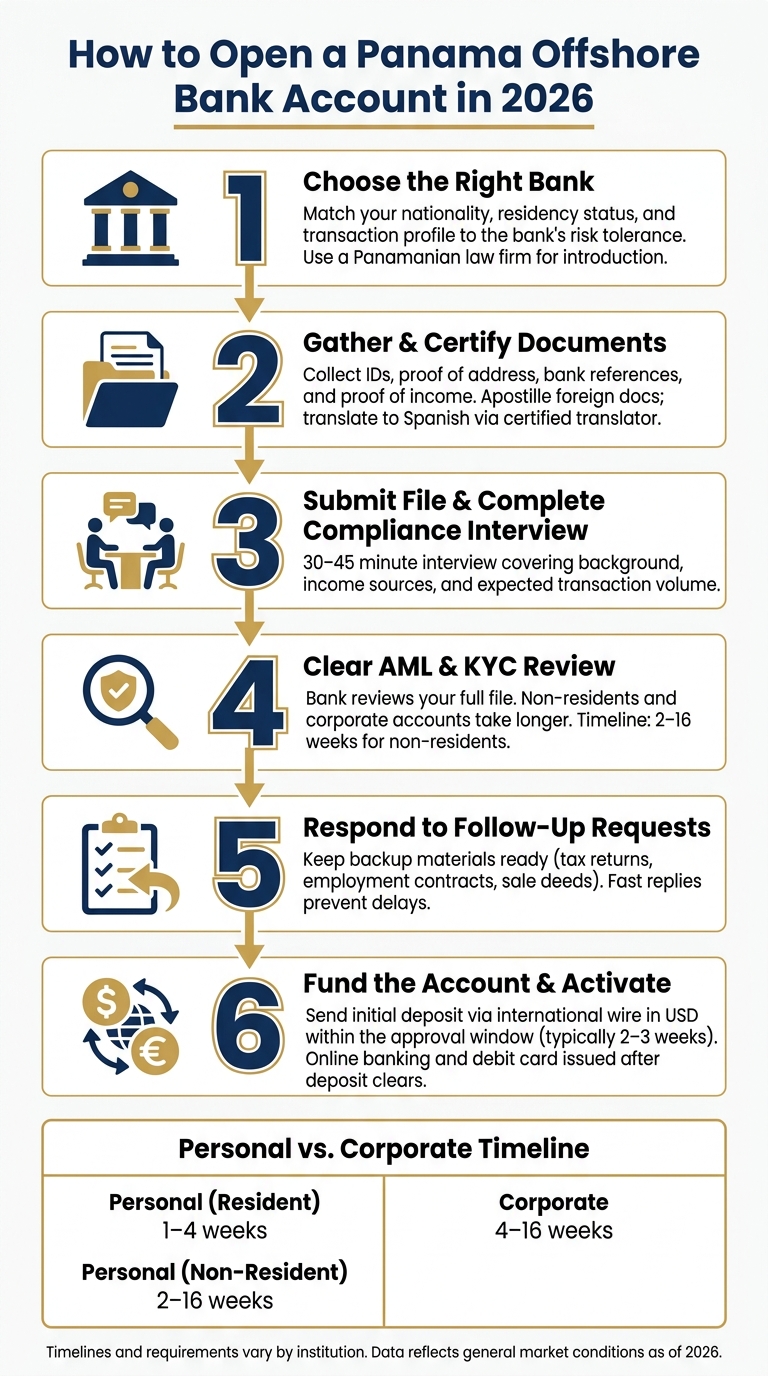
Only a small group of Panamanian banks regularly work with non-resident clients, so your bank choice has a big effect on your approval odds. Once you pick a bank that fits your case, the process turns into a matter of documents, compliance checks, and funding.
Step 1: choose the right bank and check your profile fit
Choosing a bank isn’t just picking a well-known name. Every bank has its own risk tolerance, and your nationality, tax residency, and expected transaction pattern all help shape whether the bank will take your application seriously.
Some banks are more open to U.S. persons. These clients must also navigate specific FATCA requirements for asset protection and reporting. Others lean toward local residents or businesses with a clear Panama link. Before you file anything formal, it’s smart to have a Panamanian law firm review your fit. In plain English, that means checking whether your nationality, line of work, and expected transaction volume line up with the bank’s current internal standards. Banks often give more attention to files introduced by recognized law firms because it shows that basic due diligence has already been handled. That kind of introduction can make the review process smoother.
Once the bank is chosen, your file needs to match that bank’s compliance standard exactly.
Step 2: submit documents, complete due diligence, and fund the account
After you’ve confirmed that a bank is a realistic fit, the process moves through six clear stages.
1. Gather and certify your documents
Collect the required IDs, proof of address, bank references, and proof of income before you submit anything. If you’re applying remotely, foreign documents usually need an apostille. Any foreign-language documents must be translated into Spanish by a certified translator in Panama.
2. Submit the file and complete the compliance interview
The compliance interview is standard. It usually lasts 30 to 45 minutes and covers your background, income sources, and expected transaction volume. If your answers about where your money comes from are vague or don’t line up, the application can stall fast.
3. Clear AML and KYC review
Next comes the bank’s AML/KYC review. This stage often takes longer for non-residents and for company files with cross-border ownership chains.
4. Respond to any follow-up requests immediately
Banks often ask for more documents while the file is under review. Keep a folder ready with backup materials such as tax returns, employment contracts, or sale deeds if your wealth came from a property sale or inheritance. Fast replies here help avoid most delays.
5. Send the initial deposit within the approval window
Once the bank approves the account, send the initial deposit within the stated approval window so the account can be activated.
6. Complete final activation
After the deposit clears, the bank sets up online banking access and issues debit cards, usually within 2 to 3 weeks.
Personal vs. corporate application paths: side-by-side comparison
The main difference isn’t just the paperwork. It’s the level of compliance scrutiny each account type brings.
| Feature | Personal Application | Corporate Application |
|---|---|---|
| Core Documents | Passport, second ID, bank reference, proof of income and address | Articles of incorporation, certificate of good standing, share register |
| Beneficial Ownership Review | Not applicable | Full KYC for all UBOs with more than 10–25% stake |
| Review Time | 1–4 weeks (resident); 2–16 weeks (non-resident) | 4–16 weeks, highly dependent on structure |
| Common Obstacles | Unclear source of wealth; PEP status | No economic substance; complex ownership layers |
| Post-Approval Steps | Initial deposit; debit card issuance within 2–3 weeks | Funding; signatory authorization; online banking setup |
Note: timelines and requirements vary by institution. Figures reflect general market conditions as of 2026.
After activation, ongoing reporting and account-maintenance rules become the next risk.
Compliance, tax reporting, and account maintenance risks
Getting approved is just the first hurdle. Keeping the account open means staying in line with bank rules and keeping your documents up to date. Once the account is funded, the bank’s attention usually shifts to ongoing compliance.
AML, KYC, FATCA, and CRS: what account holders must know
Panama follows a Model 1 Intergovernmental Agreement (IGA) for FATCA. That means Panamanian banks identify U.S. persons, including citizens, green card holders, and U.S. tax residents, and report account data to Panama’s tax authority, the DGI, which then sends it to the IRS. U.S. persons are generally expected to complete IRS Form W-9 and sign reporting waivers.
Your own U.S. filing duties are separate from what the bank reports. If your total foreign account balances go over $10,000 at any point during the year, you generally must file FinCEN Form 114 (FBAR). IRS Form 8938 may also apply if you meet the asset thresholds.
For non-U.S. residents, Panamanian banks also use the OECD Common Reporting Standard (CRS). Under CRS, banks share account balance and income data with the tax authority in the account holder’s country of residence. On top of that, Panama’s AML and KYC rules allow banks to ask for updated proof of address, tax forms, or recent financial statements from time to time, especially if account activity changes.
What causes account rejection or closure
The same reporting rules that help keep an account open also shape how a bank reacts when something looks off.
The biggest risk after approval is account activity that no longer matches the transaction profile you originally submitted. If there are large shifts in volume, counterparties, or countries involved, the bank may flag the account or freeze activity.
Other common reasons for closure include:
- Incoming wires that can’t be explained
- Paperwork that doesn’t match or leaves gaps
- Transactions tied to sanctioned or high-risk jurisdictions
- Inactive accounts
- Slow or missing replies to KYC update requests
Conclusion: the most workable path to a Panama bank account in 2026
Opening a Panama offshore bank account in 2026 is possible, but it isn’t simple. Approval still comes down to the same three things: source of funds, bank fit, and compliance. In plain English, banks want a clear story, current documents, and account activity that makes sense.
Minimum deposits vary by bank and applicant profile. Non-resident personal accounts often start at $5,000, while corporate accounts commonly require $10,000 or more. Corporate applications also tend to need more paperwork and usually take longer to process. After approval, staying in line with the bank’s KYC requests and handling your U.S. tax reporting on time is what keeps the account in good standing.
FAQs
Do I need Panama residency to open an account?
You don’t strictly need Panama residency to open a bank account, but it’s strongly recommended.
Many banks do accept non-residents. That said, approval is usually up to the bank, and the process tends to involve stricter due diligence and a higher minimum deposit.
Some banks require residency. Others may accept non-residents who can show a clear tie to Panama, such as:
- Property ownership
- Business interests
A local attorney can help you handle the process and sort out which banks are more open to non-resident applicants.
Can I open the account remotely?
Yes. If you’re a non-resident, you may be able to open a Panama bank account remotely. But not every bank offers that option.
Some banks still ask for an in-person interview. Others handle the process through video calls and ask for apostilled or notarized documents instead. In most cases, you’ll need a formal application, proof of source of wealth, and a higher minimum deposit – often $10,000 to $250,000.
What documents cause the most delays?
The biggest delays and rejections usually come from incomplete documentation and an unclear source of funds or account purpose. Banks apply strict due diligence, so even one missing document can slow the process down or send it back to square one.
Common problems include outdated bank references, incorrect apostille or notarization for remote applications, weak transaction profiles, and unclear Panama ties or corporate business documents.
