
Yes – Americans can still open offshore accounts after FATCA. But in 2026, the list is shorter, the paperwork is heavier, and many banks will only say yes if you have the right profile.
Here’s the short answer:
- Switzerland still works, mostly for private banking with high minimums
- Singapore still works, mostly through large international banks
- Panama is one of the better picks for U.S.-dollar banking
- The UAE can work well if you have residency and an active company
- Some Caribbean banks still accept Americans, but options vary a lot by island
- Puerto Rico is often the easiest route if you want cross-border banking under U.S. rules
The big shift is simple: FATCA didn’t end offshore banking for Americans – it made banks screen U.S. clients much harder. That means you should expect Form W-9, proof of address, source-of-funds records, and, in many cases, higher opening deposits.
What I’d focus on is fit:
- For wealth parking and currency spread, people often look at Switzerland or Singapore
- For business use, Panama and the UAE usually make more sense
- For lower friction, Puerto Rico is often the easiest place to start
- For small personal accounts, many foreign banks are now a poor fit
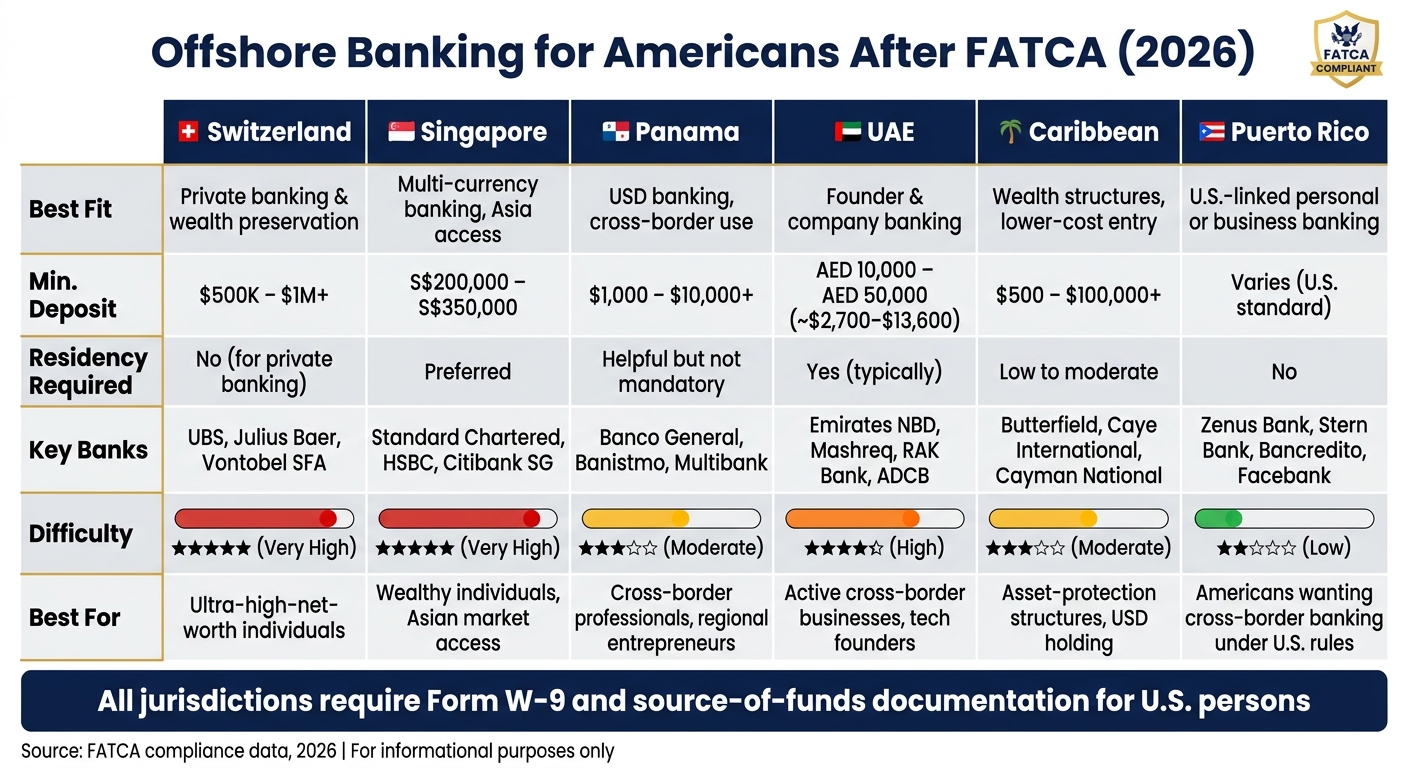
Quick Comparison
| Jurisdiction | Best Fit | Typical Barrier | Main Catch |
|---|---|---|---|
| Switzerland | Private banking | $500,000 to $1 million+ | High fees and tax filing load |
| Singapore | Multi-currency banking, Asia access | S$200,000 to S$350,000 | Strict due diligence |
| Panama | Dollar banking, cross-border use | $1,000 to $10,000+ | Heavy document checks |
| UAE | Founder and company banking | AED 10,000 to AED 50,000 | Residency usually needed |
| Caribbean | Wealth structures or lower-cost entry | $500 to $100,000+ | Fewer banks take U.S. clients |
| Puerto Rico | U.S.-linked personal or business banking | Varies | No privacy angle for U.S. taxpayers |
So if you’re asking, “Which offshore banks still accept Americans?” the answer is: mostly larger, FATCA-ready banks in places that already know how to handle U.S. reporting.
Below, I’d break down which places are still open, who they fit best, and where Americans are most likely to get turned down.
sbb-itb-39d39a6
1. Switzerland
For Americans, Switzerland usually comes down to two practical options: private banking or a retail account as a resident.
Nonresident Americans tend to hit a wall with Swiss retail banks. The reason is simple: FATCA compliance makes small U.S. accounts hard to justify from the bank’s side. Cantonal and regional banks like ZKB and Raiffeisen rarely take nonresident Americans at all.
Switzerland still works for U.S. clients, but mostly through private banks and U.S.-compliant advisory arms. The catch is the entry point can be steep.
- Vontobel Swiss Financial Advisers (SFA) requires at least CHF 750,000
- UBS and Julius Baer often start around CHF 500,000 to $1 million for nonresidents
- Pictet North America Advisors is more selective, with minimums in the CHF 3 million to CHF 5 million range
These firms serve U.S. clients through U.S.-registered advisory affiliates, which lets them operate under both Swiss and U.S. rules.
The tax side is where things get heavy. A Swiss account can trigger FBAR, Form 8938, Form 8621 for local funds, and FATCA reporting to the IRS. Annual banking and tax-compliance costs usually land around $7,000 to $15,500, with possible FATCA fees of CHF 1,000 to CHF 3,000 on top.
One point matters more than it may seem: avoid Swiss funds and ETFs. Under U.S. tax law, they’re often treated as PFICs. That means Form 8621 filing and tough tax treatment. In practice, many Americans stick with individual securities or U.S.-domiciled ETFs held in custody instead.
If you’re a U.S. person living in Switzerland, the picture is a bit different. PostFinance is one of the few retail choices still on the table. It charges a CHF 25 monthly surcharge for U.S. persons, but it can still cover the basics like Swiss-franc checking and local payments.
There’s also a business angle. U.S. entrepreneurs with a Swiss GmbH or AG often find corporate accounts easier to open, with lower thresholds around CHF 50,000 to CHF 100,000.
Switzerland can work well for Americans with large balances who are ready for the paperwork, fees, and tax filings. It’s not a casual offshore banking play. If the minimums feel out of reach, Singapore is often the next place Americans compare.
2. Singapore
If Switzerland is the private-banking play, Singapore is the next big option for Americans who want a compliant banking base in Asia.
For most Americans, Singapore works best through international banks, not local ones. Standard Chartered, HSBC, and Citibank Singapore tend to be the most practical choices because they already have FATCA systems in place and teams that work with U.S. clients. If you’re handling international business income, holding money in more than one currency, or investing across Asia, Singapore can make a lot of sense as a base.
The catch is access. Local banks rarely accept U.S. persons, and international banks usually start onboarding at S$200,000 to S$350,000. Private-client tiers often begin around S$1 million to S$2 million. That means Singapore is usually a fit for Americans with larger balances or steady cross-border income, not someone looking for a simple everyday account.
The paperwork is heavier than many people expect. In most cases, you’ll need:
- Form W-9
- FATCA self-certification
- Source-of-wealth documents tied to MAS Notice 626 requirements
If your balance is larger, expect more scrutiny. Onboarding for premier or priority banking accounts usually takes about 6 to 12 weeks.
Tax treatment matters too. The 1996 U.S.-Singapore Income Tax Treaty cuts withholding on dividends to 5% to 15%, interest to 7.5%, and royalties to 5% to 10%. One thing to watch: avoid Singapore-domiciled ETFs and unit trusts. They can create PFIC treatment and trigger Form 8621.
A small but useful edge: AmCham Singapore can help Americans get in touch with relationship managers at banks that already work with U.S. clients. A professional introduction can improve your odds by a lot.
If you need simpler business banking instead of a private-client setup, Panama is the next place to look.
3. Panama
Panama sits in the middle for Americans who want U.S.-dollar banking without the high minimums often tied to places like Switzerland or Singapore. Since Panama banks in U.S. dollars, Americans don’t have to deal with exchange-rate swings, which makes transfers and bookkeeping a lot simpler. The most realistic options for U.S. citizens are Banco General, Banistmo, and Multibank. These banks already have FATCA procedures in place for American clients. Panama operates under a Model 1 IGA with the U.S., which means banks send account data to Panama’s tax authority, the DGI, and the DGI then passes that data to the IRS. Signing IRS Form W-9 is not optional.
Residency changes the process quite a bit. If you’re a resident with a cédula, account opening can be pretty manageable, with minimums around $50 to $500 and a timeline of about 1 to 2 weeks. Nonresidents usually deal with a tougher path: minimums often land between $1,000 and $10,000+, and review can take 2 to 4+ weeks.
The paperwork is heavy, and there’s no way around that. Expect to provide:
- A passport
- A second ID
- Proof of income
- Proof of address
- One or two recent bank reference letters on official letterhead from your U.S. bank
Foreign documents must be translated into Spanish by a sworn translator in Panama.
Corporate accounts ask for even more. You’ll usually need bylaws, beneficial ownership documents, a business plan, and contracts. Approval often takes four to eight weeks, and minimum deposits tend to start around $5,000 to $25,000+, depending on the business profile.
One thing that matters a lot in Panama: bank introducer relationships. In plain English, a lawyer can often get your file in front of compliance faster than if you just walk in on your own. That service usually costs about $1,000 to $3,000+. And once the account is open, don’t let it sit idle. Six months of inactivity can lead to a freeze and an in-person trip to reactivate it.
If you need a larger, more flexible hub for business or private banking, the UAE is the next jurisdiction to compare.
4. United Arab Emirates
After Panama’s easier dollar banking, the UAE is often a better match for Americans who already have residency and are actively running a business.
That’s the key point. The UAE tends to work best for Americans who can get residency and open a corporate account. Major banks like Emirates NBD, Mashreq, ADCB, and RAK Bank generally won’t open an account for a U.S. citizen unless that person has a valid UAE residence visa and an Emirates ID.
Once you become a resident, the process looks a lot more familiar. You’ll sign a W-9, provide your SSN or EIN, and the bank will report U.S. person account data through the UAE’s FATCA framework. Americans usually go through longer reviews than non-U.S. clients because the bank needs to check residency, source-of-funds documents, and in-person identity verification. In most cases, banks also want at least one in-person visit.
There’s one step people often miss: check that the bank is FATCA-registered before you apply. If a smaller bank isn’t registered, it will usually decline U.S. persons right away.
For many founders, the most practical setup is a Free Zone company. That route gives you 100% foreign ownership and a valid Trade License. But the license by itself usually isn’t enough. Banks often want to see signed contracts and projected revenue too. If there’s no proof the business is active, the application may get turned down.
Among FATCA-registered banks, these tend to be the most workable choices for resident founders and operating companies.
| Bank | Best For | Min. Balance (AED) | Onboarding Speed |
|---|---|---|---|
| Emirates NBD | Cross-border businesses, relationship banking | 25,000 | 5–14 business days |
| Mashreq | Online businesses, Free Zone setups | 25,000–50,000 | 2–10 business days |
| RAK Bank | Smaller Free Zone setups | 10,000 | 7–10 business days |
| ADCB | Existing international banking relationships | 25,000 | 5–7 business days |
There’s also a currency angle here. The UAE dirham has been pegged to the U.S. dollar at 3.6725 since November 1997, which gives Americans a steady exchange rate for UAE-based balances. That can make planning a lot less stressful if money is moving in and out across borders.
That said, the tax side doesn’t get simpler. The UAE has no bilateral tax treaty with the U.S., so Americans are still taxed on worldwide income. And if your foreign account balance goes above $10,000 at any point during the year, you’ll need to file an FBAR using FinCEN Form 114. Getting a U.S.-qualified tax adviser involved before the first transaction clears is the smart move.
In plain English, the UAE is open to Americans when the applicant fits what the bank wants to see: resident, documented, and actively doing business. That makes it a strong option for entrepreneurs, consultants, and e-commerce operators who need a proper company setup to collect international revenue and pay overseas contractors. For smaller balances or simpler personal banking needs, the Caribbean is often the next place people look.
5. Selected Caribbean Jurisdictions
If Europe, Asia, and the Gulf feel like too much work, the Caribbean can look like an easier way in. But that’s only partly true. The region is uneven. Some places still work with U.S. clients, while others are, for all practical purposes, shut. In most cases, the deciding factor isn’t the island itself. It’s whether the bank has a formal policy for U.S. clients.
| Jurisdiction | Practical Use Case | Bank Type | Key Banks | Min. Deposit (U.S. Citizens) |
|---|---|---|---|---|
| Cayman Islands | High-net-worth wealth management, funds, trusts | Private bank / offshore commercial bank | Cayman National, Butterfield, RBC Cayman | $10,000 – $100,000+ |
| Bermuda | Institutional stability, strong compliance culture | International retail bank / private bank | Butterfield Bank, Clarien Bank | $5,000 – $25,000+ |
| Belize | IBC/LLC operations, lower-cost entry | Offshore commercial bank | Caye International, Belize Bank International | $500 – $1,000 |
Of the three, Cayman Islands has the deepest banking setup, while Belize is the lower-cost play.
Cayman Islands is the most selective option and, in many cases, the most polished. Cayman National and Butterfield still have the scale to take American clients, but getting in usually means showing a clear business or residency reason and going through detailed due diligence. The Cayman Islands adopted updated OECD reporting rules on January 1, 2026.
Bermuda gives you stability and a strict compliance mindset, but U.S. clients shouldn’t expect a cheap or simple process.
Belize still works as a lower-cost entry point through Caye International Bank and Belize Bank International, though approval now turns on a full source-of-wealth review.
For paperwork, expect the usual stack:
- W-9 certification
- Proof of address
- Bank references
- Recent statements
If you refuse to sign the W-9, the application will usually stop right there.
That’s the thing about the Caribbean. The paperwork itself isn’t much different from what you’d see in Switzerland, Singapore, or Panama. The gap is in bank depth. Smaller islands may ask for the same FATCA documents, but they often have fewer banks and less capacity to deal with U.S. clients in a smooth way.
For Americans, the main job is simple: match the place to the goal. Are you looking for private wealth services, lower-cost banking, or an account for business use?
6. Puerto Rico
Puerto Rico is different from the foreign jurisdictions above. It’s a U.S. territory, not a foreign offshore center, and that changes a lot.
Its international banks are tied to the U.S., comply with FATCA, and are often easier for Americans to use than foreign offshore banks. For Americans who want access, not secrecy, Puerto Rico is often the most practical pick on this list.
Under FATCA, Puerto Rico’s international banks are classified as "Territory Financial Institutions." That means they are treated as U.S. domestic entities, not foreign financial institutions. So the onboarding process looks familiar: a W-9, SSN or EIN, proof of source of funds, and, for business accounts, beneficial ownership documents. These banks report to the IRS, not to foreign tax authorities under CRS.
Most of these banks are digital-first, and many don’t require you to show up in person to open an account. They’re built to serve clients outside Puerto Rico and aren’t allowed to compete in the island’s local banking market. That setup can help Americans who keep getting turned down by foreign banks.
This is not a privacy move for U.S. persons. Normal U.S. tax and reporting rules still apply. But if you’re shut out elsewhere, Puerto Rico can be the clearest U.S.-law option. In that sense, it also works as a useful benchmark for the level of compliance Americans should expect in other places.
| Bank | Best For | Notable Feature |
|---|---|---|
| Zenus Bank | Personal & business accounts | Efficient FX and cross-border payments |
| Stern Bank | Trade finance | Specialized in global business and trade finance |
| Bancredito | Wealth clients | Wealth management; unique AMEX Black offerings |
| Facebank | Latin American clients | Largest IFE by client volume |
What Americans Should Expect From Banks After FATCA
After FATCA, banks still open accounts for Americans. But they usually do it only when the extra compliance work makes business sense.
That’s the key shift.
Banks tend to treat U.S. clients as higher-compliance accounts because IRS reporting adds more work and more cost during onboarding. So when a bank does take American clients, it usually means the bank already has the internal setup to deal with U.S. reporting. It also means the applicant will need to arrive with a fully documented file, not just a passport and a form.
In plain English: the best targets are banks with the systems, staff, and scale to handle U.S. reporting.
Most Americans should expect to provide:
- A W-9
- Certified ID
- Proof of address
- Reference letters
- A source-of-wealth file backed by tax returns, pay records, or sale documents
In higher-barrier places like Singapore, applying cold can lead to an instant rejection. Using a bank introducer can help you avoid that first “no,” so it’s smart to factor that into your plan before you apply.
Banks also turn down U.S. applicants when the account is too small to justify the compliance workload.
Use the table below as a quick screen for places where Americans still have a realistic shot.
| Jurisdiction | Residency Sensitivity | Typical Deposit Threshold | Main Approval Obstacles |
|---|---|---|---|
| Switzerland | Low (for private banking) | $250,000 – $1M+ | High minimums; strict SOW verification |
| Singapore | High | $200,000 – $500,000 | Strict due diligence; high KYC standards |
| Panama | High | $1,000 – $5,000 | Physical presence or residency often required |
| United Arab Emirates | High | ~$6,800 (AED 25,000) | Residency or corporate presence typically required |
| Caribbean | Low to moderate | $10,000 – $100,000 | De-risking pressure; high thresholds for private banking |
| Puerto Rico | N/A (U.S. territory) | Varies (U.S. standard) | Standard U.S. onboarding only. |
Pros and Cons by Jurisdiction
No single jurisdiction works for every American. The right pick comes down to your balance size, how you plan to use the account, and how much compliance friction you’re willing to deal with.
A simple way to start: rule out the bad fits first, before you contact banks. In practice, the UAE and Singapore tend to fit active business use better, while Caribbean options are often a better match for passive holding structures.
| Jurisdiction | Main Pros | Main Cons | Best For | Least Suitable For |
|---|---|---|---|---|
| Switzerland | Extreme stability; CHF currency diversification; world-class wealth management | $1M+ practical minimum; $7,000–$15,500/year in fees and tax compliance | Ultra-high-net-worth individuals; long-term asset preservation | Small accounts; fee-sensitive users |
| Singapore | Highly stable; 150+ licensed banks; long record of bank stability | $200,000–$500,000 minimum for U.S. persons; difficult remote onboarding | Wealthy individuals; Asian market access; multi-currency business | Retail customers; anyone needing a quick setup |
| Panama | USD as legal tender; low minimums ($1,000–$5,000); accessible onboarding | "Panama Papers" reputational stigma; more wire scrutiny | Cross-border professionals; regional entrepreneurs; personal banking | Asset protection from creditors; privacy-sensitive users |
| UAE | Zero personal income tax; strong digital banking | Residency or real corporate presence typically required; high non-resident fees | Active cross-border businesses; tech founders; entrepreneurs | Passive savers with no regional business presence |
| Caribbean | Tax-neutral; asset-protection structures; English-speaking | De-risking pressure from global banks; limited deposit insurance | Asset-protection structures; USD investment holding structures | Daily retail banking; non-residents |
The next filter is simple but strict: does a specific bank in that jurisdiction have a real FATCA onboarding path for U.S. persons?
Conclusion
Americans can still bank offshore legally in 2026, but the path is narrower and comes with more compliance work than it did before FATCA. The pool of banks is smaller now, yet there are still workable paths for the right applicant.
What changes from bank to bank? Mostly the purpose of the account, your residency status, and the balance you plan to keep. So the best choice depends on what you need the account for: personal banking, wealth preservation, or active business use.
Before you apply, screen banks carefully. Check that they accept U.S. persons, accept nonresidents if that matters in your case, and clearly state their minimum deposit and document rules. Be direct from the start about your U.S. status, and ask for the bank’s FATCA onboarding process up front. If a bank can’t explain how it handles U.S. applicants, it’s probably not worth your time.
For Americans, offshore banking is a compliance test first and a banking decision second. Start with banks that already work with U.S. persons, then match the jurisdiction to the way you plan to use the account.
FAQs
Can I open an offshore account as a nonresident American?
Yes. A nonresident American can open an offshore bank account if the bank is FATCA-compliant and takes U.S. citizens.
That said, it’s not always simple. Many smaller banks steer clear of U.S. clients because the compliance work is a headache. Larger banks and specialized international institutions are often more open to working with Americans.
In most cases, you’ll need:
- A U.S. passport
- Proof of address
- A Taxpayer Identification Number
- Source-of-funds documents
You should also expect extra due diligence, possible minimum deposit requirements, and ongoing FBAR and FATCA reporting duties.
What documents do banks usually ask Americans for?
U.S. citizens should expect strict due diligence when applying for an offshore account. In most cases, banks will ask for a valid passport, proof of residence, tax returns, and clear records that show where the money comes from.
They may also ask you to explain your business activities, financial background, and your long-term plans for the account. In some jurisdictions, retail banks also ask for residency documents, such as a TIE or NIE.
Which jurisdiction is easiest for smaller U.S. accounts?
For smaller U.S. accounts, the easiest places to start with are usually the ones with low opening deposits and simple paperwork.
Thailand is often one of the easiest options. Banks such as Bangkok Bank or Kasikorn may open accounts in one to two days, with opening deposits as low as $20 to $100.
Panama is also fairly easy to access. Banks like Global Bank or Banesco often ask for $0 to $1,000 to get started.
Portugal and Mexico can also move fairly fast if you meet local residency or document rules.
