
If I had to give the short answer first: the best offshore bank for a U.S. citizen in 2026 depends on your balance, your reason for opening it, and how much tax paperwork you can handle. For most people, the shortlist is HSBC, DBS, Standard Chartered, OCBC, CIM Banque, BIL, UBS for very high balances, and Caye International Bank for lower-cost entry.
Here’s the simple version:
- Best for everyday multi-currency use: HSBC, DBS, OCBC
- Best for business or frequent wires: Standard Chartered
- Best for Swiss banking with lower entry than top private banks: CIM Banque
- Best for EU banking: BIL
- Best for ultra-high-net-worth clients: UBS via Vontobel SFA
- Best for low minimum deposits: Caye International Bank
There’s a catch: U.S. citizens still have to report offshore accounts. If your total foreign balances go above $10,000 at any point in the year, you usually need to file an FBAR. At higher levels, Form 8938 may apply too. And many offshore banks still refuse Americans because of FATCA.
So when I look at these banks, I’d focus on four things first:
- Will they accept a U.S. citizen at all?
- How much do I need to deposit?
- Can I open it remotely?
- Does the bank fit my goal: travel, savings, business, or wealth planning? (and how it fits into your offshore asset protection strategy)
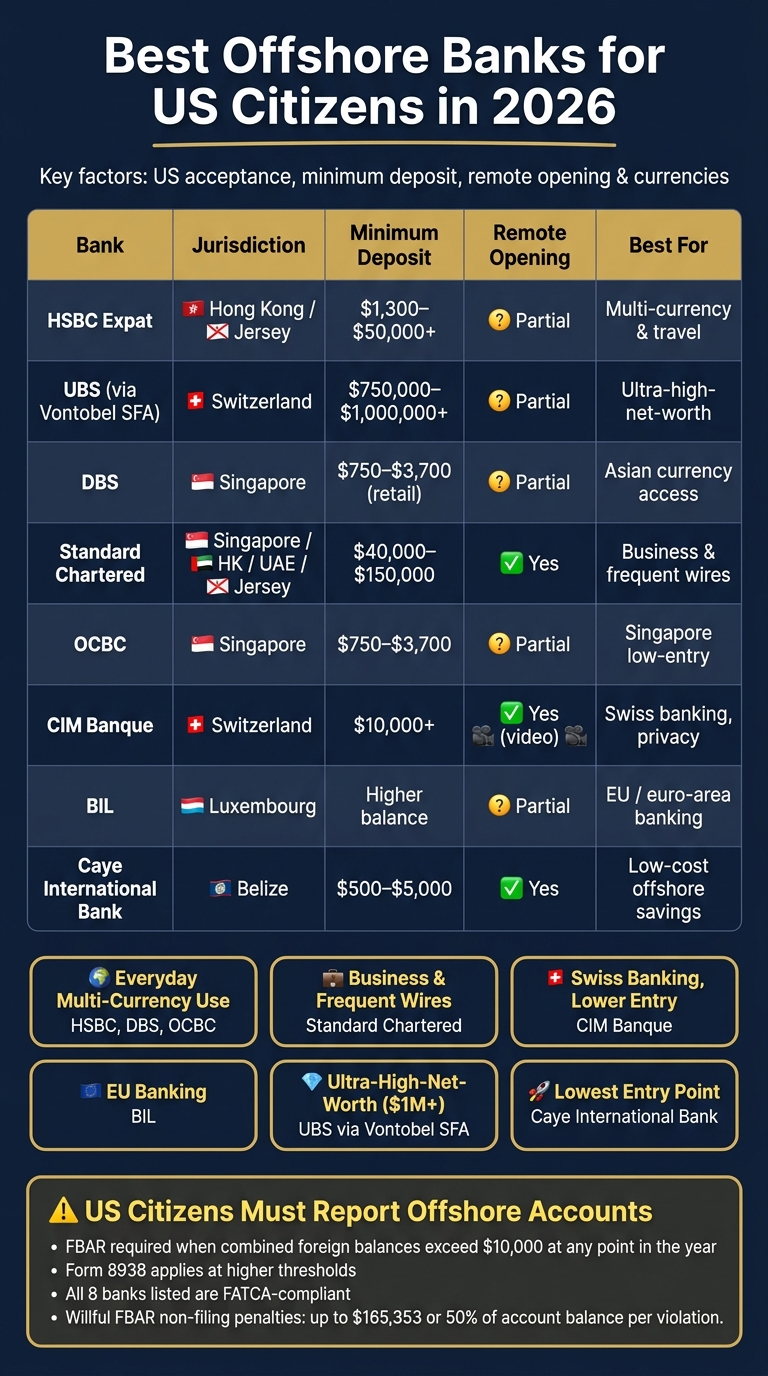
Quick Comparison
| Bank | Best For | Entry Level | Remote Opening | Main Currencies |
|---|---|---|---|---|
| HSBC Expat / HSBC International | Travel, global transfers, holding many currencies | About $1,300 to $50,000+ depending on unit | Partial | USD, EUR, plus 20+ currencies in some setups |
| UBS | Very high-net-worth wealth management | About CHF 750,000 to $1,000,000+ | Partial | CHF, USD, EUR |
| DBS | Singapore banking and Asian currency access | About $750 to $3,700 for retail; much more for wealth tiers | Partial | SGD, USD, EUR, GBP, HKD |
| Standard Chartered | Business use, frequent international transfers | About $40,000 to $150,000 | Yes, in many cases | 10+ currencies |
| OCBC | Singapore access with lower minimums | About SGD 1,000 to SGD 5,000 | Partial | USD, EUR, SGD, others |
| CIM Banque | Swiss account with video onboarding | About $10,000+ | Yes | USD, EUR, CHF |
| BIL | Luxembourg and euro-area banking | Higher-balance focus | Partial | EUR, USD, GBP, CHF |
| Caye International Bank | Lower-cost offshore savings | About $500 to $5,000 | Yes | Varies by account |
My takeaway: if you want a bank you can actually use day to day, I’d start with HSBC, OCBC, DBS, or Standard Chartered. If you want Swiss or EU diversification, I’d look at CIM Banque or BIL. If you have $1 million+, UBS enters the picture. If your goal is just to get started with a small amount, Caye International Bank is the easiest place to begin.
That’s the big picture. Now the rest of the article breaks down where each bank fits, what it costs, and what U.S. citizens need to watch before applying.
sbb-itb-39d39a6
1. HSBC Expat / HSBC International
HSBC accepts U.S. citizens in 2026 and has the compliance setup to report FATCA data straight to the IRS. That matters. A lot of offshore banks either avoid U.S. clients or make the process so slow and heavy that it becomes a headache. HSBC is different because it pairs U.S. access with multi-currency banking and a well-established compliance process. For many Americans, that makes it one of the few large offshore banking options that still feels practical.
The main issue is simpler than it sounds: do HSBC’s access, fees, and currency options match how you actually use your money?
Eligibility and onboarding start online, then move to identity checks. You begin the application online and finish video or in-person verification with a U.S. passport, proof of address, 6–12 months of statements, and your SSN. It also helps to submit a signed W-9 at the start to cut delays.
HSBC Hong Kong starts at around $1,300. HSBC Expat in Jersey may require $50,000+ to keep Premier status and avoid monthly fees.
| Feature | HSBC Hong Kong | HSBC Expat (Jersey) |
|---|---|---|
| Min. Deposit | ~$1,300 (HKD 10,000) | $50,000+ |
| Currency Support | USD, EUR, and other major currencies | 20+ currencies |
| Transfer Fees | Reduced FX fees | $0 within HSBC network |
| Remote Opening | Video or in-person required | Hybrid (online start) |
HSBC Expat’s multi-currency setup is one of its biggest selling points, especially for travelers and people who move money across borders on a regular basis. It supports 20+ currencies. Some account tiers also include no FX markup on card spending, and transfers between HSBC accounts around the world cost $0. If you get paid in one currency, spend in another, and hold cash in a third, that kind of setup can save time and friction.
There’s also a location tradeoff. Jersey offers stronger legal predictability, while Hong Kong gives broader access but comes with more geopolitical risk. So the fit depends on what you care about more: a steadier legal setting or broader market access.
HSBC tends to work best for travelers, expats, and people focused on multi-currency cash management. On the other hand, HSBC’s U.S. footprint can mean more exposure in disputes tied to foreign affiliate accounts, which makes it a weaker choice for people focused on maximum asset protection. For a deeper dive into secure jurisdictions, consult our offshore banking report.
For readers who want a different balance of minimums and service style, the next bank to look at is UBS.
2. UBS
UBS is a poor fit for most U.S. citizens who want an offshore bank account. But it still matters for high-net-worth wealth management. If you’re a U.S. citizen, you generally can’t open a standard retail account there.
Instead, UBS now routes Swiss diversification clients through Vontobel Swiss Financial Advisers (SFA), not normal UBS retail onboarding. U.S. clients go through Vontobel SFA, which is an SEC-registered investment adviser. That setup comes with higher pricing.
This is a high-balance option. Minimums start at about CHF 750,000 to $1 million, and annual costs can land around $7,000 to $15,500 once custody, management, and tax/reporting costs are added in.
UBS supports CHF, USD, and EUR, along with SEPA and SWIFT transfers. That said, its large U.S. footprint makes it less useful for clients who want strict jurisdictional separation. It’s also weaker for asset protection, since that U.S. footprint can increase jurisdictional exposure.
| Requirement | Details for U.S. Citizens |
|---|---|
| Access Route | Referral to Vontobel SFA (SEC-registered) |
| Minimum Entry | CHF 750,000 to $1,000,000+ |
| Currencies Supported | CHF, USD, EUR |
| Opening | Partly remote; meetings available in U.S. offices (NY, Miami, LA) |
| Docs Needed | Passport, SSN/ITIN, W-9, FATCA self-certification, and two years of Form 1040s |
| IRS Reporting | Automatic via FATCA |
If you want something more retail-friendly with a lower bar to entry, the next bank is DBS.
3. DBS
DBS is one of the few major Singapore banks that still works with U.S. citizens, usually through a savings account or DBS Treasures. The catch is simple: the bar is high.
For Americans, DBS Treasures often calls for about $200,000 to $500,000 in investible assets, and the Treasures Private Client tier requires S$350,000. So while DBS can be a good fit for U.S. clients who want money in Singapore, it’s aimed much more at people with large balances than at casual account holders.
Opening the account also takes time. In most cases, the process runs 8 to 12 weeks, and it’s usually not fully remote. You’ll generally need documents like:
- A passport
- Proof of address
- A W-9
- Source-of-funds documents
Some applicants also have to complete video verification or make an in-person visit. And if you want to avoid monthly service fees, you’ll want to keep balances above SGD 1,000.
Once the account is open, DBS gives you solid multi-currency access. Supported currencies include SGD, USD, EUR, GBP, and HKD. Its mobile app and online banking get good marks, and the bank supports low-cost transfers in major currencies. For U.S. expats handling rent or utility payments in places like Singapore or Hong Kong, that can make day-to-day banking a lot easier.
Singapore also stands out as a stable banking jurisdiction. U.S. civil judgments are not automatically recognized there, which means a creditor would usually need to start a new action in Singaporean courts.
| Feature | DBS Details |
|---|---|
| U.S. Citizen Acceptance | Yes, usually through savings or DBS Treasures tiers |
| Minimum Deposit – Retail | About $750 to $3,700 |
| Minimum Deposit – Wealth Tier | About $200,000 to $500,000; Treasures Private Client requires S$350,000 |
| Currencies Supported | SGD, USD, EUR, GBP, HKD, and others |
| Remote Onboarding | Partial; video verification or in-person visit may be required |
| Onboarding Timeline | 8 to 12 weeks |
| IRS Reporting | Automatic reporting through FATCA and CRS |
| Deposit Insurance | Up to S$100,000 per depositor on SGD deposits; foreign-currency deposits are typically excluded |
DBS makes the most sense for high-net-worth U.S. citizens who want Singapore-based diversification, Asian currency exposure, or a place to hold liquid assets. It’s far less suited to travelers who want fast setup and low-cost entry. For a different mix of access and international banking features, the next bank is Standard Chartered.
4. Standard Chartered
Standard Chartered sits at a lower entry point than many of the banks above, and it gives U.S. citizens access through more booking centers. For 2026, that makes it one of the more reachable large offshore banks for Americans. It accepts U.S. clients through Singapore, Hong Kong, the UAE, and Jersey. The bank is FATCA-compliant, so U.S. clients usually need to submit a W-9, a passport copy, and proof of address.
The minimum relationship balance usually lands between $40,000 and $150,000 in deposits or investments. You can also open an account remotely, which is a big plus if you don’t want to fly out just to get started. For U.S. clients with mid-range balances, that makes Standard Chartered a practical way into offshore banking.
It also works well for people who move money often. Multi-currency accounts support 10+ currencies, and the bank offers free international wire transfers through mobile banking. If you’re an expat or a frequent traveler, that’s the kind of day-to-day banking setup that can save time and cut friction.
On the digital side, Standard Chartered links clients with a relationship manager through myRM. Its SC Mobile app handles FX trading, portfolio management, and global market data. Through Singapore, clients can get access to as many as 12 major stock exchanges and more than 300 online funds.
Standard Chartered generally reports U.S. persons under FATCA each year. So while it’s useful for expats and multi-currency banking, it offers less distance from U.S. exposure than a smaller offshore bank. If creditor shielding is your main aim, this probably isn’t the first place you’d look.
| Feature | Standard Chartered Details |
|---|---|
| Primary Hubs | Singapore, Hong Kong, UAE, Jersey |
| Minimum Entry | $40,000 to $150,000 in deposits or investments |
| Currency Support | 10+ currencies for transactions; 60+ pairs for investment |
| Transfer Fees | Free for international transfers via mobile banking |
| Remote Onboarding | Yes, passport copy and proof of address required |
| U.S. Eligibility | Accepted; FATCA-compliant |
If you want a smaller-bank option with a different jurisdictional profile, the next section covers CIM Banque.
5. OCBC
Like DBS, OCBC gives U.S. citizens access to banking in Singapore, but the entry bar is lower. OCBC is a Singapore bank regulated by MAS, and it accepts U.S. citizens for personal and business accounts in 2026. It is also fully FATCA-compliant.
You can open savings, investment, and multi-currency accounts. Minimum deposits range from SGD 1,000 to SGD 5,000 – about $750 to $3,700 – based on the account type. To avoid monthly maintenance fees, you’ll need to keep at least SGD 1,000 in the account.
OCBC supports USD, EUR, SGD, and other major currencies, which makes it a solid pick if you move money across borders. It also offers low-cost international transfers, plus online and mobile banking. For business owners or people who pay overseas often, that setup makes day-to-day banking a lot easier.
Remote onboarding is only partial and usually goes through a licensed intermediary. In most cases, you should expect to provide certified passport copies, proof of residence, and a source-of-funds statement. Some applicants may still need to visit a branch, depending on the account type and the bank’s compliance review.
Singapore does not recognize U.S. civil judgments, so a creditor would need to bring a separate action in Singaporean courts to try to reach assets held there. For people thinking about asset protection, that point stands out.
| Feature | OCBC Details |
|---|---|
| U.S. Eligibility | Yes, personal and business |
| Minimum Deposit | SGD 1,000 to 5,000 (~$750 to $3,700) |
| Remote Opening | Partial, via licensed intermediaries |
| Currency Support | USD, EUR, SGD, and others |
| Compliance | Fully FATCA-compliant |
| Primary Regulator | Monetary Authority of Singapore (MAS) |
U.S. reporting rules still apply, including FBAR when required.
OCBC is a good fit for readers who want Singapore banking access without DBS-level minimums.
6. CIM Banque
For readers who want Swiss jurisdiction instead of Singapore, CIM Banque is the lower-bar entry point. It’s a Swiss private bank that accepts U.S. citizens in 2026 and requires FATCA compliance.
Its main draw is simple: you can open the account remotely by video. There’s no branch visit and no licensed intermediary needed. That makes the process far less of a hassle for Americans who want Swiss banking access from abroad. The tradeoff, of course, is paperwork. Swiss access still comes with documentation and compliance checks.
The minimum initial deposit is about $10,000 or more. That puts CIM Banque in a useful middle ground. If you want Swiss banking access but don’t have the kind of balance many elite Swiss private banks ask for, this bank fills that gap.
CIM Banque supports USD, EUR, and CHF, and it handles international transfers through SWIFT and SEPA. In plain English, that works well for holding more than one currency and sending regular cross-border payments. Online access also supports remote account management, which helps if you’re nowhere near a Swiss branch.
Switzerland offers a stable legal and banking setting. Its legal system does not automatically recognize or enforce U.S. civil judgments. On top of that, CIM Banque has a low U.S. legal footprint because it has no domestic branches.
U.S. clients must complete a W-9 and FATCA self-certification when opening the account. There’s also a tax-reporting point you can’t ignore: if your foreign account balances go over $10,000 at any time during the year, you must file an FBAR. One more caution here: avoid Swiss-domiciled collective funds, since they can trigger PFIC tax treatment for U.S. taxpayers.
| Feature | CIM Banque Details |
|---|---|
| U.S. Eligibility | Yes, FATCA-compliant |
| Minimum Deposit | Approximately $10,000+ |
| Remote Opening | Yes |
| Currency Support | USD, EUR, CHF |
| Transfer Network | SWIFT and SEPA |
| Jurisdiction | Switzerland |
| U.S. Legal Nexus | Low (no U.S. branches) |
7. Banque Internationale à Luxembourg (BIL)
If you want EU banking instead of Switzerland, BIL is the next place to look. Banque Internationale à Luxembourg (BIL) can work well for U.S. citizens who want an EU-based bank in a stable, tightly regulated jurisdiction with strong multi-currency support.
BIL accepts U.S. citizens through FATCA-compliant onboarding, and full U.S. reporting rules still apply. The bank supports EUR, USD, GBP, and CHF, and many non-resident clients can complete onboarding through video verification. In plain English, BIL tends to fit higher-balance U.S. clients who want euro-area banking, access to U.S. dollars, and the stability of an EU jurisdiction. That makes it a useful benchmark when you compare stable EU banking options with access to major currencies.
Deposits are protected up to €100,000 per depositor, per bank under EU rules. U.S. investors should also note that DAC8 expands crypto reporting on January 1, 2026.
| Feature | BIL Details |
|---|---|
| U.S. Eligibility | Yes, FATCA-compliant onboarding for U.S. Persons |
| Currency Support | EUR, USD, GBP, CHF |
| Remote Onboarding | Video verification available for non-residents |
| Deposit Insurance | Up to €100,000 per depositor, per bank |
| Best Fit | Higher-balance personal banking and private wealth management |
| Key Compliance Note | DAC8 crypto reporting effective January 1, 2026 |
8. Caye International Bank
If you want a more accessible way into offshore banking, Caye International Bank (CIBL) in Belize deserves a close look. It is a FATCA-compliant Belize bank licensed by the Central Bank of Belize. U.S. citizens can open accounts here and still stay in line with U.S. reporting rules.
Minimum deposits range from $500 to $5,000, depending on the account. Options include personal and business checking, savings, demand deposits, time deposits, and investment accounts. International wires move through SWIFT/BIC code CAYEBZBZ, and the bank allows remote account opening, so you don’t need to fly to Belize to get started. That lower entry point matters even more when you look at Belize’s reserve rules.
Belize requires international banks to hold a 24% liquidity ratio. That’s a high reserve requirement. In plain English, Caye makes more sense for liquid-asset diversification and offshore savings than for top-tier asset protection. Belize’s creditor-resistance laws are weaker than those in places like the Cook Islands, and a U.S. court order may be enforced more easily here than in the Cook Islands.
For U.S. citizens, Caye is a good match for lower-cost offshore savings and multi-currency access. Just check which currencies are available for your exact account type, because some may call for higher minimum balances. U.S. tax reporting still applies, including FBAR when balances go over $10,000. That makes Caye a useful point of comparison against the larger offshore banks above.
| Feature | Caye International Bank Details |
|---|---|
| U.S. Eligibility | Yes, FATCA-compliant |
| Minimum Deposit | $500–$5,000 depending on account type |
| Remote Onboarding | Yes |
| Currency Support | Confirm by account type |
| Best Fit | Low-cost offshore savings |
In the comparison below, Caye stands out for its low entry costs, while the larger banks offer broader service and deeper private-banking support.
Side-by-Side Comparison and Pros & Cons
The table below compares the eight banks across the factors that tend to matter most for U.S. clients.
| Bank | Jurisdiction | U.S. Client Access | Minimum Deposit | Supported Currencies | Online Banking | Best Use Case |
|---|---|---|---|---|---|---|
| HSBC Expat | Hong Kong / Jersey | Yes, mainly through Premier | About $1,300 | 20+ currencies | Excellent | Frequent international transfers |
| UBS | Switzerland | Yes, via Vontobel SFA | CHF 750,000–$1,000,000+ | CHF, USD, EUR | Strong | Wealth management and CHF exposure |
| DBS | Singapore | Moderate | $750–$3,700 | SGD, USD, EUR, GBP, HKD | Excellent | Multi-currency use and Asian stability |
| Standard Chartered | Singapore / Hong Kong / UAE / Jersey | Moderate | $40,000–$150,000 | Strong multi-currency support | Strong | Business banking and corporate transfers |
| OCBC | Singapore | Moderate | SGD 1,000–5,000 | Strong multi-currency support | Strong | Singapore-based diversification |
| CIM Banque | Switzerland | Yes | $10,000+ | CHF, USD, EUR | Remote opening available | Remote opening and privacy |
| BIL | Luxembourg | Yes | – | EUR, USD, GBP, CHF | Partial | Euro-zone diversification and wealth planning |
| Caye International Bank | Belize | Yes | $500–$5,000 | Confirm by account type | Limited | Low-cost offshore savings |
The big trade-off comes down to jurisdiction. Singapore stands out for stability, Switzerland leans toward privacy, and the global banks are often easier to access.
| Bank | Pros | Cons |
|---|---|---|
| HSBC Expat | Wide currency support, strong digital tools, globally recognized brand | Large U.S. footprint creates U.S. nexus risk for asset protection |
| UBS | Deep private banking, strong CHF exposure, SEC-registered advisory route via Vontobel SFA | Very high minimums (CHF 750,000–$1,000,000+); U.S. nexus risk |
| DBS | Top-tier MAS regulation, excellent multi-currency accounts, strong digital platform | Foreign currency deposits (USD/EUR) are often excluded from Singapore deposit insurance |
| Standard Chartered | Strong for business and corporate transfers, broad international network | Moderate U.S. client acceptance |
| OCBC | Stable Singapore jurisdiction, solid multi-currency options, good digital access | Foreign currency deposits (USD/EUR) are often excluded from Singapore deposit insurance |
| CIM Banque | Full remote onboarding via video ID, strong privacy, no U.S. branches | Higher minimum than Caye |
| BIL | EU regulatory framework, strong EUR/CHF diversification, wealth planning depth | Better suited to higher-balance clients than basic retail banking |
| Caye International Bank | Low-cost offshore savings; FATCA-compliant | Better for straightforward savings than complex wealth planning |
If your main goal is asset protection, HSBC and UBS look weaker because of their U.S. nexus.
Before you open any account, check the filing, tax, and source-of-funds rules that apply to U.S. citizens.
What U.S. Citizens Should Check Before Applying
Before you apply, check three things first: compliance, account access, and balance rules. That quick review can help you narrow these eight banks down to the one that fits your filing load and your cash level.
FATCA compliance is mandatory. Fees matter, sure. But the first issue is simpler than that: will the bank even take a U.S. person? Some will. Some won’t. Ask that question before you spend time on forms or calls.
Once you fund the account, your U.S. filing duties start. FBAR applies when your combined foreign-account balance goes over $10,000 at any point during the year. Form 8938 kicks in at higher thresholds based on your filing status and where you live. These forms don’t create extra tax by themselves, but missing them can get expensive fast. Willful non-filing penalties for FBAR can reach the greater of $165,353 or 50% of the account balance per violation.
There’s another trap here: PFICs. Foreign-domiciled mutual funds and ETFs can trigger PFIC reporting under Form 8621. For many U.S. citizens, that’s a headache not worth inviting. A safer route is often individual stocks, bonds, or U.S.-domiciled ETFs.
Use the table below as a filter before you apply.
| Check before applying | Why it matters | Typical variation across banks |
|---|---|---|
| FATCA readiness | The bank must accept U.S. persons and report to the IRS | Standard at all major banks here; smaller local banks often reject U.S. clients |
| Remote vs. in-person onboarding | Determines whether you need to travel to open the account | Ranges from full video onboarding to partial in-person verification |
| Minimum balance and fee waivers | Falling below the threshold can trigger monthly maintenance fees | Ranges from $750 (DBS/OCBC) to $1,000,000+ (UBS private banking) |
| Source of funds documentation | A common reason applications stall or accounts freeze | Some banks only need simple salary or savings records; others may ask for tax returns and business records |
| U.S. nexus | Banks with U.S. branches are reachable by U.S. court orders, weakening asset protection | Larger banks such as HSBC and UBS carry higher nexus risk |
| Wire and FX fees | Affects the real annual cost of maintaining the account | Fees are often waived at Premier or private banking tiers; retail clients typically pay $25 to $50 per wire plus FX spreads |
| PFIC exposure | Foreign-domiciled funds trigger punitive U.S. tax treatment | Banks with SEC-registered advisory arms (e.g., Vontobel SFA for UBS clients) offer U.S.-compliant portfolio options |
One last item that catches people off guard: tax prep costs. FBAR, Form 8938, and Schedule B can add anywhere from a few hundred dollars to several thousand dollars a year.
Conclusion
After looking at access, minimum deposits, currencies, and jurisdiction, the answer is pretty simple: it comes down to fit. There isn’t one offshore bank that’s right for every U.S. citizen. The better move is to match the bank to your balance, how you plan to use the account, and how much compliance work you’re willing to handle.
Seen that way, the top picks fall into three clear groups. HSBC, DBS, Standard Chartered, and OCBC make sense for expats, frequent travelers, and business owners who need multi-currency banking. UBS and CIM Banque are a better match for higher-balance clients who want private banking and stability. Caye International Bank fits people looking for lower-cost offshore savings and liquid diversification.
Offshore banking is legal for U.S. citizens, but only if the accounts are fully disclosed and reported. U.S. reporting rules still apply no matter which bank or jurisdiction you pick. It’s also smart to keep one U.S. account open for refunds and government payments.
FAQs
Which offshore bank is best for my goals?
The best offshore bank comes down to what you need it to do.
If your main goal is asset protection, look at institutions that don’t have U.S. branches, subsidiaries, or correspondent ties. Some private banks in Switzerland fit that profile.
If you need multi-currency business banking and easy access, fintech-style platforms or banks like HSBC (Hong Kong) can make more sense. They tend to be more practical for day-to-day use.
For wealth management, Singapore, Switzerland, and the Cayman Islands are often top picks because they offer stable, regulated banking environments.
One thing you should always check: FATCA compliance.
Can I open an offshore account remotely as a U.S. citizen?
Yes. U.S. citizens can open some offshore bank accounts remotely, but the process is often stricter than opening an account with a bank in the United States.
The main factor is choosing a FATCA-compliant bank that still works with Americans. If you go that route, expect a longer checklist. Most banks will ask for detailed paperwork, including proof of identity, your tax identification number, and documents that show where your money comes from.
What U.S. tax forms do I need for a foreign bank account?
Usually, there are two main reporting forms.
FBAR (FinCEN Form 114) is required if the total value of your foreign financial accounts goes over $10,000 at any point during the year. The filing deadline is April 15, and there’s an automatic extension to October 15.
You may also need IRS Form 8938 with your federal tax return if you meet higher asset thresholds. These forms are for reporting only, but any interest or other income still needs to be reported on Form 1040.
