
Rich people usually don’t keep their money in one bank account. They split it into jobs. In 2026, that often means one bucket for spending, one for short-term yield, one for long-term growth, one for lawsuit and creditor shielding, and one for estate transfer. The reason is simple: FDIC insurance still stops at $250,000 per depositor, per insured bank, per ownership category, and large balances bring more than bank risk.
If I had to sum up the article in one line, it would be this: wealthy families build a money system, not a single account.
Here’s the short version:
- Liquidity bucket: cash for bills, taxes, and near-term use
- Safe-yield bucket: T-bills, CDs, or short-term reserves for steady income
- Growth bucket: brokerage accounts, retirement accounts, real estate, and business equity
- Protection bucket: LLCs and trusts to split assets from personal risk
- Estate bucket: structures that help move wealth to heirs with less friction
A few points stand out:
- Treasury bills can be more tax-efficient than bank savings for people in states like California or New York because Treasury interest is free from state and local income tax.
- Money market funds are often used for idle brokerage cash, with many cautious investors sticking to Treasury or government funds.
- Real estate and private business ownership still hold a big share of wealthy households’ net worth.
- Offshore trusts and foreign accounts are used by some families, but they still come with IRS and FinCEN reporting rules, such as FBAR, Form 8938, and Form 3520.
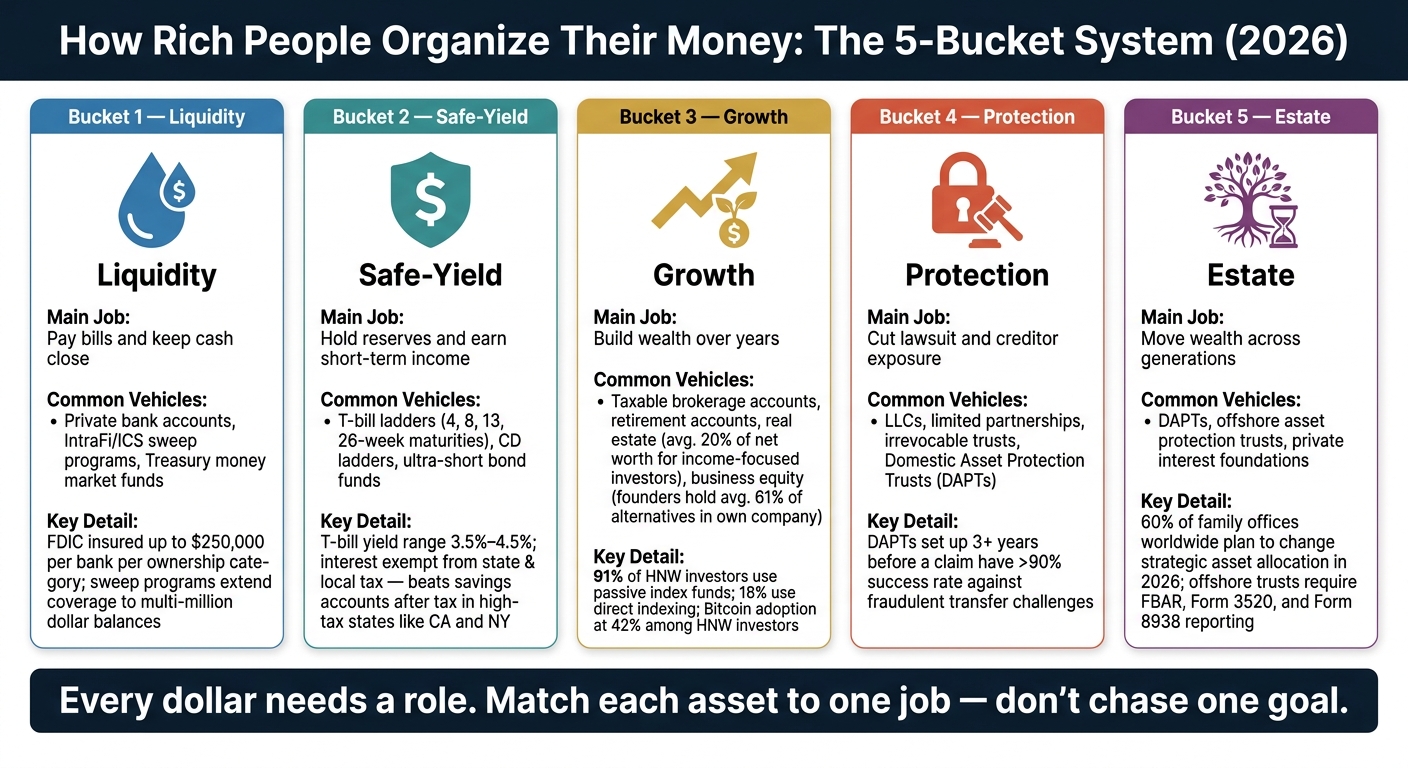
Quick comparison
| Bucket | Main job | Common places money goes |
|---|---|---|
| Liquidity | Pay bills and keep cash close | Private bank accounts, insured cash sweeps, money market funds |
| Safe-yield | Hold reserves and earn short-term income | T-bill ladders, CD ladders, ultra-short bond funds |
| Growth | Build wealth over years | Brokerage accounts, retirement accounts, real estate, business equity |
| Protection | Cut lawsuit and creditor exposure | LLCs, limited partnerships, irrevocable trusts |
| Estate | Move wealth across generations | DAPTs, offshore trusts, private interest foundations |
The core idea is not to chase one “best” account. It’s to match each dollar to one job. That’s the thread running through the whole piece.
sbb-itb-39d39a6
1. Liquidity buckets: private banks, money market funds, and Treasury ladders
This bucket is for money you might need in days or months. When cash balances get large, the first job isn’t chasing yield. It’s making sure the money stays easy to reach and properly insured.
Private banks and tiered cash management
Wealthy clients often expand FDIC coverage by spreading cash across ownership categories like single, joint, revocable trust, irrevocable trust, and retirement accounts. Each category is insured separately up to $250,000.
For much larger balances, many private banking clients use insured cash sweep programs like IntraFi. It automatically moves deposits across a large network of FDIC-insured banks in amounts below $250,000 per bank. The client still gets one account, one statement, and one banking relationship. That’s a simple setup with full insurance coverage across much larger sums.
Brokerage-linked money market funds for idle cash
Cash sitting in a brokerage account while it waits to be invested often goes into a money market fund (MMF).
There are two main buckets here:
- Treasury MMFs hold only government securities
- Prime MMFs add short-term corporate debt and more credit risk
Most cautious investors stay with Treasury or government MMFs. And there’s an important distinction here: brokerage cash falls under SIPC protection, up to standard limits, for broker failure, not for market losses.
Treasury and CD ladders for short-term yield with planned access
When cash has a known future use date, a Treasury bill ladder is one of the cleanest options out there. You buy T-bills with staggered maturities, often 4, 8, 13, and 26 weeks, so part of the cash comes due on a rolling basis.
A few simple examples make the point:
- A quarterly tax payment due in 13 weeks fits a 13-week T-bill
- A tuition payment due in six months fits a 26-week bill
Treasury interest is exempt from state and local tax. That matters a lot for high earners in places like California or New York. In a high-tax state, T-bills can beat a higher-yield savings account on an after-tax basis.
Most wealthy investors build T-bill ladders in brokerage accounts instead of TreasuryDirect. Why? The brokerage account makes secondary-market sales easier if plans change, and it keeps tax reporting for all holdings in one place.
| Vehicle | Liquidity | Yield | Credit Risk | Typical Use Case |
|---|---|---|---|---|
| Checking / Savings | Immediate | Low | FDIC insured to $250k | Daily spending |
| IntraFi / ICS Sweep | Next-day | Moderate | FDIC insured (multi-million) | Insured reserves |
| Treasury MMFs | T+1 | 3.3%–3.6% | Minimal (U.S. govt-backed) | Idle brokerage cash |
| T-Bill Ladder | At maturity | 3.5%–4.5% | Minimal (U.S. govt-backed) | Planned expenses |
| Multi-bank CDs | Fixed term | 4.0%–5.0% | FDIC insured to $250k/bank | Known needs 12+ months out |
Once short-term cash is covered, excess capital usually moves into long-term growth assets.
2. Growth buckets: brokerage accounts, retirement accounts, real estate, and business equity
Once cash is handled, the next step is to grow capital while keeping tax drag as low as possible. These accounts and assets do more than build wealth. They help split up cash flow, tax treatment, and control.
In 2026, wealthy investors often spread long-term growth across four main buckets: taxable brokerage accounts, retirement accounts, real estate, and business equity. Some also keep a small hedge sleeve for gold or Bitcoin.
Taxable brokerage accounts and retirement accounts
A smart move here is asset location. Put each investment in the account type that gives it the best tax treatment.
Tax-friendly holdings like broad-market ETFs and individual stocks usually fit best in taxable brokerage accounts. That setup can work well because long-term capital gains rates apply, and tax-loss harvesting can help offset gains.
Less tax-friendly holdings like REITs, taxable bonds, and private credit often fit better in tax-deferred retirement accounts. There, income can compound without a current-year tax bill.
This isn’t just theory. A Long Angle study of 233 high-net-worth investors found that 91% hold passive, low-fee index funds, and 18% use direct indexing for tighter loss harvesting. Retirement accounts can also offer state-law creditor protection that ordinary brokerage accounts often lack.
Real estate and operating companies as major stores of wealth
For many wealthy Americans, real estate and operating businesses hold a big share of net worth. They’re not side bets. They’re often core holdings.
Income-focused investors hold about 20% of net worth in real estate, compared with 10% for growth-focused peers. Many prefer direct ownership instead of REITs or funds because it gives them more control. That can mean more say over financing, tenant choices, upgrades, and timing.
Business equity is even more concentrated. Founders and company owners hold an average of 61% of their private-equity and alternatives allocation in their own company. That’s a huge bet on one asset, but for many owners, it’s the engine that built their wealth in the first place.
Section 1202 Qualified Small Business Stock (QSBS) can be a major tax tool for founders using C-corps. It may allow up to $10 million in gains to be excluded from federal taxes. But there’s a catch: illiquidity and structure risk. If ownership is set up the wrong way, a strong asset can become a liability magnet.
A limited hedge allocation to gold or Bitcoin
Alternatives are usually a small sleeve, not the center of the plan.
Family offices expect to move gold allocations from 2% to 3% in 2026 as a hedge against geopolitical risk. Bitcoin is also more common now among wealthy investors. Adoption among high-net-worth investors stands at 42%, which is above private equity fund adoption at 39%. Among investors under 40, crypto makes up about 15% of their private-equity and alternatives allocation.
| Feature | Physical Gold / Gold ETFs | Bitcoin |
|---|---|---|
| Primary Role | Defensive hedge / currency protection | Asymmetric growth / "digital gold" |
| Volatility | Moderate to low | High |
| Liquidity | High (global markets/ETFs) | High (24/7 exchanges/ETFs) |
| Custody | Physical vaults or brokerage | Digital wallets or specialized custodians |
| U.S. Regulatory Clarity | High (Established) | Improving (Spot ETFs approved) |
| Typical Portfolio Allocation | 2–3% | Avg. 13% of alternative bucket |
Neither gold nor Bitcoin replaces equities, real estate, or business equity as a core growth engine. They play a limited defensive or diversifying role. The next question is not what to own, but how to hold it.
3. Protection buckets: LLCs, trusts, offshore structures, and family offices
Owning assets is the easy part. Keeping them safe takes planning.
The main rule is simple: separate ownership from control. That idea sits behind most asset protection planning. At the high end, family offices help manage this across the full balance sheet, handling custody, taxes, estate planning, and risk in one place.
Once the growth bucket is in place, the next step is to protect it from claims, taxes, and jurisdiction risk.
Domestic entities and trusts for basic protection and estate control
LLCs and limited partnerships are usually the first line of defense. A common setup is to place each major asset, such as a rental property or operating business, inside its own LLC. If one asset gets hit with a lawsuit, that claim is less likely to spill into the rest. Properly maintained LLCs and limited partnerships help keep one asset’s liability from reaching the others. But there’s a catch: if you mix personal and business funds, you weaken that shield.
A common layered structure in 2026 looks like this:
- An individual sets up a Domestic Asset Protection Trust (DAPT) at the top
- The DAPT owns a holding LLC
- The holding LLC owns separate subsidiary LLCs for each property or investment
This setup creates distance between the person, the holding entity, and the assets themselves.
Revocable living trusts help families avoid probate, but they do not protect assets from lawsuits. Irrevocable trusts are different. That group includes DAPTs, which can protect assets from creditors because legal ownership is transferred. Of course, that comes with a tradeoff: once assets go in, they can’t simply be pulled back out at will.
Timing matters too. DAPTs set up at least three years before a creditor claim have a success rate above 90% when facing fraudulent transfer challenges. In practice, a family office doesn’t replace these structures. It helps organize and manage them.
Offshore companies, international banking, and offshore trusts
Domestic structures handle most situations. Offshore structures come into play when domestic protection isn’t enough.
If someone faces higher lawsuit risk, has major cross-border exposure, or wants to reduce single-country legal risk, offshore asset protection can add another layer. An offshore asset protection trust in a place like the Cook Islands can force a creditor to start a new case in that offshore jurisdiction under a much tougher standard.
One structure gaining traction in 2026 is the bridge approach. In this setup, a domestic DAPT owns an offshore LLC. During normal periods, assets stay in the U.S. for ease of use. If serious litigation shows up, a flight provision in the trust document may allow the trustee to move assets beyond U.S. court reach.
That said, offshore planning is not a shortcut or a secret door. For U.S. persons, the reporting rules are strict:
- Foreign accounts must be reported through FBAR (FinCEN Form 114) if total balances go over $10,000 at any point during the year
- Foreign trusts require Form 3520 filings
Offshore planning only works when the reporting is complete and accurate.
Where Global Wealth Protection fits in a compliant structure
The best setup depends on a few plain facts: which assets are exposed, what the actual risks look like, and which mix of domestic and cross-border tools deals with those risks without turning the plan into a mess.
For someone who mainly needs liability separation for U.S.-based assets, that may mean a private U.S. LLC set up and maintained the right way. For someone with cross-border exposure or a higher-risk profile, it may mean offshore company formation paired with an offshore trust or private interest foundation for estate planning and asset protection.
One rule cuts across all of this: build the structure before a claim appears. Once a claim is on the table, moving assets can be attacked as fraudulent.
4. How to match each bucket to your goal without overcomplicating the plan
Match the bucket to the job. Don’t start with the product. Start with what the money needs to do. Once you do that, the buckets above turn into a simple decision tree.
If the goal is cash preservation and near-term access
For money you may need soon, keep the setup simple and split it by time horizon.
- Use checking or Treasury money market funds for 0–3 months
- Use T-bills or short CD ladders for 3–24 months
- Use a mix instead of putting everything into one product
That last point matters. One tool rarely does everything well. Checking gives you access. Treasury money market funds can help with yield and liquidity. T-bills and short CDs can work better when the cash has a slightly longer job.
If balances go above $250,000, sweep programs can spread cash across multiple banks while still keeping one banking relationship. And if you live in a high-tax state, T-bills often come out ahead of CDs after taxes because their interest is exempt from state and local tax.
Once you’ve assigned cash, the next step is figuring out whether the bigger need is protection or legacy planning.
If the goal is lawsuit protection or country diversification
For many U.S.-based entrepreneurs, simple LLC segregation handles the routine stuff. The idea is plain: keep one problem from spilling into the rest of the balance sheet.
If the risk level is higher, the structure usually needs to step up too. For high-risk professionals and cross-border owners, irrevocable trusts – domestic or offshore – are often the standard play. Timing matters here. Put protection structures in place before any claim shows up, because transfers made after a claim can be challenged as fraudulent.
Country diversification is a different goal. It’s not about secrecy. It’s about optionality – keeping wealth usable even if one jurisdiction gets restrictive. In practice, that means separating functions across jurisdictions and staying current with FBAR, FATCA, and Form 3520 reporting.
From there, the conversation usually shifts to what happens over time and across generations.
If the goal is building wealth across generations
Multi-generational wealth needs governance. Who controls the assets? What rules apply? How are decisions made when the original owner is no longer around?
That’s where trusts and private interest foundations can earn their keep. They don’t just deal with growth. They set the rules for where wealth sits, who can direct it, and how it moves after the original owner is gone.
The table below compares the main vehicles by what they deliver:
| Structure | Control | Protection Strength | Privacy | Complexity | Best-Fit Use Case |
|---|---|---|---|---|---|
| Revocable Trust | High | Low | Moderate | Low | Basic estate planning and probate avoidance |
| Irrevocable Trust | Low | High | Moderate | Moderate | Estate tax reduction and long-term legacy |
| Domestic Asset Protection Trust (DAPT) | Moderate | Moderate | Moderate | Moderate | U.S.-based entrepreneurs with moderate risk |
| Offshore Asset Protection Trust | Low | Very High | High | High | High-risk professionals or jurisdictional diversification |
| Private Interest Foundation | High | High | High | High | Multi-generational governance and philanthropy |
In most cases, the simplest structure that solves the risk wins.
Conclusion: Rich people keep money in systems, not in one account
The main idea is simple: each account should do one job – spending, yield, growth, protection, or succession. Put another way, every dollar needs a role.
That bucket-based setup is showing up more often in 2026. A record 60% of family offices worldwide plan to change their strategic asset allocation. The move is about resilience, not putting too much in one place.
For U.S.-connected readers, the checklist is short:
- Spread assets across more than one institution, so a single bank failure or transfer freeze doesn’t cut off access.
- Keep liquid reserves in a separate bucket from long-term capital.
- Use legal entities and trusts for liability separation and estate planning – and set them up before any claim arises, not after.
- Add offshore pieces only when there’s a clear reason and the setup can be explained to banks and regulators.
The job here is straightforward: match each asset to one purpose and keep the setup as lean as the risk allows. More moving parts don’t automatically lead to better results. In many cases, the simplest setup that covers the real risk works best. The system should be documented, each account should have a clear role, and the setup should still work when life changes.
FAQs
How much cash should stay liquid?
There’s no single right percentage here. The amount of cash you should keep liquid depends on your time horizon, tax situation, and risk profile.
Some wealthy investors hold about 5% to 20% of net worth in cash and cash equivalents. But a better way to think about it is this: match liquidity to what you expect to need, and when you expect to need it.
A simple tiered structure can make that easier:
- 0 to 1 month: daily cash
- 2 to 6 months: core reserves
- 6 to 12+ months: extended reserves
When do offshore trusts actually make sense?
Offshore trusts make the most sense when the goal is long-term wealth preservation and shielding major assets from future legal or creditor risk. They can be especially useful when control needs to move outside your home jurisdiction and into one that has stronger barriers against fast creditor claims.
That said, this only works if you’re willing to give up direct ownership. The trust has to be genuinely independent. If it isn’t, the whole setup can fall apart under scrutiny.
In practice, offshore trusts are usually a better fit for people facing high business risk, litigation exposure, or family wealth-planning concerns.
What bucket should I set up first?
Start by defining what each pool of money is meant to do. That keeps you from drifting into admin chaos. Don’t start with jurisdictions or institutions. Start by sorting your capital by role, like daily household liquidity, international reserves, emergency funds, or business operations.
Once that part is clear, match each bucket to the right vehicle. For a safety net, put capital preservation first. That usually means FDIC-insured deposits, U.S. Treasury bills, or money market funds.
