
If you rely on one passport, one tax home, and one banking system, you put a lot of control in one place. This article’s main point is simple: wealthy families build a citizenship portfolio to spread risk across travel, banking, tax residence, relocation, and inheritance.
Here’s the short version:
- A second passport is not the same as a citizenship portfolio
- A portfolio usually mixes citizenship + residency rights
- The goal is more control and more options if rules change
- This matters most for people with cross-border assets, business, or family
- Around 34% to 36% of ultra-high-net-worth individuals already hold or are pursuing a second passport
Put another way: if your life is local, one extra passport may be enough. If your money, family, or business touches several countries, you may need a broader setup.
A few points stand out:
- Travel risk: visa delays and border limits can block deals, moves, or family emergencies
- Banking risk: U.S. citizens can face account issues abroad because of FATCA
- Tax risk: a new rule in one country can hit your whole setup at once
- Estate risk: if all assets sit under one legal system, heirs may have fewer choices
In most cases, the mix looks like this:
- a Caribbean passport for backup citizenship and visa-free travel
- a European residency for access to the EU and Schengen area
- a UAE residency for a tax-friendly base and banking access
The big idea: the passport is the document, but citizenship and residency rights are the asset.
Quick comparison
| Setup | Main use | What it helps with | Limits |
|---|---|---|---|
| Second passport only | Travel backup | Visa-free access, backup identity | Does little on its own for tax residence, banking, or estate planning |
| Citizenship portfolio | Multi-country risk spread | Travel, relocation, banking access, tax residence planning, family planning and asset protection | More moving parts and higher cost |
Typical examples in the article include:
- Caribbean citizenship by investment: often starts around $200,000
- Portugal Golden Visa: about €500,000 in qualifying funds
- UAE Golden Visa: about AED 2 million or roughly $545,000
- A family of four may spend $1,000,000 to $1,500,000+ for a stacked setup
So when do people build one? Usually when one country has too much control over their movement, money, and family plans.
That’s the core idea I’d take from this piece: the rich do not collect passports for status; they build jurisdictional backups so one government cannot control everything at once.
sbb-itb-39d39a6
The problem: What a single-country setup exposes you to
A single-country setup can look fine on paper. Then travel gets blocked, a bank starts asking hard questions, or a move falls apart. For cross-border families, that kind of friction isn’t minor. It costs time, money, and room to maneuver.
The strain usually shows up in three areas: movement, money, and continuity.
Mobility, visa, and relocation bottlenecks
Visa access is a business issue, not just a travel headache. If your passport requires advance visa applications for key markets, a last-minute trip for a deal or due diligence can turn into a mess. During 2020–2023, border closures and entry restrictions disrupted international business operations and emergency family moves for travelers who had no backup option. One delayed visa can cancel a closing, block a site visit, or leave family members stuck during a crisis.
Tax, banking, and regulatory exposure
If travel is the first pain point, banking is often next.
Tax rules can shift fast. The UK ended non-dom in April 2025, and France has floated new wealth-tax proposals. If your full financial life sits in one jurisdiction, you take the hit all at once.
Banking adds another problem. U.S. citizens face specific tax challenges like FATCA reporting requirements create compliance burdens that can lead international banks to restrict or close accounts held by American nationals. If you hold only one nationality in a strict compliance setting, your banking options can narrow, often in places like Switzerland, Singapore, or Dubai.
One point matters here: a second citizenship does not automatically change your tax obligations. Tax residency depends on where you live and how long you stay there, not just the passport in your pocket. Still, a broader setup gives you options that a single-country structure just can’t offer.
Business continuity, asset access, and succession pressure
Once financial access gets tighter, estate and family planning get harder too.
If all your assets sit inside one legal system, a single court order, creditor action, or government seizure can reach them at the same time. There’s no separation by geography, no backup jurisdiction, and no buffer in the structure.
Succession planning hits the same limit. Inheritance laws vary a lot by country. If your estate is ruled by one set of laws, your heirs get whatever that system allows. Families with children in different countries, or assets spread across several markets, can run into serious probate issues when everything is tied to one place by law. At higher wealth levels, cross-border continuity is less of a luxury and more of a practical need.
The solution: How a citizenship portfolio is built
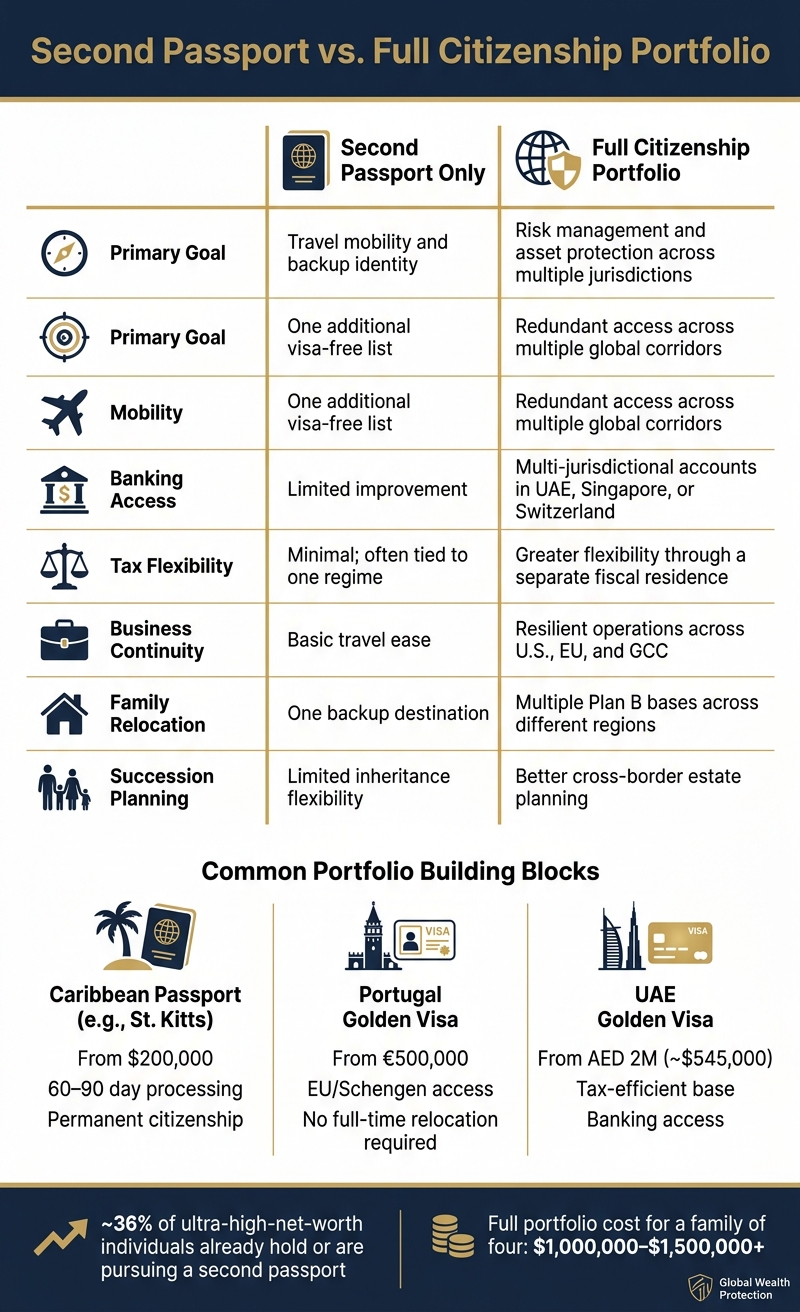
Once the risk is clear, the next step is simple: build layers that solve different problems.
A citizenship portfolio is a layered mix of citizenship and residency rights. The point is to spread mobility, banking, tax, and succession risk across more than one jurisdiction.
Common building blocks: U.S. citizenship plus EU, Caribbean, and backup residency options
For American families, the starting point is U.S. citizenship. From there, each added layer does a different job. A Caribbean citizenship-by-investment passport gives you a fast backup. An EU residency opens the door to Schengen access. A UAE residency can serve as a tax-efficient banking base.
Start with the Caribbean layer. Countries like St. Kitts and Nevis can process applications in roughly 60 to 90 days, with minimum investments usually starting around $200,000. That gives a family a permanent backup citizenship, not just a residence permit that may expire or be revoked.
Portugal’s Golden Visa requires a €500,000 investment in qualifying funds. It adds a longer-term lifestyle base without forcing full-time relocation, as long as applicants stay within residency-day limits. The UAE Golden Visa requires a property investment of about AED 2 million, or roughly $545,000, and gives families a tax-efficient base for tax planning and banking access.
What each layer solves: travel, tax flexibility, banking, and family options
Each part of the portfolio handles a specific risk.
The Caribbean passport helps with travel bottlenecks by expanding visa-free access across key global corridors. The EU residency creates a relocation base with access to European healthcare, education, and business markets. That matters when a family doesn’t want all its options tied to one country. The UAE residency anchors the tax base and supports banking access, especially for Americans dealing with FATCA reporting rules.
Succession planning also gets easier when assets and legal status sit across several jurisdictions instead of being packed into one legal system.
A second passport fixes one issue. A full portfolio covers several.
Comparison table: Second passport vs. full citizenship portfolio
| Feature | Second Passport Only | Full Citizenship Portfolio |
|---|---|---|
| Primary goal | Travel mobility and backup identity | Risk management and asset protection across more than one jurisdiction |
| Mobility | One additional visa-free list | Redundant access across multiple global corridors |
| Banking access | Limited improvement | Multi-jurisdictional, with accounts in stable hubs such as the UAE, Singapore, or Switzerland |
| Tax flexibility | Minimal; often tied to one regime | Greater flexibility through a separate fiscal residence |
| Business continuity | Basic travel ease | More resilient operations across the U.S., EU, and GCC |
| Family relocation | One backup destination | Multiple Plan B bases across different regions |
| Succession planning | Limited inheritance flexibility | Better cross-border estate planning |
For a family of four, combined costs can reach $1 million to $1.5 million or more.
The next question is whether you need only a second passport or the full stack.
When a second passport is enough and when a full portfolio makes sense
Not every situation calls for a full portfolio. The right setup depends on how complicated your financial and personal life is.
Cases where a second passport is mainly a travel tool
If travel is the main problem, a single second passport may do the job.
For many people, that’s enough when the goal is better visa-free access and not much else. If your income comes from one country, your assets are held in one place, and your family lives in one jurisdiction, a second passport from a Caribbean program such as Antigua or St. Lucia can make travel much easier without adding much extra complexity. This setup works best when your finances remain domestic and mobility is the main concern.
Signs you need a broader citizenship portfolio
Once your money, family, or business starts crossing borders, mobility stops being the only issue.
At that point, the test changes. A full citizenship portfolio makes more sense when one country has too much control over your residency, banking, and assets. If you have cross-border investments, business operations in more than one country, family members living in different jurisdictions, or assets spread across several legal systems, one extra passport can leave too many weak spots.
That’s when the question shifts. It’s no longer about picking the “best” passport. It’s about finding the right mix of citizenship and residency rights to lower your exposure if tax, banking, residency, and citizenship rules all move against the same country.
Succession planning adds another layer. Residency permits are conditional and can be revoked or expire, while citizenship provides permanent, inheritable rights. For families thinking past their own lifetime, that difference matters.
Comparison table: Matching your risk profile to the right structure
The right structure depends on where your risk sits.
| Profile | Recommended Structure | Key Benefit |
|---|---|---|
| Location-independent entrepreneur | Caribbean passport (e.g., Antigua) + UAE residency | Fast mobility + potentially tax-efficient base |
| $5,000,000+ investor | Caribbean passport + Portugal or Greece Golden Visa | Immediate travel fallback + long-term EU access |
| Family office with assets in several countries | Caribbean (speed) + European residency anchor + UAE or Vanuatu (strategic) | Maximum global reach across 190+ countries + asset protection |
| U.S. citizen with high tax exposure | Grenada passport (E-2 treaty access) + Portugal Golden Visa | Live/work access to the U.S. + European residency base |
If your life is simple, one extra passport is often enough. If your wealth, business, or family stretches across multiple countries, a portfolio approach is usually the more practical tool.
Conclusion: Citizenship portfolios are about control and optionality
Once mobility, banking, tax, and succession all enter the picture, the question shifts. It’s no longer just, “Do I need another passport?” It becomes: “Do I need a broader jurisdictional plan?”
A citizenship portfolio is a coordinated mix of citizenships and residencies built to reduce control risk across mobility, banking, tax, and succession. As Dominic Volek, Group Head of Private Clients at Henley & Partners, put it:
"A citizenship portfolio is not about collecting passports, but about reducing concentration risk across mobility, regulation, banking, tax exposure, and family planning."
A second passport can solve a travel issue. A portfolio does more than that. It ties together mobility, banking, tax, and succession in one plan. About 36% of ultra-high-net-worth individuals already hold a second passport, but portfolio-level planning aims at something bigger: where you can move if your home country turns hostile, where your banking remains steady, and whether your children inherit the same rights you worked to secure.
That’s why coordination matters so much. Add a passport without lining it up with tax residency, banking, and asset-holding entities, and you can end up with more friction, not less.
In other words, implementation is a coordination problem, not a paperwork problem.
How Global Wealth Protection fits into the planning process
Implementation calls for legal, tax, and asset-protection planning that works as one system. Global Wealth Protection coordinates legal, tax, and asset-protection planning for clients building a multi-jurisdictional structure.
The passport should support the plan, not drive it. When citizenship, residency, business structure, and asset protection are planned together, the result is more control, more staying power, and more optionality.
FAQs
How is a citizenship portfolio different from owning two passports?
Owning two passports simply means you have two travel documents. A citizenship portfolio is much bigger than that. It’s a deliberate plan for risk management and long-term life planning.
It brings together citizenships, residency rights, and legal structures to improve mobility and cut exposure to geopolitical, regulatory, and fiscal risk. It also gives you more room to spread out where you live, bank, hold assets, and keep citizenship ties.
Can a second citizenship lower my taxes by itself?
No. A second citizenship does not lower your taxes on its own. In most cases, your tax bill depends on tax residency, not the passport you carry.
For U.S. citizens, things get even more complicated. The United States taxes worldwide income no matter where you live. So if you’re thinking about tax savings, the main issue is usually where you’re a tax resident, not whether you have a second passport.
How do I know if I need a full portfolio or just one backup passport?
It comes down to what you want to protect and how much flexibility you need.
A single backup passport can work as a simple Plan B. It helps with travel, gives you another way out in an emergency, and adds a layer of personal mobility.
But if your goals go beyond that, a full citizenship portfolio is often the better fit. That matters if you’re thinking about estate planning, tax flexibility, or reducing exposure to geopolitical risk. It also makes more sense when your life already spans more than one country, like when you have assets across borders, family in multiple places, or want to keep your residence, banking, and citizenship in separate jurisdictions.
