
If you want a passport fast, the Caribbean wins in 2026. If you want to live in Europe long term, Europe wins.
I’d boil the whole comparison down like this:
- Caribbean CBI gives me citizenship in about 2 to 6 months
- European routes usually give me residency first, then citizenship after 5 to 10 years
- Caribbean entry costs start around $200,000
- European entry costs often start around €250,000 to €500,000
- Grenada stands out for U.S. E-2 visa access
- Portugal, Greece, Malta, and Italy make more sense if I want an eventual EU passport
- Tax rules are not the same as passport rules: U.S. citizens still face U.S. tax filing, and EU tax residency can start if I spend too many days there
This means the better option depends on the job I need it to do:
- Fast second passport: Caribbean
- Lower entry cost: Caribbean
- No long stay rule: Caribbean, in most cases
- Path to EU life and work: Europe
- Family relocation and school planning: Europe
- U.S. business route through E-2: Grenada
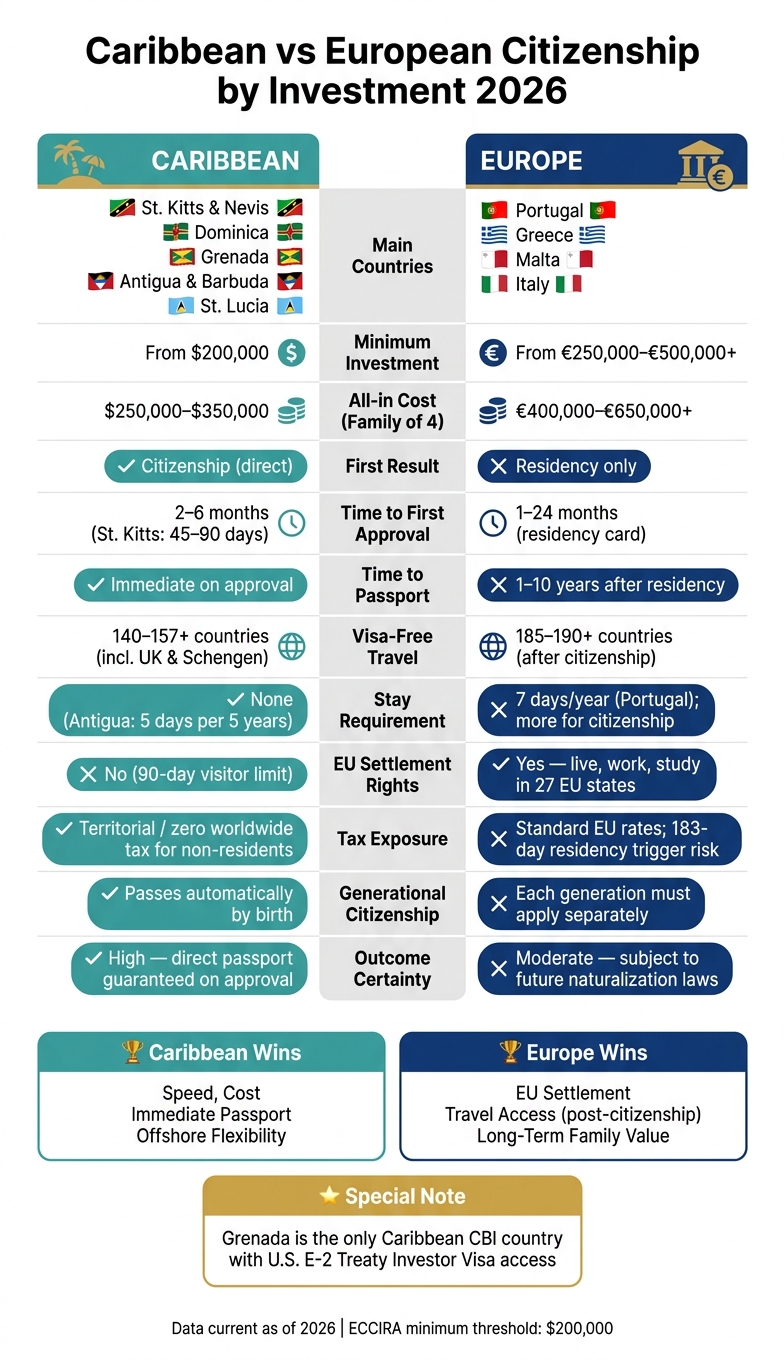
Quick Comparison
| Factor | Caribbean CBI | European residency-to-citizenship |
|---|---|---|
| Main countries | St. Kitts and Nevis, Dominica, Grenada, Antigua and Barbuda, St. Lucia | Portugal, Greece, Malta, Italy, others |
| Starting amount | $200,000+ | €250,000 to €500,000+ |
| First result | Citizenship | Residency |
| Time to first approval | 2 to 6 months | 1 to 24 months |
| Time to passport | Immediate on approval | 1 to 10 years, depending on route |
| Stay rule | Usually none | Often light for residency, but more for citizenship |
| Travel access | About 140 to 160+ places | No new passport at start |
| Best fit | Mobility, backup passport, offshore planning | Relocation, EU settlement, long-term family plans |
My takeaway: Caribbean programs sell certainty and time savings. Europe sells a longer path with a bigger end goal: EU citizenship and settlement rights.
If I’m comparing these routes in 2026, that is the lens I’d use from the start.
sbb-itb-39d39a6
Caribbean citizenship by investment in 2026
Caribbean CBI is still one of the few second-passport routes you can complete from a distance. The process is remote, passports are usually sent by courier, and only Antigua and Barbuda asks for physical presence: five days during the first five years. When people compare these programs side by side, four things tend to matter most: speed, cost, family coverage, and travel access.
Core options, minimum costs, and realistic timelines
In 2026, ECCIRA set a mandatory minimum investment threshold of $200,000 across the five main programs, which pushed the floor to $200,000. Even so, the programs are not identical. They sit close to each other on price, but they differ in processing speed and who you can include in one application.
| Program | Min. Donation (Single) | Real Estate Min. | Typical Timeline |
|---|---|---|---|
| Dominica | $200,000 | $200,000 | 2–4 months |
| Antigua & Barbuda | $230,000 | $200,000+ | 3–6 months |
| Grenada | $235,000 | $270,000 | 3–6 months |
| St. Lucia | $240,000 | $200,000+ | 3–4 months |
| St. Kitts & Nevis | $250,000 | $325,000 | 45–90 days (Accelerated) |
The headline number only tells part of the story. For a U.S. investor applying with a spouse and two children, government fees, due diligence fees, and legal costs can add about $25,000 to $75,000 on top of the base investment. In St. Kitts and Nevis, for example, that can include another $25,000 for a spouse and $10,000 per dependent child. So if you’re comparing programs, compare the all-in cost, not just the advertised entry point.
A few patterns stand out. St. Kitts and Nevis is the speed leader, thanks to its Accelerated Application Process, with results in 45 to 90 days. Dominica is often the best-value pick for a single applicant. And for bigger families, Antigua and Barbuda stands out because its $230,000 flat contribution can be the lowest-cost family route in the region. Cheap on paper doesn’t help much if the passport doesn’t match how you plan to travel or who you need to include.
Mobility, tax treatment, and family inclusion rules
In 2026, Caribbean passports generally offer visa-free or visa-on-arrival access to about 140 to 160+ countries, including the UK, the EU Schengen Area, Singapore, and Hong Kong. St. Kitts and Nevis ranks 27th globally on the Henley Passport Index and gives access to more than 157 destinations.
For investors with U.S. interests, Grenada gets special attention. It’s the only Caribbean CBI country with an E-2 Treaty Investor Visa agreement with the United States. That gives Grenadian citizens a route to live and work in the U.S. through an investment in a U.S. business. If your goal is not just travel but a working path into the U.S. market, Grenada sits in its own lane.
Family rules are fairly broad across the region. Most programs let you include:
- A spouse
- Dependent children, often up to age 30
- Parents and grandparents
That said, Antigua and Barbuda is the only program here with a residency rule: five days in the first five years after citizenship is granted. The citizenship itself is for life and can pass to future generations.
On tax, the basic setup is simple for non-residents. Caribbean jurisdictions often use territorial tax systems and generally have no income, capital gains, or wealth taxes for non-residents. But U.S. citizens don’t get a free pass. U.S. worldwide tax and reporting rules still apply even after you get a second passport, including FBAR and FATCA obligations. Put plainly, a Caribbean passport can help with movement. It does not fix U.S. tax exposure.
Program risk, due diligence, and long-term reliability
These programs don’t operate in a vacuum. Caribbean CBI has faced pressure from the EU, UK, and OECD, and the response has been tighter screening, not looser standards. Due diligence now uses multiple layers of checks, including Interpol, financial intelligence units, and third-party forensic agencies.
In 2026, ECCIRA added binding regional rules on due diligence, biometric data collection, and pricing transparency. St. Kitts and Nevis also rolled out a biometric passport upgrade in April 2026, with all passport holders required to re-enroll by July 2027.
The main long-range issue is visa policy. If the EU or UK limits access for one Caribbean passport, that passport loses part of its travel appeal overnight. That’s why administrative history matters. St. Kitts and Nevis has the longest track record in the space, and Dominica, which has operated since 1993, also has deep program history. In this market, price matters. But so do track record, government process, and how likely the passport is to hold its access over time. Europe, by contrast, trades this faster route for a slower path built around residence first.
European routes to citizenship in 2026
Compared with Caribbean CBI’s fast passport, Europe takes the slower route: residence first, citizenship later. There is no direct citizenship-by-investment path in Europe anymore. In practice, that means investment can open the door, but it usually doesn’t get you citizenship on its own.
Malta‘s route and other active European options
Malta is still the closest thing Europe has to a citizenship-style investment route. Its current program, MEIN (Naturalisation for Exceptional Services by Direct Investment), calls for a total commitment of more than €690,000, including a €600,000 to €750,000 contribution, property purchase or rental, and a charitable donation. Applicants must complete 12 or 36 months of genuine residence before citizenship can be granted, and approval is discretionary.
Portugal requires a minimum €500,000 investment in qualifying funds. Real estate no longer qualifies. The physical presence rule is light at 7 days per year, and the naturalization timeline now runs from 5 to 10 years, depending on the route and the applicant’s nationality. Before naturalization, applicants also need to pass an A2-level Portuguese language test.
Greece has one of the loosest visa-maintenance rules in Europe, with no minimum stay needed to keep the residence permit active. Investment thresholds range from €250,000 for restoration projects to €800,000 in prime zones. But citizenship still takes 7 years of genuine legal residence.
The tradeoff is pretty plain: Europe gives you less speed upfront, but more long-range upside.
Time to passport, stay requirements, and tax exposure
The gap between Caribbean and European programs is hard to miss. A European residence permit may take anywhere from 1 to 12 months to secure, depending on the country. But citizenship eligibility starts at 5 years in Portugal for certain nationalities and stretches to 10 years in places like Italy and Latvia.
| Country | Min. Investment | Years to Citizenship | Key Requirement |
|---|---|---|---|
| Portugal | €500,000 (funds) | 5–10 years | A2 language test; 7 days/year stay |
| Greece | €250,000–€800,000 | 7 years | Genuine legal residence |
| Malta (MEIN) | €690,000+ | 1–3 years | Discretionary approval; 12–36 months residence |
| Italy | €250,000–€500,000 | 10 years | Long-term legal residence |
Tax treatment depends less on the permit itself and more on where you spend your time. In many European countries, spending more than 183 days a year can make you a tax resident. In Portugal, the top income tax rate can reach 48% on worldwide income. So the permit and the tax result are not the same thing. Days on the ground are what usually matter.
Why Europe appeals despite higher cost and slower timelines
Europe makes more sense for people thinking about relocation and long-term settlement than for someone who just wants a fast second passport. Passports from places like Malta, Portugal, and Greece usually give visa-free access to 185 to 190+ countries, including the United States, Canada, and Australia.
There is also the bigger draw: EU citizenship gives you the right to live, work, and study in any of the 27 EU member states on a permanent basis. Caribbean citizenship doesn’t offer that kind of settlement freedom. That’s the core tradeoff here – speed on one side, long-term access on the other.
Caribbean vs Europe: side-by-side comparison by decision factor
Cost, speed, and certainty of outcome
When people compare these paths, they often fixate on the sticker price. But certainty matters more than price.
Caribbean programs start at $200,000 and can deliver citizenship in 2 to 6 months. European residency routes usually start at €300,000 to €500,000 and often take 12 to 24 months just to get a residency card. That gap matters more than the headline number.
And the end result isn’t the same.
A Caribbean approval means immediate, lifelong citizenship. A European residency permit may lead to citizenship only after 5 to 10 years of residence and compliance, based on the country and whatever rules apply at that time. That’s a big distinction. European rules can change while an investor is still midway through the process.
| Factor | Caribbean CBI | European residency-to-citizenship routes |
|---|---|---|
| Min. Investment | $200,000 – $250,000 | €300,000 – €500,000 |
| Est. All-in Cost (Family of 4) | $250,000 – $350,000 | €400,000 – €650,000+ |
| Time to Approval | 2 – 6 months | 12 – 24 months (residency only) |
| Time to Citizenship | Immediate | 5 – 10 years |
| Outcome Certainty | High – direct passport on approval | Moderate – subject to future naturalization laws |
There’s also a timing edge inside the Caribbean itself. St. Kitts and Nevis can process an application in as little as 45 to 60 days through its accelerated route.
Mobility, tax profile, and asset protection fit
The same pattern shows up in travel rights and tax exposure.
Caribbean CBI gives you a new passport. European residency-to-citizenship routes give you residency only, plus Schengen travel on your current passport.
| Feature | Caribbean CBI | European residency-to-citizenship routes |
|---|---|---|
| Visa-Free Travel | 140 – 157 countries (inc. UK/Schengen) | Schengen access only; no new passport |
| Right to Live in EU | No (90-day visit limit) | Yes, in the issuing country only |
| Tax Posture | Territorial / zero worldwide tax | Standard EU rates; possible tax residency trigger |
| Asset Protection Fit | Strong – supports offshore structuring | Better suited for an EU-based business footprint |
On tax, the practical risk is pretty simple. European residency can trigger local tax residency if you spend enough time in the country, which may pull your worldwide income into the local tax net. Caribbean citizenship does not create the same risk for non-residents.
That difference matters if your plan includes offshore structuring. Caribbean citizenship pairs well with offshore companies, trusts, or U.S. LLCs. And Grenada has one extra angle that stands out: it is the only Caribbean CBI country with an active E-2 Treaty Investor Visa agreement with the United States. That gives Grenadian citizens a direct route to U.S. business residency that no European route can match.
Family coverage, lifestyle value, and political stability
This is also where the two paths start to serve very different family goals.
| Factor | Caribbean CBI | European residency-to-citizenship routes |
|---|---|---|
| Dependent Scope | Spouse, children to 30, parents, siblings | Spouse, minor children, dependent parents |
| Stay Requirement | None (Antigua: 5 days per 5 years) | 7 days/year (Portugal); more for citizenship |
| Lifestyle Value | Global mobility and offshore structuring flexibility | Right to live, work, and study across 27 EU countries |
| Generational Rights | Citizenship inherited by birth | Each generation must pursue citizenship separately |
| Political Stability | ECCIRA regional oversight since April 2026 | Subject to ECJ rulings and EU Commission policy |
For legacy planning, Caribbean citizenship has a clear edge: citizenship passes by birth automatically. It’s a short point, but it carries long-term family value.
European residency-to-citizenship routes offer deeper settlement rights. You can live, work, and study across the EU once citizenship is reached. But those rights come with years of compliance, language tests, and rules that may shift along the way.
ECCIRA’s regional oversight, active since April 2026, adds more confidence around Caribbean program continuity. That split is what shapes the fit: Caribbean routes suit investors who want speed, a direct passport, and planning flexibility, while European routes fit people who want a path toward long-term life in Europe.
Which wins in 2026 for different investor profiles?
After comparing cost, speed, and tax treatment, the choice comes down to one thing: what you want this second passport or residence route to do for you. The best option depends on the result you’re after: fast processing, EU settlement, tax options, or long-range family plans.
When Caribbean wins on speed and certainty
Caribbean CBI is the clear winner if your main goal is a fast, direct passport. It can deliver citizenship in a matter of months, with a regional minimum of $200,000 and no mandatory residency requirement.
If your focus is mobility and offshore structuring, Caribbean CBI is often the cleaner match. You get a simpler path, less waiting, and a more direct outcome.
A few cases stand out:
- St. Kitts and Nevis and Antigua can mean lower local tax exposure for non-residents
- Grenada adds access to the U.S. E-2 visa route, which matters for investors who want business access in the United States
When Europe wins on long-term benefits
Europe works differently. It pays off when residence and long-term settlement matter more than speed.
Put simply, Europe wins when residence, not speed, is the goal. If you’re planning a move, Europe is often the better fit because the passport comes at the end of the journey, not at the start. That changes the whole equation.
There’s also a family angle. EU citizenship can lower university costs for children. So for families thinking on a 5- to 8-year horizon and with a real interest in building a life in Europe, the slower timeline and higher upfront cost may still make sense.
Final verdict: choose based on your real goal
The split is pretty clear. Caribbean wins on speed and immediate passport access. Europe wins on settlement rights and long-range family value.
Use Caribbean CBI if you want speed and flexibility. Use Europe if your target is relocation, education, and long-term EU access. The smart move is to pick the route that fits your actual objective, not just the one with the lower headline price.
FAQs
Which option is better for a U.S. investor?
For a U.S. investor, the better pick comes down to what you want out of it.
Caribbean citizenship-by-investment programs, which start at $200,000, are the fast-track option. They offer a second passport with no residency rules, visa-free access to 150+ countries, and tax neutrality. Grenada also stands out for people who want E-2 treaty visa access to the United States.
European golden visas are a different play. They usually call for more money up front, often over €500,000, and work as residency-to-citizenship routes. That makes them a better fit for investors who care more about long-term EU residence and work rights.
Can residency lead to citizenship in Europe?
Yes. In Europe, residency can lead to citizenship, but it doesn’t happen right away. It takes time, and you have to follow the rules the whole way through.
Most Golden Visa programs give you legal residency in exchange for an investment. If you keep that residency for the required period, you may later apply for naturalization. In most cases, that timeline is five to ten years, depending on the country.
That said, time alone usually isn’t enough. Countries often also require things like:
- language ability
- integration into local society
- a clean criminal record
- meeting physical presence rules
So the basic idea is simple: investment can open the door to residency first, and citizenship may come later if all conditions are met.
What hidden costs should I budget for?
Beyond the main investment, you’ll also need to budget for admin and professional fees, and those can change a lot by region.
In the Caribbean, single applicants often pay an extra $10,000–$30,000 on top of the main amount. That usually includes due diligence fees of $7,000–$10,000, along with processing charges and passport issuance fees.
European pathways are far more expensive on the fee side. Legal fees alone often land in the €30,000–€40,000 range for a family. On top of that, there are usually government application and renewal fees, private health insurance costs, and travel expenses for biometric collection.
