
Citizenship by Investment (CBI) programs let you gain permanent citizenship through the simplest citizenship programs in the world by investing in a country’s economy. These programs offer benefits like global mobility, tax advantages, and financial returns. Popular Caribbean programs include St. Kitts and Nevis, Antigua and Barbuda, Grenada, Dominica, and St. Lucia. Each has unique investment options, visa-free travel perks, and financial incentives.
Key Takeaways:
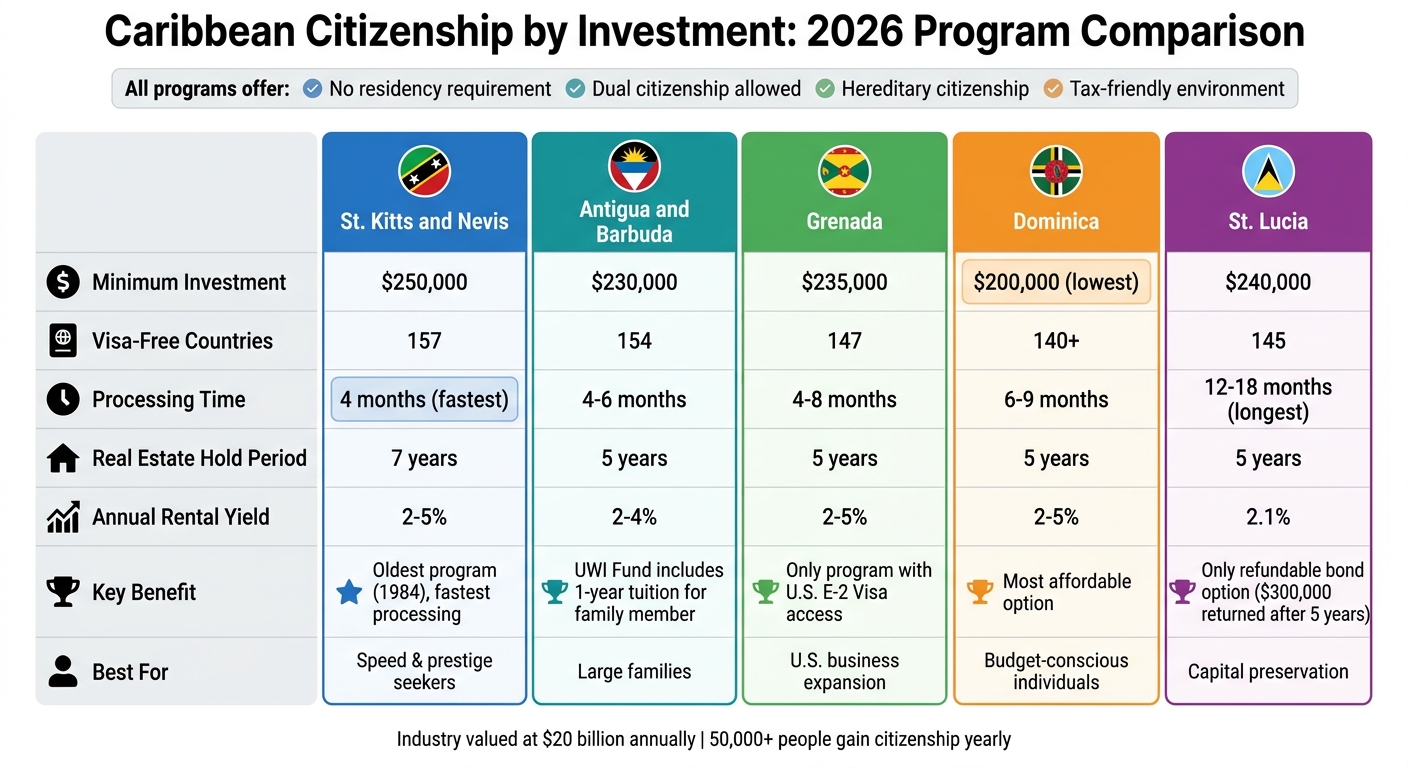
- St. Kitts and Nevis: Starts at $250,000; visa-free access to 157 countries; strong real estate returns.
- Antigua and Barbuda: Starts at $230,000; ideal for families; includes a one-year tuition benefit for a family member.
- Grenada: From $235,000; offers access to the U.S. E-2 Visa; strong real estate growth.
- Dominica: Most affordable at $200,000; no residency requirement; steady property returns.
- St. Lucia: Unique government bond option; refundable investment; visa-free access to 145 countries.
CBI programs provide a mix of financial growth, global mobility, and lifestyle upgrades, making them a long-term investment for individuals and families.
1. St. Kitts and Nevis
Investment Minimums
St. Kitts and Nevis, home to the world’s oldest Citizenship by Investment (CBI) program established in 1984, offers four distinct investment options. The Sustainable Island State Contribution (SISC) requires a non-refundable donation of US$250,000 for a single applicant or a family of up to four. For those opting for real estate, the minimum investment is higher – US$325,000 for approved developments or US$600,000 for private homes – with a mandatory 7-year holding period before resale to another CBI applicant. The Public Benefit Option also starts at US$250,000.
Additional costs include due diligence fees of US$10,000 for the main applicant and US$7,500 for dependents aged 16 and older. Applicants are also required to submit biometric data, which incurs a fee of US$2,500 for the first adult.
These investment thresholds are complemented by the program’s strong travel and financial benefits, making it an attractive long-term option.
Visa-Free Access
A St. Kitts and Nevis passport grants visa-free or visa-on-arrival access to 157 countries and territories as of 2026, placing it 19th globally on the Henley Passport Index. This includes 90-day stays in the Schengen Area within a 180-day period and up to 6 months in the United Kingdom. Key Asian destinations like Hong Kong (90 days), Singapore (30 days), and Taiwan (30 days) are also accessible without a visa.
As part of the Organisation of Eastern Caribbean States (OECS), citizens can live and work freely in Antigua and Barbuda, Dominica, Grenada, and Saint Lucia. However, starting in late 2026, travelers will need an ETIAS authorization for short stays in the Schengen Area.
5-Year/10-Year Financial Returns
In addition to its travel perks, the program offers competitive financial returns for investors.
Real estate investments come with a 7-year lock-in period, making the assets medium-term and less liquid. Over a 5-year period, rental yields range from 2–5% annually, amounting to 10–25% of the initial investment. Over 10 years, property values typically appreciate by 4% annually – a property initially worth US$325,000 could grow to approximately US$480,000, with total rental income adding up to 20–50% of the purchase price.
The country’s territorial tax system is another highlight, as it exempts worldwide income, capital gains, inheritance, and wealth from taxation. This framework significantly enhances the overall financial appeal.
Lifestyle and Mobility Benefits
Citizenship through this program is hereditary, offering a lasting legacy for future generations. With a safety index score of 59.98, St. Kitts and Nevis ranks among the safest nations in the Caribbean. Citizens also enjoy the benefits of CARICOM membership, allowing them to live and work in 15 member states. Additionally, as a Commonwealth nation, St. Kitts and Nevis provides simplified business registration and educational opportunities in the United Kingdom and other member states.
Passports are valid for 10 years (renewal fee: approximately US$361) and include eligibility for a 10-year U.S. visitor visa. For those seeking expedited processing, the timeline from application to passport issuance can be reduced to about 60 days.
These lifestyle and mobility benefits add significant practical value, making the program appealing not just for financial returns but also for everyday convenience and generational planning.
sbb-itb-39d39a6
2. Antigua and Barbuda
Antigua and Barbuda’s Citizenship by Investment (CBI) program stands out for its competitive investment requirements and a range of benefits, including global mobility and lifestyle perks.
Investment Minimums
The program offers three main investment options:
- A non-refundable contribution of $230,000 to the National Development Fund (NDF).
- A real estate investment of at least $300,000 in government-approved properties, with a mandatory five-year holding period.
- A business investment of $1.5 million for individual projects or $400,000 per applicant in joint ventures totaling $5 million.
For a family of four, processing fees amount to $20,000, due diligence fees are $17,500, and interviews cost $1,500 per adult, bringing the total investment to around $270,500. Along with citizenship, these investments offer extensive travel opportunities.
Visa-Free Access
As of April 15, 2026, Antigua and Barbuda passport holders enjoy visa-free or visa-on-arrival access to 154 destinations. Ranked 22nd on the Henley Passport Index, this includes key locations such as:
- United Kingdom (six months)
- Schengen Area (90 days within 180 days)
- China (30 days)
- Hong Kong (90 days)
- Singapore (30 days)
- Russia (90 days within 180 days)
Additionally, citizens benefit from freedom of movement within the Organisation of Eastern Caribbean States (OECS) and indefinite stays in CARICOM member states for those holding a CARICOM Certificate of Skills. They are also eligible for a 10-year B-1/B-2 U.S. visitor visa .
5-Year/10-Year Financial Returns
Real estate investments under the program often yield annual rental returns of 2%–4%, translating to a total of 10%–20% over five years. Property values typically increase by 3%–5% annually. The program saw a significant 205% surge in applications during the first half of 2024, with 739 applications submitted.
Antigua and Barbuda also offers a tax-friendly environment, exempting citizens from taxes on worldwide income, capital gains, inheritance, and wealth. For high-net-worth individuals, these benefits are often integrated into a broader asset protection and private family office strategy. However, tax residency requires spending at least 183 days annually in the country.
Lifestyle and Mobility Benefits
Citizenship in Antigua and Barbuda is hereditary and permits dual nationality. Initial passports are valid for five years, with a minimum five-day residency required during that period for renewal. Renewed adult passports extend to a 10-year validity.
The country boasts 365 beaches, making it a top choice for a luxurious lifestyle. A $260,000 contribution to the UWI Fund also includes one year of free tuition for a family member. As a Commonwealth nation, citizens enjoy certain benefits in the UK, including consular assistance from British Embassies or High Commissions in the absence of Antiguan and Barbudan diplomatic missions. Processing times for citizenship applications typically range from four to six months.
3. Grenada
Grenada stands out among Caribbean nations with its Citizenship by Investment (CBI) program, offering a unique advantage: exclusive access to the U.S. E-2 Treaty Investor Visa. This feature makes it particularly attractive for individuals seeking U.S. investment opportunities.
Investment Minimums
Grenada’s CBI program offers two main investment options:
- A non-refundable contribution of US$235,000 to the National Transformation Fund (NTF). This applies to a single applicant or a family of up to four.
- A real estate investment, starting at US$270,000 for shared ownership or US$350,000 for full ownership in government-approved properties. An additional US$50,000 government fee applies.
Investors must hold properties for at least five years before reselling them to another CBI applicant. Additional fees include US$5,000 per applicant (aged 17+) for due diligence, US$1,000 per adult for interviews, and US$1,500 per adult (or US$500 per minor) for processing. The application process is fully remote and typically takes 4–8 months.
Visa-Free Access
Grenadian passport holders enjoy visa-free or visa-on-arrival access to 147 countries (as of 2026), including destinations like the United Kingdom, the Schengen Area, Hong Kong, and Singapore. Notably, Grenada offers visa-free travel to China, a rare benefit among Caribbean nations.
For those aiming to leverage the E-2 visa, applicants must demonstrate three years of continuous domicile in Grenada before applying. A notable example is Indian IT entrepreneur Snehal, who used this route in 2025 to establish U.S. business operations, avoiding the higher costs and lengthy wait times of the EB-5 visa. This combination of mobility and investment opportunities makes Grenada’s program highly appealing.
5-Year/10-Year Financial Returns
Real estate investments in Grenada’s CBI program provide annual rental returns of 2%–5%, translating to cumulative returns of 10%–25% over five years. Over a decade, these returns can grow to 20%–50%, factoring in rental income and property appreciation.
Some projects offer structured returns, such as:
- Hideaway True Blue: Guarantees a 3% annual return and a buyback option at market value after five years. Its full occupancy since 2019 is attributed to serving students from St. George’s University.
- Beach House by Silversands: Opened in February 2024, it offers 4%–5% annual income and a buyback feature at the original purchase price after five years.
Between 2020 and 2023, real estate investments under Grenada’s CBI surged by 345%, growing from EC$151 million to EC$672 million. By mid-2025, 80% of new applicants were opting for real estate over the donation route.
Lifestyle and Mobility Benefits
Grenada offers several tax advantages, including no taxes on worldwide income, capital gains, inheritance, or wealth. The Eastern Caribbean dollar has remained stable against the U.S. dollar at a fixed rate of 2.70 since 1976, ensuring currency reliability.
Citizenship extends to a wide range of family members, including spouses, children under 30, parents, grandparents, and unmarried siblings over 18. With no residency requirements, investors can secure a second passport without altering their current lifestyle. Additionally, citizenship is transferable to new spouses and future generations.
"The flexibility of Caribbean citizenship makes it an ideal Plan B. Investors can maintain their current residence and lifestyle while securing a second passport."
- Lyle Julien, Investment Programmes Expert
4. Dominica
Dominica’s Citizenship by Investment (CBI) program, launched in 1993, stands out as one of the most cost-effective options in the Caribbean. A key feature of this program is that it doesn’t require physical residency or travel to the island either before or after obtaining citizenship. This makes it an attractive choice for those looking to avoid disruptions to their current lifestyle.
Investment Minimums
Dominica’s program offers two main investment options, catering to different preferences:
- Economic Diversification Fund (EDF): A non-refundable contribution of US$200,000 for a single applicant or US$250,000 for a family of four. Additional dependents cost US$25,000 per child under 18 or US$40,000 per adult.
- Real Estate Option: An investment of US$200,000 in government-approved real estate projects, plus a government fee of US$75,000 for a single applicant or US$100,000 for a family of four. Properties must be held for at least three years for open-market resale or five years if reselling to another CBI applicant.
Both options include mandatory fees, such as:
- Due diligence fee: US$7,500 for the main applicant and US$4,000 for dependents aged 16 and older.
- Processing fee: US$1,000 per application.
- Interview fee: US$1,000 for applicants aged 16 and older.
- Naturalization certificate fee: US$500 per person.
A virtual interview is required for all applicants aged 16 and older. Processing times typically range from six to nine months.
Visa-Free Access
Dominica passport holders can travel visa-free or with visa-on-arrival to over 140 destinations, including the United Kingdom, the Schengen Area, Hong Kong, and Singapore. Adult passports are valid for 10 years, while those for children under 16 are valid for five years.
"Dominica remains the most affordable and established choice for investors seeking fast and cost-effective citizenship."
This mobility, combined with the program’s financial structure, bolsters its appeal for investors.
5-Year/10-Year Financial Returns
The EDF donation is a non-refundable expense, resulting in a -100% financial return. However, it offers the lowest upfront cost for single applicants. On the other hand, real estate investments provide potential returns, with rental yields ranging from 2% to 5% annually. Over five years, this could mean cumulative returns of 10%–25%, and over ten years, 20%–50%. Properties tied to international brands often deliver more predictable rental income. After the mandatory five-year holding period, investors can sell these properties either to other CBI applicants or on the open market.
In the 2022/23 fiscal year, Dominica’s CBI program generated approximately US$232 million, accounting for about 37% of the country’s GDP.
Lifestyle and Mobility Benefits
Dominica operates under a territorial tax system, meaning non-residents are not taxed on foreign-sourced income, capital gains, wealth, or inheritance. To fully access local tax benefits, individuals must reside in the country for at least 183 days per year. Citizenship extends to spouses, dependent children up to age 30, and parents or grandparents over 65. Dual and multiple citizenships are allowed, and citizenship is both permanent and inheritable, ensuring benefits for future generations. Importantly, there are no residency requirements, making it easy for investors to secure a second passport without relocating.
5. St. Lucia
On July 1, 2024, St. Lucia increased its Citizenship by Investment (CBI) minimum investment to $240,000, aligning with a regional OECS agreement. What makes St. Lucia stand out is its position as the only Caribbean nation offering a government bond option for citizenship. This provides a distinct capital preservation route, alongside the more common donation and real estate investment pathways.
Investment Minimums
St. Lucia’s CBI program offers four main investment options:
- National Economic Fund Donation: A non-refundable $240,000 contribution for a single applicant or a family of up to four.
- Real Estate Investment: A $300,000 investment in approved projects, requiring a five-year holding period.
- Government Bonds: A $300,000 investment in non-interest-bearing bonds, plus a $50,000 fee. The principal is fully refundable after five years.
- Enterprise Investment: Requires $3.5 million for a solo project creating three jobs, or $250,000 per applicant for joint projects with up to three dependents.
Additional fees apply, including a $7,500 due diligence fee for the main applicant and $5,000 for dependents aged 16 or older. Processing times vary but typically range from three to fifteen months, depending on the complexity of the application.
These varied options provide flexibility for investors while opening doors to competitive travel benefits.
Visa-Free Access
With a St. Lucia passport, investors gain visa-free or visa-on-arrival access to 145 countries. However, as of March 5, 2026, travelers to the United Kingdom now require a visa, even for air transit. Schengen access remains unchanged, allowing 90 days of travel within a 180-day period.
5-Year/10-Year Financial Returns
St. Lucia’s government bond option is unique among Caribbean CBI programs, offering a full return of the $300,000 principal after the required five-year holding period. For those choosing real estate, the investment can generate an annual rental income of approximately 2.1% of the property’s value. This translates to cumulative returns of around 10.5% over five years and 21% over ten years.
The National Economic Fund donation, while offering the lowest entry cost for families, is non-refundable, resulting in a -100% financial return. However, St. Lucia’s territorial tax system offers significant financial advantages by eliminating taxes on worldwide income, capital gains, wealth, and inheritance for non-residents. Citizenship is permanent and transferable by descent, ensuring wealth preservation for future generations.
Lifestyle and Mobility Benefits
St. Lucia’s CBI program does not impose any physical residency requirements, either before or after citizenship is granted. This allows investors to maintain their current lifestyle and manage global business operations without interruption. Citizenship extends to spouses, dependent children up to age 25, and parents, with dual citizenship fully recognized. Additionally, citizens have the right to live and work freely across CARICOM member states.
"For most it’s an insurance policy against whatever they’re concerned about. Having a second citizenship is a good back-up plan."
- Dominic Volek, Henley & Partners
With its combination of capital preservation, tax advantages, and transferable citizenship, St. Lucia offers a compelling option for investors seeking financial security and global mobility.
Advantages and Disadvantages
Caribbean citizenship by investment programs come with a mix of benefits and drawbacks, often balancing cost, processing time, and strategic advantages. Here’s a closer look at how these programs stack up.
For single applicants, Dominica stands out as the most affordable option, starting at $200,000. However, it comes with some travel limitations. On the other hand, St. Kitts and Nevis offers the fastest processing time – around four months – and visa-free access to 167 countries, though it requires a $250,000 donation to get started. If you’re applying as a larger family, Antigua and Barbuda is particularly appealing. Its University of the West Indies Fund option covers up to six family members for $260,000 and even includes a one-year tuition-only scholarship.
Grenada brings a unique perk to the table: it’s the only Caribbean program that grants access to the U.S. E-2 Investor Visa. This allows families to live and work in the U.S. through a qualifying business investment. Meanwhile, St. Lucia is the only program offering a refundable investment option – a $300,000 government bond that returns the principal after five years. However, its processing time is the longest, taking 12 to 18 months.
"The question is not ‘Is $230,000 a lot of money?’ The question is ‘What is a globally respected second passport for every member of my family, for life, actually worth?’" – HPT Group
Across all programs, enhanced due diligence and additional fees apply, typically ranging from $10,000 to $25,000. For families, the overall cost becomes more economical. For example, a $230,000 investment covering five family members averages out to $46,000 per person, and the value grows over generations as citizenship passes down.
Here’s a quick comparison of the programs, highlighting their strengths, weaknesses, and ideal investors:
| Program | Primary Strength | Key Weakness | Best For |
|---|---|---|---|
| Dominica | Lowest cost ($200,000) | Travel restrictions | Budget-conscious individuals |
| St. Kitts & Nevis | Fast processing (4 months) and broad visa-free access (167 countries) | Higher cost ($250,000) and longer real estate hold (7 years) | Speed and prestige seekers |
| Antigua & Barbuda | Strong family value with inclusion of multiple members | 5-day residency requirement | Large families |
| Grenada | Access to U.S. E-2 Investor Visa | Mid-range pricing | U.S. business expansion plans |
| St. Lucia | Only refundable bond option | Longest processing time (12–18 months) | Capital preservation focus |
This breakdown helps investors identify which program aligns best with their priorities and future plans.
Conclusion
Selecting the ideal citizenship by investment program boils down to your priorities – whether you’re focused on cost, speed, global mobility, or long-term financial benefits. For single applicants on a budget, Dominica offers a compelling option with its $200,000 entry point. Meanwhile, families find Antigua and Barbuda appealing, thanks to the University of the West Indies Fund, which accommodates up to six members for $260,000. If speed matters most, St. Kitts and Nevis stands out with a processing time of about four months and visa-free access to 157 countries.
For investors seeking financial returns, Caribbean real estate options require a holding period of five to seven years, which can delay capital recovery. Grenada, however, offers a unique advantage for those eyeing U.S. business opportunities, as it’s the only Caribbean program that provides access to the E-2 Investor Visa.
These programs go beyond immediate benefits, offering broader financial and lifestyle advantages. Combining citizenship by investment with strategies like tax residency planning, offshore company structures, and international banking diversification enhances these benefits. Jurisdictions such as St. Kitts, Nevis, and Grenada provide tax-friendly environments with no personal income tax, capital gains tax, or inheritance tax. Services like those from Global Wealth Protection can help investors maximize mobility and asset protection while reducing global tax exposure.
"A second passport is not a consumer purchase. It is a multi-decade asset – one that provides travel freedom, political insurance, banking access, tax planning optionality, and a legacy that can be passed to children and grandchildren." – HPT Group
The investment migration industry is thriving, valued at approximately $20 billion annually, with over 50,000 people securing citizenship through these programs each year. Whether your focus is on travel freedom, tax planning, or ensuring a safety net for your family, pairing the right citizenship program with comprehensive wealth strategies can deliver lasting, measurable advantages.
FAQs
Which CBI option has the best long-term ROI for me: donation, real estate, or bonds?
When evaluating citizenship-by-investment (CBI) options, the long-term return on investment (ROI) largely depends on your personal objectives. Among the available choices, real estate often stands out as the most rewarding.
Here’s why:
- Donations: These provide quick access to citizenship but don’t offer any potential for asset growth. Essentially, they’re a one-time expense with no financial return.
- Bonds: While they can deliver consistent returns, they typically lack the added perks of enhanced lifestyle or global mobility.
- Real Estate: This option strikes a balance by offering financial growth through property appreciation, greater travel freedom, and the potential for generational value. It’s a choice that aligns with both wealth-building and lifestyle enhancement.
For those seeking to maximize both financial benefits and personal freedom, real estate emerges as a compelling choice within the CBI landscape.
How should I compare visa-free travel benefits across these Caribbean passports?
When evaluating visa-free travel perks, it’s essential to look at two key factors: the number of countries a passport grants access to without a visa and the regions included. Caribbean passports often allow visa-free entry to 140–150+ countries, covering destinations in Europe and the Caribbean.
However, it’s important to double-check the entry requirements for these visa-free destinations. Some countries may have specific restrictions or conditions, even if a visa isn’t required.
To get a clearer picture of a passport’s travel advantages and overall appeal, tools like the CBI Index can be helpful. These rankings offer insights into the desirability and benefits of different passports.
Will a Caribbean CBI passport help me reduce taxes without moving?
A Caribbean CBI passport can provide perks like increased global mobility and potential tax benefits. That said, it doesn’t automatically reduce your personal taxes unless you also change your tax residency. Keep in mind, local tax laws and residency rules will still apply, so you may need to relocate to take full advantage of any tax-related benefits.
