
The short answer: I’d pick the path based on the job I need the passport to do. If I want travel help, I compare access to the exact countries I visit. If I want family backup, I check who I can include and whether future children get citizenship. If I want a fast route, I look at processing time and the full cost, not the ad price.
Here’s the core idea in plain English:
- Start with one main goal: travel, tax setup, asset shielding, family backup, or business access
- Match that goal to the path: descent, investment, residence, or marriage
- Check the fine print: dual citizenship rules, family eligibility, inheritance rules, and residency duties
- Price the whole deal: extra fees can add $50,000+
- Think past the first year: rules can change, and some passports lose access over time
A few facts make this clear fast:
- CBI can take about 2 to 8 months
- Naturalization often takes 2 to 10 years
- Descent can cost as little as $500 to $5,000 if your documents line up
- Vanuatu lost Schengen visa-free access in 2024
- Italy tightened its jure sanguinis rules in March 2025
If I were building a shortlist, I’d score each option on six points: mobility, full cost, processing time, family coverage, long-term stability, and compliance burden. That keeps me from buying the simplest citizenship programs instead of the one that fits my life.
| Path | Best for | Time | Typical cost | Main catch |
|---|---|---|---|---|
| Descent | People with a qualifying family line | 12–36 months | $500–$5,000 | Heavy paperwork |
| Investment (CBI) | People who need a passport fast | 2–8 months | $100,000–$2,000,000+ | High total cost |
| Naturalization | People already planning to move | 2–10 years | Low filing fees, plus living costs | You must live there |
| Marriage | People with a documented marriage to a citizen | 1–3 years | Under $1,000 in filing fees | Proof and cohabitation rules |
My takeaway: a second citizenship is not a trophy. It’s a tool. I’d judge it by what it solves, what it costs, and whether it still works 5 to 10 years from now.
Step 1: Match your goal to the right citizenship pathway
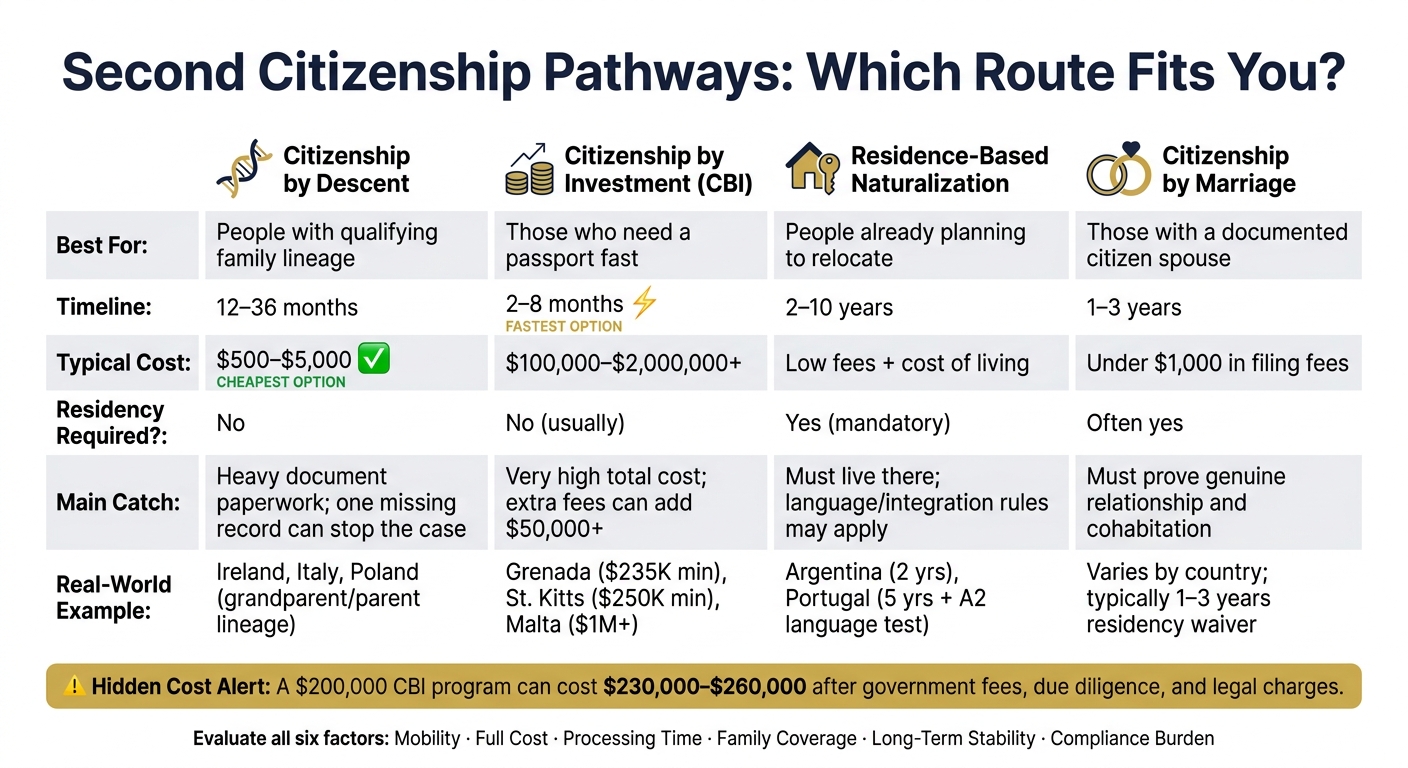
Each legal path to a second citizenship works a little differently. The best fit comes down to three things: your timeline, your budget, and how much paperwork or relocation you’re ready to take on.
Citizenship by descent, investment, residence, and marriage: how each works
Citizenship by descent is often the lowest-cost route with the biggest upside, if your family line qualifies. In countries like Ireland, Poland, or Italy, you may be able to claim citizenship through a parent or grandparent, often for about $500 to $5,000 in government and document fees. There’s no large investment, and there’s usually no residency requirement. The catch? Paperwork. You need to prove the full chain of citizenship, and one missing record can stop the case cold. This path makes sense only if your documents are clean and complete.
Citizenship by investment (CBI) is the fastest legal route. But speed has a price tag. Use this path only when timing matters more than cost.
Residence-based naturalization fits people who already plan to move. It usually takes 2 to 10 years and often comes with language or integration rules. Argentina is the fastest example, with just 2 years of legal residence. Portugal requires 5 years and an A2 Portuguese language test, while Mexico and Ireland each require 5 years with language proficiency. This path works best when relocation is already part of the plan.
Marriage can shorten naturalization, often cutting the residency period to 1 to 3 years and requiring proof of a real relationship and, in many cases, cohabitation. This route only makes sense when the relationship is genuine and easy to document.
Use this table to rule out paths that don’t fit your budget, timeline, or tolerance for residency:
| Pathway | Timeline | Estimated Cost | Residency Required |
|---|---|---|---|
| Descent | 12–36 months | $500–$5,000 | No |
| Investment (CBI) | 2–8 months | $100,000–$2M+ | No (usually) |
| Naturalization | 2–10 years | Low fees; cost of living | Yes |
| Marriage | 1–3 years | Under $1,000 | Often yes |
When the cheapest path is not the right path
Low fees on paper don’t always mean the path is cheap in real life. Naturalization can look inexpensive at the application stage, but the residency requirement means a real life change. You’re not just filing forms. You’re building day-to-day ties in another country.
That matters even more for U.S. citizens, because a second passport by itself does not change worldwide tax obligations. So the issue isn’t only how long you stay somewhere. It’s also where you base your daily life and tax ties.
Once you know which path fits your goal, the next step is to compare what the passport actually gives you: travel access, residency burden, dual citizenship rules, family inclusion, and total cost. Then look at the long game too, including long-term stability.
sbb-itb-39d39a6
Step 2: Compare the criteria that actually matter before you shortlist
Once you know which pathway fits your situation, the next step is simple: test each option against hard criteria. Marketing pages will tell you a passport sounds good. That doesn’t tell you whether it matches the countries you need, your legal setup, or your family plans.
Start with travel access. Then look at residency rules, processing time, dual citizenship, family coverage, and what happens later with inheritance.
Travel access, residency burden, and processing time
Visa-free totals are a weak shortcut. A passport with access to 150 countries may look strong on paper, but that number means little if the places you care about aren’t on the list. The better question is this: which countries does your current passport make hard to enter, and which program removes those pain points?
For U.S. entrepreneurs, Grenada and Turkey are the main CBI options that give access to the U.S. E-2 Investor Visa treaty route. If your business depends on regular travel to China and the UK, Grenada stands out because it covers both.
Speed also matters. São Tomé and Príncipe processes in about 1 to 3 months. Vanuatu moves at a similar pace, but its appeal dropped hard after the EU suspended Vanuatu’s Schengen visa-free access on November 13, 2024. That change cut its day-to-day travel use a lot.
| Country | Visa-Free Access | Processing Time | Residency Required |
|---|---|---|---|
| St. Kitts & Nevis | 150+ (UK, EU, Singapore) | 4–6 months | None |
| Grenada | 140+ (China, UK) | 6–8 months | None |
| Antigua & Barbuda | 150+ | 6–7 months | 5-day visit |
| Turkey | 110+ (Japan, SE Asia) | 6–8 months | None |
| Vanuatu | 90+ (no Schengen/EU) | 2–3 months | None |
| Malta (MEIN) | 185+ (EU, USA ESTA) | 12–36 months | Limited |
Dual citizenship, family inclusion, and inheritance rules
After travel, check whether you can even keep the new citizenship without losing the one you already have. China, India, and Japan generally do not allow dual nationality, so getting a second citizenship could mean giving up the first. For U.S. citizens, dual citizenship is allowed, but two passports do not change worldwide tax duties.
Family rules also vary a lot from one program to another. This is where people often get tripped up. Antigua and Barbuda charges a flat fee for families of four, which can work well for parents with young children. Saint Lucia includes siblings under 18. Grenada and St. Kitts are more generous than many other programs when it comes to siblings and grandparents.
If family coverage matters, don’t stop at the first approval letter. Check whether children born later get citizenship automatically. That one detail can make a big difference.
Then look one step further ahead. If this citizenship is meant to help more than one generation, you need to know what happens after approval and after death. Inheritance rules are easy to miss until they become a problem. Cyprus falls under EU succession regulations, which gives a more predictable estate-planning setup. The UAE is different. It applies Sharia-influenced inheritance rules by default, and that can create issues for non-Muslim applicants with more complex estates.
Political stability, total cost, and long-term usability
Look at the full price, not the ad price. A "$200,000 program" can end up costing $230,000 to $260,000 once government fees and related charges are added.
Political stability matters too, and not just in an abstract way. A passport that looks efficient today can turn into a headache later if the country faces diplomatic pressure, visa suspensions, or program rule changes. Think of it like buying a house in a nice-looking area without checking what the neighborhood might look like in 10 years.
What matters isn’t only how the program works now. It’s whether the passport will still be useful five or ten years down the road.
| Country | Dual Citizenship | Political Stability | Inheritance Rules |
|---|---|---|---|
| Grenada | Recognized | High | Citizenship by descent |
| Turkey | Recognized | Moderate | Citizenship by descent |
| Vanuatu | Recognized | Moderate | Limited |
| Cyprus (RBI) | Recognized | High | EU Succession Regulations |
| UAE (RBI) | Restricted | Very High | Sharia-influenced |
Step 3: Build a goal-based shortlist that fits your risk profile
Now it’s time to cut the list down to two or three programs that match what you’re trying to do. The point here isn’t to hunt for the “best” passport on paper. It’s to find the few options that fit your goal, then compare them side by side.
How to filter by travel, tax planning, asset protection, and family security
Don’t chase the passport with the biggest headline number.
If travel is your main goal, don’t ask, “How many countries can I enter?” Ask which 10 countries you visit most often, and which program removes friction for those places. That’s the filter that matters.
If you’re thinking about tax planning, put residency rules and reporting burden ahead of passport strength. In plain English: what matters more is where you live in practice and where you’re treated as tax resident. Understanding digital nomad taxes is essential for managing these obligations.
If asset protection is the focus, lean toward programs with a long track record and rules that have stayed steady over time. If family security is the priority, look closely at two things: whether future-born children get citizenship automatically, and whether dependent rules cover your full family setup, not just your spouse and minor children.
Use a weighted scorecard instead of gut instinct
A scorecard helps strip out emotion and shiny marketing claims. It pushes you to look at what you need, not just what sounds good.
Assign a weight from 1 to 5 to each of these six factors based on how much each one matters to your case:
- Mobility: visa-free access to the places you actually visit
- Total cost: the full cost, not the advertised minimum
- Processing time
- Family inclusion: dependents, parents, siblings
- Long-term benefits: stability and tax effects
- Banking and compliance burden: due diligence and reporting duties
Then score each program from 1 to 5, multiply that score by the weight, and add up the totals. The highest score is your strongest fit on paper. That turns a subjective decision into something you can measure.
Here’s what that looks like in practice.
A sample shortlist process for a U.S. entrepreneur
Example:
A U.S.-based entrepreneur runs a consulting firm with clients in the U.S., U.K., and China. Budget: up to $250,000. Timeline: passport needed within 12 months. Family: spouse and two children under 18.
The scorecard should give you a shortlist, not a giant menu of options.
| Program | Why It Makes the List | Key Tradeoff |
|---|---|---|
| Grenada | E-2 Investor Visa treaty | 3–4 month processing; $235,000 minimum investment |
| Antigua & Barbuda | Flat family pricing for a family of four; 165+ visa-free destinations | 6–9 month processing; $230,000 minimum investment |
| St. Kitts & Nevis | 40+ year track record; strict due diligence | 4–6 month processing; $250,000 minimum investment |
All figures exclude fees.
For this entrepreneur, Grenada comes out on top because the E-2 treaty creates a direct path to operating a U.S. business as a treaty investor, and the faster processing fits the 12-month deadline. Antigua & Barbuda looks strong on family cost. St. Kitts & Nevis stands out for stability.
So the shortlist becomes simple: Grenada as the main option, with St. Kitts & Nevis as the backup if a longer track record matters more than a faster timeline. That’s what a goal-based shortlist looks like.
Conclusion: Treat second citizenship as part of a larger international plan
Once you’ve got a shortlist, pause and look at each option in the context of your full international plan. A second citizenship should work with your travel, tax, and estate plan, not sit off to the side. Banks and regulators look at your passport, residence, and business ties as one picture, so if your passport doesn’t match your residency and business activity, that mismatch can draw extra scrutiny.
That point matters because citizenship can change mobility, but it doesn’t control every other part of planning. A new passport, by itself, does not change tax residency. Your day-to-day life, where you spend time, and where your business activity sits are what matter. For U.S. citizens, especially, a second passport tends to change travel options far more than tax status.
Estate planning follows a similar pattern. It still turns on domicile, trusts, and local succession rules, not citizenship alone. If family security is part of the long-term goal, the citizenship choice should connect to your estate structure, not just the document you carry.
Key rules for making a better decision
Before you decide, run these four checks:
- Ignore popularity and marketing claims. A program that gets a lot of attention online is not automatically the right fit or the best long-term option.
- Verify whether your current nationality allows dual citizenship before you apply.
- Calculate the full cost, including due diligence, legal, and government fees.
- Prioritize long-term usability over headline benefits.
Choose the passport that fits your life, not the one that looks best in a brochure.
FAQs
How do I choose the right second citizenship for my main goal?
Start with your main goal, not hype or marketing noise. If you want a fast, permanent path for travel or security, citizenship by investment may be the right fit. If your focus is long-term access to Europe, residency by investment that leads to naturalization may make more sense.
Compare your options by budget, timeline, family inclusion, and the benefits tied to your specific purpose. It also helps to check how the passport fits into your broader tax, residency, and legal plan so you don’t end up with an expensive mismatch.
What hidden costs should I expect beyond the advertised price?
The advertised price is rarely the full amount you’ll pay.
Common add-on costs often include government processing, due diligence, passport or certificate issuance, legal fees, and document expenses like translations, apostilles, and notary services.
If the route involves real estate, there’s more to factor in. Your money may be tied up for five to seven years, and you may also face maintenance or property management fees along the way.
Travel costs can pile up too, especially if the program requires in-person meetings or residency visits. On top of that, tax filing or inheritance-related compliance costs may come into play.
Will a second citizenship affect my taxes or my children’s status?
A second citizenship can often pass down to children over time. That can help future generations with things like access to education and the freedom to live, study, or work in more than one country.
On taxes, a second passport by itself usually does not change your tax status. In most cases, countries look at where you live and where you handle your personal and financial affairs to decide tax residency. For U.S. citizens, tax on worldwide income generally still applies no matter where they live.
