
As of June 20, 2026, 125 countries are in the ICC. That means some major states are still outside it. If you want the short answer, the 18 countries covered here are: the United States, China, India, Russia, Israel, Saudi Arabia, Pakistan, Turkey, Indonesia, Iraq, Iran, Egypt, Vietnam, Myanmar, Ethiopia, Libya, Yemen, and Qatar.
But here’s the part many people miss: “not part of the ICC” does not mean one single legal status. A country may have:
- never signed the Rome Statute
- signed but not ratified
- withdrawn its signature
- or joined before and later left
That difference matters because the ICC can still reach non-member states in some cases, such as:
- crimes on the soil of an ICC member
- a UN Security Council referral
- a state’s own one-time acceptance of ICC jurisdiction
So if you’re asking, “Which countries are not part of the ICC?” the short answer is the list above.
If you’re asking, “What does that mean in legal terms?” the answer is more mixed.
Quick facts:
- 125 ICC States Parties as of June 20, 2026
- 18 countries listed here as outside the ICC
- 3 in this group withdrew their signatures: United States, Russia, and Israel
- 2 countries have fully left the ICC in the past: Burundi and the Philippines
Quick Comparison
| Country | ICC status |
|---|---|
| United States | Withdrew signature |
| China | Never signed |
| India | Never signed |
| Russia | Withdrew signature |
| Israel | Withdrew signature |
| Saudi Arabia | Never signed |
| Pakistan | Never signed |
| Turkey | Never signed |
| Indonesia | Never signed |
| Iraq | Never signed |
| Iran | Signed, not ratified |
| Egypt | Signed, not ratified |
| Vietnam | Never signed |
| Myanmar | Never signed |
| Ethiopia | Never signed |
| Libya | Signed, not ratified |
| Yemen | Signed, not ratified |
| Qatar | Never signed |
In other words: some countries stayed out from day one, some signed and stopped, and some later pulled back. That’s the main point I’d make before getting into the country-by-country details.
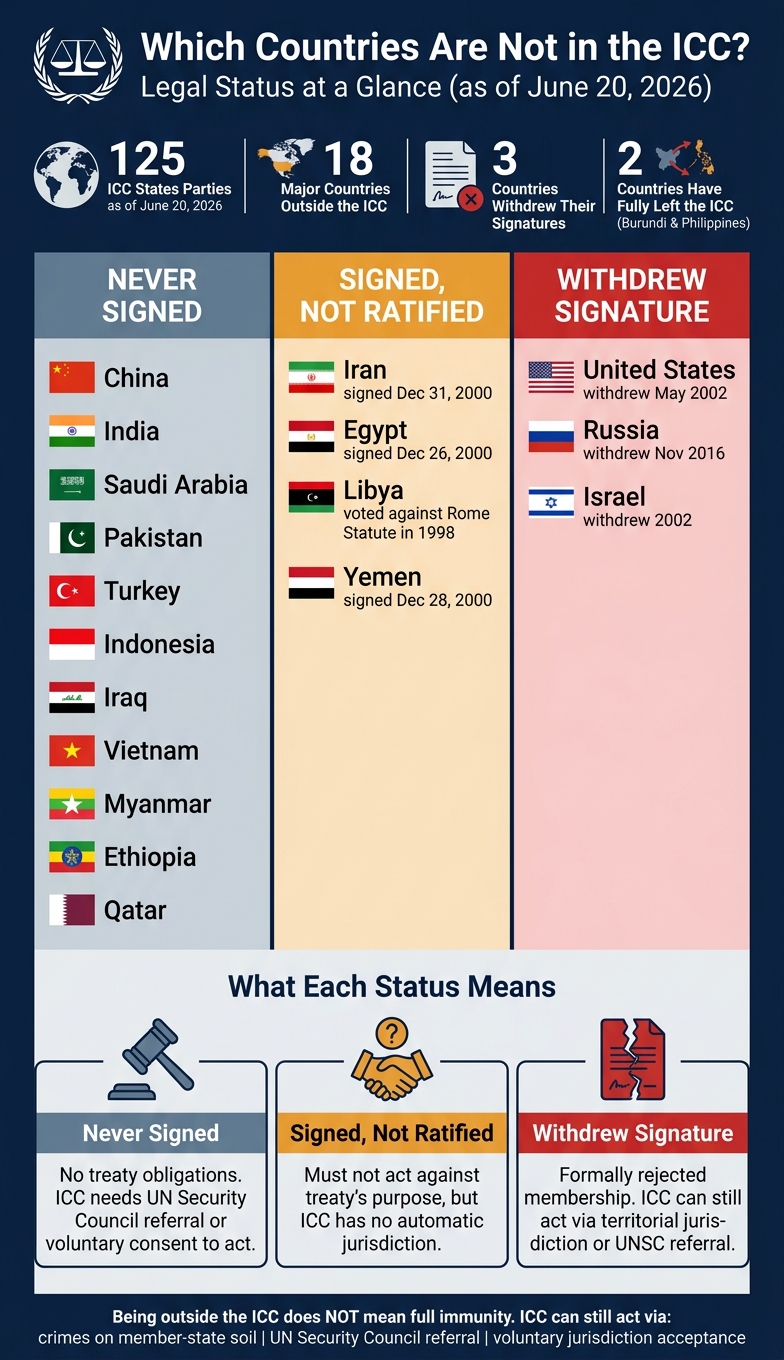
What it means to be outside the ICC
"Outside the ICC" means a country is not a State Party to the Rome Statute. In plain English, that can describe three different situations: a country never signed, signed but never ratified, or joined and later left.
Signing shows an intent to join, but it does not make the treaty binding in full. A signatory still must not act against the treaty’s purpose. Ratifying or acceding is the step that makes the Rome Statute legally binding and creates duties to cooperate.
Some countries signed the Rome Statute and later withdrew their signatures in a formal notice to the UN Secretary-General, saying they no longer planned to join. The United States did this in May 2002 under President George W. Bush, and Russia did the same in 2016. That’s why a simple status guide is useful: it helps separate non-signatories, non-ratifiers, and former members.
There’s also a separate category for former State Parties that withdrew under Article 127. That withdrawal takes effect one year after notification, and it does not stop investigations that were already in progress. So far, only Burundi and the Philippines have fully gone through that process.
This distinction matters because the ICC can still act in narrow situations, even when a country is not a member. A non-member can still come under ICC jurisdiction through:
- territorial jurisdiction
- a UN Security Council referral
- a voluntary declaration accepting ICC jurisdiction
A good example is Vladimir Putin. The ICC issued warrants for him in 2023 because Ukraine had accepted ICC jurisdiction. Sudan shows another path: the UN Security Council referred Darfur to the ICC in 2005.
The next section breaks these statuses down country by country.
sbb-itb-39d39a6
How countries can be outside the ICC: a quick status guide
Here’s the quick status guide. The table below uses simple labels so you can see each country’s ICC status at a glance.
Never signed means the country has no treaty obligations under the Rome Statute.
Signed, not ratified means the country has not finished the steps needed to become a State Party, and its signature carries only a limited obligation.
Withdrew signature applies to countries that formally notified the UN Secretary-General that they no longer intend to join.
| Country | ICC Status |
|---|---|
| United States | Withdrew signature |
| China | Never signed |
| India | Never signed |
| Russia | Withdrew signature |
| Israel | Signed, not ratified |
| Saudi Arabia | Never signed |
| Pakistan | Never signed |
| Turkey | Never signed |
| Indonesia | Never signed |
| Iraq | Signed, not ratified |
| Iran | Signed, not ratified |
| Egypt | Signed, not ratified |
| Vietnam | Never signed |
| Myanmar | Never signed |
| Ethiopia | Signed, not ratified |
| Libya | Signed, not ratified |
| Yemen | Signed, not ratified |
| Qatar | Signed, not ratified |
Next, each country is broken down in the same order.
1. United States
ICC status: Withdrew signature
The U.S. is outside the ICC for a pretty clear reason: it signed the Rome Statute in 2000, then told the UN in 2002 that it did not plan to ratify it and said its earlier signature created no binding obligations.
Congress also passed the American Service-Members’ Protection Act, which limits U.S. cooperation with the ICC.
The main U.S. objections come down to sovereignty and due process. In plain English, many U.S. officials have argued that an international court should not have authority over U.S. citizens. That stance has not stayed fixed, either. Across different administrations, U.S. policy has swung from open hostility to limited engagement. In February 2025, the U.S. reimposed sanctions on ICC officials after arrest warrants tied to Israeli leaders.
That said, being outside the court does not put Americans fully out of reach. The ICC can still prosecute U.S. citizens for crimes committed on the territory of a member state. So there is still room for ICC jurisdiction when a case is linked to member-state territory.
2. China
ICC status: Never signed
China never signed the Rome Statute. So, in most cases, the ICC has no direct jurisdiction there unless China agrees to it or the UN Security Council sends a case to the court.
China voted against the Rome Statute when it was adopted in 1998. Its main objection is simple: it says the court’s jurisdiction cuts into state sovereignty. And because China is a permanent member of the UN Security Council, it can veto referrals to the ICC. That makes it much harder for the court to act in cases involving Chinese nationals or crimes on Chinese territory. In plain terms, that veto gives China another layer of protection from ICC referrals.
In practice, the ICC usually cannot prosecute crimes committed in China or by Chinese nationals unless China accepts the court’s jurisdiction or the Security Council refers the case.
3. India
ICC status: Never signed
India never signed the Rome Statute. It abstained at the Rome Conference, where the Statute was adopted with broad support.
This wasn’t just a case of paperwork left unfinished. India objected to key parts of the court’s design, especially the UN Security Council’s power to refer or defer cases. It also pushed for a broader list of ICC crimes, including terrorism.
Because India is outside the ICC, it has no legal duty to cooperate with the court or carry out its arrest warrants. That point mattered in 2023, when India invited Russian President Vladimir Putin to the G20 and SCO summits. Since India is not bound by the ICC, it had no legal duty to arrest him under the warrant the court issued that year.
India also does not have the usual ICC cooperation duty unless some other legal basis comes into play, such as territorial jurisdiction or a UN Security Council referral. Put simply, India is a clear non-signatory, not a country that signed first and then stopped before ratification.
4. Russia
ICC status: Signed but never ratified; signature withdrawn
Russia signed the Rome Statute on Sept. 13, 2000. But it never ratified the treaty. Then, on Nov. 30, 2016, it told the UN Secretary-General that it no longer planned to join.
Russia rejects the court’s authority, especially after the ICC treated Crimea as occupied Ukrainian territory.
Still, stepping away from the court did not shield Russian officials from ICC action. On March 18, 2023, the ICC issued warrants for Vladimir Putin and Maria Lvova-Belova over the alleged unlawful deportation of Ukrainian children to Russia.
Those warrants cannot be enforced inside Russia. Even so, they can create problems outside the country, especially for foreign travel and state visits. That tension came into view before a BRICS summit in South Africa in August 2023, when Putin was expected to attend. South African presidential spokesperson Vincent Magwenya said:
"All heads of state would be expected to attend the summit. But now we have a spanner in the works in the form of this ICC warrant."
Russia also holds another layer of protection at the UN. As a permanent member of the UN Security Council, it can veto any referral to the ICC. At the same time, its case shows a hard truth: even countries outside the court can still run into ICC pressure once their leaders step onto the global stage.
5. Israel
ICC status: Signed but signature withdrawn
Israel is another case of a country that signed the Rome Statute and later pulled back. It signed on Dec. 31, 2000. But in 2002, Israel told the UN Secretary-General that it would not become a State Party and said its signature created no binding obligations.
Its main objection centered on the treaty’s war-crimes rule about transferring population into occupied territory. Israel saw that provision as aimed at its settlement policy.
Still, staying outside the treaty did not stop ICC action. The court says it has jurisdiction over crimes committed on Palestinian territory, which joined the ICC in 2015. On Nov. 21, 2024, the ICC issued arrest warrants for Prime Minister Benjamin Netanyahu and former Defense Minister Yoav Gallant. The court said there were reasonable grounds to believe they deprived Gaza civilians of essential supplies, including food, water, medicine, fuel, and electricity.
Those warrants have shaped travel plans too. In April 2025, Netanyahu reportedly rerouted a flight to the U.S. to avoid some ICC member states. Why does that matter? Because ICC member states are expected to enforce warrants if the targets enter their territory.
Israel’s case makes one point plain: being outside the Rome Statute does not fully shield officials from ICC reach.
6. Saudi Arabia
ICC status: Never signed
Saudi Arabia has never signed the Rome Statute, so it sits outside the ICC. As a non-State Party, it does not have to cooperate with ICC investigations or carry out arrest warrants unless the UN Security Council refers a case or Saudi Arabia accepts the court’s jurisdiction.
7. Pakistan
ICC status: Never signed
Pakistan is a clear non-signatory. It has never signed the Rome Statute, which means it sits outside the ICC.
Because of that, the ICC does not have direct jurisdiction over crimes committed on Pakistani territory or by Pakistani nationals. For the court to step in, one of two things would need to happen: the UN Security Council would have to refer the situation, or Pakistan would have to accept the court’s jurisdiction on its own.
So ICC involvement is possible, but only through those narrow, exceptional paths.
8. Turkey
ICC status: Never signed
Turkey has never signed or ratified the Rome Statute.
Because Turkey is not a State Party, the ICC usually does not have jurisdiction over crimes committed on Turkish territory or by Turkish nationals. The main exception would be a referral from the UN Security Council. So, in this list, Turkey is a straightforward non-signatory.
9. Indonesia
ICC status: Never signed
Indonesia has never signed or ratified the Rome Statute, so it sits outside the ICC. In plain terms, the court doesn’t have automatic reach there.
For the ICC to step in, it would need an unusual legal route. The court can act only if the UN Security Council refers the case or Indonesia accepts jurisdiction.
Iraq follows next, with a different ICC status.
10. Iraq
ICC status: Never signed
Iraq has never signed the Rome Statute and remains outside the ICC.
That means the ICC has no automatic jurisdiction in Iraq. For the court to act there, it would need either a UN Security Council referral or a voluntary declaration from Iraq. Neither has happened.
Because Iraq is not part of the Rome Statute system, it has no duty under that treaty to work with ICC investigations or carry out ICC arrest warrants on its territory.
Next: Iran, which is also outside the ICC but for different reasons.
11. Iran
ICC status: Signed, not ratified
Iran signed the Rome Statute on Dec. 31, 2000, on the last day it was open for signature, but it never ratified the treaty. So, in practice, Iran remains outside the ICC. That puts it in a middle ground between countries that never signed at all and countries that signed first, then later pulled out.
Since Iran is still a signatory, it must not act against the treaty’s object and purpose. But that does not mean the ICC automatically has jurisdiction over crimes committed in Iran or by Iranian nationals. For the court to step in, the UN Security Council would need to refer a case, or Iran would need to accept the court’s jurisdiction.
Egypt comes next with a similar signed-but-not-ratified status.
12. Egypt
ICC status: Signed, not ratified
Egypt signed the Rome Statute on Dec. 26, 2000, but never ratified it. That means the country is still outside the ICC.
So what does that mean in practice? Since Egypt is not a State Party, the ICC usually does not have jurisdiction over crimes committed in Egypt or by Egyptian nationals. There are still a couple of ways the court could step in: if the UN Security Council referred a situation, or if the crimes were committed on the territory of a State Party.
Next comes Vietnam, another country that has stayed outside the Rome Statute.
13. Vietnam
ICC status: Never signed
Vietnam has stayed outside the Rome Statute from the start. It has never signed the treaty, so its status is simple: non-signatory.
That matters for jurisdiction. Because Vietnam is not a State Party, the ICC usually cannot act on crimes committed in Vietnam or by Vietnamese nationals unless the UN Security Council refers the case or another valid legal basis applies.
Myanmar follows next with a similar never-signed status.
14. Myanmar
ICC status: Never signed
Myanmar has never signed or joined the Rome Statute. That means the ICC does not have automatic jurisdiction over crimes committed inside Myanmar. It can step in only if the UN Security Council refers the situation, or if part of the alleged conduct took place on the territory of a State Party.
The main exception is the Bangladesh/Myanmar case. Bangladesh is a State Party, so the ICC authorized an investigation in November 2019 into the Bangladesh/Myanmar situation (ICC-01/19). The investigation focuses on the forced deportation and persecution of the Rohingya. The court said it had jurisdiction because part of the alleged deportation happened on Bangladeshi territory.
Because Myanmar is not a member, it has no Rome Statute duty to cooperate with the court, hand over evidence, or carry out arrest warrants. In November 2024, the ICC Prosecutor filed an application for an arrest warrant for Senior General Min Aung Hlaing, citing alleged crimes against humanity tied to the deportation and persecution of the Rohingya.
A Security Council referral is unlikely, since China and Russia would veto it. For now, that leaves a major impunity gap.
Ethiopia follows, with a different ICC status.
15. Ethiopia
ICC status: Never signed
Ethiopia has never signed the Rome Statute and is not an ICC member.
That puts Ethiopia outside the ICC’s automatic jurisdiction. In plain terms, the court could step in only if the UN Security Council made a referral, or if Ethiopia filed an ad hoc declaration accepting ICC jurisdiction.
Ethiopia is one of the few African states outside the Rome Statute. Since it remains outside the treaty, it does not have to cooperate with ICC requests unless some other legal basis applies. In practice, that leaves domestic courts responsible for prosecution.
Libya follows with a different status: signed but not ratified.
16. Libya
ICC status: Signed, not ratified
Libya opposed the Rome Statute from the start. In 1998, it voted against the treaty’s adoption alongside six other countries.
That said, the ICC still has an active investigation into Libya. Membership is not the deciding factor here. The UN Security Council referred the situation to the court, and Article 13(b) of the Rome Statute gives the ICC jurisdiction even when a state is not a member. As of early 2026, Libya is one of 12 situations under active investigation by the ICC Office of the Prosecutor.
The tougher issue is enforcement. Because Libya has no treaty duty to cooperate, requests for evidence and arrest warrants depend on voluntary cooperation or outside pressure. And the ICC cannot carry out arrests on its own. So if cooperation does not happen, warrants can sit there without being enforced.
Yemen follows next.
17. Yemen
ICC status: Signed, not ratified
Yemen is in the same bucket as Libya: it signed the Rome Statute on Dec. 28, 2000, but never ratified it. That means Yemen is not a State Party.
So what does that mean in practice? The ICC does not get automatic jurisdiction over crimes committed on Yemeni territory. The court could only step in if the UN Security Council made a referral or if Yemen filed an Article 12 declaration accepting ICC jurisdiction. Neither has happened.
Yemen also has no treaty duty to cooperate with ICC investigations or carry out arrest warrants.
For now, alleged crimes in Yemen remain outside the ICC’s reach unless one of those jurisdiction triggers happens.
Qatar follows with the same signed-but-not-ratified status.
18. Qatar
ICC status: Never signed
Qatar stands apart from the earlier entries because it never signed the Rome Statute. Put simply, Qatar has never signed the Rome Statute and is not a State Party.
In 1998, Qatar voted against adoption of the Rome Statute. It was one of seven countries that did so.
Because Qatar is not a member, it has no treaty duty to cooperate with the ICC or enforce its warrants. The ICC also has no automatic jurisdiction over crimes in Qatar or crimes committed by Qatari nationals abroad unless another legal basis applies, such as a UN Security Council referral or crimes committed on the territory of an ICC State Party.
ICC status at a glance: comparison table for all 18 countries
These 18 countries are outside the ICC, so the Court usually has no automatic jurisdiction. Here’s the same information in a compact table.
| Country | Treaty Action | One-Line Legal Effect |
|---|---|---|
| United States | Withdrew signature | The U.S. actively opposes Court authority over its personnel. |
| China | Never signed | China opposes the Court’s reach. |
| India | Never signed | India cites sovereignty and security concerns for staying out. |
| Russia | Withdrew signature | Russia does not recognize the Court’s authority. |
| Israel | Withdrew signature | Israel disputes the Court’s authority over its territory. |
| Saudi Arabia | Never signed | A UN Security Council referral or Saudi Arabia’s consent would be needed. |
| Pakistan | Never signed | A UN Security Council referral or Pakistan’s consent would be needed. |
| Turkey | Never signed | A UN Security Council referral or Turkey’s consent would be needed. |
| Indonesia | Never signed | A UN Security Council referral or Indonesia’s consent would be needed. |
| Iraq | Signed, not ratified | A UN Security Council referral or Iraq’s consent would be needed. |
| Iran | Signed, not ratified | A UN Security Council referral or Iran’s consent would be needed. |
| Egypt | Signed, not ratified | A UN Security Council referral or Egypt’s consent would be needed. |
| Vietnam | Never signed | A UN Security Council referral or Vietnam’s consent would be needed. |
| Myanmar | Never signed | A UN Security Council referral or Myanmar’s consent would be needed. |
| Ethiopia | Never signed | A UN Security Council referral or Ethiopia’s consent would be needed. |
| Libya | Signed, not ratified | A UN Security Council referral or Libya’s consent would be needed. |
| Yemen | Signed, not ratified | A UN Security Council referral or Yemen’s consent would be needed. |
| Qatar | Never signed | A UN Security Council referral or Qatar’s consent would be needed. |
A couple of patterns jump out. Three countries – the United States, Russia, and Israel – formally withdrew their signatures. And 7 of the 18 countries also voted against adopting the Rome Statute in 1998.
That split matters most when jurisdiction gets tested in actual cases.
Why some countries stay outside the ICC
Governments tend to stay outside the Rome Statute for a few recurring reasons.
Sovereignty is the biggest sticking point. Major powers often say an international court shouldn’t have authority over their citizens.
Military exposure is another concern. States worry ICC cases could go after soldiers or senior officials.
In the U.S., critics also say the Rome Statute clashes with constitutional due process.
Regional politics matter too. Nine of the first ten situations the ICC first investigated involved African countries. That fed claims that the Court is biased toward weaker states. In 2009, after the ICC indicted Sudanese President Omar al-Bashir, several African states called for a mass withdrawal from the Rome Statute.
This mix of motives helps explain why staying outside the ICC doesn’t always mean a country has zero exposure to the Court. It also shapes cooperation, enforcement, and arrest risk.
What non-membership means in practice
Non-members can still face ICC action, but the court’s reach is narrower.
The core rule: the ICC usually can’t investigate crimes committed on a non-member state’s territory or by its nationals. But there are two big exceptions.
If a national of a non-member state commits crimes on the territory of a member state, the ICC can still go after that person. And the UN Security Council can refer any situation to the ICC, whether or not the country involved signed the Rome Statute. That’s how the court got jurisdiction over Sudan in 2005 through Resolution 1593 and Libya in 2011.
So while non-members sit outside the treaty, they aren’t completely out of reach.
The most obvious effect shows up in travel. As of April 2025, 31 individuals were still at large despite active ICC arrest warrants. ICC member states must arrest warrant targets if they enter their territory. In April 2025, Israeli Prime Minister Benjamin Netanyahu’s flight to the United States added 400 km to its route to avoid flying over European member states that might have been legally required to act on his warrant if an emergency landing became necessary.
That’s where the difference becomes concrete. A non-member state does not have to help the ICC under the Rome Statute. It does not have to carry out arrest warrants, share intelligence, or hand over evidence. In plain terms, enforcement often turns on travel risk, UN Security Council referrals, and voluntary action.
The table below sums up the main differences between member and non-member states:
| Status | Obligation to Arrest Warrant Targets | Can ICC reach nationals? | Can ICC reach territory? |
|---|---|---|---|
| State Party | Legally required | Yes | Yes |
| Non-Member | No duty to cooperate under the Rome Statute | Possible if crimes occur on member soil | No automatic territorial jurisdiction; only through a UN Security Council referral |
In practice, the biggest gaps come down to arrest duties, cooperation, and territorial jurisdiction.
The ICC also acts only when national courts are unwilling or unable to prosecute. That’s the complementarity principle. It helps explain why ICC jurisdiction can still matter even when a country is outside the Rome Statute.
Can a country’s ICC status change?
Yes. These statuses are current, not permanent. A country’s ICC status can change over time. States can join, withdraw, or pull back a withdrawal notice.
Countries join through ratification or accession. Ratification applies to countries that signed the Rome Statute earlier. Accession applies to countries that never signed it. Armenia, for example, acceded to the Rome Statute on November 14, 2023, and became the 124th State Party on February 1, 2024.
The reverse can happen too. A State Party can withdraw by notifying the UN Secretary-General. That withdrawal takes effect one year later. But a country can also rescind that notice before the deadline.
Hungary did exactly that. It notified the UN of its intent to withdraw on June 2, 2025, then rescinded that notification on May 29, 2026, only days before it would have taken effect. South Africa also rescinded its withdrawal notice after a domestic court ruled that it was unconstitutional without parliamentary approval.
Conclusion
Put side by side, these examples make one thing clear: being "outside the ICC" doesn’t mean just one legal status. It can mean a state never signed the Rome Statute, signed it but never ratified it, withdrew its signature, or joined and later left.
That distinction matters. Each status comes with different legal effects. It shapes whether the ICC can act through treaty duties, territorial jurisdiction, or a Security Council referral. It also affects cooperation, arrest risk, and how far ICC jurisdiction can extend.
As of June 20, 2026, there are 125 States Parties to the Rome Statute. ICC status can change over time, so this list is a snapshot, not a permanent ranking.
FAQs
Can the ICC prosecute people from non-member countries?
Yes. The ICC can prosecute people from non-member countries in some cases.
In most situations, the court has jurisdiction when the alleged crime happened in a member state, no matter the person’s nationality.
It can also investigate a case if:
- The United Nations Security Council refers the situation
- The non-member state accepts the court’s jurisdiction for that specific situation
What is the difference between signing and ratifying the Rome Statute?
Signing the Rome Statute shows that a country intends to join the International Criminal Court. But signing alone does not make the treaty legally binding.
It does, however, mean the country should avoid actions that would undermine the treaty’s purpose.
Ratification is the formal step that makes a country a full ICC member. That’s the point when the country becomes legally bound by the court’s rules and jurisdiction.
Can a country join or leave the ICC later?
Yes. A country can join the International Criminal Court by ratifying or acceding to the Rome Statute, which makes it a State Party. And if a country signed the treaty but didn’t ratify it at the time, it can still ratify it later.
A State Party can also leave the Court. To do that, it must formally notify the United Nations Secretary-General. In most cases, the withdrawal takes effect one year after the notice is received.
