
A second passport is now a backup plan, not a trophy. I’d sum up the 2026 shift like this: wealthy families want mobility, banking access, tax planning room, and a way to avoid having their whole life tied to one government.
Here’s the short version:
- Global demand for residency and citizenship programs climbed about 300% from 2020 to 2025
- U.S. applications doubled in 2025 and remain high in 2026
- 93% of those U.S. applicants are still living in the United States
- Families are using second citizenship to reduce one-country risk across travel, taxes, banking, and relocation
- The main paths in 2026 are Caribbean citizenship by investment, Malta, and residency-first routes like Portugal
- A passport alone does not protect wealth; it usually works best when paired with trusts, holding companies, and LLCs
If I were putting it plainly, the logic is simple: if one country changes its tax rules, limits movement, tightens banking access, or adds controls, a family with only one passport has fewer options. That’s why many high-net-worth families now treat citizenship as part of the same planning stack as trusts and cross-border entities.
A few routes stand out. Caribbean programs are often used for lower cost and fast processing. Malta is aimed at families that want EU citizenship and can handle a much higher spend plus a residence period. Portugal fits people who can wait five years for a path to EU citizenship through residence first.
| Route | Main draw | Typical timeline | Main tradeoff |
|---|---|---|---|
| Caribbean CBI | Lower cost and faster approval | About 2 to 9 months | Donation usually not returned |
| Malta | Full EU citizenship | About 12 to 36 months | High cost and tighter review |
| Portugal residency-first | Lower upfront spend | 5 years | Residence period and language test |
The big takeaway: wealthy buyers are not just buying travel perks. They’re buying options. And in 2026, options matter more than image.
The risks pushing wealthy families toward second passports
Problem: geopolitical instability, capital controls, and sudden policy shifts
That shift shows up in three clear pressures. In 2026, wealthy families face more exposure to sanctions, capital controls, and sudden policy shifts. Account freezes, emergency financial measures, and capital controls can appear with almost no warning. The UK’s abolition of its non-dom regime is a good example of how fast a favorable tax setup can disappear. For families, the risk isn’t just about money. It’s also about whether spouses and children can relocate fast if conditions get worse.
More wealthy families are building multi-jurisdiction portfolios made up of residence rights, citizenships, and business interests. The aim is simple:
"The objective is to ensure that no single government holds the whole of a family’s life and capital." – Basil Mohr-Elzeki, Managing Partner and Head of Private Clients Americas, Henley & Partners
Problem: travel freedom can disappear faster than most people expect
The years from 2020 to 2022 showed just how fast travel freedom can vanish. That period pushed wealthy families to treat mobility as a risk issue, not just a lifestyle perk.
Vanuatu and Spain make that point in a very direct way. In 2024, Vanuatu‘s EU Schengen visa-free access was permanently revoked. That left recent passport holders with a document that no longer delivered its main benefit. Spain shut down its real estate-linked Golden Visa program that same year. For mobile families, a passport can lose value almost as fast as an investment can. A second citizenship from another jurisdiction gives them a backup path if visa-waiver deals change or borders tighten.
Problem: Americans face worldwide taxation and growing reporting complexity
The U.S. is one of only two countries in the world that taxes its citizens on global income, no matter where they live or where the income was earned. That means U.S. citizens deal with worldwide taxation, FBAR and FATCA reporting, and steep penalties if they make mistakes. On top of that, many foreign banks refuse to open accounts for U.S. passport holders. In plain English, a second passport can act like a practical key for banking outside the U.S. system.
There’s another catch. To renounce U.S. citizenship, a person must already hold another nationality. Renunciation can also trigger exit tax obligations, which makes timing and sequencing a big deal. Getting a second citizenship years before any renunciation decision gives families room to plan around those costs. That’s why many wealthy families now treat second citizenship as a planning tool, not a luxury purchase.
sbb-itb-39d39a6
How a second passport addresses these problems
Solution: citizenship creates jurisdictional diversification
Those risks help explain why wealthy families look at citizenship as a form of jurisdictional diversification. A second passport gives a family legal ties to another country. When conditions shift fast, that matters. It also lowers exposure to any single jurisdiction.
Citizenship is harder to lose than residency, so it serves as a stronger fallback when rules change. A Golden Visa gives you a residency permit, and that permit can be revoked. Citizenship by investment (CBI) gives you full nationality and a much more durable right to live, work, and retire in that country. A visa-policy change can’t strip those rights away.
"Citizenship is no longer pursued as an end goal. It has become one component within a broader risk-management architecture." – Patricia Casaburi, CEO, Global Citizen Solutions
For families that want a backup plan they can count on, citizenship is the more durable choice.
Solution: backup mobility, residency options, and family continuity
That staying power matters most when a family needs to move fast, keep children in school, or maintain banking access. EU citizenship can open the door to local healthcare and lower university tuition across member states, which helps preserve family continuity across borders.
Some citizenships also come with specific business rights. Grenada‘s CBI program is one of only a few that makes applicants eligible for the U.S. E-2 Treaty Investor visa. That can let holders operate businesses inside the United States. This isn’t a vague perk. It’s tied to a specific treaty right.
For Americans, a second citizenship is often the first move in a longer-term expatriation plan. U.S. law, in practice, requires another nationality before you can renounce U.S. citizenship, because renouncing without one would leave you stateless.
Solution: better results when paired with asset-protection structures
Citizenship by itself doesn’t protect assets. It has to fit into a bigger structure. A passport helps with mobility and legal access. On its own, it doesn’t fix ownership, privacy, or estate-planning issues. That’s where legal entities come in.
"The wealthiest families increasingly think like portfolio managers. They are building a deliberate architecture across jurisdictions: residence in one country, citizenship in another, business and banking structures elsewhere." – Basil Mohr-Elzeki, Managing Partner, Henley & Partners
In practice, that usually means pairing a second citizenship with structures such as offshore holding companies, U.S. LLCs, and irrevocable trusts. The citizenship handles where you can go and how you can bank. The entities handle what you own, how it’s titled, and how it passes to the next generation.
For U.S. citizens, timing matters. Secure the second citizenship before moving assets into foreign holding entities. Get the order wrong, and you can trigger unwanted U.S. tax exposure, including exit tax issues. A second passport works best as part of a coordinated tax, legal, and residency plan.
The second-passport routes wealthy investors are using in 2026
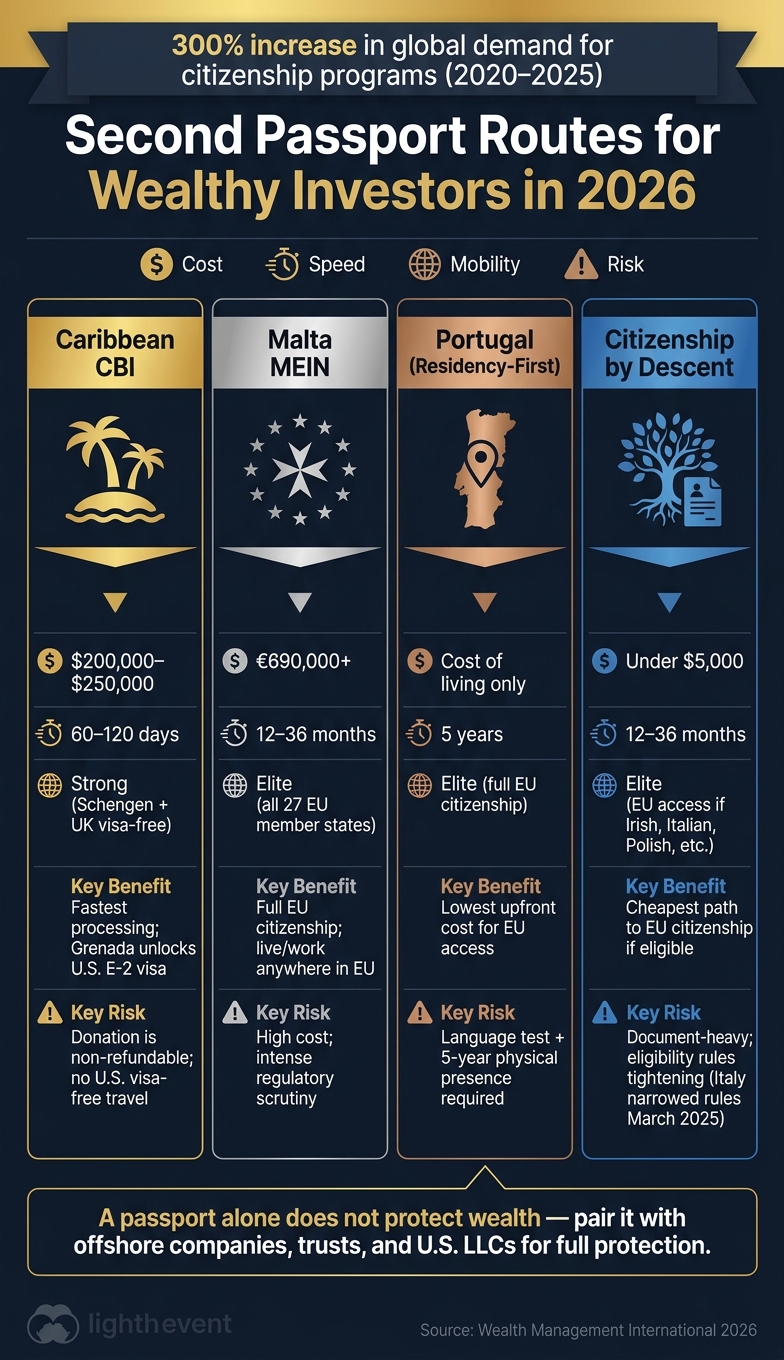
Once the risk profile is clear, the next move is picking the route that fits the family’s timing and goals. And that matters, because not every second-passport route solves the same problem.
Some families want speed. Others care most about EU access, business rights, or a path to move for good. In 2026, most routes fall into three main buckets.
European options: Malta and Austria for top-tier access
Malta and Austria remain at the top end of the market because they offer full European Union citizenship. That means the right to live, work, and do business across all 27 EU member states.
For families that want the strongest foothold in Europe, these are the premium choices.
Malta’s program, the Malta Exceptional Investor Naturalisation (MEIN) route, requires a contribution of €600,000, or €750,000 for a faster track, plus a property lease or purchase and a €10,000 charitable donation. The all-in cost comes to about €690,000 or more.
There’s a catch: applicants must also complete 12 to 36 months of residence in Malta before citizenship is granted. The European Commission has kept a close eye on the program, which has made the process tighter and slower.
Caribbean citizenship-by-investment: faster processing and lower entry costs
If speed is the main goal, the Caribbean is usually the clearest match. Most programs deliver citizenship in about 3 to 9 months, and they do so without residency requirements.
In 2026, the five Eastern Caribbean nations operate under the Eastern Caribbean Citizenship by Investment Regulatory Authority (ECCIRA), which became operational in April 2026. ECCIRA standardized due diligence across the region and set a $200,000 minimum price floor.
The programs don’t all look the same. Cost, timing, and perks vary, so the small print matters.
| Program | Min. Donation Cost (USD) | Processing Time | Notable Benefit | Key Tradeoff |
|---|---|---|---|---|
| St. Kitts & Nevis | $250,000 | ~60 days (AAP) | Fastest route via AAP | Higher cost than some peers |
| Antigua & Barbuda | $230,000 (family of 4) | 3–6 months | Flat fee for larger families | 5-day physical visit required in first 5 years |
| Dominica | $200,000 | 3–6 months | Lowest entry cost in region | Primarily a mobility-and-backup option |
| Grenada | $235,000 | 3–6 months | U.S. E-2 Treaty Investor visa eligibility; visa-free China access | Slightly higher cost than Dominica |
| Saint Lucia | $240,000 | 3–6 months | Flexible investment options | More expensive than Dominica |
St. Kitts and Nevis stands out as the fastest route on the market. Its Accelerated Application Process (AAP) can deliver citizenship in about 60 days.
Antigua and Barbuda often works best for families of four or more. Why? Because the $230,000 donation covers the full family, instead of adding charges person by person.
Residency-first and fast-track paths for longer-term planners
Families with more time can take a different route: lower upfront cost in exchange for patience.
Portugal’s D7 and D8 visas are the best-known example in 2026. A family can set up legal residency in Portugal through passive income or remote work, live there for five years, pass a basic Portuguese language test, and then apply for full EU citizenship. Portugal costs far less upfront than Malta, but it asks for something else in return: five years of residence and a language test.
Tradeoffs, legal risks, and how to build a complete plan
Problem: the wrong passport strategy can create cost, compliance, and reputational risk
After a family picks a path, the next challenge is simple: cost, compliance, and structure.
Caribbean programs cost less and usually rely on a donation model. Malta sits in a very different tier, with an all-in price in the high six figures.
That price gap can tempt people to chase the cheapest option. But there’s a catch. If a program has weak due diligence, the passport can lose part of its travel value over time. A low price is not much of a deal if the program later faces tighter scrutiny or weaker acceptance abroad.
There’s also a tax point that trips people up. A second passport does not change U.S. tax status or reporting duties. And for some Americans who give up citizenship, covered expatriate rules can trigger exit tax.
Here’s how the main routes stack up:
| Route | Cost | Speed | Mobility | Key Risk |
|---|---|---|---|---|
| Caribbean CBI | $200,000–$250,000 | 60–120 days | Strong (Schengen/UK) | Non-refundable donation; lacks U.S. visa-free travel |
| Malta (premium EU route) | €690,000+ | 12–36 months | Elite (EU access) | High cost; intense regulatory scrutiny |
| Naturalization (Portugal) | Cost of living | 5 years | Elite (EU access) | Language test and physical presence required |
| Citizenship by descent | Under $5,000 | 12–36 months | Elite (EU access) | Document-heavy; eligibility rules are tightening |
Rules can also change fast. Spain shut down its golden visa in 2024, and Italy narrowed ancestry-based claims in March 2025, cutting off many great-grandparent claims. What looks open today can close before next year rolls around.
"A single passport, however strong, is no longer sufficient. Sovereign optionality has moved from a secondary consideration to a primary one." – Dominic Volek, Group Head of Private Clients, Henley & Partners
Solution: pair citizenship with offshore companies, trusts, and private U.S. LLCs
Travel access matters. But wealth protection comes down to how the passport fits into the ownership setup.
A second passport solves a mobility issue. By itself, it does not protect a company, guard an estate, or cut a tax bill. That takes legal planning around ownership, control, and succession.
The strongest setup pairs citizenship with the right tools for the job:
- An offshore company in a place like Anguilla can support international business activity and investments.
- An offshore trust can help with estate planning and asset protection.
- A private U.S. LLC can hold investments with a layer of privacy and structural separation that a personal account does not provide.
Put plainly: the passport handles mobility; the structure handles ownership and succession. Trying to build one without the other is like buying a safe and leaving the door open.
Before spending six figures on CBI, it also makes sense to check descent first. Many Americans have Irish, Italian, or Polish ancestry that may open the door to EU citizenship for under $5,000. Missing that option can turn into a very expensive mistake.
Conclusion: second passports are now a contingency asset, not a luxury
In 2026, a second passport is less of a status symbol and more of a backup plan for families who know that geopolitics, tax rules, and travel access can shift faster than expected.
The demand shows it. Applications from U.S. nationals for residency and citizenship programs doubled in 2025 and are still at record highs this year. More than 28% of investment migration applicants in early 2026 already live outside their country of nationality. People are setting up options before a problem forces their hand.
Families that do this well don’t treat citizenship as a stand-alone purchase. They combine passport-based mobility and jurisdictional spread with wealth protection and succession planning through offshore companies, trusts, and private U.S. LLCs, all built with proper legal and tax guidance as one plan.
FAQs
How do I choose the right second-passport route?
Choose the route that fits your main goal – travel, tax flexibility, or long-term security – not prestige.
- Citizenship by investment is the fastest path. In most cases, it takes about 3 to 12 months.
- Citizenship by descent is often the lowest-cost option, if you qualify through family history.
- Naturalization takes more time, but it can cost less if you’re able to move and live in the country.
The key is simple: match your budget, timeline, and ancestry to the option that solves the problem you’re trying to fix.
Will a second passport reduce my U.S. taxes?
No. A second passport does not lower your U.S. taxes.
The United States taxes its citizens on worldwide income, no matter where they live. That means you still have to file U.S. tax returns and report foreign accounts under FATCA and FBAR.
A second passport might open up tax-planning options in another country. But it does not erase your main U.S. tax duties.
What should I set up before applying?
First, figure out which path matches your resources, timeline, and personal background: descent, investment, naturalization, marriage, or a golden-visa-to-citizenship route. At the same time, get clear on your goal. Are you after a geopolitical backup, more visa-free travel, or better tax and business mobility? That choice shapes almost everything that follows.
If you’re a U.S. applicant, pay close attention to tax reporting rules like FATCA and FBAR. You’ll also want to confirm any physical-presence rules and double-check your eligibility and paperwork, especially if you’re applying through citizenship by descent. A missing document can slow the whole process down fast.
