
Yes – I can often get a second passport and keep my U.S. passport too. The main issue is not the United States. It’s the other country’s law and the path I use to get citizenship.
Here’s the short version:
- The U.S. usually allows dual citizenship
- Some countries do not, or they limit it by application type
- I usually have 4 legal paths:
- Descent
- Residency-based naturalization
- Marriage
- Investment
- A second passport does not end U.S. tax filing rules
- I need to check cost, timeline, family coverage, and any renunciation rule before I apply
If I want the lowest out-of-pocket route, I’d check family ancestry first. If I can move abroad, naturalization may work. If I’m married to a foreign citizen, that may cut the wait. If I want the fastest route and can pay $100,000+, citizenship by investment may be the path.
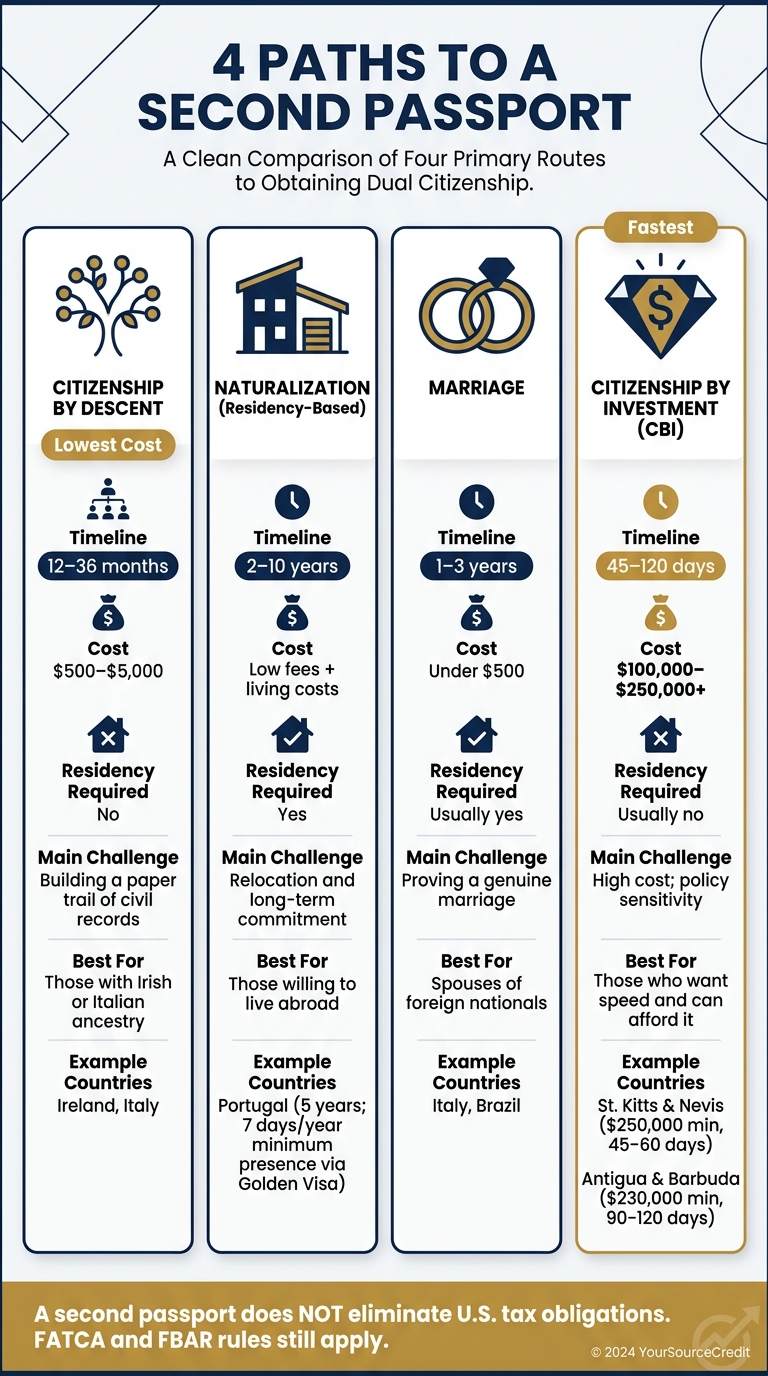
Quick comparison
| Path | Usual timeline | Cost | Need to live there? | Main issue |
|---|---|---|---|---|
| Descent | 12–36 months | $500–$5,000 | No | Paper trail |
| Naturalization | 3–10 years | Fees + living costs | Usually yes | Time and relocation |
| Marriage | 1–3 years | Often under $500 | Usually yes | Proof of a real marriage |
| Investment | 45–120 days | $100,000–$250,000+ | Usually no | High cost |
A few facts stand out. Portugal can lead to citizenship after 5 years of legal residency via the Portugal D7 visa. St. Kitts and Nevis may process in about 45 to 60 days. Antigua and Barbuda often takes 90 to 120 days. Ireland may allow a claim through a grandparent, and Italy now limits many descent cases to those with an Italian-born grandparent under Law 74/2025.
Before I file anything, I’d confirm these 5 points:
- Does the target country allow dual citizenship for my route?
- Will it ask me to give up my first citizenship?
- How much will the full process cost in U.S. dollars?
- Can my spouse or children be included?
- Will I still owe U.S. taxes and foreign account reports? Yes.
That’s the core answer: I can often get a second passport without renouncing my first, but only if both countries’ rules line up and I choose the right path.
sbb-itb-39d39a6
1. Check dual citizenship rules before you apply
Before you apply, check both sets of rules: whether your current citizenship allows dual nationality and whether your target country allows it under the route you plan to use. That part matters more than many people think. The goal isn’t just to get a second passport. It’s to get one without losing the first.
And here’s the catch: the rule can change by route. A country might allow dual citizenship through descent but require renunciation for naturalization. Once you know where you stand, it gets much easier to pick the path that fits your timeline, budget, and family plans.
What dual citizenship means for U.S. citizens
For U.S. citizens, the baseline rule is fairly simple: you can usually keep your U.S. citizenship when you naturalize in another country unless you formally renounce it. Even so, dual citizenship doesn’t erase U.S. obligations. U.S. citizens still need to enter and leave the United States using a U.S. passport, so it’s smart to confirm the exact rules with the other country’s embassy or consulate before you move ahead.
How to confirm whether the second country requires renunciation
Around 150 countries allow some form of dual citizenship, but the fine print can vary a lot by route. Germany is a good recent example. In June 2024, it changed its laws to generally let naturalization applicants keep their original citizenship. Other countries are more limited. Spain and the Netherlands allow dual citizenship only in certain treaty-based cases, and South Africa requires citizens to apply for retention approval before they voluntarily acquire another citizenship.
So don’t rely on a country’s general image or what you’ve heard online. Check the rule tied to your exact path – descent, marriage, naturalization, or something else.
Tax, reporting, and planning issues to review first
A second citizenship does not change U.S. tax rules. U.S. citizens still owe tax on worldwide income and must report foreign accounts over $10,000. FATCA also requires foreign financial institutions to report accounts held by U.S. citizens directly to the IRS. In plain English, a second passport may change how easily you travel, but it does not change your U.S. tax exposure.
It’s also worth checking two other points early:
- Whether the second country has military-service rules
- Whether it limits U.S. consular help for dual nationals while they are in that country
Once the legal side is clear, the next step is to compare your options by speed, cost, and who qualifies. That usually comes down to four main paths: descent, residence, marriage, or investment.
2. The four legal paths to a second passport
These four routes mainly differ on cost, speed, residency, and who qualifies. The best fit comes down to your paperwork, how open you are to living abroad, and how much you can spend. The simplest way to narrow it down is to compare the simplest citizenship programs and each path by timeline, cost, residency rules, and whether family members can come along.
Which route fits your situation
Descent is often the lowest-cost path, so it should usually be the first one you check if you have Irish or Italian roots. The catch isn’t money. It’s proof. You’ll need birth, marriage, and sometimes death records that show the full family line. That paper trail can take a while to build, even when government fees stay fairly low.
Naturalization works for people who are willing to live in a country long enough to qualify. It usually means legal residency for a set number of years, often 3 to 10 years, and it often comes with language and civics tests. Out of the four, this one asks the most from your day-to-day life because you need to relocate, stay there, and become part of the country.
Marriage can shorten the path for spouses of foreign citizens, often down to 1 to 3 years, and filing fees are often under $500. But this isn’t just a paperwork shortcut. You need to show that the marriage is real, and many countries also expect some time spent in the country.
Citizenship by investment (CBI) is the fastest option for people who want flexibility and can afford the price tag. Caribbean programs like St. Kitts and Nevis and Antigua and Barbuda (where you can occasionally find CBI price reductions) can process applications in as little as 60 to 120 days, and they generally don’t ask for long-term residency. It moves fast, but it also costs the most and can shift with policy changes. A single applicant should expect around $100,000 to $250,000+.
Comparison table: descent vs. naturalization vs. marriage vs. investment
Use the table below to line up each route with your budget and timeline.
| Route | Typical Timeline | Estimated Cost (USD) | Residency Required | Main Trade-off | Example Countries |
|---|---|---|---|---|---|
| Descent | 12–36 months | $500–$5,000 | No | Heavy on proof; archival research needed | Ireland, Italy |
| Naturalization | 2–10 years | Low fees + living costs | Usually yes | Slow; requires relocation and settling in | Portugal |
| Marriage | 1–3 years | Under $500 | Usually yes | Requires proof of a real marriage | Italy, Brazil |
| Investment | 60–120 days | $100,000–$250,000+ | Usually no | Expensive and sensitive to policy shifts | St. Kitts and Nevis, Antigua and Barbuda |
Treat these as rough ranges. Exact rules depend on the country and your case.
If you can verify European ancestry, start with descent before spending money on investment citizenship. If descent looks possible, the next move is proving the family line.
3. Getting a second citizenship through ancestry, residence, or marriage
Citizenship by descent: Ireland and Italy as examples
Citizenship by descent can give you a legal path through a parent or grandparent, even if you’ve never lived in that country. If your family line qualifies, this is often the fastest and lowest-cost option.
Ireland is one of the more straightforward examples. If one grandparent was born there, you may be able to register on the Foreign Births Register for about €278 ($330). Processing usually takes 12 to 18 months.
Italy also permits descent claims, but the rules are tighter now. Under Law 74/2025, only descendants of a grandparent born in Italy qualify. The consular fee is about €300, and total costs, including document gathering and certified translations, can range from $2,000 to $10,000. Processing through a U.S. consulate can take 2 to 5 years. If you apply directly at an Italian municipality, it may take 3 to 6 months.
The hard part with descent claims is the paper trail. You need a full chain of certified civil records, including birth, marriage, and death certificates for each person linking the qualifying ancestor to you.
For Italian cases, there’s another hurdle: you must show that the ancestor did not naturalize in the United States before the next generation was born. A Certificate of Non-Existence can help with that. You’ll also need to apostille and translate all foreign records before filing.
If ancestry isn’t an option, residency-based naturalization is the next route most people look at.
Naturalization in a dual-friendly country: Portugal
Portugal offers a dual-friendly path to naturalization after 5 years of legal residency, proof of Portuguese language ability, and a clean criminal record. Application fees are generally under $1,000.
One reason Portugal gets so much attention is its Golden Visa route. The physical presence rule can be as low as 7 days per year during the 5-year residency period. After those 5 years, you can apply for citizenship without giving up your U.S. passport. That said, rules can shift, so it’s smart to check the current physical presence rules with Portuguese authorities before you apply.
Marriage can also shorten the timeline, but only if the country’s citizenship laws allow it.
Citizenship through marriage
Marriage can cut down the wait for naturalization. In Italy, for example, a foreign spouse must be married for 2 years if living in Italy or 3 years if living abroad before applying. Filing costs are usually under $500, though background checks, proof that the relationship is genuine, and sometimes a language requirement may also apply.
Even then, marriage-based citizenship still depends on the country’s dual-nationality rules, and some countries still require renunciation.
4. Citizenship by investment: when speed and flexibility matter
When speed matters more than residency, investment-based routes move to the front of the line. If ancestry and residency paths don’t work for you, citizenship by investment can be the faster legal route.
How Caribbean citizenship by investment programs work
Applicants usually pick either a donation route or a real estate route. After that, they go through due diligence checks, including background reviews, source-of-funds checks, and interviews.
St. Kitts and Nevis has a minimum donation of $250,000 through the Sustainable Island States Contribution (SISC), or $325,000 through a qualifying real estate purchase. Its Accelerated Application process can lead to citizenship in 45 to 60 days. There is no physical presence rule, and the passport gives visa-free access to 157 destinations, including the Schengen Area and the U.K.
Antigua and Barbuda asks for a minimum donation of $230,000 to the National Development Fund for a family of up to four. For families of six or more, the University of the West Indies Fund route is $260,000. Processing usually takes 90 to 120 days. Antigua also requires at least 5 days of physical presence during the first five years of citizenship. As of January 2026, the U.S. put partial visa restrictions on Antigua and Barbuda nationals in the B-1/B-2, F, M, and J categories.
Both programs allow dual citizenship, which means you can keep your current passport. One catch: applications must go through a licensed agent. You can’t submit directly to the Citizenship by Investment Units.
Comparison table: Portugal vs. St. Kitts and Nevis vs. Antigua and Barbuda
The table below compares timing, presence rules, family coverage, and visa access.
| Feature | Portugal (Golden Visa) | St. Kitts and Nevis | Antigua and Barbuda |
|---|---|---|---|
| Route Type | Residency-by-investment leading to citizenship | Donation or real estate | Donation or real estate |
| Time to Citizenship | 5 years | 45–120 days | 90–120 days |
| Min. Investment | ~$216,000 (€200,000) | $250,000 | $230,000 |
| Physical Presence | 7 days per year | None | 5 days in first 5 years |
| Dual Citizenship | Allowed | Allowed | Allowed |
| Family Inclusion | Spouse and dependents | Spouse and dependents | Spouse, children, parents (55+), siblings |
| Visa Access | Full EU freedom of movement | 157 visa-free destinations | Schengen and U.K. access; some U.S. visa categories are restricted |
Antigua also lets you include unmarried siblings and financially dependent adult children who are still in higher education under one application.
How a second citizenship fits a broader asset-protection plan
A second passport can help spread jurisdictional risk. For many U.S. citizens, that means more travel options, more legal flexibility, and the option to hold assets across different legal systems.
That said, a second passport does not cut your U.S. tax duties. If you’re a U.S. citizen, you’re still taxed on worldwide income and still subject to FATCA and FBAR reporting, no matter how many other passports you hold.
Before applying, add up the full cost, the expected timeline, and who in your family can be included.
5. Pre-application checklist: costs, timelines, family, and long-term security
Budget the full cost in U.S. dollars, not just the headline fee
Once you narrow down the route, pressure-test the full price before you commit. The headline fee is almost never the full bill.
Budget in U.S. dollars and include everything: government charges, due diligence, legal help, translations, apostilles, dependent fees, and any real estate holding costs. If the route requires you to keep money tied up for a set period, factor in the cost of lost liquidity too. Locked-up capital, holding periods, and resale limits can change the deal more than people expect.
Then compare that total with what you’re getting in return. That might mean:
- family coverage
- visa-free access
- EU freedom of movement
- a faster backup plan
A route that looks cheap at first can end up costing more, while a pricier option may offer far better long-term use.
Confirm timelines, residence commitments, and family eligibility
Next, check the practical details that often knock applications off course. Confirm the actual timeline, the residence requirement, and who in your family qualifies before you file.
Paperwork delays and consular backlogs can stretch descent-based claims far past the first estimate. And if a route requires physical presence, missing the required days in country can reset your naturalization clock. In plain English: tracking time in-country isn’t optional.
Family rules matter just as much. Citizenship by descent can offer the strongest multigenerational path. For example, Irish citizenship registered on the Foreign Births Register can be passed to your children. Some CBI programs are tighter, especially when it comes to adding family members later if they weren’t part of the first application. If your main goal is long-term family use rather than speed, that difference can change the math in a big way.
Conclusion: Choose the route that matches your mobility and protection goals
Use those checks to choose the route that fits what you need most. The right path is the one that solves your actual goal, whether that’s mobility, backup residence, family continuity, or long-term legal security.
A second passport works best when it sits inside a broader legal plan. That means checking dual-citizenship compatibility with your current country first, coordinating with a tax professional on FATCA and FBAR obligations, and making sure the new citizenship can help your family in the next generation, not just on the next trip.
FAQs
Which second-passport route is best for my situation?
The best route depends on what matters most to you: speed, cost, stability, family eligibility, and long-term mobility goals.
Here’s the simple breakdown:
- Fastest: citizenship by investment in Caribbean countries like St. Kitts and Nevis, Antigua and Barbuda, or Grenada
- Lowest cost: citizenship by descent, if you qualify through ancestry
- Most practical for relocation: naturalization through residency if you already plan to live abroad
Can my spouse and children get citizenship with me?
Yes, often they can. It depends on the country’s rules around citizenship, naturalization, or family reunification.
In many cases, a spouse may qualify through marriage. Children may qualify through family reunification or derivative citizenship. The timeline and eligibility rules can vary a lot, so it’s smart to check the exact requirements in the country where you’re applying.
What documents should I gather before I apply?
Gather the documents that show who you are, how your family line connects, and why you qualify.
That usually includes your birth certificate, the birth and marriage records of the ancestor tied to your claim, and the records that connect each generation. In plain English, you need a paper trail from that ancestor to you.
That paper trail can include:
- Name change records
- Naturalization papers
- Divorce decrees
- Adoption records
In some cases, you may also need proof of residence or tax residency, along with documents that show your link through ancestry, marriage, or investment.
One detail trips people up all the time: paperwork rules. If the country handling your case asks for it, make sure each document is apostilled and translated the right way.
