
If your grandparents were born in another country, you might qualify for citizenship there. Many nations, especially in Europe, offer citizenship through descent, allowing you to claim a second passport without living abroad or making large investments through the simplest citizenship programs. Here’s what you need to know:
- Key Requirement: Your grandparent must have been a citizen of the country when your parent was born. An unbroken chain of citizenship is crucial.
- Benefits: A second passport can grant access to live, work, and travel freely in multiple countries, including visa-free travel to over 170 nations.
- Popular Countries: Ireland, Italy, Poland, and others allow claims through grandparents, each with unique rules and timelines.
- Costs: Applying through ancestry is typically under $1,500 in government fees, much lower than investment-based options.
- Challenges: Missing documents, name mismatches, or complex lineage rules (like Italy’s “1948 Rule”) can complicate applications.
To start, gather your family’s birth, marriage, and naturalization records. Confirm your eligibility and prepare for varying processing times and legal requirements. A second passport isn’t just about travel – it’s about expanding options for living, working, and financial planning.
Eligibility Criteria for Citizenship by Descent
How to Self-Assess Your Eligibility
The first step is to determine whether your grandparent retained their original citizenship when your parent was born. This detail is crucial in deciding whether the lineage remains intact or has been interrupted.
Start by gathering key details for each generation: birth dates, birth countries, naturalization dates (if applicable), and the birth date of the next generation. Typically, if your grandparent became a U.S. citizen after your parent was born, the lineage is considered intact. However, if they naturalized before your parent’s birth, the chain is broken. To confirm the naturalization date, you can request records from USCIS or the National Archives and Records Administration (NARA).
If no naturalization record exists, you can obtain a Certificate of Non-Existence from USCIS. This document verifies that your ancestor never naturalized, providing strong evidence to support your claim that the lineage is unbroken.
Common Legal Requirements Across Countries
Once you’ve assessed your eligibility, it’s time to review the legal requirements that apply to citizenship-by-descent programs.
Most countries require an unbroken chain of citizenship transmission. This means no ancestor in the lineage must have voluntarily renounced their original citizenship before the next generation was born. Additionally, applicants must provide a complete set of certified documents for every individual in the family chain.
Certain rules can catch applicants off guard. For instance, Italy’s "1948 Rule" prohibits claims through a female ancestor born before January 1, 1948, unless you file and win a judicial appeal. These appeals typically cost between $3,300 and $6,600. Similarly, Ireland requires that if your claim is based on a great-grandparent, your parent must have been registered on the Foreign Births Register before your birth to maintain the citizenship link.
Countries That Allow Citizenship Through Grandparents
With these legal frameworks in mind, let’s look at countries that allow citizenship claims based on grandparent heritage. Here’s a breakdown of some key programs available to Americans:
| Country | Grandparent Requirement | Key Eligibility Date | Processing Time |
|---|---|---|---|
| Ireland | Grandparent born in Ireland or Northern Ireland; requires FBR registration | Registration on the Foreign Births Register | 12–18 months |
| Italy | Grandparent born in Italy (post-March 2025 law) | Post-March 17, 1861 (Unification) | 2–5 years (consular) |
| Poland | Grandparent held Polish citizenship | Post-January 31, 1920 | 3–12 months |
| Lithuania | Grandparent held Lithuanian citizenship | Pre-June 15, 1940 (Soviet Occupation) | Varies |
| Slovakia | Allows claims up to great-grandparent level | 2022 expansion | Varies |
Italy’s recent legal changes are particularly noteworthy. Under Law 74/2025, the country now limits claims to applicants with a grandparent born in Italy. Previously, there was no generational cap, and applicants often traced their lineage back several generations.
"The new law limits claims to applicants with a grandparent born in Italy. Previously, Italy had no generational limit at all – applicants routinely traced lineage back 4, 5, or even 6 generations. That era is now over." – WhereNext Research Team
Poland, on the other hand, remains relatively flexible. As long as the ancestor held Polish citizenship after January 31, 1920, there is no strict generational limit. Slovakia also expanded its program in 2022, allowing claims up to the great-grandparent level without requiring applicants to meet a language proficiency standard.
Meanwhile, Hungary stands out for its language requirement. Applicants must pass a conversational interview in Hungarian at a B1 proficiency level, making it one of the few programs that includes a mandatory language test.
Across Europe, the demand for citizenship-by-descent programs has surged. By 2025, over 1.2 million applications had been filed, leading to increased competition for consular appointments and longer processing times.
sbb-itb-39d39a6
Preparing Documents for Citizenship Applications
Key Documents You Will Need
For a citizenship-by-descent application, you’ll need a thorough set of documents that clearly trace your lineage back to your ancestor. This includes birth, marriage, and death certificates for every individual in the chain – from your grandparent born in the home country through each generation. Missing even one record could delay or derail your application.
In addition to vital records, you’ll need evidence of your ancestor’s citizenship status. A naturalization certificate is essential if they became a U.S. citizen. If they never naturalized, you’ll need a Certificate of Non-Existence from USCIS to confirm this officially.
| Document Type | Purpose | Common Challenge |
|---|---|---|
| Birth Certificate | Establishes the bloodline link | Missing records due to war, fire, or name changes |
| Marriage Certificate | Connects generations and confirms identity | Discrepancies between religious and civil records |
| Naturalization Record | Proves the citizenship chain was not broken | Records split between USCIS and NARA |
| Certificate of Non-Existence | Confirms ancestor never naturalized | Must be obtained directly from USCIS |
Once you’ve collected these documents, the next step is to address any inconsistencies or gaps that could complicate your application.
How to Handle Missing or Inconsistent Records
Missing records are a common hurdle, especially for ancestors who emigrated in the late 1800s or early 1900s. Begin your search with your own documents, then work backward through your parents’ and grandparents’ records. Generally, the closer the records are to the present, the easier they are to locate.
One major red flag that consulates often spot is a name mismatch. For example, an ancestor who arrived as "Giuseppe" but later went by "Joseph" creates a gap in documentation. To bridge this, you might need a court order or a "one and the same" affidavit to confirm both names refer to the same person. If civil records are entirely missing – such as those destroyed in parts of Italy or pre-1926 Quebec – Catholic parish records can often serve as substitutes. For example, the Drouin Collection, digitized by FamilySearch, is a trusted source for older baptismal and marriage records.
For Polish citizenship claims, you may encounter partition-era records written in Russian, German, or Yiddish, depending on the ruling empire at the time. These documents are valid but must be translated by a certified translator before submission.
Once your documents are complete, the next step is ensuring they meet international authentication and translation standards.
Apostilles, Legalization, and Translations
After gathering your records, many countries require an additional layer of authentication. An apostille – a stamp verifying the document’s authenticity for international use – is often required. For instance, Italy and Poland mandate apostilles on every generation’s civil records submitted to their consulates. Ireland’s Foreign Births Register process, however, usually does not require apostilles for most standard submissions.
Certified translations are another key requirement. Countries like Italy demand that all documents be translated into Italian by a certified translator. Translation fees typically range from $25 to $50 per page. If you’re pursuing Polish citizenship, be prepared for higher costs and longer timelines when translating partition-era records, as these often require translators with expertise in historical languages.
One crucial tip: never submit photocopies of previously issued certified documents. Always request new certified copies with an embossed seal directly from the issuing authority. Consulates, including those of Italy and Canada’s IRCC, will reject photocopies outright, and resubmitting can add months to an already lengthy process.
How the Application Process Works in Key Countries
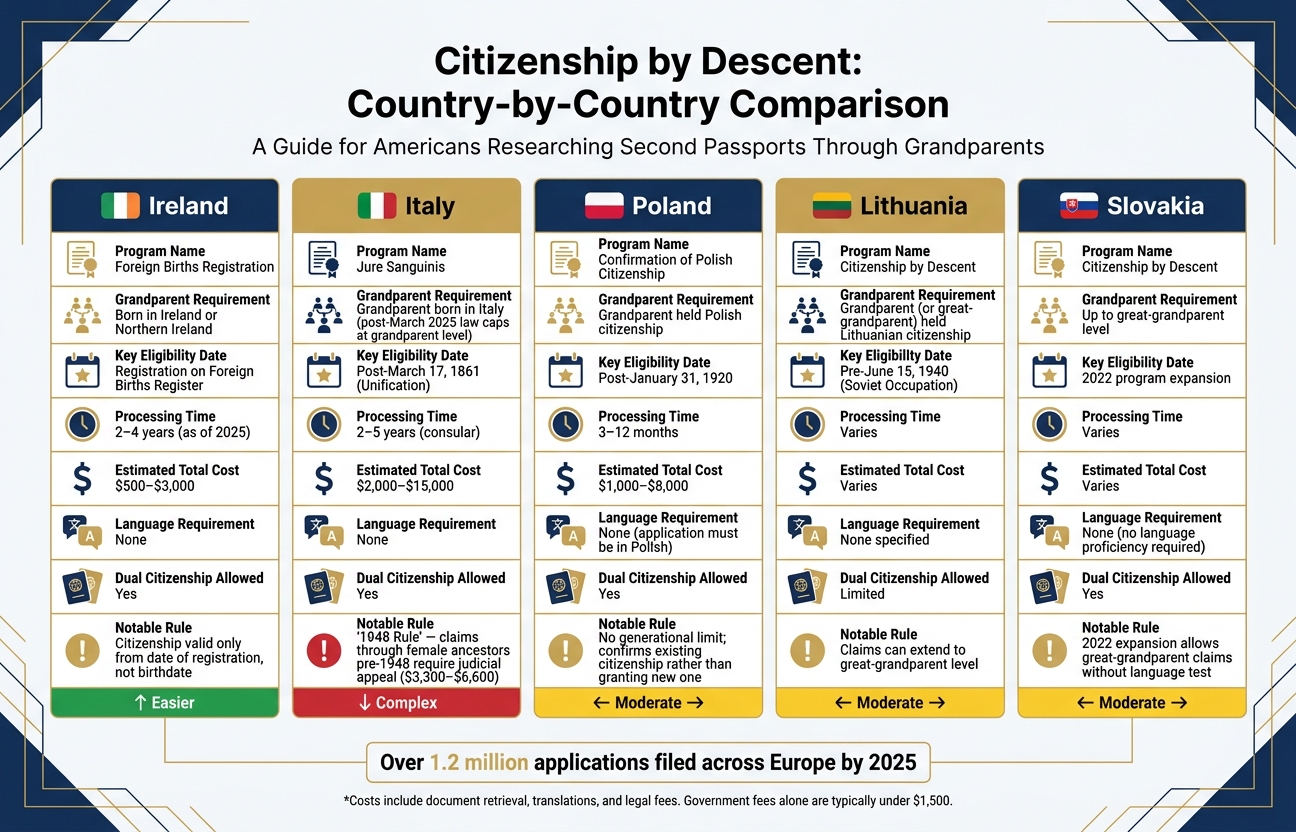
Understanding the citizenship application process in different countries is crucial to avoid unnecessary delays. Each country has its own unique steps, so being prepared can save time and effort.
Ireland: Registering on the Foreign Births Register
If you have an Irish-born grandparent, you can claim Irish citizenship by registering your birth on the Foreign Births Register, overseen by Ireland’s Department of Foreign Affairs. This is not automatic – you need to apply, submit the necessary documents, and wait for approval before you can obtain an Irish passport.
One key detail: Irish citizenship through this method becomes valid only from the date of registration, not your birthdate. This means if you want to pass citizenship to your children, you must complete your registration before their birth.
The required documents include:
- Full long-form birth certificates for you and your Irish-born grandparent
- Marriage certificates linking each generation
- Your current U.S. passport
For grandparents born before 1864, when civil registration began in Ireland, you’ll need to rely on church records available through resources like the National Archives of Ireland or IrishGenealogy.ie.
The registration fee is around €278, but processing times are lengthy. As of early 2025, applications submitted roughly 30 months earlier were still being processed. Plan for a potential wait of 2 to 4 years. The good news? Ireland allows dual citizenship, so you won’t need to give up your U.S. passport.
Now, let’s see how Italy’s process differs.
Italy: Claiming Citizenship by Descent (Jure Sanguinis)
Italy’s jure sanguinis program allows individuals to claim citizenship through a grandparent, provided your Italian ancestor did not naturalize as a U.S. citizen before the next generation was born. This ensures a continuous citizenship chain through your lineage.
Applications must be submitted to the Italian consulate responsible for your area, and wait times vary depending on the consulate. Costs for this process typically range from $2,000 to $15,000.
Next, let’s explore how Poland and nearby countries handle their citizenship confirmation processes.
Poland and Central Europe: Proving Citizenship Continuity
Poland’s process, called Confirmation of Polish Citizenship (potwierdzenie posiadania obywatelstwa polskiego), is managed by the regional authority (Wojewoda) where your ancestor lived. Unlike Ireland or Italy, Poland doesn’t grant new citizenship; instead, it confirms that you’ve held Polish citizenship continuously through your lineage.
A major challenge is proving that your ancestor never voluntarily renounced their Polish citizenship. For instance, obtaining U.S. citizenship before 1962 could have led to automatic loss of Polish citizenship under certain historical laws. Applications must be submitted in Polish, with all foreign documents certified and translated.
Other Central European countries, like Lithuania and Latvia, have similar programs based on pre–World War II citizenship records. In Lithuania, you can claim citizenship through a grandparent – or even a great-grandparent – who was a Lithuanian citizen before June 15, 1940. Each country has its own documentation requirements, so the process varies. Regardless, precise records are essential for securing another passport, which can open up financial and travel opportunities.
| Country | Program Name | Estimated Total Cost (USD) |
|---|---|---|
| Ireland | Foreign Births Registration | $500 – $3,000 |
| Italy | Jure Sanguinis | $2,000 – $15,000 |
| Poland | Confirmation of Polish Citizenship | $1,000 – $8,000 |
Asset Protection and Tax Planning With a Second Passport
Securing a second passport through descent opens doors to offshore banking, legal strategies, and global residency options. For many Americans, it provides access to foreign banking, company formation, and residency opportunities that a U.S. passport alone cannot offer.
Tax Implications for US Citizens
Here’s an important point: a second citizenship doesn’t erase your U.S. tax responsibilities. The U.S. taxes its citizens on worldwide income, no matter where they live or how many passports they hold. You’re still required to file annual U.S. tax returns and report foreign accounts via FBAR (FinCEN Form 114) if your combined foreign account balances exceed $10,000 at any point during the year.
For 2026, the Foreign Earned Income Exclusion (FEIE) allows you to exclude up to $132,900 of foreign earned income if you reside abroad. Additionally, the Foreign Tax Credit (FTC) can help reduce double taxation. However, these provisions don’t eliminate the need to file U.S. tax forms. Missing required filings like the FBAR can result in penalties starting at $10,000 per unfiled form.
If you’re considering renouncing U.S. citizenship to eliminate future tax obligations, having a second passport is non-negotiable. Without another citizenship secured, renunciation isn’t even an option.
These tax obligations coexist with offshore strategies that can strengthen your global asset protections.
How Dual Citizenship Fits Into Offshore Strategies
Dual citizenship goes beyond tax considerations to unlock additional offshore opportunities. For instance, holding EU citizenship – whether Irish, Italian, or Polish – grants you unrestricted freedom to live, work, and travel across all 27 EU member states and EFTA countries, without needing visas or meeting income thresholds. This creates what some advisors call a "downstream residency target" – essentially, using your EU passport to establish tax residency in a different country. For example, Irish citizens can legally reside and pay taxes in Portugal, effectively separating their tax obligations from Ireland.
The tax treaty between your second country and the U.S. is another key factor. Some treaties, like the U.S.-Italy agreement, offer favorable provisions for things like pensions, while others, such as the U.S.-Poland treaty, are less comprehensive. Choosing your citizenship pathway based solely on accessible family records, rather than aligning it with your financial and legal goals, is a common mistake.
Dual citizenship also facilitates offshore company formation and foreign banking. The legal right to live and work in a jurisdiction provides a stronger basis for opening accounts and creating business structures in countries with different asset protection laws.
Understanding these benefits is essential, but missteps during the process can derail your plans.
Common Mistakes to Avoid
Beyond documentation errors, there are financial and structural mistakes that can cause serious challenges later.
One major issue is failing to review your U.S. financial structures first. It’s important to update your domestic financial setup to avoid unexpected compliance issues.
Another common pitfall is overlooking PFIC rules. For instance, U.S.-Canadian dual citizens who hold Canadian mutual funds or ETFs face harsh U.S. tax treatment under Passive Foreign Investment Company (PFIC) rules. Opting for individual stocks or U.S.-domiciled funds instead can sidestep this problem entirely.
Lastly, underestimating total costs can lead to financial shortfalls midway through the process. While government fees for descent programs are generally low, expenses like document retrieval, certified translations, legal advice, and travel can add up quickly. For example, applying through an Italian consulate might cost between $2,000 and $10,000, while Irish applications typically range from $400 to $1,300.
Conclusion: Taking Action on Citizenship by Descent
A second passport through your grandparents is more than just a dream – it’s a real possibility for millions of Americans. Consider this: about 33 million Americans have Irish ancestry, 17 million trace their roots to Italy, and 9 million have Polish heritage. Yet, for many, these citizenship rights remain untapped, hidden within their family history.
The first and most critical step? Tracing your lineage and confirming that the citizenship chain remains intact from your grandparents to you. This involves verifying naturalization dates, understanding registration requirements, and familiarizing yourself with the specific rules of the country you’re targeting. As one legal framework puts it:
"You are not applying for a favor; you are confirming a right that has existed since your ancestor’s time." – whereTOemigrate
Time is of the essence. Policies can change quickly. For example, Italy recently limited its generational rule to the grandparent level in March 2025. Delaying action could mean missing out on opportunities that are available today. That’s why it’s so important to start gathering and authenticating your documents as soon as possible. Keep in mind that obtaining naturalization records from USCIS or NARA can take anywhere from 4 to 12 months.
Beyond the passport itself, the benefits are substantial. A second passport can enhance your global mobility, provide access to offshore banking, open doors to EU residency, and even offer more favorable tax planning options. It’s not just about travel – it’s about creating a stronger, more secure financial future.
For more complex cases, like navigating Italy’s 1948 judicial route or dealing with Polish partition-era records, expert guidance can make all the difference. A preliminary eligibility assessment – whether conducted by a legal professional or through a structured intake process – can save you both time and money before diving into a full application. Start your research now and take the first step toward securing not just a second passport, but a more flexible and resilient global future.
FAQs
How do I know if the citizenship chain was broken?
To determine if the citizenship chain remains intact, ensure that each ancestor retained their citizenship up until the birth of their child. If any ancestor became a naturalized citizen of another country before their child was born, the chain is considered broken. Collect key documents such as birth, marriage, death, and naturalization records. Verify all dates using official sources to confirm accuracy. Maintaining an unbroken chain is a critical requirement for qualifying for citizenship by descent.
What documents are usually the hardest to get or fix?
The most challenging documents to secure or amend are often naturalization records, proof of non-naturalization, and birth, marriage, and death certificates for ancestors in your family line. These records can be particularly tricky to track down if they are outdated, incomplete, or stored in another country. On top of that, they frequently need certification, apostilles, and translations, which can make the process even more complicated and time-consuming.
Will a second passport change my U.S. taxes?
As a U.S. citizen, having a second passport doesn’t change your tax responsibilities. The U.S. taxes its citizens on their worldwide income, no matter how many additional citizenships or passports they hold.
Related Blog Posts
- EU Citizenship by Descent: How to Claim an Ancestral Passport You Didn’t Know You Had
- The World’s Easiest Citizenships: Passports You Can Get Without Major Investment
- Citizenship by Investment vs. Citizenship by Descent: Which Path Makes More Sense?
- Which countries let you get citizenship through ancestry?
