
Three countries are introducing new citizenship by investment (CBI) programs in 2026: Argentina, Saint Vincent and the Grenadines (SVG), and São Tomé and Príncipe (STP). These programs cater to individuals seeking second citizenship through economic contributions, offering unique benefits and investment thresholds:
- Argentina: Requires $300,000–$500,000 in sectors like renewable energy and technology. Benefits include visa-free access to 161–165 destinations, Mercosur residency rights, and U.S. E-2 treaty visa eligibility. However, its implementation faces delays.
- Saint Vincent and the Grenadines: Estimated $200,000 minimum donation to a national fund. Offers visa-free access to 150+ destinations, with a 30-day residency requirement.
- São Tomé and Príncipe: The most affordable option at $90,000. Provides limited visa-free travel (61–74 destinations) but includes pathways to Portuguese citizenship via CPLP membership.
Each program varies in cost, benefits, and mobility, making it essential to compare these against the simplest citizenship programs in the world to align choices with personal goals.
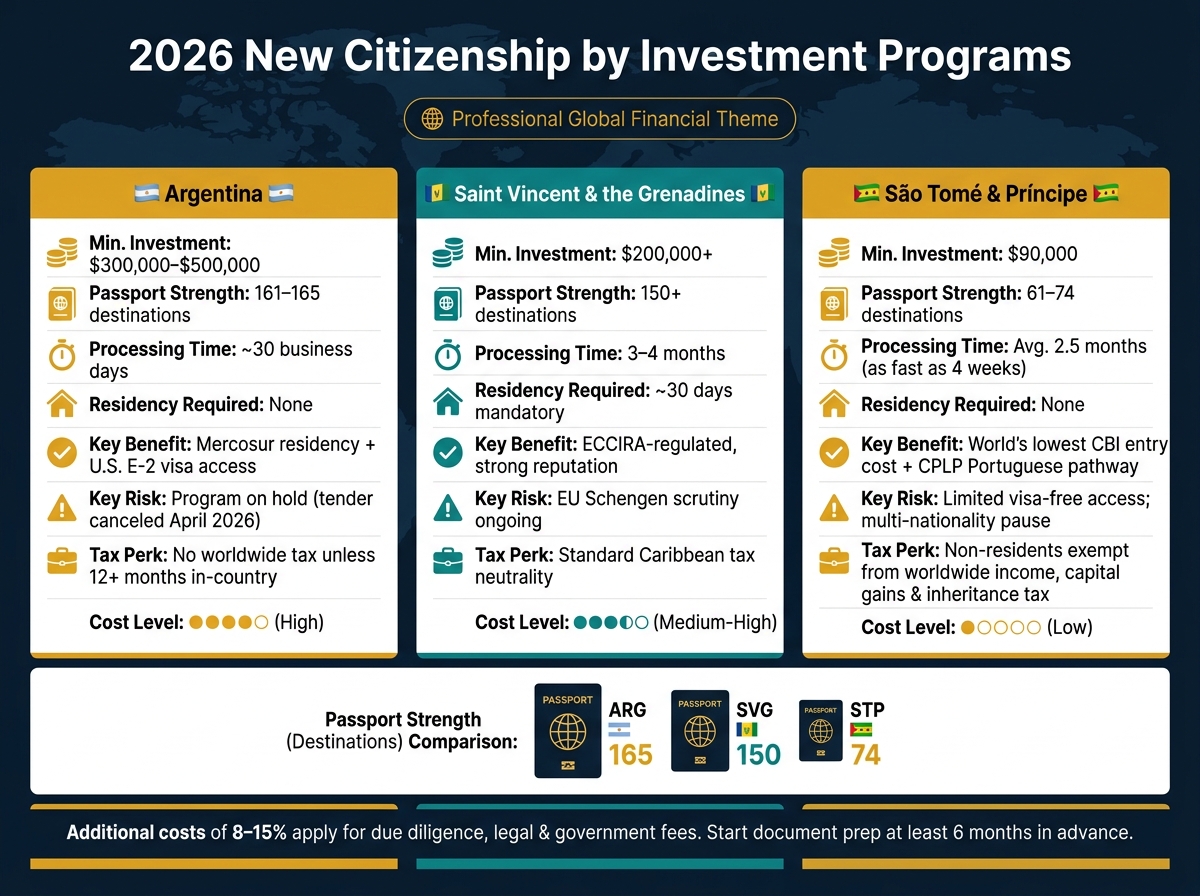
Quick Comparison
| Country | Min. Investment | Key Benefits | Passport Strength | Processing Time |
|---|---|---|---|---|
| Argentina | $300,000–$500,000 | Mercosur residency, U.S. E-2 visa access | 161–165 destinations | ~30 business days |
| Saint Vincent and the Grenadines | $200,000+ (estimated) | 150+ visa-free destinations, ECCIRA standards | 150+ destinations | 3–4 months |
| São Tomé and Príncipe | $90,000 | Low cost, CPLP Portuguese pathway | 61–74 destinations | ~2.5 months |
These programs offer distinct opportunities for global mobility, tax benefits, and asset protection, tailored to different investor priorities.
sbb-itb-39d39a6
1. Argentina
Argentina is preparing to launch its first official citizenship by investment program. This initiative marks a shift in the country’s strategy to attract foreign capital, grounded in a solid legal framework.
Launch Status
The program was established under Decree 524/2025 in July 2025 and is currently in the final stages of implementation. It is expected to officially launch in the second half of 2026. However, there was a recent hiccup – an international tender for a program master agent was canceled in April 2026 due to procedural issues. The Ministry of Economy explained:
"Continuing under the current conditions could not ensure the required strategic coherence."
Despite this, the program’s legal foundation remains intact. The government projects it will bring in about 5,000 investor families and generate over $2.5 billion in foreign direct investment.
Minimum Investment
The expected minimum investment for the program is $500,000, though the final terms are still being finalized. This amount is notably lower than the U.S. EB-5 visa threshold of $800,000, aiming to attract high-net-worth individuals. Applications are expected to be processed within 30 business days once submitted.
Investment Type
Investors will need to direct their funds into specific sectors such as agribusiness, renewable energy (including lithium and green hydrogen), technology, mining, and infrastructure. Residential real estate investments are excluded. European attorney Victoria Cold from Golden Harbors commented:
"The focus is expected to be on productive investments rather than purely passive options."
This focus aligns with President Javier Milei’s broader economic reforms, which aim to channel international investments into projects that support Argentina’s development goals.
Mobility and Asset Protection Benefits
The program offers significant benefits for investors, particularly in terms of mobility and asset protection. Argentina’s passport ranks between 12th and 15th globally, providing visa-free or visa-on-arrival access to 161–165 destinations, including the EU Schengen Area, the UK, Japan, and South Korea. Additionally, citizenship grants the right to live and work across Mercosur member and associated states, such as Brazil, Chile, Uruguay, and Colombia – an economic region of over 295 million people.
From a tax perspective, the program is highly appealing. Investors are not subject to personal income tax on foreign-sourced income. Moreover, acquiring citizenship does not automatically make an investor a tax resident unless they maintain a physical presence in Argentina for 12 continuous months. As a U.S. E-2 treaty country, Argentina also allows its citizens to apply for U.S. investor visas, providing opportunities to operate businesses in the United States. Dual citizenship is fully allowed, letting applicants retain their original nationality.
| Feature | Details |
|---|---|
| Legal Basis | Decree 524/2025 and Decree 366/2025 |
| Expected Launch | Second Half of 2026 |
| Min. Investment | $500,000 (Anticipated) |
| Key Sectors | Agribusiness, Renewable Energy, Tech, Mining |
| Passport Rank | 12th to 15th Globally |
Applicants should be prepared to provide detailed documentation regarding the source of their funds. Seven government agencies, including the State Intelligence Secretariat (SIDE) and the Financial Information Unit (UIF), will be involved in the vetting process. Dual citizenship is fully permitted, allowing investors to maintain their original nationality.
2. Saint Vincent and the Grenadines
Saint Vincent and the Grenadines (SVG) is the sixth and final independent Eastern Caribbean nation to introduce a citizenship by investment program.
Launch Status
The program is scheduled to launch in mid-2026, with the government projecting an initial revenue of $10 million for that fiscal year. Prime Minister Dr. Godwin Friday emphasized the program’s guiding principles:
"We will not compete on volume. We will not compromise on standards. And we will not trade reputation for short-term gain."
From day one, SVG’s program will adhere to ECCIRA standards. This includes biometric screenings, standardized interviews, and ongoing due diligence (CIDD) throughout the life of the citizenship. Vetting will be centralized through CARICOM IMPACS.
Minimum Investment
The program sets an estimated minimum donation of $200,000. While the government has confirmed the existence of a mandated investment floor, the exact figure has yet to be officially announced.
Investment Type
All contributions will be directed to the Saint Vincent and the Grenadines Investment Fund (SVGIF). The funds will support three primary areas:
- Climate-resilient infrastructure
- Social infrastructure, such as healthcare and education
- A fiscal resilience buffer for debt reduction and disaster liquidity
A real estate investment option is being considered but remains unconfirmed.
As of March 2025, SVG’s public debt had surpassed $3 billion, with a debt-to-GDP ratio expected to reach about 113% by mid-2026. Deputy Prime Minister Major St. Clair Leacock highlighted the program’s economic significance:
"Citizenship by investment will be an important contributor to the economic transformation that must and will take place."
These structured investments aim to bolster global mobility and provide robust asset protection.
Mobility and Asset Protection Benefits
Holders of an SVG passport will gain visa-free access to over 150 jurisdictions, including the EU Schengen Area. Processing times are expected to range from 3 to 4 months. Unlike many other Caribbean programs, SVG will require applicants to complete a mandatory residency of about 30 days, fostering a genuine connection to the nation.
| Feature | Details |
|---|---|
| Target Launch | Mid-2026 |
| Min. Donation | $200,000 (Estimated) |
| Investment Vehicle | Saint Vincent and the Grenadines Investment Fund (SVGIF) |
| Residency Requirement | Mandatory (estimated 30 days) |
| Processing Time | 3–4 months (Estimated) |
| Visa-Free Access | 150+ jurisdictions, including the EU Schengen Area |
3. São Tomé and Príncipe
São Tomé and Príncipe (STP), a small island nation in the Gulf of Guinea, has quietly entered the spotlight by introducing the world’s most affordable citizenship by investment (CBI) program.
Launch Status
The program officially launched on August 1, 2025, under Decree-Law No. 07/2025. Applications became available in September 2025, with the first passports issued in January 2026. The early response was promising. Disney Leite Ramos, Director of the Citizenship Investment Unit, shared:
"I’m proud to announce that the CIU has received over 220 submissions… in our first few months of operation."
A key update came on April 10, 2026, when a legislative amendment allowed passports and National IDs to be issued entirely remotely. This process uses video verification with the Civil Registry and Notary Office. Imad Elbitar, Managing Partner at NTL, highlighted:
"Remote passport issuance now enables applicants to complete the process online, removing the need for travel."
However, applications from individuals holding three or more foreign nationalities were temporarily paused in April 2026, pending a parliamentary review.
Minimum Investment
STP’s program stands out for its affordability. At just $90,000 for a single applicant, it significantly undercuts competitors. For families of two to four members, the cost rises modestly to $95,000, with an additional flat $5,000 submission fee per application. Adding a spouse later costs $10,000 more than including them in the initial application. Below is a breakdown of the government costs:
| Applicant Type | NTF Contribution | Submission Fee | Est. Total Gov. Cost |
|---|---|---|---|
| Single Applicant | $90,000 | $5,000 | $95,750 |
| Family (2–4) | $95,000 | $5,000 | $101,500–$103,000 |
| Family (5+) | $100,000+ | $5,000 | $108,750+ |
Investment Type
The program offers one investment route: a non-refundable contribution to the National Transformation Fund (NTF). Funds from the NTF are allocated to key sectors such as renewable energy, healthcare, education, tourism, and industrial infrastructure. Unlike other programs, there are no real estate or equity investment options. Notably, São Tomé and Príncipe is the first CBI program to integrate blockchain technology, using the OPN Chain to record applications and payments for added transparency.
Mobility and Asset Protection Benefits
The STP passport provides visa-free or visa-on-arrival access to approximately 61–74 destinations, including Singapore, Hong Kong, and South Africa. While this mobility is less extensive compared to Caribbean passports (which typically cover 140–150+ countries), the program’s affordability makes it a strong contender. Additionally, São Tomé and Príncipe’s membership in the Community of Portuguese Language Countries (CPLP) offers simplified residency and work pathways in Portugal and Brazil. Citizens can also qualify for Portuguese citizenship after just seven years of residence, compared to the standard ten years for non-CPLP nationals.
From an asset protection perspective, citizenship is granted without being published in official registries, ensuring privacy for investors. Furthermore, non-residents are exempt from taxes on worldwide income, dividends, capital gains, or inheritance. The program boasts a swift processing time, averaging 2.5 months, with some approvals completed in as little as four weeks.
| Feature | Details |
|---|---|
| Official Launch | August 1, 2025 (Decree-Law No. 07/2025) |
| Min. Contribution | $90,000 (Single Applicant) |
| Investment Vehicle | National Transformation Fund (NTF) |
| Processing Time | Avg. 2.5 months (as fast as 4 weeks) |
| Remote Processing | Available as of April 10, 2026 |
| Visa-Free Access | 61–74 destinations |
| CPLP Pathway | Eligible for Portuguese citizenship after 7 years |
With its combination of low costs, privacy, and streamlined processing, São Tomé and Príncipe’s program carves out a unique space in the CBI market for 2026. It offers an appealing option for those seeking an affordable route to second citizenship while benefiting from asset protection and CPLP privileges.
Pros and Cons
Each of the three programs discussed in this article caters to a different type of investor. The table below outlines their key strengths and weaknesses side by side.
| Factor | Argentina | Saint Vincent and the Grenadines | São Tomé and Príncipe |
|---|---|---|---|
| Passport Strength | 169+ destinations, including Schengen and UK | ~140–150 destinations | 60–75 destinations |
| Minimum Investment | $300,000–$500,000 (estimated) | $200,000+ | $90,000 |
| Processing Time | 30 business days (target) | Standard Caribbean timeline | Avg. 2.5 months |
| Physical Presence Required | None (waived under Decree 524/2025) | None | None |
| Key Advantage | Mercosur residency rights + US E-2 treaty access | ECCIRA-regulated, stronger reputation | World’s lowest entry cost |
| Key Risk | Program currently on hold; master agent tender canceled April 2026 | EU Schengen scrutiny ongoing | Limited visa-free access; multi-nationality pause |
| Tax Treatment | No automatic worldwide tax unless residing 12+ months in-country | Standard Caribbean tax neutrality | Non-residents exempt from worldwide income, capital gains, inheritance tax |
| Due Diligence Level | Multi-agency review (SIDE + UIF) | ECCIRA harmonized standards | Standard criminal and health checks |
| Family Pricing | Not yet finalized | Tiered per dependent | Family of 4 for just $5,000 more than single applicant |
| Program Stability | High uncertainty in 2026 | Stable, regulated framework | Early-stage; multi-nationality applications paused |
Now, let’s break down their distinct benefits and challenges.
Argentina’s program is appealing for high-net-worth investors seeking strong global mobility. It offers access to 169+ destinations, Mercosur residency rights, and U.S. E-2 treaty privileges. Tax treatment is another highlight: individuals are not automatically tax residents unless they reside in Argentina for more than 12 months. However, the program faces serious hurdles. It is currently on hold due to the master agent tender being canceled in April 2026, along with legal disputes. Backlogs in residency permit processing – ranging from 4 to 12 months – further complicate its implementation.
São Tomé and Príncipe stands out for its affordability and fast processing, making it the most accessible Citizenship by Investment (CBI) program globally. However, this affordability comes with trade-offs. The passport offers visa-free access to only 60–75 countries, excluding major regions like the EU, UK, and US. Additionally, a pause on applications for individuals with multiple nationalities has introduced uncertainty.
Saint Vincent and the Grenadines offers a more stable and regulated option within the Caribbean CBI market. It provides access to 140–150 destinations and operates under ECCIRA’s harmonized standards. However, ongoing scrutiny from the EU regarding Schengen access poses potential risks for future applicants.
As Patricia Casaburi, CEO of Global Citizen Solutions, explains:
"Citizenship is no longer pursued as an end goal. It has become one component within a broader risk-management architecture."
Argentina provides excellent benefits but comes with procedural challenges, São Tomé and Príncipe offers unmatched affordability but at the cost of passport strength, and Saint Vincent and the Grenadines delivers a stable, well-regulated option. Each program has its own trade-offs, requiring careful consideration based on individual priorities.
Conclusion
Each Citizenship by Investment (CBI) program caters to a specific type of investor, offering distinct advantages and trade-offs. Argentina stands out as a premium choice for high-net-worth individuals who value extensive global mobility and business opportunities. Benefits include U.S. E‑2 treaty eligibility and Mercosur residency rights across South America. However, its investment threshold of $300,000 to $500,000 may put it out of reach for some investors. On the other hand, São Tomé and Príncipe appeals to those prioritizing affordability, with the lowest entry cost among the options. That said, its visa-free travel access is limited to about 60–75 countries. Saint Vincent and the Grenadines offers a balanced approach, with a stable regulatory framework under ECCIRA, access to around 140–150 destinations, and a straightforward application process.
Applicants should plan for additional costs – typically 8%–15% on top of the investment – for due diligence, legal, and government fees. It’s also wise to start gathering required documents, such as 10-year criminal records and source-of-funds proof, at least six months in advance, as these are common causes of delays.
Dr. Christian H. Kaelin, Chairman of Henley & Partners, highlights the importance of strategic engagement in this field:
"Forward-thinking countries such as Singapore and the UAE are engaging strategically with globally mobile investors… policy certainty and openness are decisive competitive advantages."
Among the three programs, Saint Vincent and the Grenadines offers the most stable environment, Argentina provides excellent benefits if its program materializes as planned, and São Tomé and Príncipe is the most accessible for investors willing to accept limited travel benefits. Beyond mobility, these programs also serve as tools for protecting assets and aligning with broader wealth management strategies, making it essential for investors to evaluate them based on both immediate and long-term goals in today’s global economy.
FAQs
Which 2026 CBI program is best for visa-free travel?
Caribbean citizenship by investment (CBI) programs are a great option for visa-free travel in 2026, granting access to destinations like the EU’s Schengen Area and the UK.
- St. Kitts and Nevis: Offers visa-free entry to approximately 155 destinations worldwide.
- Grenada: Includes access to the Schengen Area and the UK, plus eligibility for the U.S. E-2 visa, which allows investors to live and work in the U.S.
- Vanuatu: Though faster and more affordable, it no longer provides access to the Schengen Area or the UK.
Each program has its own advantages, so choosing the right fit depends on your travel priorities and long-term goals.
Will I become a tax resident if I get citizenship through these programs?
No, gaining citizenship through a citizenship by investment (CBI) program does not automatically make you a tax resident in that country. Tax residency typically depends on factors like how much time you physically spend there (e.g., the 183-day rule) or where your primary personal and economic ties are located. For example, U.S. citizens are taxed on their worldwide income unless they officially renounce their U.S. citizenship.
What documents should I start gathering before applying?
To apply for a citizenship by investment program, you’ll need to prepare a range of documents that confirm your identity, financial standing, and personal background. Essential items include certified copies of your passport, birth certificate, marriage certificate (if applicable), national ID, and driver’s license. Additionally, you’ll need to provide proof of funds, such as bank reference letters, along with police clearance certificates, medical certificates, and proof of address.
It’s important to ensure all documents are properly translated and legalized. Applications must also be submitted through an authorized agent to meet the program’s requirements.
