
The $90,000 Caribbean passport is officially a thing of the past. Starting in 2026, the Eastern Caribbean Citizenship by Investment Regulatory Authority (ECCIRA) has set a $200,000 minimum investment requirement for all Citizenship by Investment (CBI) programs in Antigua & Barbuda, Dominica, Grenada, Saint Lucia, and St. Kitts & Nevis. This change aims to address international concerns about security risks and program credibility, while also eliminating price competition between nations.
Here’s what you need to know:
- New Minimum Costs: Investment thresholds have doubled or more across most countries, with donations starting at $200,000.
- Stricter Rules: ECCIRA now enforces uniform standards, including biometric data collection and a 30-day residency requirement (effective June 30, 2026).
- Global Mobility: Despite higher costs, these passports still offer visa-free access to over 140 countries, including the UK and Schengen Area.
- Key Deadlines: Applications submitted before June 30, 2026, will avoid the new residency requirement.
- Program Choices: Grenada stands out for U.S. E-2 visa access, while Antigua offers family-friendly pricing, and Saint Lucia provides a refundable bond option.
The reforms make Caribbean citizenship more expensive but aim to ensure better oversight and global acceptance. If you’re considering applying, timing and aligning your goals with the right program are critical.
What ECCIRA‘s $200,000 Minimum Investment Requirement Actually Changes
ECCIRA’s recent reforms have significantly altered the investment landscape for Citizenship by Investment (CBI) programs in the Caribbean. The most immediate and noticeable change? The minimum investment requirement has doubled. Programs that previously allowed entry at $100,000 now mandate a $200,000 minimum. This shift stems from a regional agreement aimed at eliminating the practice of undercutting between countries.
ECCIRA’s Role in Regional Coordination
The Eastern Caribbean Citizenship by Investment Regulatory Authority (ECCIRA) now plays a central role in overseeing CBI programs across five nations: Antigua and Barbuda, Dominica, Grenada, St. Kitts and Nevis, and Saint Lucia. Operating from its headquarters in Grenada, with local offices in each member state, ECCIRA enforces shared standards across the region. This includes imposing penalties, conducting audits, and even revoking licenses when necessary. A shared applicant register further strengthens the system, ensuring that if one country rejects an applicant, that individual is flagged across all participating programs.
"This body will oversee all CBI/CIP activities, ensuring uniform standards, rigorous oversight, and compliance across participating States." – Loverly Anthony, Head of Communications, OECS
ECCIRA became fully operational in 2026 following the passage of enabling legislation in late 2025.
Caribbean CBI Investment Requirements: Before and After
The table below highlights how the minimum donation and real estate investment thresholds have shifted under the new regional pricing framework:
| Country | Previous Min. Donation | 2026 Min. Donation | Minimum Real Estate Investment |
|---|---|---|---|
| Dominica | $100,000 | $200,000 | $200,000 |
| Antigua & Barbuda | $100,000 | $230,000 | $300,000 |
| Saint Lucia | $100,000 | $240,000 | $300,000 |
| Grenada | $150,000 | $235,000 | $270,000 |
| St. Kitts & Nevis | $250,000 | $250,000 | $325,000 |
While St. Kitts & Nevis already exceeded the new minimum, other nations saw notable increases. Dominica, for example, doubled its minimum donation, while Antigua and Saint Lucia raised theirs by over 130%. These adjustments effectively eliminate the ultra-low-cost options that previously existed.
Why the $90,000 Option No Longer Exists
The sub-$100,000 pricing tiers were a result of intense competition among Caribbean nations, each trying to attract a higher volume of applicants. However, this strategy came at a price – compromising program credibility and weakening applicant vetting processes. Pressure from international players like the United States, the United Kingdom, and the European Union hastened the need for reform. A pivotal moment came in January 2026, when the U.S. reduced B-1/B-2 visa validity for Caribbean CBI passport holders from 10 years to just 3 months. This action underscored the risks of prioritizing low-cost, fast-track citizenship models.
As Joe Rice, an expert with Global Citizens Solutions, puts it:
"The ECCIRA signals a maturing phase of Caribbean citizenship by investment. Caribbean countries are no longer focused on offering the simplest citizenship programs, but on constructing programs that meet global standards."
Beyond the increase in investment thresholds, ECCIRA’s reforms include new measures like mandatory biometric data collection for all applicants and a requirement for 30 cumulative days of physical residency within the first five years of citizenship. These changes aim to align the region’s CBI offerings with international expectations while enhancing their overall credibility.
sbb-itb-39d39a6
How the $200K Floor Affects CBI Applicants
Higher Costs and Who Gets Priced Out
The new $200,000 minimum investment threshold for Citizenship by Investment (CBI) programs has made entry significantly more expensive. Beyond this base amount, applicants must also cover additional fees, including stricter due diligence and mandatory interview costs, which push the total cost well beyond $200,000. For middle-income investors who once saw the $100,000 donation option as a feasible goal, this change effectively takes the Caribbean off the table. The region is no longer operating as a high-volume, budget-friendly market. However, despite the increased costs, the core appeal of visa-free travel remains unchanged.
What This Means for Visa-Free Travel and Global Mobility
Even with the price hike, the five ECCIRA passports still provide visa-free or visa-on-arrival access to over 140 countries, including key destinations like the Schengen Area and the United Kingdom. These reforms aim to preserve this access by meeting EU and U.S. security standards, ensuring that the mobility value of these passports remains strong for those who qualify.
However, planning your global mobility strategy now requires greater attention to detail. With pricing standardized across the region, the decision about which country to choose depends more on specific travel needs than cost. For instance, Grenada stands out for investors with U.S. business interests due to its E-2 Investor Visa treaty with the United States. This distinction becomes even more critical as Dominica passport holders will face reduced B-1/B-2 visa validity starting January 1, 2026.
"A Caribbean passport is becoming something you have to show up for, not just wire money toward." – Liberty Mundo
How This Affects Offshore Asset Protection Planning
The higher investment threshold isn’t just about travel or affordability – it also impacts asset protection strategies. Caribbean nations continue to offer territorial tax benefits, meaning no taxes on foreign-sourced income, wealth, or inheritance. This key advantage remains intact.
However, the new 30-day physical residency requirement, effective June 30, 2026, adds an extra layer of complexity. This rule brings indirect costs like travel, lodging, and time away from work. For tax planning, it’s important to note that holding a Caribbean passport doesn’t automatically establish tax residency. Most jurisdictions still require at least 183 days of physical presence to qualify under CRS/FATCA frameworks.
Joseph Boll, CEO of Frederick Capital, highlights the long-term benefits of these stricter standards:
"The transition of the Caribbean CBI sector into a fully regulated financial asset class is a net positive for sophisticated investors… they guarantee that the resulting second passport is a highly respected, durable asset." – Joseph Boll
What Applicants Can Do Now
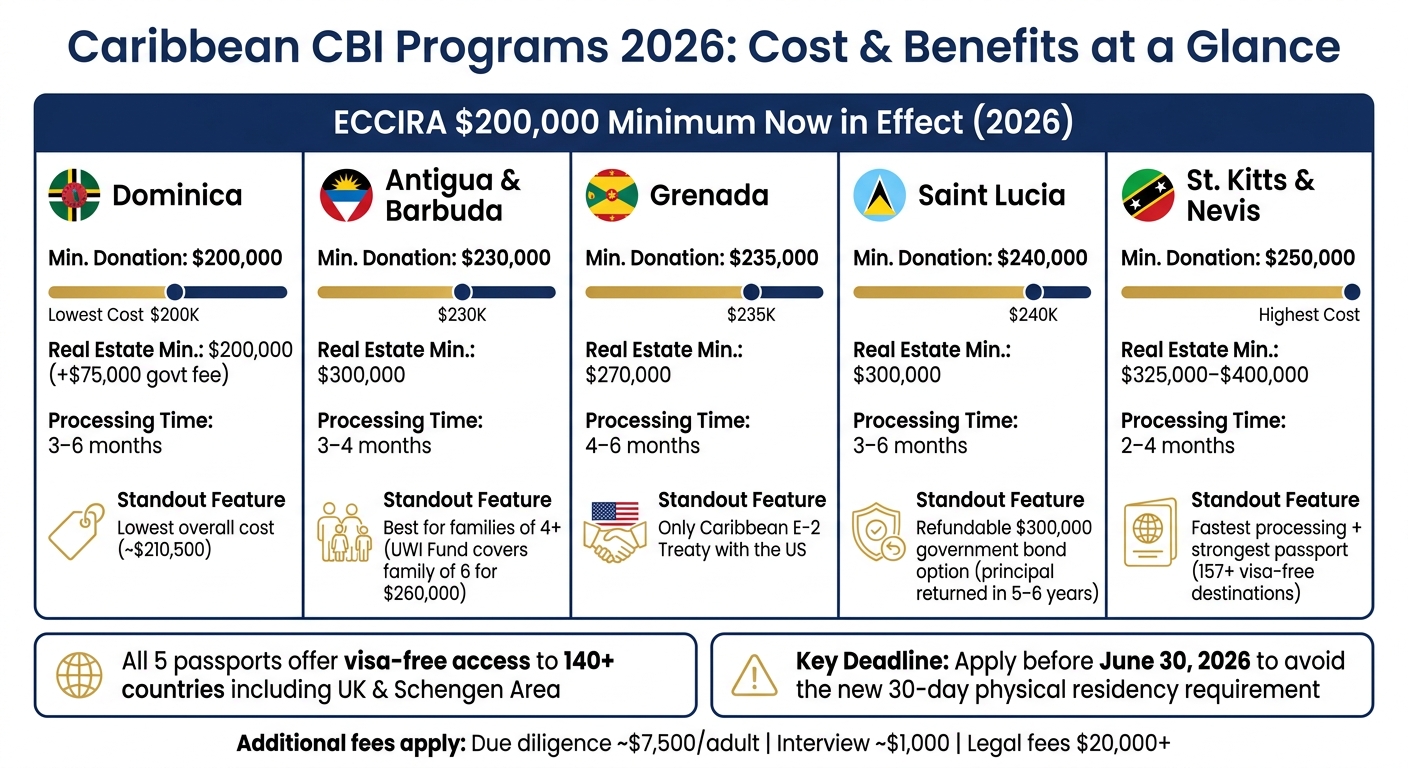
Caribbean CBI Programs Available at the $200K Floor
The five ECCIRA member nations are still accepting applications, each offering distinct advantages under the updated $200,000 minimum. The choice of program depends on which passport aligns best with your personal and financial goals.
| Country | Donation | Real Estate Minimum | Processing Time | Standout Feature |
|---|---|---|---|---|
| Dominica | $200,000 | $200,000 (+ $75,000 govt fee) | 3–6 months | Lowest overall cost (~$210,500) |
| Antigua & Barbuda | $230,000 | $300,000 | 3–4 months | Best for families of 4+ |
| Grenada | $235,000 | $270,000 | 4–6 months | Only Caribbean E‑2 Treaty with the US |
| Saint Lucia | $240,000 | $300,000 | 3–6 months | Refundable $300,000 government bond option |
| St. Kitts & Nevis | $250,000 | $325,000–$400,000 | 2–4 months | Strongest passport in the region (157+ destinations) |
It’s important to note that the headline investment doesn’t cover all costs. Additional fees, such as due diligence ($7,500 per adult), interview fees (around $1,000), and legal fees (often exceeding $20,000), can significantly increase the total expense. Planning your budget carefully is crucial when comparing these programs.
Applications submitted before June 30, 2026, will be grandfathered under the old rules, allowing applicants to bypass the new 30-day physical residency requirement.
These details provide a foundation for exploring pathways to Caribbean citizenship.
Real Estate Investment as a Path to Caribbean Citizenship
While donations offer a straightforward, non-refundable route to citizenship, real estate investment involves purchasing a qualifying asset – usually in a government-approved resort or hotel project – and holding it for 3 to 7 years before resale.
The real estate route requires a higher upfront cost. For instance, Dominica’s option starts at $200,000 but includes an additional $75,000 fee. Similarly, St. Kitts and Nevis requires investments ranging from $325,000 to $400,000. However, some hotel developments in Antigua and St. Kitts may provide rental returns of 3% to 8%, which can help offset carrying costs.
"For investors prioritizing capital preservation over non‑refundable contributions, the real estate pathway across all five nations represents a highly sophisticated alternative." – Joseph Boll, CEO, Frederick Capital
Saint Lucia stands out with its refundable $300,000 government bond option, which allows you to recover your principal after 5 to 6 years. However, this route comes with a non-refundable $50,000 administrative fee, making it the only program in the region offering potential recovery of your investment.
Deciding Whether CBI Still Makes Sense for You
Now that the investment options are clear, the next step is determining if these programs align with your goals. With the $200,000 minimum in place, Caribbean citizenship-by-investment requires careful consideration of your long-term objectives.
If access to the US market is your priority, Grenada is the only program that qualifies you for an E‑2 Investor Visa, enabling you to live and work in the United States. For those focused on passport strength, St. Kitts and Nevis leads the region with visa-free access to over 157 destinations and faster processing times of just 2 to 4 months. Families planning to apply together may find Antigua and Barbuda appealing, as it offers family-friendly pricing for up to four members and extends eligibility to include unmarried siblings and grandparents aged 55 and older.
"The price is fixed, but the value is variable. Don’t pay $200,000 for a citizenship that doesn’t align with your long‑term goals." – Robert McCray, Principal, CIVITAS
For those unable to meet the $200,000 threshold, alternatives like Vanuatu (starting at $130,000) exist, though they come with weaker travel access and no Schengen guarantee. Overall, Caribbean programs remain a compelling choice in the sub-$500,000 market for second citizenship, provided you fully understand the benefits they offer. These programs are especially appealing for those seeking asset protection and enhanced global mobility.
How to Choose the Right Second Citizenship Path
Cost, Timing, and Benefits: What to Weigh First
Thanks to the recent ECCIRA reforms, choosing the right second citizenship path has become more structured, but it still requires careful consideration of cost, timing, and benefits. While minimum investment amounts are now standardized, the challenge lies in identifying the program that best aligns with your personal goals.
Start by defining your priorities. For example, if gaining access to the U.S. is your main objective, Grenada is the only Caribbean program that qualifies for the E‑2 Investor Visa. If speed is your top concern, St. Kitts and Nevis stands out, with application processing times of just 2 to 4 months. It also ranks as the leading program in the 2026 Global Citizenship Programs Index. For those applying as a large family, Antigua and Barbuda‘s University of the West Indies (UWI) Fund is particularly attractive. A $260,000 investment covers a family of six and includes one year of tuition-free education for a dependent. This makes it a compelling option for families seeking both mobility and educational benefits.
Timing is another critical factor. Applications submitted before June 30, 2026, will bypass the upcoming 30-day residency requirement – a key advantage for those not ready to commit to immediate physical presence.
Your approach to capital deployment is equally important. For those seeking capital preservation, Saint Lucia offers government bond or real estate investment options that return your principal within 5 to 7 years. These programs not only enhance mobility but also provide a layer of asset protection.
In summary, align your choice with your primary goals: U.S. access (Grenada), fast processing (St. Kitts & Nevis), family-focused benefits (Antigua & Barbuda), or capital recovery (Saint Lucia).
"The programs still standing in ten years will not be the most affordable or the fastest; they will be the ones with rigorous due diligence, transparent governance, and strong international standing." – Patricia Casaburi, CEO, Global Citizen Solutions
Caribbean CBI Programs Side by Side: A Comparison Table
| Country | Min. Donation | Real Estate Min. | Processing Time | Key Benefit |
|---|---|---|---|---|
| Dominica | $200,000 | $200,000 | 3–6 months | Entry-level donation threshold |
| Antigua & Barbuda | $230,000 | $300,000 | 3–4 months | UWI Fund tailored for large families |
| Grenada | $235,000 | $270,000 | 4–6 months | Access to the U.S. E‑2 Investor Visa |
| Saint Lucia | $240,000 | $300,000 | 3–6 months | Government bond option with capital recovery |
| St. Kitts & Nevis | $250,000 | $325,000 | 2–4 months | Fastest processing and top-ranked program |
Important Note: Under ECCIRA’s centralized registry system, if your application is rejected by one country, this information is shared across all participating nations. This makes it significantly harder to secure approval elsewhere after a denial.
Conclusion: Navigating Caribbean CBI After the $200K Floor
The days of the $90,000 Caribbean passport are over. With the introduction of the 2024 Memorandum of Agreement and ECCIRA’s $200,000 minimum, the path to second citizenship in the Caribbean has become more structured – and pricier. These changes haven’t just increased costs; they’ve transformed Caribbean citizenship into a more formalized financial and legal option. Timing has now become a key factor for applicants.
One of the most pressing deadlines is June 30, 2026. Submit your application before this date to avoid the new 30-day physical residency requirement, which will apply during your first five years of citizenship.
Another significant change is the introduction of a Centralized Rejection Registry, shared among all five Caribbean nations. This means a rejection in one country could affect your ability to apply elsewhere. Roughly 8–15% of CBI applications are denied, often due to issues like undisclosed visa refusals, inadequate source-of-wealth documentation, or prior sanctions exposure. Working with a licensed advisor can help you identify and address these red flags before they turn into lasting obstacles.
Successfully navigating the application process requires more than just completing forms. As one advisory firm highlights:
"A 30-minute review can save you from filing under the wrong program, missing a family eligibility window, or triggering a due diligence flag that would have been avoidable." – Truvon Global Citizenship
Anton Stravinsky of Newstrail offers a fresh perspective: the smarter question isn’t "which program is fastest or cheapest", but rather, "which program is most likely to remain usable, explainable, and defensible years after approval?". Answering this requires a clear understanding of your goals, an honest self-assessment, and guidance from someone who knows the regulatory landscape inside out. Scheduling a private consultation with an experienced advisor is a practical first step to ensure your plans align with your long-term mobility and asset protection objectives.
FAQs
Does the $200,000 minimum include all fees?
The $200,000 minimum is just the starting point for Caribbean citizenship programs, but it doesn’t include all the additional fees. The total cost varies depending on the country and the applicant’s specific situation. For instance, programs in places like Antigua and Barbuda or Grenada might bundle certain processing fees into their pricing, while others could come with higher expenses beyond the base amount.
How does the 30-day residency rule work in practice?
The 30-day residency rule under ECCIRA mandates that new citizens spend at least 30 days in the country within a five-year period. Designed to encourage stronger connections to the region, the rule has now been delayed until June 2026. Importantly, any applications submitted before June 30, 2026, will not be subject to this requirement. Once in effect, this rule will cover all five Caribbean nations involved in the program to ensure consistent citizenship standards.
If I’m rejected in one country, can I apply elsewhere?
Yes, you can apply to other programs, but Caribbean nations have tightened their processes through the Eastern Caribbean Citizenship by Investment Regulatory Authority (ECCIRA). While each country still runs its own program, this regional collaboration ensures stricter checks across borders. If your application is rejected in one country, you’re likely to face the same level of scrutiny in others, making it harder to sidestep the rules by switching programs.
