
If I had to boil it down to one line: St Kitts and Nevis is the better pick for speed and passport reach, while Dominica is the better pick for lower upfront cost and broader family rules.
If you’re comparing these two Caribbean citizenship-by-investment programs in 2026, here’s the short answer:
- For a single applicant, Dominica costs less – about $210,000 total government cost vs. about $260,300 for St Kitts and Nevis.
- For a family of four, the gap is small – about $266,500 for Dominica vs. about $268,700 for St Kitts and Nevis.
- St Kitts and Nevis is faster – 4 to 8 months standard, plus a 45- to 60-day accelerated route.
- Dominica is slower – about 6 to 9 months.
- St Kitts and Nevis has stronger travel access – 155+ destinations vs. about 136 to 145 for Dominica.
- Dominica has looser dependent rules – with room for older children, parents, grandparents, and some siblings.
- Neither passport changes U.S. tax rules – U.S. persons still face tax on worldwide income and reporting duties.
If your main goal is fast approval, better travel reach, and a stronger compliance profile, I’d lean toward St Kitts and Nevis. If your main goal is lower cost for a single applicant or more family flexibility, I’d lean toward Dominica.
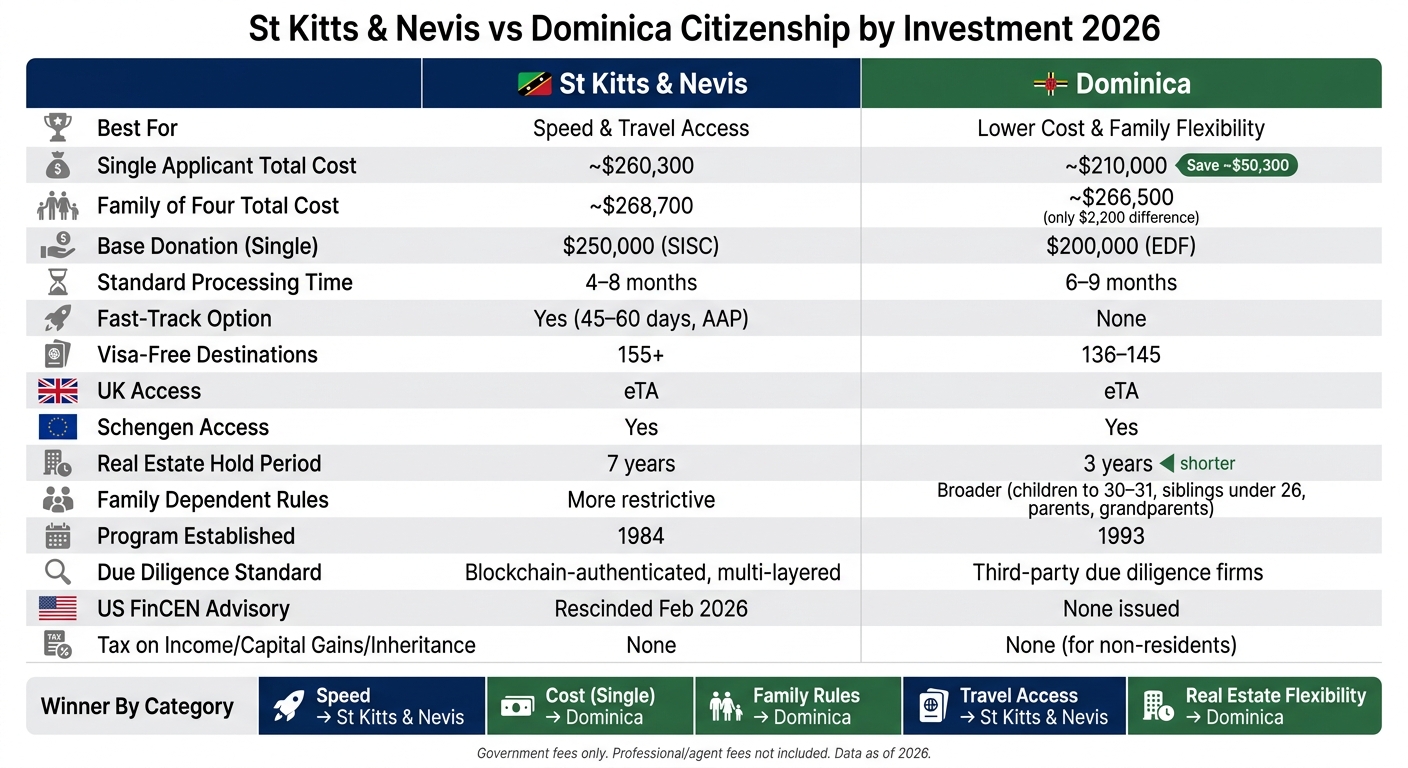
Quick Comparison
| Criteria | St Kitts and Nevis | Dominica |
|---|---|---|
| Best for | Speed and travel access | Lower cost and family setup |
| Donation for single applicant | $250,000 | $200,000 |
| Est. total government cost, single | ~$260,300 | ~$210,000 |
| Est. total government cost, family of 4 | ~$268,700 | ~$266,500 |
| Processing time | 4 to 8 months | 6 to 9 months |
| Fast-track option | Yes | No |
| Visa-free access | 155+ | 136 to 145 |
| UK access | eTA | eTA |
| Real estate hold period | 7 years | 3 years |
| Family rules | More narrow | More broad |
| Tax point | No personal income, capital gains, or inheritance tax | No tax on foreign income, capital gains, or inheritance for non-residents |
That’s the decision in plain English: pay less with Dominica, or pay more for faster processing and stronger passport reach with St Kitts and Nevis.
sbb-itb-39d39a6
St Kitts and Nevis citizenship in 2026
Eligibility, investment routes, and total cost
St Kitts and Nevis is still the premium Caribbean choice in 2026. It comes with tighter screening and, in many cases, faster handling than other programs in the region. To qualify, applicants need a clean criminal record, a lawful source of funds, and good health. Since April 14, 2026, all new applicants must complete biometrics. Applicants age 16 and older must also complete an interview.
There are four investment routes. The main path is the Sustainable Island State Contribution (SISC): $250,000 for a single applicant or a family of up to four. The Public Benefit Option (PBO) also starts at $250,000 and sends funds to government-approved infrastructure projects. If you want a property-based route, approved developer real estate starts at $325,000 with a 7-year hold, while private real estate starts at $600,000 with the same hold period.
On the SISC route, total government cost is about $260,300 for a single applicant and about $268,700 for a family of four.
That higher price is tied to tighter vetting and faster case handling.
Processing time, due diligence, and passport strength
Standard processing usually takes 4 to 8 months. If time matters more than price, St Kitts and Nevis also offers an Accelerated Application Process (AAP). That route can deliver citizenship in about 45 to 60 days for an extra fee.
The due diligence process is one of the toughest in the Caribbean. It includes mandatory interviews, layered background checks, and, since October 2025, a blockchain-based authentication system for due diligence reports.
The passport gives access to 155+ destinations, including Schengen countries and the UK via eTA.
Tax profile and planning value for U.S. persons
St Kitts and Nevis does not impose personal income tax, capital gains tax, or inheritance tax. For people thinking about offshore planning, that can be a strong part of the appeal.
But there’s an important catch for U.S. persons: a second passport does not change U.S. tax rules. U.S. persons still owe tax on worldwide income and still face reporting duties, including FBAR and FATCA. So while a St Kitts passport can help with mobility and cross-border planning, it is not a fix for U.S. taxes.
One recent change matters here. In February 2026, the U.S. rescinded a long-standing FinCEN advisory that had been issued against the program in 2014. That move removed a major compliance overhang for U.S.-connected applicants and improved the program’s acceptance profile for mobile families and founders.
Dominica’s lower-cost structure is the clearest contrast.
Dominica citizenship in 2026
Eligibility, investment routes, and total cost
Dominica is still one of the lower-cost Caribbean options. It also tends to work well for larger family applications, even though its travel access is weaker than St Kitts and Nevis.
The program has been around for years and is known for a lower entry price and broader family rules. In most cases, applicants need a clean criminal record, a verified source of funds, a health certificate, and due diligence approval.
There are two main routes: the Economic Diversification Fund (EDF) donation and the real estate option.
- The EDF starts at $200,000 for a single applicant and $250,000 for a family of up to four.
- The real estate route also starts at $200,000, but the money must go into a government-approved project. It comes with a 3-year holding period, which is the shortest in the Caribbean.
That 3-year hold stands out. St Kitts and Nevis, for example, requires a 7-year property hold.
Under the EDF route, total government costs are about $210,000 to $220,000 for a single applicant and about $266,500 to $280,000 for a family of four.
Dominica is often a better fit for extended families. Its dependent rules can include children up to age 30 or 31, along with parents, grandparents, and unmarried siblings under 26.
Processing time, due diligence, and passport strength
Processing usually takes 6 to 9 months. That timeline has stretched because of tighter compliance checks, mandatory interviews, biometric collection, and 10-year background checks.
In June 2026, ECCIRA started standardizing due diligence and agent licensing across the region. That matters because the Caribbean CBI market is under more scrutiny than it was a few years ago.
Travel access is decent, but not top tier. Dominica’s passport covers about 136 to 145 destinations. St Kitts and Nevis is stronger here, with 155+ destinations.
The UK is one of the main weak spots. Dominica lost visa-free access in July 2023 after the UK cited "clear and evident abuse" of the program. As of 2026, passport holders can still travel to the UK through the Electronic Travel Authorisation (eTA) system. U.S. visa access is also weaker for Dominica nationals.
Tax profile and planning value for U.S. persons
Dominica does not tax foreign-source income, capital gains, or inheritance for non-resident citizens. That can help with diversification and asset-protection planning.
For U.S. persons, though, the main upside is diversification rather than U.S. tax relief.
This is where the trade-off starts to show: lower cost and broader family coverage on one side, but slower processing and less travel access on the other.
Head-to-head comparison: cost, speed, mobility, and family fit
At this stage, the choice comes down to four things: cost, speed, mobility, and how well the program works for your family.
Which program costs less for individuals and families
For a single applicant, Dominica is cheaper by a clear margin. For a family of four, though, the difference is tiny.
St Kitts and Nevis sets its SISC at $250,000 for single applicants and families of up to four. Dominica prices its EDF at $250,000 for a family of four. Once you add due diligence, processing, naturalization, and interview fees, the total gap for a family of four is just $2,200.
| Applicant Profile | St Kitts and Nevis (SISC) | Dominica (EDF) | Difference |
|---|---|---|---|
| Single applicant | $260,300 | $210,000 | Dominica saves about $50,300 |
| Family of four | $268,700 | $266,500 | Difference of $2,200 |
Note: Includes contribution, due diligence, processing, naturalization, and interview fees. Professional agent fees are not included [3].
That makes the cost picture pretty simple:
- Single applicant: Dominica has the lower total.
- Family of four: The numbers are close enough that price alone probably won’t decide it.
Which program is faster and offers better travel access
If speed matters, St Kitts and Nevis has the edge.
It is the only Caribbean CBI program with a formal accelerated route. Its Accelerated Application Process (AAP) can lead to citizenship in 45 to 60 days, though that comes with an extra government fee. Under standard timelines, St Kitts and Nevis takes 4 to 8 months, while Dominica takes 6 to 9 months.
| Factor | St Kitts and Nevis | Dominica |
|---|---|---|
| Standard processing | 4 to 8 months | 6 to 9 months |
| Fast-track option | Yes, 45 to 60 days (AAP) | No |
| Visa-free destinations | 155+ | 135 to 145 |
| UK access | eTA required | eTA required |
| Schengen access | Yes | Yes |
On travel access, St Kitts and Nevis also comes out ahead on paper, with 155+ visa-free destinations versus 135 to 145 for Dominica. Both offer Schengen access, and both now require an eTA for the UK.
Speed and mobility are easy to spot in a table. The harder part is thinking a few years ahead.
Which program fits better into a long-term asset protection plan
For long-range planning, program reputation and family rules start to matter more than headline pricing.
St Kitts and Nevis is the older program. It began in 1984, compared with 1993 for Dominica. It also uses tighter screening, and the U.S. FinCEN advisory was rescinded in February 2026. In October 2025, St Kitts and Nevis became the first CBI program to use a blockchain-based authentication system for due diligence reports.
That matters because offshore planning is not about dodging tax. It’s about whether the passport works in practice: banking acceptance, travel use, and family coverage. In that setting, reputation can carry a lot of weight.
Dominica, on the other hand, gives families more room. It allows unmarried siblings under 26 and children up to 31. It also has a shorter real estate hold period: 3 years, versus 7 years for St Kitts and Nevis.
| Factor | St Kitts and Nevis | Dominica |
|---|---|---|
| Program established | 1984 | 1993 |
| Family inclusion | More restrictive | Broader, including siblings |
| Due diligence standard | Blockchain-authenticated, multi-layered | Third-party due diligence firms |
| FinCEN advisory | Rescinded Feb. 2026 | None |
| Tax on worldwide income, capital gains, and inheritance | None | None |
| Real estate hold period | 7 years | 3 years |
So the trade-off is pretty clear. St Kitts and Nevis looks stronger on speed, travel reach, and reputation. Dominica looks more flexible for larger or less standard family setups, and it gives you a shorter property hold if real estate is part of the plan.
Conclusion: which citizenship is the better choice in 2026?
The better choice comes down to what matters most to you.
If speed and travel access are at the top of your list, St Kitts and Nevis is the stronger option. It offers a 45-day accelerated processing route and access to 155+ visa-free destinations, which gives it an edge for applicants who want a fast timeline and broader travel reach.
If your focus is price and family options, Dominica stands out. For a single applicant, total government fees are about $50,000 lower, and its real estate path has a shorter 3-year holding period. Its dependent rules also cover a broader range of family members.
That matters even more for families. Once you start adding dependents, the price gap can shrink, so eligibility rules may carry just as much weight as the upfront cost.
For U.S. persons, there are many reasons to consider a second citizenship for mobility and diversification. But it does not change U.S. worldwide tax obligations.
FAQs
Which option is better for U.S. citizens?
For U.S. citizens, St. Kitts and Nevis is generally the better pick in 2026 if your main priority is mobility and passport strength. It gives access to more visa-free or visa-on-arrival destinations than Dominica in one comparison – about 145+ vs. 135+ – and is often positioned as the strongest Caribbean option.
Dominica may make more sense only if your top goal is a lower entry cost. But it does not offer the kind of U.S. access that some other Caribbean programs provide.
Can I add family members after approval?
Generally, no. In most cases, family members you want to include must be named and vetted as part of the original citizenship application.
If you become a citizen first, relatives who were not included in that first application will usually need to apply on their own. That separate process is usually subject to the standard eligibility rules, due diligence checks, and government fees in effect at the time they apply.
Is the real estate route worth it in 2026?
It comes down to one thing: how comfortable you are with illiquidity and project risk compared with the simpler donation path.
Dominica offers the easier real estate option. The minimum is $200,000, and the holding period is three years.
St. Kitts and Nevis is a much bigger commitment. Entry starts at $325,000–$400,000, and the holding period is seven years – the longest in the region.
That gap matters. Real estate can tie up your money for years, and there’s also project risk and exit liquidity risk to think about. So before you move ahead, vet the deal with care.
