
If your goal is U.S. business access through an E-2 visa, Grenada is the only Caribbean citizenship-by-investment passport that can help you qualify. But there’s a catch: in 2026, this is a 4- to 5-year plan, not a fast move.
If I strip this down to the parts that matter most, here’s the answer:
- Grenada is the only Caribbean CBI program in this group with U.S. E-2 treaty access
- The E-2 is not a green card
- Getting Grenadian citizenship does not mean the U.S. visa gets approved
- CBI citizens now need 3 years of domicile in Grenada before applying for E-2
- You still need a live U.S. business and at-risk investment, often around $100,000 to $300,000+
- Grenada citizenship costs start at about $245,000 for one person and about $259,000 for a family of four
- The full budget can reach about $487,500 to $861,500 over time
So if you want the short version: Grenada can open the nationality door for E-2, but you still need time, money, and a business that meets U.S. rules.
A fast way to look at it:
| Point | What it means |
|---|---|
| Why Grenada matters | It is the only Caribbean CBI passport here tied to U.S. E-2 access |
| Main limit | E-2 is temporary and renewable; it is not permanent residence |
| Big delay | 3-year Grenada domicile rule for CBI citizens |
| Typical citizenship cost | About $245,000 single / $259,000 family of four |
| U.S. business spend | Often $100,000 to $300,000+ |
| Best fit | Founders, investors, and families planning a U.S. move through an active business |
I’d frame this route in a simple way: buying Grenada citizenship is only step one. After that, you need to live in Grenada long enough, build records that show that domicile, and then file an E-2 case backed by a business that is active, funded, and able to do more than just support a bare living.
That’s the core idea of the article.
How to obtain Grenadian citizenship through investment
Grenada’s citizenship-by-investment program is run by the Investment Migration Agency (IMA). It gives applicants two main options: make a non-refundable contribution to the National Transformation Fund (NTF) or buy government-approved real estate.
Both routes lead to the same end result: Grenadian citizenship. But they work a bit differently in practice. The choice affects your upfront cost, how much money stays tied up, whether you may get some capital back later, and how soon you can move on to the E-2 stage.
National Transformation Fund contribution route
The NTF route is the simpler path. You make a donation to a government fund that supports national infrastructure and development. That money is not returned.
The minimum investment is $235,000 for a family of four. For a single applicant, the total cost is about $245,000 once standard due diligence, application, interview, and processing fees are added in.
Why do some people pick this route? Mainly because it removes a lot of moving parts. There’s no property to manage, no resort developer to vet, and no resale plan to think about later.
Government-approved real estate route
The real estate route involves buying a share in an approved tourism project, most often a hotel or resort. Fractional ownership starts at $270,000, while sole ownership starts at $350,000. On top of that, there is a non-refundable government fee of $50,000, plus the same per-person fees charged under the NTF route.
The big draw here is simple: some of your capital may come back. After a required 5-year holding period, the property can be sold to another CBI applicant. Some approved projects may also pay rental yields of around 2% to 4% per year during that holding period.
Still, this route takes more care. Government approval is not a promise that the project will be finished on time or that resale will be easy. Think of it this way: approval gets a project through the door, but it doesn’t guarantee a smooth exit. That’s why independent due diligence on the developer and the project’s past record matters before you wire any funds.
Eligibility, due diligence, and processing steps
Before an application is filed, applicants need to pass background checks, source-of-funds review, and document screening.
Applicants must be at least 18 years old, in good health, free of disqualifying criminal convictions, and able to show a lawful source of funds. A medical certificate is also required, including an HIV/AIDS test dated within 90 days of submission.
You also can’t apply on your own. All filings must go through an Authorized Local Agent; the IMA does not accept direct submissions. After filing, the IMA runs background checks covering criminal history, source-of-funds review, and national security screening.
As of mid-2026, the Eastern Caribbean Citizenship by Investment Regulatory Authority (ECCIRA) also requires biometric data collection, applicant interviews, and a 30-day residency requirement during the first five years of citizenship.
Citizenship and passport issuance usually take about 6 months:
| Step | Action | Timeline |
|---|---|---|
| 1 | Engage Authorized Local Agent | Week 1 |
| 2 | Document compilation and medical exams | Weeks 2–4 |
| 3 | Submission and due diligence fees paid | Month 2 |
| 4 | IMA due diligence and background checks | Months 3–5 |
| 5 | Approval-in-principle and investment completion | Month 5 |
| 6 | Citizenship certificate and passport issuance | Month 6 |
One small paperwork issue can slow the whole file down. Foreign-issued documents must be apostilled or legalized and include certified English translations. Missing authentication is a common cause of delays.
That passport becomes the nationality basis for the E-2 application. But it doesn’t, by itself, get the visa approved. The U.S. business must still satisfy treaty-investor rules.
sbb-itb-39d39a6
How Grenada citizenship supports a US E-2 visa application
Once you have a Grenadian passport, you meet the nationality rule needed to apply for a U.S. E-2 treaty investor visa. That said, the passport only clears one hurdle. The U.S. business still has to pass E-2 review on its own.
So Grenada helps, but only if the business also fits the E-2 rules.
Nationality requirement: why the Grenadian passport matters
Grenada is E-2 treaty-eligible. That means Grenadian citizens can apply for the visa. If your current citizenship doesn’t come from an E-2 treaty country, Grenadian citizenship can supply the nationality you need.
There is one big catch for CBI applicants. Under the 2022 AMIGOS Act, CBI citizens must show three continuous years of domicile in Grenada before filing for E-2 status. In plain English, that means you need to prove you actually lived there over that period.
You’ll want a steady paper trail from the date of naturalization, including residential leases, utility bills, local bank statements, and school enrollment records kept month by month.
The US business must be real, active, and non-marginal
A Grenadian passport makes you eligible to apply for E-2 status, but it does not guarantee approval. The business itself still has to qualify.
Passive investments don’t work here. For example, simply owning residential rental property does not meet the E-2 standard. The business must already be operating or be genuinely ready to operate when you file.
Your investment also has to be committed and at risk. Officers usually look for proof that the money has already gone into the business, such as executed leases, paid invoices, equipment purchases, and payroll records. In other words, they want to see action, not just plans on paper.
Another major test is non-marginality. The business must be able to produce more than a minimal living for you and your family. In practice, that usually means a five-year business plan with a believable path to revenue and U.S. hiring.
There is no fixed minimum investment in the statute. Even so, many approved E-2 cases involve about $150,000 to $300,000+ committed to the business, and consular officers often examine cases below $100,000 much more closely.
| E-2 Requirement | What Officers Look For |
|---|---|
| Nationality | Valid Grenadian passport and certificate of registration |
| At-risk capital | Paid invoices, equipment purchases, executed leases, payroll records |
| Non-marginality | Five-year business plan with hiring projections and revenue assumptions |
| Active operations | Ready to operate with premises secured, licenses filed, and at least two vendor or customer contracts in place |
| Domicile (CBI citizens) | 36 months of continuous Grenada residency evidence prior to filing |
Those rules shape the budget, filing timeline, and business setup from the start.
Spouse and children under the E-2 structure
A spouse and unmarried children under 21 can come with the main E-2 investor. The spouse can work for any U.S. employer or start a separate business. Since January 2022, spouses no longer need to file a separate Employment Authorization Document (EAD) to work in the U.S..
Children under 21 can live in the U.S. and attend school or college. The key planning issue is the age-out rule: once a child turns 21, they lose dependent E-2 status and need to move to another visa category, such as an F-1 student visa, to stay in the U.S. legally.
These family benefits matter most when the plan involves a full household move, not just travel access for the main investor.
Next, the article maps the investment amounts, processing timeline, and order of steps.
Costs, timelines, and the step-by-step sequence
Minimum investment levels and total cost ranges
The full budget comes in two parts: Grenada citizenship costs first, then the U.S. business capital needed for the E-2 filing.
For a family of four, the published minimums look like this.
| Cost Item | NTF Route (Family of 4) | Real Estate Route (Fractional) |
|---|---|---|
| Minimum Investment | $235,000 | $270,000 |
| Government Contribution | N/A | $50,000 |
| Due Diligence Fees | $10,000 (2 adults at $5,000 each) | $10,000 (2 adults at $5,000 each) |
| Application Fees | $6,000 | $6,000 |
| Processing Fees | $4,000 | $4,000 |
| Interview Fees | $2,000 (2 adults at $1,000 each) | $2,000 (2 adults at $1,000 each) |
| Passport & Oath | ~$2,000 | ~$2,000 |
| Estimated Total | ~$259,000 | ~$344,000 |
These totals do not include legal or agent fees. Extra dependent costs also vary. On the NTF route, each added dependent increases the cost by $25,000 for standard dependents, $50,000 for parents or grandparents under 55, and $75,000 for siblings.
Then comes the second layer. Once you add a typical $100,000–$300,000 E-2 business investment, the full project budget climbs fast.
Expected timeline from citizenship filing to US visa interview
The passport is just the first step. The main bottleneck is the domicile clock.
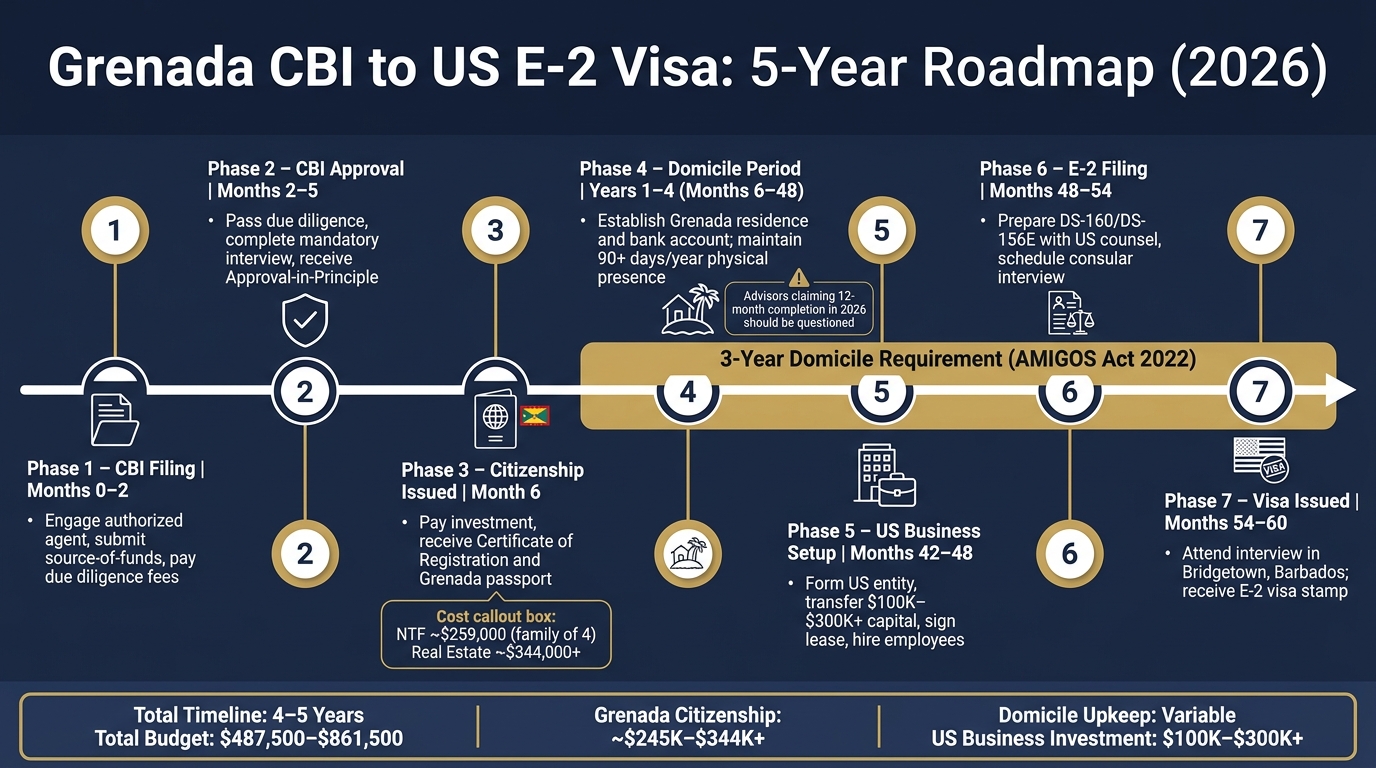
A realistic 2026 path from CBI filing to E-2 visa issuance looks like this.
| Phase | Action | Timeline |
|---|---|---|
| 1. CBI Filing | Engage agent, submit source-of-funds, pay due diligence fees | Months 0–2 |
| 2. CBI Approval | Pass due diligence, complete mandatory interview, receive Approval-in-Principle | Months 2–5 |
| 3. Citizenship Issuance | Pay investment, receive Certificate of Registration and Grenada passport | Month 6 |
| 4. Domicile | Establish Grenada residence and bank account; maintain documented residence | Years 2–4 |
| 5. U.S. Business Setup | Form U.S. entity, transfer substantial capital, sign lease, hire employees | Months 42–48 |
| 6. E-2 Filing | Prepare DS-160/DS-156E with U.S. counsel; schedule consular interview | Months 48–54 |
| 7. Visa Issuance | Attend interview in Bridgetown, Barbados; receive E-2 visa stamp | Months 54–60 |
The 3-year domicile requirement creates most of the delay. Due diligence and consular scheduling add more waiting time, but they are not the main issue.
And domicile is not just a paper exercise. It means actual residence, not the occasional trip. Consular officers look for a physical presence pattern of about 90 or more days per year, a main home such as a lease or deed, and local financial ties like a Grenadian bank account. As of 2026, new applicants also face a 30-day residency requirement within the first five years of citizenship.
So if an advisor says they can get both Grenada citizenship and an E-2 visa done in 12 months in 2026, that claim deserves a hard second look.
Example scenario: using Grenada citizenship to relocate through a qualifying business
Here’s what this looks like on the ground.
A tech founder from a non-treaty country such as India gets Grenada citizenship through the NTF route. After receiving her passport, she builds real domicile in Grenada by keeping a residence, opening a local bank account, and spending about 90 or more days per year on the island.
While that three-year domicile period runs, she works with U.S. immigration counsel to prepare a real, active, non-marginal business and line up a substantial investment in the $100,000–$300,000 range.
Once the domicile requirement is met, she files the E-2 application. Her spouse can work in the U.S. The big decision points are pretty clear: get the Grenada citizenship first, build a solid domicile record next, and start shaping the U.S. business early enough to show it is non-marginal when the E-2 filing goes in.
Who this strategy fits and key takeaways
Now that the mechanics, costs, and timing are on the table, the big issue is simple: does this plan match what you want to do?
Best fit: founders, investors, and internationally mobile families
This path makes the most sense for people who want U.S. business access without holding a treaty-country passport. The clearest fit is founders from non-treaty countries who need U.S. access that can be renewed over time.
It also works well for people who need a treaty-based business route instead of a visa tied to wages or payroll.
Families may find it useful too. Grenada’s citizenship-by-investment program allows dependents up to age 30, and that citizenship can also pass to children born later.
That said, this is not the right route for everyone. If your goal is a green card, passive U.S. real estate income, or a fast outcome, this plan likely won’t fit. The domicile rule turns it into a multi-year project.
Where Grenada citizenship fits into a broader mobility and tax plan
For many people, the upside goes past visa access.
Grenada citizenship can support more than E-2 planning. In 2026, the passport ranks 27th worldwide and offers visa-free access to 147 destinations, including the UK, the Schengen Area, Singapore, and mainland China. If you run a business across more than one region, that kind of travel access can make life much easier.
There’s also a tax angle. Grenada uses a territorial tax system. For non-residents, foreign-source income is generally not taxed. But U.S. tax residence is a separate issue, and it still depends on physical presence and treaty planning.
Conclusion: the main decision factors to weigh
At bottom, the choice rests on three things: your visa need, your patience with the timeline, and whether you can build real business substance.
The value of Grenada citizenship here is narrow but clear. It is the only Caribbean passport that makes you eligible to apply for a U.S. E-2 visa. Over five years, the total cost falls between $487,500 and $861,500, including citizenship costs, domicile upkeep, and the U.S. business investment. The timeline is at least four to five years.
If you need renewable U.S. business access without EB-5-level costs or long visa backlogs, Grenada is the Caribbean passport that can support that plan.
FAQs
Can I qualify for E-2 without living in Grenada first?
No. If you got Grenadian citizenship through investment, you can’t apply for an E-2 visa right away.
Under the 2022 policy update, you first need to be domiciled in Grenada for 3 continuous years. That means showing real ties to the country, such as:
- A residence in Grenada
- A local bank account
- Meaningful time spent in the country, usually at least 90 days per year
So this isn’t just about holding a passport. You need to show that Grenada is your actual place of residence for that three-year period.
What kind of U.S. business works for an E-2 case?
An E-2 business must be a real, active enterprise. In plain English, that means an operating business, not a passive investment like real estate.
You also need to own at least 50% of the business or have operational control over it. The government wants to see that you’re not just putting money in from the sidelines. You need to be in a position to run the business and make key decisions.
The investment must be substantial when compared with the total cost of the business and high enough to support successful operations. There’s no set minimum in the law, but many approved cases involve $100,000 or more. Just as important, you must actively develop and direct the business rather than treat it like a hands-off asset.
Is Grenada citizenship worth it if I want a green card?
No. Grenada citizenship does not provide a green card.
What it can do is support a non-immigrant route through the E-2 investor visa. That visa lets you live and work in the United States while you manage a qualifying business.
But there’s an important catch: the E-2 does not lead to permanent residency or U.S. citizenship. It stays valid only as long as the business keeps operating.
If you gain Grenadian citizenship by investment, you also need to keep domicile in Grenada for three continuous years before you can apply for the E-2 visa.
Related Blog Posts
- Best Citizenship by Investment Programs for Travelers
- Caribbean Citizenship by Investment: Comparing St. Kitts, Dominica, Grenada, and Antigua
- Investment Immigration for High Net Worth Individuals: 10 Premium Programs Worth the Price Tag
- Second Citizenships Without Donations: 5 Programs Where You Keep Your Investment
